She is just 11 years old and studying in Class VII, but she can easily solve maths problems from Intermediate textbooks.
Meet S. Harshita Reddy, who has been excelling in maths since the last six years and winning many awards.
Harshita added another feather to her cap by bagging a silver medal in the National Child Awards for Exceptional Achievements-2013 from the ministry of women and child development in New Delhi on November 14. She was also given a certificate and a cash award of Rs 10,000.
The daughter of an English teacher at a government school, Harshita developed her passion for maths when she was studying in Class I.
“I was surprised after she could remember tables from 1-20 within three days at the age of five. I started teaching her a few topics from algebra, trigonometry and some other tough concepts when I saw that she was blessed with extraordinary skills,” recalls Govardhan Reddy, science teacher at a government school.
When Harshita was nine, she was asked to solve Class X problems and it was a cakewalk for her. “I organised over 50 sessions to demonstrate easy methods to solve maths for students in the school. I would like to develop a method or technique on my own,” said Harshita, adding, “I want to be a maths scientist.”
Harshita claimed she was termed a legend in maths and maro Shakuntala Devi (another Shakuntala Devi) by her critiques and teachers.
Karimnagar MP Ponnam Prabhakar and former MLC, Chukka Ramaiah had complimented her for her talent and achievements.
She has also won awards from the World Amazing Records and India Book of Record and was given the Andhra Bala Ratna Award by a voluntary organisation based on Vizag.
source: http://www.deccanchronicle.com / Deccan Chronicle / Home> News> Current Affairs / by Santosh Padala / DC / December 13th, 2013
Director of Centreal Institute of Fisheries Nautical & Engineering Training R.C. Sinha and his colleagues of CIFNET Visakhapatnam at the conclusion of training programme for inspectors of Marine Police of the State in Visakhapatnam on Friday. / Photo: C. V. Subramanyam / The Hindu
Marine Police undergo training in vessel navigation
Sea conditions change drastically but the training provided to senior officers -Inspectors – of the AP Marine Police by the Central Institute of Fisheries Nautical and Engineering Training (CIFNET) would keep them in good stead and help tackle the difficult conditions, CIFNET Director R.C. Sinha said at the valedictory function of the training programme here on Friday.
Maintaining security was one aspect and reacting in time on the sea was another. Sea was not like a road on which one could stop or start easily and this required the right people with good training, Mr. Sinha told the police officers. Everyone in the Marine Police must be on the sea for at least 10 days in a month, he said.
Referring to the Marine Police, he suggested that some of its boats could be kept with CIFNET by turns for maintenance and training since maintenance was a difficult job.
Fifteen Inspectors of the Marine Police from different police stations along the AP coast received certificates after completing their short-term training programme on vessel navigation and engineering.
Surveyor in-charge cum DDG (tech) of Mercantile Marine Department Jayant Mukhopadhaya wanted the Marine Police to also take up protection of marine life as they were also responsible for taking action against polluting vessels.
Chief Technical Officer of Coast Guard Commandant Manish Bahl professional excellence was required more while discharging duty on the sea. Head of Office of CIFNET’s Visakhapatnam unit A.K. Choudhury said this was one of the best courses designed by his organisation and set a benchmark. Home Guards and some constable attended the training in the first batch. The present batch of police officers evinced keen interest and came up with good queries, he said.
Deputy Superintendent of Police of Marine Police K.V.R. Prasad said 15 Marine Police stations became operational from October last year and the force has now 500 personnel drawn from the civil police. Retired Navy and Coast Guard personnel were recruited as the crew and IG of Marine Police Srinivasa Reddy was planning to take in CIFNET trained youngsters, Mr. Prasad said.
He also said some of the Home Guards trained in the earlier batch had recently caught Sri Lankan fishermen along with their boat off AP coast for illegally entering the Indian waters.
One of the trainees Rudrasekhar said the training helped them understand more about navigation and marine engineering.
Senior Instructors H. Bisoyi and S.B. Rangari and Instructor M. Rangaraju also spoke about the training programme.
source: http://www.thehindu.com / The Hindu / Home> News> Cities> Visakhapatnam / by Special Correspondent / Visakahapatnam – December 07th, 2013
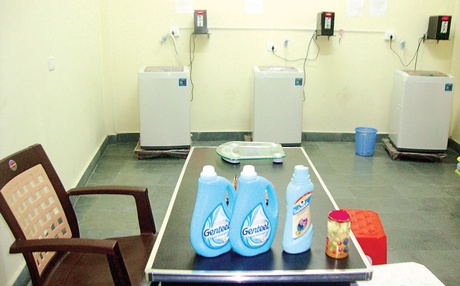
The affordable laundry system, made of three washing machines and coin acceptors from China on display at the University of Hyderabad campus on Monday. (Inset) Surendra Kesana | EXPRESS PHOTO
Tired of washing your own clothes? One would probably think of buying a washing machine. For 25-year-old Surendra Kesana, an MBA graduate from University of Hyderabad, this was a business opportunity. He developed a coin-operated laundry system, which provides laundry services at affordable rates and is reliable too.
A native of Vijayawada, Surendra developed the unique laundry system as part of his major project in MBA. Making use of his technical expertise of electronics and instrumentation engineering from his B. Tech days and management skills acquired during the MBA course at UoH, Surendra set out to achieve his aim of becoming an entrepreneur. In September, he opened his first coin-operated laundry outlet in the university and proudly claims a customer base of over 1,000 users till date. “What I have done is basically to indigenise similar systems available abroad. But, what makes my system different is the cost involved and the fact that I was able to convert a domestic washing machine for commercial purposes,” says Surendra who graduated from university in 2013. While a laundry system used commercially would cost anywhere between `3 -4 lakh, Surendra’s systems come for a mere `20,000.
He bought three 4 kg washing machines on EMIs and used his savings to set up laundrette – his outlet in the university. “We got the coin acceptors from China as they are not available in India and assembled the systems. We use a custom made copper coin for each cycle of 4 kg of clothes,” he said. He charges `50 per cycle.
source: http://www.newindianexpress.com / The New Indian Express / Home> Cities> Hyderabad / by Express News Service – Hyderabad / December 17th, 2013
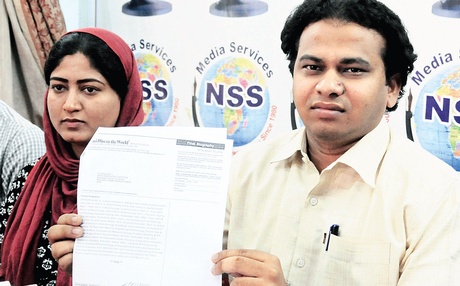
Zahoorullah S MD, assistant professor of biotechnology at JBR Engineering College, showing the letter received from Marquis Who’s Who in the World informing him of his name’s inclusion in the 2014 edition of the book at a press conference in Hyderabad on Monday. | RVK Rao
City-based biotechnologist and scientist Zahoorullah Shaikh Mohammed’s biography has been selected and enlisted for publication by Marquis Who’s Who in the World for year 2014.
The 29-year old is currently working as an assistant professor of biotechnology at Joginpally BR Engineering College here. A resident of Aziz Bagh Colony in Tolichowki, Zahoorullah has taught 27 subjects in engineering, presented 20 national and international research papers, attended 20 workshops and authored seven books. His lectures are available on the Internet and are being shared by many foreign universities, according to a press release issued here on Monday.
Marquis Who’s Who, established in 1899, is a renowned American publisher of a number of directories containing short biographies of individuals who are achievers in their respective fields. A subsidiary of News Communications Inc, the books are usually titled, Who’s Who in America, Who’s Who of American Women, Who’s Who in the World, Who’s Who in Science and Engineering, Who’s Who in American Politics, etc.
An M.Tech and Ph.D in biotechnology, Zahoorullah became an assistant professor at a young age of 23 and his appointment was ratified by JNTUH. He was also a teacher certified by Dale Carnegie Training Institute, USA in high-impact teaching skills.
He sent his biography in January and, after several stages of screening, its enlistment has been confirmed recently. “I want to become a very well-known scientist and motivate youngsters towards research. Despite having several good laboratories, our students are lagging behind in research. My only aim is to establish myself through innovation in science and engineering, and motivate others,” Zahoorullah told Express.
source: http://www.newindianexpress.com / The New Indian Express / Home> Cities> Hyderabad / by Express News Service – Hyderabad / December 03rd, 2013
The student-driven competition aims to stimulate, enable and develop high-impact, self-sustaining social businesses in India.
Tinker Tank Technologies, a ready-to-go-operational start-up venture, has emerged winner of the fifth edition of iDiyaChallenge, a one-week-long social venture competition that concluded at Indian School of Business (ISB)’s Hyderabad campus on Saturday.
The student-driven competition aims to stimulate, enable and develop high-impact, self-sustaining social businesses in India. Sponsored by ISB, this year’s programme has received 40 applications from participants across the state.
TinkerTank , which has developed Doopica, a low-cost semi-automated incense-stick machine that eliminates hard labour while producing more with less effort, helping women produce four times more incense sticks and increasing their monthly income by Rs 5,000, received an investment support of Rs 2 lakh from ISB.
While Bodhi Health Education, another ready-to-go-operational start-up that aims to provide affordable medical education to health workers in rural and semi-urban areas of India, was the first runner-up, standing in the third place was Rematerials, which makes housing roofs out of waste material for people in villages and slums.
“It is not important to have great technology in order to innovate. It is important to make incremental changes and scale them up,” Jayaprakash Narayan, member of the Legislative Assembly of Andhra Pradesh and founder of Loksatta party, said in a release.
source: http://www.business-standard.com / Business> Companies> News / by K Rajani Kanth / Hyderabad – December 01st, 2013
The J&K Coalition of Civil Society (JKCCS) has honoured Dr K Balagopal, a human rights activist and lawyer from Andhra Pradesh, with Robert Thorp Award-2013, posthumously, for his contribution in highlighting the human rights issues in Jammu and Kashmir.
The JKCCS every year confers Robert Thorp Award to persons who have shown exemplary courage and contributed to the achievement of civil society and political rights of the people of J&K. The award was received by his colleague, Prof Babaiah on Tuesday.
The award is given in memory of Robert Thorp, a young British Army officer, who arrived in Kashmir in 1865 and fought for the right of self-determination of Kashmir.
He was killed in 1868 by forces of Maharaja Gulab Singh, a feudal ruler of Kashmir, for highlighting the miseries of Kashmiris in international media.
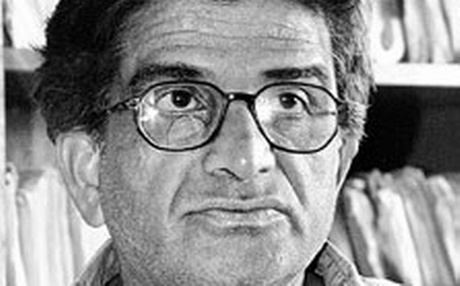
Dr Kandala Balagopal, born on June 10,1952, was a trained Mathematician and taught at Kakatiya University in Andhra Pradesh. An uncompromising human rights activist, Balagopal broke away from the Andhra Pradesh Civil Liberties Committee (APCLC), with which he was associated from 1980s, on the issue of violence perpetrated by the erstwhile CPI-ML Peoples War.
During his visits to Kashmir, Balagopal worked actively for human rights in Kashmir and wrote numerous articles on Kashmir issue, questioning Indian occupation in Kashmir.
Fifth child of a middle class Telugu Brahmin couple, his education happened in various towns across AP owing to his father’s occupation. After pre-university education at Kavali and BSc in Tirupati, he took an MSc and PhD in Mathematics from the Regional Engineering College in Warangal before proceeding to Delhi for a post-doctoral at the Indian Statistical Institute. He returned to Warangal in 1981, where he started teaching Maths at the Kakatiya University. This was also the time when he decided on social activism and joined the APCLC, which he left after two decades to form Human Rights Forum.
Balagopal, who played a commendable role in exposing the institutional impunity enjoyed by the Indian military force and his unflinching support for the right of self determination of people of Jammu and Kashmir, died of lung aspiration following bleeding of stomach ulcer in Hyderabad on October 8, 2009.
source: http://www.newindianexpress.com / The New Indian Express / Home> Cities> Hyderabad / by Express News Service – Hyderabad / November 29th, 2013
Teaching is no more just about textbooks and blackboards, as tablets, smart boards, laptops and other internet-based gadgets are steadily making their way into classrooms. Several schools are now incorporating digital media into their teaching methods in an attempt to stay tech savvy while make learning more interactive and experiential.
The Chirec Public school recently kicked off a pilot project under the city-based IGNITOR platform wherein students of class XIII, IX and X, have been provided with tablets in lieu of the textbook. The prescribed course material is already embedded in the tablet which also gives the added advantage of providing additional links for further reference.
“Gadgets are now the preferred mode of communication and it also saves the children the pain of lugging books to school. The tab also doubles up as an assessment tool as assignments are given on the device,” said Iffat Ibrahim, principal of Chirec Public Schools.
Tech experts estimate that close to one lakh out of India’s 2.6 lakh private schools have invested in some form of teaching technology. India’s market for digital learning systems is currently estimated to be around $500 million a year.
Many city-based tech firms are collaborating with the schools to build customized modules and even devices which are teacher-student friendly. Studio classrooms and the Science, Technology, Engineering and Math (STEM) are concepts that are fast replacing the standard lecture technique.
Creya Learning, an experiential learning platform initiated in Hyderabad schools, is also implemented in schools in Bangalore. It works primarily on studio-based learning where real life problems are solved using interdisciplinary and hands on approach.
Concepts such as the Laws of Newton or theories in astronomy are explained using props, technology, discussions and debates.
Digitisation is not limited to the elite schools with technology coming to the aid of even government by just enabling student teacher interaction. One of the first schools in the city to have web based classes was the Red Cross Government School.
After classes were getting stalled due to lack of teachers who were unable to travel to the school, a tech firm arranged for internet connection in the school to make web classes available. “We managed to set up a class with basic equipment and internet speed. Teachers can be located anywhere, all they need is a webcam and internet,” said Rama Krishna, chief engineer with PurpleTalk which initiated the idea.
source: http://www.articles.timesofindia.indiatimes.com / The Times of India / Home> City> Hyderabad / TNN / November 28th, 2013
Tally Solutions has tied up with Osmania University to provide vocational training to students through distance education.
As part of the collaboration, students undergoing the programme will be offered a month of training, for which all the learning material will be provided by Tally, according to a company statement.
Further, Osmania University will award them with a certificate on successful completion of the course. The plan is to extend this programme to more number of colleges in and around Hyderabad under Osmania University, the statement added.
Shoaib Ahmed, President, Tally Solutions, said: “We strongly believe that providing the right vocational training will go a long way in addressing the unemployability crisis that the country is facing. Students have to be skilled enough to sustain in this competitive industry.”
source: http://www.thehindubusinessline.com / BusinessLine / Home> Industry> Info-Tech / by The Hindu Bureau / Bangalore – November 20th, 2013
Shinya Ejima, Chief Representative, JICA India. / File photo: Kamal Narang / The Hindu
Japan will extend an assistance of Rs. 1,958 crore (30.7 billion yen) to India for Indian Institute of Technology (IIT) Hyderabad and investment promotion programme in Tamil Nadu.
An agreement to this effect was exchanged in New Delhi on Tuesday between Rajesh Khullar, Joint Secretary in the Finance Ministry and Takeshi Yagi, Ambassador of Japan to India, according to a statement issued by Japan International Cooperation Agency (JICA).
The statement said an amount of Rs. 1,129 crore will be provided for the second phase of campus development at the Indian Institute of Technology (IIT) in Hyderabad. Further, JICA will provide Rs. 829 crore for the Tamil Nadu Investment Promotion Programme. The objective of the Tamil Nadu programme is to support policy implementation to improve the investment climate in Tamil Nadu, thereby easing business hurdles for foreign investors.
This would include development of infrastructure such as road, power supply, water and sewerage systems, especially those for factories and industrial zones in the Chennai metropolitan area, where international manufacturers have set up factories.
“Development of the manufacturing sector is a key for faster growth and job creation in India. India needs foreign direct investment (FDI) in manufacturing and that can happen only if quality infrastructure is developed,” chief representative of JICA in India Shinya Ejima said.
source: http://www.thehindu.com / The Hindu / Home> Business> Economy / by Sujay Mehdudia / New Delhi – November 12th, 2013
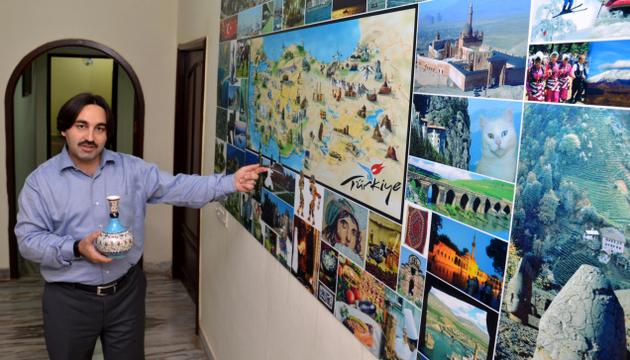
Indialogue Foundation director Osman Kayaoglu talks about the places to see in Turkey as he holds a traditional Turkish vase. / Photo: Nagara Gopal / The Hindu
As the Turkish Consulate gets ready to set up office in Hyderabad, Neeraja Murthy finds a Turkey-Hyderabad connect
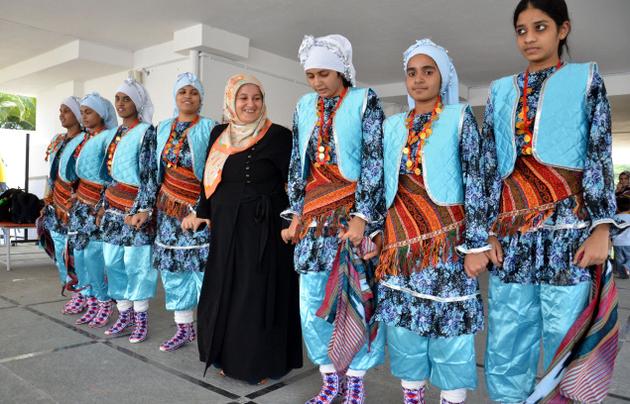
Enter the first floor of Learnium School on Road No. 44, Jubilee Hills and you’ll find a slice of Turkey in Hyderabad. On the walls is a Turkish Corner that displays photographs of ‘Turk folklor’, a Turkish bride, ‘Turk Lokumu’ among other things. Move around and there is a Indo-Turk Corner and photographs of famous Turkish palaces. As we soak in the pictures, we hear the booming voice of Sevim Kayaogolu calling out “Bir, iki, uch, dort… “(one, two, three four… in Turkish). She is teaching a Turkish dance to a group of young girls who are dancing to the beats of Yeni bir dunya, dressed in their traditional Turkish dresses.
Sevim (in the centre) joins a group of girls dancing to the tune of Turkish song ‘Yeni bir dunya’./ Photo: Nagara Gopal / The Hindu
“The students are presenting this Turkish dance for the Parents Day meeting,” informs Sevim. The school (will be called Iqbalia International School) run by a Trust (which also includes Turkish people) teaches Turkish language art, dance and culture to its students, in addition to its regular CBSE syllabus. Osman Kayaogolu, director of Indialogue Foundation’s second year in Hyderabad, calls the city ‘historical’. “Among the different cities in India, Hyderabad has a beautiful history,” he says and adds, “Turkey and Hyderabad share a lot in common in culture. We have given our daughters here in marriage – Princess Durru Shehvar who married Azam Jah, Princesses Esin and Esra have also come to Hyderabad after marriage.”
Osman talks about the ‘royal’ similarity between the two regions. “The Chowmahalla Palace looks like a replica of Dolmabahche palace, only the former is smaller. It is said that the Chowmahalla was built for Durru Shehvar so that she would feel at home in a place that reminds her of Turkey,” he smiles.
Indialogue Foundation, the Turkish cultural centre acts as a hub for the 15 Turkish families living in Hyderabad. “We get together here during religious ceremonies like Eid and we organise inter-faith seminars, talks, conferences and cultural programmes. We arrange business meetings between Turkish and Indian businessmen and also organise Turkish celebrations.”
Osman says the Turks enjoy their stay in the city. “The climate is nice and we enjoy eating biryani which is like our not-so-spicy Osmani pulao. We have made many friends here and people are affectionate too.”
What baffles Osman however is the way friendly Hyderabadis behave while driving on roads. “During busy traffic, they are not at all friendly and act differently,” he says with a smile. The Turkish women volunteers try to spread their art and culture in the city. Osman and his group of friends also play football every Sunday. “We don’t know about cricket, but now our children are picking up the game in Hyderabad.”
There is also good news for the Turkish families in the city with the Turkish Consulate coming up here. “The Turkish Consulate General Murat Omeroglu is in Hyderabad with his family and the work to establish the Consulate has begun. The process might take six months,” says Osman.
Osman says Turkish people in the city do miss their family and friends back home as well as Turkish food; but they have found a home away from home here.
“Hyderabad is our second home. Merhaba Hydarabad (Salaam Hyderabad),” he signs off.
Short film contest
Indialogue Foundation and Sarojini Naidu School of Arts and Communication, University of Hyderabad had organised a Indialogue Short Film Contest 2013on the theme ‘Peaceful Coexistence” which aimed to foster universally shared values among public .
The contest had two categories – YouTube award and Jury award. Emrah Alpaslan from Saritha Vidya Niketan with his short film titled Dedicated Life won the YouTube award with 2100+ views. Jhilam Chattaraj, from University of Hyderabad with her movie In Search of History was selected for the Jury award.
Both the awards carried a prize money of Rs. 35,000 each.
source: http://www.thehindu.com / The Hindu / Home> Features> MetroPlus / by Neeraja Murthy / November 19th, 2013