Category Archives: World Opinion

ACCENT: Helping the blind see

On this typically steamy day in Kakinada, doctors have been performing cataract surgeries all morning. There are still dozens of surgeries to go when the power goes out. I flinch and start to panic. The doctors, however, carry on like nothing happened. It feels like forever, but is actually less than 20 seconds before the hospital’s backup generator kicks in.
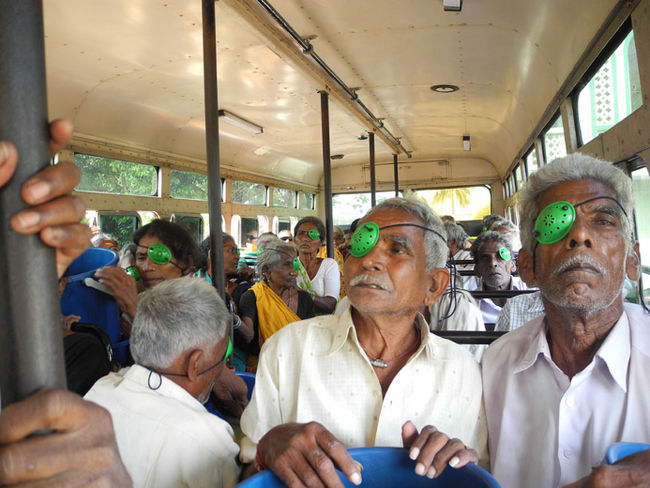
LAURA STRICKER The Sudbury Star Cataract surgery patients board the bus which will take them back to the village of Rowthulapudi, 50 kilometres from Kakinada.

I’ve been in India for more than a week and am used to the sporadic power outages. But tucked away in the corner of the operating room at the Srikiran Institute of Ophthalmology, trying to stay out of the way and make myself as small as possible, the lack of electricity makes me nervous.

For the staff, it’s just another part of working in a country where providing reliable electricity for more than one billion people has long been a challenge. One of the biggest expenses the institute has is to keep its generator running. But all that is worth it, I’m told, because they’re helping people who would otherwise spend their remaining years languishing in their homes, unable to take care of themselves.

Nalam Amalu is one of those people. When she had her first cataract surgery in 2009, it was after she’d been blind in her right eye for two years.

So, when the vision in her left eye started to go a few months ago, Amalu, 65, knew she had to go back to Srikiran. The institute was established in 1993 to help people such as herself, who have eye problems but don’t have the money to get care, or access to a hospital.

The Manjari Sankurathri Memorial Foundation, set up in 1989, runs and funds the hospital. Chandrasekhar Sankurathri (Dr. Chandra) moved from Ottawa to Kakinada and founded the organization in his family’s memory. Manjari, his wife, Srikiran, his son, and Sarada, his daughter, were killed in the June 23, 1985 Air India bombing.

“When I got my right eye operated on, I was thankful to God for sending a person like Dr. Chandra, who is able to conduct these (eye testing) camps and give sight to so many people who are neglected,” Amalu says. A short, skinny woman, the bangles on her wrists clank as she uses her torn shawl to wipe her nose and eyes.

She lives in S. Pydipala village, she explains, speaking in the local language Telugu. The village is six kilometres away from Rowthulapudi, the site of the testing camp. To get to the camp she paid 10 rupees ($0.18 Canadian) for a car ride.

“I don’t have anybody to take care of me,” she continues. “I’m so grateful to Dr. Chandra and the hospital for giving me sight again.”

Men in India are more at risk to get cataracts from working in the fields without eye protection, staff members at the hospital say. But at Srikiran, more women — who often get left behind — are the ones getting the surgery.

On average, after getting the surgery, patients see their vision improve by 90%. Infection is a common problem, though, as they don’t follow post-operative care instructions and lack the clean water necessary to wash out the eye. Even after the surgery, most people need eyeglasses. For those who can’t afford to pay, the glasses are given to them for free.

On the day of the surgery, 100 people wait patiently for their turn, sitting on thin mats scattered throughout a long room. Nurses walk from person to person to confirm identities by asking their name, which eye is getting operated on and the name of their husband or father — a step that gets repeated at every stage before the surgery. Each patient has a white sticker put over the eye getting operated on.

These surgeries, hundreds of which are performed every week, have an impact that goes beyond just improving vision.

“When people become blind, they cannot be productive citizens in the community, and somebody has to look after them,” says Dr. Chandra. “When they’re already poor and they cannot make a living because they are blind, and then another person has to look after them, this puts even more economic strain on the family.

“So, for such people, we are providing free eye care and also restoring their eyesight, completely free of cost to them. By doing so, we are making them a productive part of the family and the community again; thereby the economic burden is eased. They also get their self-respect and confidence restored.”

Another patient, who gives her name as K. Mallamma, says her restored vision means she can help her son, who lives with her, with his business.

Since January, she’d been losing vision in her left eye, she tells me through a translator. It got so bad she couldn’t see to walk the short distance from her house to get fresh water.

“Now I can move around, now I can do a little bit of housework, like sweeping. Before I was not doing these things. My son was doing those things. But now I will be able to do all that.

“At least now I’ll be able to help my son (who does laundry for people in their village) a little bit. Like when he irons the clothes, I’ll be able to fold them.”

With one cataract surgery costing $50, and 90% of the surgeries done for free, Srikiran survives largely on donations, says Dr. Chandra.

“In this aspect, I think we are very unique in India, because nobody else does that many free surgeries. And it is possible for us because several people in Canada are supporting us, from the east coast to the west coast.”

These donations also go to cover the cost of operating four vision centres outside Kakinada. If patients have problems after the operation, or have a post-operative checkup, they can go instead to one of these centres if they’re closer than Srikiran. A computer at the main branch of the institute connects via webcam to the centres.

For those who need the surgery, getting them to the post-operative stage isn’t always easy.

“Sometimes they don’t even want to come because they’re so disappointed in life, some of them are very grouchy and sad. But we tell them look, you come with us and we’ll try to help you as much as we can,” Dr. Chandra says. “So when they come, the next day when you take off the bandages, you should see the feeling in their face. It’s really hard to describe it.

“When you see those happy faces, that gives us maximum satisfaction — to see the value of what we are doing.”

Kotipalli Iswaiamma, 75, was initially scared to get the operation and unco-operative at the field camp. After the surgery, she was so overcome with emotion, she had trouble speaking.

Ten years ago, she hit a wall and lost all sight in her right eye. Six months ago, the vision in her left eye started getting worse.

This was a big problem because she looks after her husband, who is completely blind.

“I have to take care of all his needs,” she says, including taking him to the toilet and bathing him. “He stopped eating food. Instead of having three meals, he only has one so that he won’t go to the toilet as much.

“Now at least vision in my one eye is good, so I can take care of my husband,” she adds, her voice wavering.
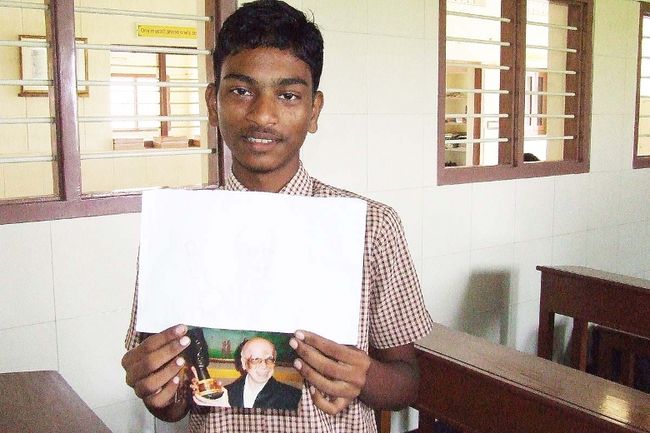
Laura Stricker photo. Guttula Manikanta, a grade 10 student at Sarada Vidyalayam school, shows a picture he drew of Chandrasekhar Sankurathri, founder of the Manjari Sankurathri Memorial Foundation.

Reflecting on the nearly 180,000 eye surgeries performed and the students that have a brighter future, Dr. Chandra says his family would approve of what he’s doing.

“I think they would be very happy, and that gives me a lot of satisfaction,” he says softly. “It’s what I do with my life now. I have no regrets about it. I’m very happy with what I do. I always wish I could do more.

“Something always at the back of my mind is to look after women and child health, because there’s a lot of problems with child-bearing women,” he continues. “Their health is not very good. Infant mortality is the one thing we want to address sometime in the near future.

“I just want to thank all the supporters across the country, and especially in Sudbury. We really appreciate their support and are looking forward to having the same support in the future, to ease some of the suffering of the poor. I really thank from the bottom of my heart.”

— Star reporter Laura Stricker’s trip to India was funded by the Ontario International Development Agency, a longtime supporter of the Manjari Sankurathri Memorial Foundation. For more information on the organizations, visit www.msmf.ca and www.ontariointernational.org. Read Accent every Saturday.

laura.stricker@sunmedia.ca Twitter: @LauraStricker

source: http://www.thesudburystar.com / The Sudbury Star, Canada / Home> NewsLocal / by Laura Stricker, Sudbury News / Saturday, December 29th, 2012

Foreign students in love with Vizag

We get the pulse of foreign students, who are increasingly opting for the city as a  study  destination

The number of foreign students  opting for Visakhapatnam as a favoured  destination  for higher education  has increased remarkably from last year, going by the number of enrollments. In addition to that, the low cost of living in the city, the foreign exchange  programmes provided by Gitam University and the full scholarship programmes offered by Andhra University are a major draw for foreign students. Apart from scholarly pursuits, there are other aspects of the city that seem to appeal to these students. The scenic beauty of Vizag is one of them. Florian Mingas and Roux Lala of France, who are in their 2nd trimester at Gitam University, say, “In this city, we never felt away from home as the beaches  remind  us of South France. The hostel facilities are good and the fellow students and professors help us in every possible way to make us understand the curriculum. The only problem we have is remembering people’s names and the food is a lot spicier that what we are used to.”

Chloe Cherri of France, a foreign exchange student in Gitam, says that the demeanour of Vizagites has altered her perception of Indians. She says “When I was working in New Zealand as a hotel management employee, I came across a few Indians and they were very rude. I never wanted to come to India, but I had to come to Vizag. And after staying here, I have realised that all Indians are not the same.”.

While that’s the scenario in Gitam, Andhra University has a diverse foreign population from Afghanistan,  Iraq, Iran, Nepal  and Ethiopia. These students say that they have adapted to the city easily, but the only hurdle they face is the humidity during summers. Milkiyas Mehreteab from Ethiopia , who is studying his 1st year business management, says “The college management is good and they are very helpful. It’s like going back to school. My major issue is with the humidity, I have a T-shirt which says ‘bear the heat or sweat it out’ — other than that I’m really happy here,” he quips.

For students from Nepal, who come from cooler climes, the oppressive heat and humidity coupled with the frequent power cuts is a big challenge they face. Even learning the language is a major problem for them. Pooja Ranjitkar, a 2nd year finance  student of Nepal, says, “It is wonderful city, no doubt. Whenever we need help, our  friends  try and teach us Telugu words, but it’s a difficult language. Also, the climate here is very hot and humid and the frequent power shutdowns make it worse. We still need to acclimatise.”

Summing up the Vizag experience, Nasir Ahmed, a 2nd year Applied Geology student from Afghanistan   says, “We are happy that our embassy chose this place for our studies. It’s a great place to socialise and we get to know about many historical places . We have been able to adapt to the lifestyle and food habits  very quickly. But the funny thing is that, here winter is like summer in Afghanistan. But it’s quite a relief as we do not have zero degree temperatures here. The major hurdle we have is the communication barrier. Sometimes, our lecturers’ converse in the regional dialect and it becomes difficult for us to understand. We have to stay back after college hours and talk to the professors and clear our doubts. It’s time consuming. Apart from that, we love the City of Destiny as it is considered to be one among the multicultural cities.”

leena.sri@timesgroup.com

source: http://www.timesofindia.indiatimes.com / Home> Life & Style> People / by Leena Shri Pampana, TNN / December 06th, 2012

Cathay Pacific launches Hyd-Hong Kong direct service

Hong Kong-headquartered  international carrier Cathay Pacific has launched its direct flight between Hong Kong and Hyderabad.

The first flight of the four-day weekly A-330-300 service landed at the GMR-operated Rajiv Gandhi International Airport (RGIA) in Hyderabad on Sunday.

With the Hyderabad service, Cathay Pacific now has 46 flights departing each week from India to Hong Kong, according to Tom Wright, country manager (South Asia, Wet Asia and Africa). The airline company had recently increased the frequency of its Chennai-Hong Kong-Chennai flights to daily service from the four-days-in-a-week service.

“Introduction of this new destination will play a very important role in promoting tourism, as Hyderabad has always been the favourite holiday destination for residents abroad. Similarly, it will open a direct window for the people of Hyderabad to choose Hong Kong as an exciting holiday destination and enjoy the dynamic city,” said Vikram Jaisinghani, chief executive officer of GMR Hyderabad International Airport Limited (GHIAL).

In fact, the recent rise in the international traffic has partly offset the steep fall in domestic passenger numbers at the Hyderabad international airport, which saw a 3 per cent dip in the overall passenger traffic in the first half of the current financial year, according to Jaisinghani. The airport operator expects few more international flight services to commence from Hyderabad in the coming months.

GHIAL is aiming at transforming the Hyderabad airport into a gateway of south and central India. The airport has been active with a unique campaign called ‘Fly Via Hyderabad’, launched in 2010, where 18 Indian cities in the catchment area of Hyderabad are being connected seamlessly, according to the company.

RGIA is the first greenfield public-private partnership in the Indian airport infrastructure sector and is eventually designed to handle over 40 million passengers and 1 million tonne of cargo in future.

source: http://www.Business-Standard.com / Home> Companies & Industry/ by BS Reporter / Chennai, Hyderabad / December 03rd, 2012

London Mayor meets AP ministers, officials

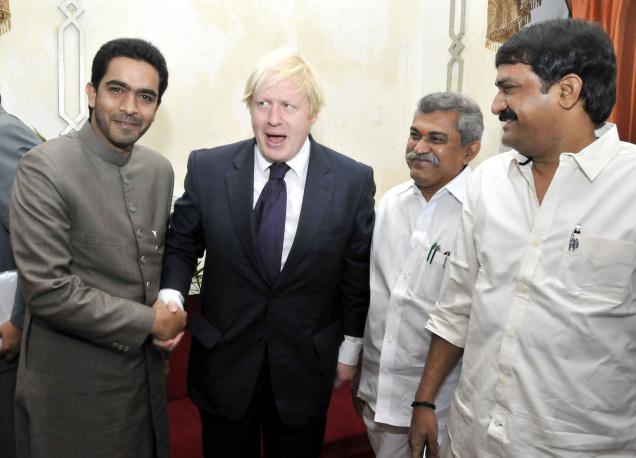
Boris Johnson Mayor of London being received by the Mayor of Hyderabad Mohammed Majid Hussain on Wednesday. At right are G. Srinivasa Rao Minister for Ports and Infrastructure Development and M. Maheedhar Reddy. — /  P. V. Sivakumar / Business Line
Hyderabad, NOV 28:

Regeneration of Hyderabad city, lake cleaning and development projects and an intelligent transport system were some of the areas that companies based out of London could help Hyderabad with as part of its infrastructure development programme.

This emerged out of an interactive session between Mayor of London Boris Johnson and ministers and officials from the Andhra Pradesh Government here today.

The London Mayor’s two-day visit to Hyderabad coincided with the visit of a 22-member UK Trade Mission to India.

Johnson said he was “fascinated” with the infrastructure development works unfolding in Hyderabad. “Capacity addition due to population increase is a focus area both for London and Hyderabad,” he pointed out.

The Mayor took interest in knowing about the metro rail project underway in Hyderabad. He was also informed of the State Government’s interest in taking up cleaning and development of Hussain Sagar Lake in Hyderabad. Johnson said London had considerable expertise in riverfront development projects, which could be taken up in Hyderabad.

Although the meeting did not end with finalisation of any joint venture deals, officials said this was the beginning of what could be a greater partnership between London and Hyderabad.

amitmitra@thehindu.co.in

source: http://www.TheHinduBusinessLine.com / Home> News> States / by Amir Mitra / Hyderabad, November 28th, 2012

Vizag girl makes mark in US

Battula Aparna Das became the first Indian girl to get a US jockey licence.  / Photo: Special Arrangement / The Hindu

“I don’t want to give too much thought to the fact that I am the first Indian girl to achieve this. I just want to be a winning jockey” said Battula Aparna Das of Andhra Pradesh, the first Indian girl to get a US jockey licence.

Battula Aparna Das of Andhra Pradesh created history of sorts by becoming the first Indian girl to get a US jockey licence a few days ago. This 23-year-old youngster, born in Visakhapatnam, did her schooling in St. Francis Xavier and later graduated from Mount Carmel College in Bangalore.

This Telugu-speaking girl has a wonderful track record in sports. She has won many medals in national skating meets, inter-college athletics champion besides, being a school-level hockey player. For someone, who loves go-karting, swimming and bungy jumping, Aparna is apparently delighted at her latest achievement.

“Ever since, I had done the basic one-year training in horse riding at Bangalore Turf Club I always had a fascination to be a jockey,” says Aparna, who owes a lot to her trainer and mentor Shinklyer Marshall of Jockey Association of India. “Yet, I don’t want to give too much thought to the fact that I am the first Indian girl to achieve this. I just want to be a winning jockey,” she says.

As part of her endeavour to keep improving and pursuing her passion, Aparna did a two-year diploma in North American Racing Academy at Kentucky, USA.

“Apparently, the internship under famous jockeys later in US helped me a lot,” says the champion youngster, who has the full support of her parents – Velangini Das and Aruna Das. While Ms. Das is the director of Aruna Fashion Design College in Bangalore, Mr. Velangini Das works as an engineer in Armed Forces. They hail from Visakhapatnam.

“Yes, the basic training I had under BARI captain Goutam and later thanks to the efforts of the trainer in Nityanand Stables proved very handy to me,” she says.

Aparna’s first brush with quality competition was when she took part in the first race at Gulfstream Park Florida along with some of the best jockeys in March last year and she finished third. “That result gave me immense confidence that I can realise my dream,” she looks back.

“Right now, I am keen to go back to US and compete in as many races as possible this winter. I can always come back to India and be a jockey. First, I want to make a mark in US,” signs off Aparna.

source: http://www.TheHindu.com  / Home> News> Cities> Hyderabad / by V.V. Suhrahmanyam / June 20th, 2012

Hyderabad: Pearls from China dominate pearl market

Hyderabad:

Much like the market of decorative items, toys and a lot of other goods in India, the pearl market of Hyderabad is now dominated by China. Shop owners in the city say China has overtaken other countries from where pearls are being imported. Hyderabad is known as the “city of pearls”. But the irony of its pearl story is that the city is nearly 300 km away from the ocean!

The pearls that give the city its moniker are all sourced from outside. After being imported, they are drilled in different parts of the state. In Chandanpet, just outside Hyderabad, for instance, almost the entire population is engaged in the delicate art of pearl drilling. Once they are drilled, the pearls are bleached, washed and separated in accordance with their shape and size.

Vijay Dochania, manager at the Amarsons Pearls jewellery shop, said though pearls are sourced from several countries, China dominates all. “Pearls from China have been coming here for more than 100 years now, but today they dominate the market. They are available in different price ranges, depending on their shape, size, sheen and lustre,” Dochania told IANS.

China has been the world’s biggest pearl producer for two decades, flooding the world market with small and cheap pearls of costume-jewellery quality. The pearl farming industry there is now using new techniques to push into the lower reaches of the market. Freshwater pearl farms in east-central China are reported to be producing white pearls that cost a fraction of the saltwater variety.

It was the patronage of the Nizams for pearls that attracted Arab traders from the Gulf to Hyderabad, which was also known for its diamonds — the latest being a diamond from Golconda that fetched a record price at Christie’s auction. “Long time back, pearls from Ceylon (Sri Lanka) were imported. Basra pearls which come from the Gulf countries were also very popular at one time since they are of very fine quality. You will still find them in the market today, but rarely so,” Dochania said.

Jai Prakash, another jewellery shop owner in the city, said pearls are also imported from Japan, Tahiti, Indonesia, Australia and Venezuela. South Sea pearls, which are sourced from the South China Sea, are also readily available and fall in the expensive range because of their large size and sheen. Tahitian pearls cost more than others.

“There are three kinds of pearls – natural, cultured and semi-cultured or man-made. Natural pearls come from places like Tuticorin (India) and Venezuela. Basra (Iraq) pearls are also natural pearls. Cultured pearls mostly come from Japan and China. When Japan was struck by the tsunami, the pearl trade here was affected to some extent. In any case, they come more from China than Japan,” he said. The Majorica pearl is a man-made pearl from Spain.

The city’s pearl trade is worth around Rs 500 crore annually. “Almost 40 percent of our sales are attributed to tourists. People are mostly not too bothered about where the pearl has come from, they are more concerned about the quality of the pearl, its shape, its colour,” said Naresh Agarwal of Mangatrai Pearls.

Visiting Hyderabad on work, 42-year-old Shalini Singh said the only concern that she has while shopping for pearls is their quality. “I bought a set of necklace and earrings of South Sea pearls from a reputable shop, so I am assured of the quality. I also bought a whole lot of pearl earrings, which, the shop owner mentioned, were China pearls. They look good and the price fits my budget, so I am happy,” Singh said.

Victoria Humphrey, a British tourist, however, found it surprising that the pearls that Hyderabad is so famous for are all imported. “I asked a shopkeeper what was so typically Hyderabad about the pearls here, and he replied quite honestly that they were mostly from China! I appreciated his honesty but I had bought my share of Chinese pearls when I was in Beijing; so I did not buy here,” Humphrey told IANS.

source: http://www.ibnlive.in.com / Home> South> Andhra Pradesh / Pradesh /  IANS / November 20th, 2012

In Andhra Pradesh, Catholic nuns bring drinking water to 250 tribal families

Residents in the village of Koderna (East Godavari District) drank polluted water, fighting malaria and typhoid. Five Sisters of the Cross were instrumental in getting a pump to bring water from a clean source as well as opening a school and a dispensary.

Hyderabad (AsiaNews)

Thanks to the efforts of five Sisters of the Cross of Chavanod, a tribal community in Koderna (East Godavari District, Andhra Pradesh) now can meet basic needs like safe drinking water and education for their children. Until a year ago, the 250 families that call the village home had to rely on polluted water and typhoid and malaria were widespread. Local kids did not go schools. Now villagers have a well with clean water, a dispensary for basic health needs and a school.

Last year, the Sisters of Chavanod visited the unspoilt mountains that are next to the village. During their trip, they discovered the village. “Beside the tranquil streams and sparkling atmosphere of the mountains stood the village where people drank highly polluted water,” said Sister Priyanthi Samala.

Sadly, the government has shown little interest for the fate of this village, as did other communities in the area. A school does exist in Koderna but it lies empty because the teacher comes every two months.

Outsiders do visit the village but only to buy local goods, like tamarind, wood, charcoal, ragi (finger millet), bamboo, brooms and spices at very low prices.

In view of the situation, the nuns got in touch with an engineer who looked at the ground to see how drinking water could be brought to the village from another source.

Eventually, he succeeded in his search. The nuns then approached the government for help and began to work on the villagers to have them join the project.

“After a year of assiduous efforts to motivate this community and several frequent visits, we gained the confidence of the people and established our work in their location. We were certain of their cooperation,” Sister Samala said.

“They did not hesitate to send their children to the school,” but “the few children who saw the school for the first time were terrified and perplexed.”

Now about100 of them attend the school the nuns set up and run out of a rented house. Eventually, the sisters hope to get a building of their own.

source: http://www.asianews.it / Home> India / by Santosh Digal / November 17th, 2012


Myanmar’s Suu Kyi visits Andhra villages to study socio-economic transformation

Hyderabad:

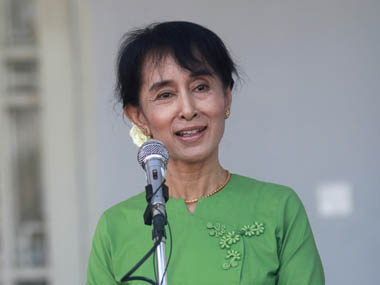
Myanmar’s pro-democracy leader Aung San Suu Kyi on Saturday arrived in Andhra Pradesh’s Anantapur district to study the socio-economic transformation of people in villages brought about by various government welfare schemes.

The Nobel laureate arrived in Kothulagutta village around 9.30 a.m. in a helicopter from Bangalore. She was accompanied by Union Minister for Rural Development Jairam Ramesh and Andhra Pradesh Chief Minister N. Kiran Kumar.

Amid tight security, three helicopters carrying the leaders and their aides landed in the village.

Suu Kyi saw a power point presentation on the rural development in the state and the impact of the welfare schemes being implemented by the central and state governments.

She later travelled by road to Govindapuram village and interacted with the people working under the Mahatma Gandhi Rural Employment Guarantee Scheme (MGREGS).

The Myanmar opposition leader will also visit Papasanipalli village and interact with women to gain first hand knowledge of how the self-help group movement has changed their lives.

After visiting the house of a member of a self-help group, she will fly back to Bangalore.

IANS

source: http://www.firstpost.com / Home> World / November 17th, 2012

Hyderabad’s Rajiv Gandhi International Airport Receives Carbon Accreditation

Rajiv Gandhi International Airport (RGIA), Hyderabad, has received Airport Carbon Accreditation at Level 2 –‘Reduction’ for its efforts in managing and reducing carbon emissions.

The Airport Carbon Accreditation certification was presented to RGIA on 8 November during the 8th ACI Asia-Pacific Small Airports Seminar organized by ACI Asia-Pacific and hosted by GMR Hyderabad International Airports Ltd (GHIAL).

Mr. Vikram Jaisinghani, CEO of GHIAL, operator of RGIA, said, “This accreditation is a significant milestone in the advancement of airport’s overall sustainability strategy as it involved calculating the carbon footprint of RGIA, using internationally recognised methodology and independent verification. RGIA has compiled an independently verified carbon footprint and succeeded in reducing their overall emissions and carbon footprint over the past number of years.”

On the same occasion, Mr. P.S. Nair, CEO-Corporate, Airport Sector of GMR Airports Limited was also presented with the Airport Carbon Accreditation certificate for Delhi’s Indira Gandhi International Airport, another GMR-led airport in India, which was accredited at Level 2 – ‘Reduction’ in July this year.

Regional Director of ACI Asia-Pacific, Mrs. Patti Chau said, “It was this month last year that Airport Carbon Accreditation was introduced in Asia Pacific and I am indeed very pleased to see that 6 airports in the region have been accredited and 3 are even accredited at Level 2 – ‘Reduction’, including RGIA.”

Airport Carbon Accreditation is the institutionally endorsed program that independently assesses and recognises airports’ efforts to manage and reduce their CO2 emissions.

Participating airports can be certified at 4 progressive levels of accreditation as follows: ‘Mapping’, ‘Reduction’, ‘Optimisation’, and ‘Neutrality’.

First launched by ACI Europe in 2009, the programme received support from ICAO and was extended to the Asia Pacific region in November 2011.

Airport Carbon Accreditation is administered by WSP Environment & Energy, an international consultancy appointed to enforce the accreditation criteria for airports. The administration of the programme is overseen by an independent Advisory Board.

Airports must have carbon footprints independently verified in accordance with ISO14064 (Greenhouse Gas Accounting). Evidence of this must be provided to the administrator together with all claims regarding carbon management processes which must also be independently verified.

source: http://www.asiatraveltips.com / Home / Monday, November 12th, 2012

Finally, Icomos team lands in Hyderabad

Hyderabad:

The International Council on Monuments and Sites (Icomos) finally arrive in the city on Wednesday and will carry out its inspection of Charminar, Golconda Fort and Quli Qutub Shahi Tombs starting today. The city has been pushing for World Heritage tag for these structures for many years now and has pinned its hopes on the visiting team for it to come through.

GV Ramakrishna Rao, director, department of archeology and museums, said the team will start its survey with a visit to the Quli Qutub Shah Tombs on Wednesday morning followed by the Golconda Fort in the evening where they will also attend the sound and light show. On November 2, the team will inspect Charminar followed by a separate visit to Chowmohalla Palace on November 3.

While officials of the Archaeological Survey of India and the department of archeology and museums remained tight-lipped about the Icomos visit, they were optimistic that all three monuments would make the prestigious World Heritage Monument tag. An archeology department official said, “Work has been moving at a fast pace so that the inspection goes well. All three monuments are being spruced up. We are confident of getting the heritage tag.” Clearly, officials believe that their months and years of indifference to the city’s crumbling heritage will not show with quick sprucing up efforts.

While the Bhagyalakshmi Temple and the Chilla in Charminar will continue to remain untouched,  ASI officials said that the overhead water tanks used by the temple have been permanently removed after consulting temple officials. They however added that temple officials are yet to heed to their repeated requests of removing saffron flags and buntings put up during Dasara. Heritage activists noted that the authorities had failed to utilise the window of opportunity provided to them after the Icomos visit was delayed.

It was earlier reported in these columns that the series of inspections were scheduled to take place from September 25 onwards, but was delayed due to passport issues of one of the expert committee members. “Charminar continues to have lichen on its walls and the Qutub Shah tombs are surrounded by encroachments. The GHMC had hastily taken up demolition of these encroachments near the tomb complex but made little progress. We were informed that smaller encroachments will be removed for just one day,” said an activist.

Meanwhile, a group of noted heritage activists said that the government has kept them isolated from the Icomos developments.

They said that despite making several requests with the government for a meeting with experts, they have received no reply. An activist requesting anonymity said, “They are afraid that we will speak about the Naya Qila issue where the government is clearly at fault. We want to appraise our concerns with the Icomos team but the government has completely shut us out.”

source: http://www.timesofindia.indiatimes.com / Home> City> Hyderabad / TNN / November 01st, 2012