Category Archives: World Opinion

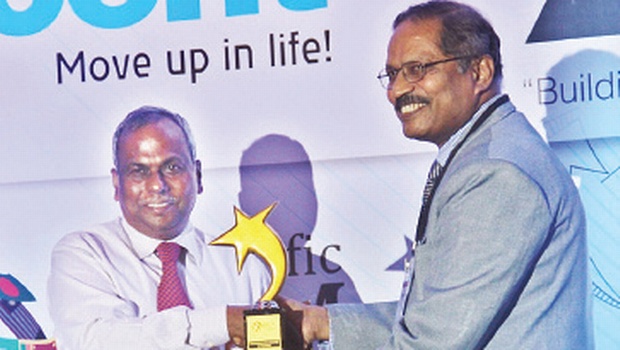
HRM Body Awards DCIL for Innovative Practices

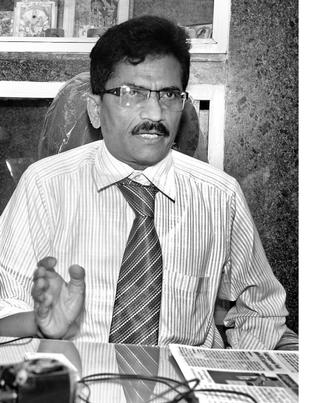
DCIL chairman-cum-managing director Captain DK Mohanty receiving the award at a grand ceremony held at Bangalore

Visakhapatnam :

Dredging Corporation of India Limited (DCIL) has bagged the ‘Organisation with Innovative HR practices’ award presented at the Asia Pacific HRM Congress 2014, a conclave of CEOs and HR professionals.

DCIL was selected for the award in recognition of the strategic position the organisation holds in the fraternity. Chairman-cum-managing director DK Mohanty received the award at a function held at Bangalore.

The DCIL, during the past three years, has taken various steps for improving the working condition on board the dredgers and redressal of grievances of the floating staff.

At present the corporation employs about 750 marine personnel to man its dredgers. During the past two years, the Corporation recruited 32 Diploma in Nautical Sciences (DNS) and 29 Trainee Marine Engineers (TME) with professional skills, who are undergoing training on various dredgers. In due course they will be elevated as Dredge Masters and CEOs.

Attrition rate in the Corporation has also reduced considerably among the floating officers, owing to the constant efforts made by DCI in providing training to DNS and TME engineers who completed their requisite courses from Indian Maritime University affiliated institutions. Availability of trained manpower in the field has been suitably addressed by innovative methods as well.

source: http://www.newindianexpress.com / The New Indian Express / Home> States> Andhra Pradesh / by Express News Service / September 16th, 2014

[Techie Tuesdays] Anand Chitipothu – The village boy who is impacting the world

Anand Chitipothu had very humble beginnings and he made sure he worked hard to make the best use of whatever he had to make an impact on the world. Our Techie Tuesday for this week works at archive.org and is a Python enthusiast to the core.

The impact of the kind of work which Anand has been doing is not limited to one person or even a country. If you have a website or just browse the internet casually then there are chances that you might have clicked an archived link and visited a backed up version of a webpage at some point of time. Archive.org is a project by Aaron Swartz to create an archive of the internet and Anand works at Open Library – A project under archive. org, which aims to have a web page for every book.
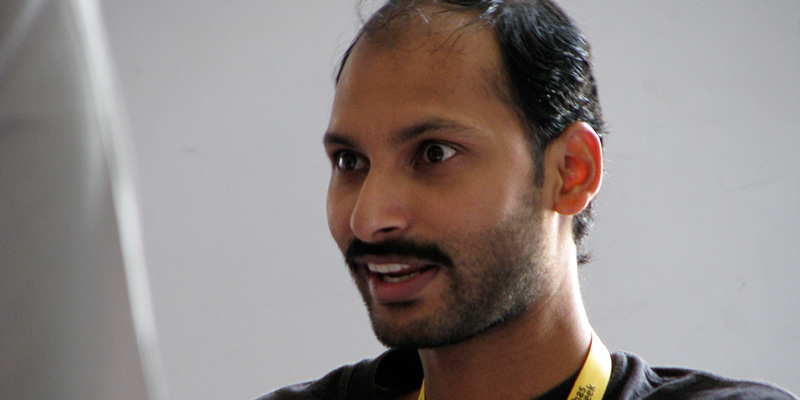
AnandANDHRA17sept2014

Anand comes from Lingarao Palem, a small village near Guntur in Andhra Pradesh and had his early schooling in Telgu medium. It was only when he started studying in class 12th (intermediate as it was called then) he switched to English medium. In his first attempt Anand couldn’t get a seat in EAMCET – The common Entrance Exam conducted by Jawaharlal National University Hyderabad. Anand waited for a year and joined the electrical Engineering Course at Regional Engineering Collage (Now NIT) Bhopal. It was here that he was introduced to computers embarked on a journey which would change the course his entire life also affect a huge number of lives in the years to come.

They were introduced to PASCAL but the experience wasn’t good. The only things they could manage was to compile and run very basic programs on a DOS machine. Also the access the computer was a luxury even in the premier engineering college. Anand remembers, ” The computer center would close soon after the college hours and they wouldn’t let us skip the classes to use the computers. The only available time was lunch break and an hour just after the college times. ” To overcome the problem Anand and his friend decided to pool in some money and bought a computer for themselves to practice.

During the holidays Anand bought C programming books and practice reading and writing programs on paper. Once the college would reopen he would then go and practice those programs on the computer. The year was 1996 and Internet was not easily affordable by everyone. The only means available for Anand was to install Linux distros which used to come with magazines like PC Quest and language they could play around was C. Anand made best use of all the tools he had. He would look at a math equation and then figure out a way to plot a curve for that equation using C on the computer.

There was never a dearth of problems for them to work on and for Anand it was always a new challenge. Once he wrote a simulator for the 8085 microprocessor when the actual device started giving problems. Anand recalls, “8085 is microprocessor that is taught to electrical engg. students. It requires you to type in the machine code of the program in keyboard. In the lab, the instrument always used to give some error due to some hardware issues. So I wrote a simulator to try it without having to go to the lab and hold a physical device.”

By the time Anand passed out, he knew that his heart lie in computers and not in electrical engineering. Anand tried to get a job in programming but it was in vain. He decided to pursue higher studies in Computational Sciences and appeared for GATE. He got a seat in IISc. IISc proved to be a blessing in disguise.

Anand had moved from C to VC++ and from VC++ to Java. Each language was better than the previous one. There was ease of use. Talking about his migration from VC++ to Java, Anand says,  “I hated VC++ because of the way it works. It generates a lot of code and asks you to modify that. It used to become a mess very quickly. On the other hand Java was very beautiful, everything that you want to do is specified in the code. What happens on a button click, what is the title of the button etc, are all in the code. But in VC++, it was driven by UI. 

After IISc, Anand took a job in a Strand Life Sciences – A startup from IISc itself. Which is where the introduction to Python happened and the interest in Python grew. After experimenting with Python for some time to automate workflows and developing tools in Jython (Python on a JVM) Anand started looking around for more Python related communities and joined Bangpypers – The Bangalore Python Group where he attended Python meetups and met likeminded Python enthusiasts.

Working in a startup, it was evident for Anand to read and follow the startup community. He started following Paul Graham very closely and decided to plunge into web programming after getting to know about viaweb(the startup Paul Graham sold to Yahoo in 1998). Anand tried to learn different frameworks like Django, Plone but found them too complicated.

Aaron Swartz released web.py framework at the same time and Anand took to it. Soon he started web programming and also after looking at the simplicity of Python, the dislike for Java crept in. Anand Says, “I knew how to build websites, my hands were itching to build something using the new things that I learnt. By then I started disliking java, after tasting Python. Java is too verbose. It takes too much code solve something. It was like ‘I knew what to do, I knew how to do, but takes 3 days coding to finish it’.

Anand quit Strand and joined another startup called Picsquare. The required a custom photosite for events. Anand implemented it using web.py. During this time Anand also started working with Aaron Swartz, Anand recollects,” I remember seeing this page couple of times and dreaming about being there. http://web.archive.org/web/20051201022645/http://infogami.com/  though I hadn’t seen the code of Infogami, I tried building a clone of that for fun. It was very crude, but I could make one. 

Reddit.com and Infogami.com were launched around the same time. After few months of helping the startup, I saw an email in the web.py group from Aaron that he is looking for someone to help him on a web.py project. 

I replied to that email saying that I’m interested.He was looking for someone to build the next version of Infogami and I showed the clone that I built. He liked it and I started working with him on building Infogami. While I was working on Infogami, I started contributing to web.py and took over the maintenance of it from him.

It was in 2007, Aaron asked Anand if he can move to US for a project, Anand decided he can be a part of the project from India itself and would work remotely. The project Aaron wanted Anand to work on was openlibrary and Anand was one of the first members on the team. Aaron moved on to activism while Anand continued working with the openlibrary project.

Like most of us in the open source community, Aarons death came as a surprise to Anand.                                                

“It was a shock. 

I never expected Aaron would do that. A friend of mine started working with Aaron on a project just couple of months before his death. I heard his big plans for future and what kind of things he wanted to build. I miss him dearly. 

We worked pretty well together. He had very good trust on my abilities and I enjoyed working with him. He asked me 2 months before his death if I wanted to work with him on a long-term project. I couldn’t accept because I wasn’t ready to quit the archive at that time.”

Anand is also actively involved in organizing PyCon India and have been in the organizing team since its inception. He is also leading an initiative on organizing Python workshops around the country with his initiative PythonExpress.

For people just starting out in technology, Anand refers them to read an article by Aaron Swartz. His advice to students is, “Be passionate, work hard, try new things. 

World is full of interesting problems waiting to be solved. There are lot of interesting problems around us, we just need to look around.” 

source: http://www.yourstory.com / YourStory.com / Home / by Aditya Bhushan Dwivedi / September 16th, 2014
Man behind submarine museum felicitated

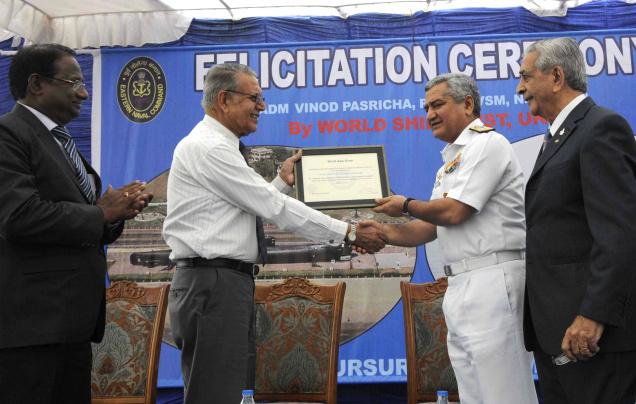
Vice Admiral (retd) Vinod Pasricha receiving 'Individual Achievement Award' of World Ship Trust of UK from Flag Officer Commanding-in-Chief Eastern Naval Command Vice Admiral Satish Soni at a felicitation function organised at INS Kursura Submarine Museum on the Beach Road in Visakhapatnam on Wednesday. Photo:C.V. Subrahmanyam  / The Hindu
Vice Admiral (retd) Vinod Pasricha receiving ‘Individual Achievement Award’ of World Ship Trust of UK from Flag Officer Commanding-in-Chief Eastern Naval Command Vice Admiral Satish Soni at a felicitation function organised at INS Kursura Submarine Museum on the Beach Road in Visakhapatnam on Wednesday. Photo:C.V. Subrahmanyam
/ The Hindu

World Ship Trust of UK honours Vice Admiral (retd) Vinod Pasricha with ‘Individual Achievement Award’. Visakhapatnam is the home of submariners of the Indian Navy and it is befitting that such an iconic museum is part of the city landscape, Vice Admiral Satish Soni said.

Recognising the unstinted efforts of Vice Admiral (retd) Vinod Pasricha, who as then Flag Officer Commanding-in-Chief of Eastern Naval Command, saw INS Kursura beached and converted into a museum World Ship Trust of UK honoured him with ‘Individual Achievement Award’.

Very appropriately he received the award aboard the decommissioned INS Kursura from Flag Officer Commanding-in-Chief Eastern Naval Command Vice Admiral Satish Soni at a simple ceremony here on Wednesday.

The first submarine museum in South East Asia and probably the best in the world became a reality thanks to the efforts of a team of committed Naval officers and others from civil society who worked hard for it, Vice Admiral (retd) Pasricha said in his acceptance speech.

INS Kursura, the ex-Soviet Foxtrot class submarine, was one of the first four submarines acquired by the Indian Navy and commissioned in the late 1960s saw action in the 1971 Indo-Pakistan war. It served the Indian Navy for 31 years before being beached and decommissioned in 2001. On August 14, 2002 the submarine museum was dedicated to the nation by then Chief Minister Nara Chandrababu Naidu and since then has become one of the main tourist attractions of the city.

Visakhapatnam is the home of submariners of the Indian Navy and it is befitting that such an iconic museum is part of the city landscape, Vice Admiral Satish Soni said.

The felicitation speech was read by president Indian Maritime Foundation and representative in India of World Ship Trust of the UK Commodore (retd) Rajan Vir. Visakhapatnam Urban Development Authority which maintains the museum was represented by its Vice Chairman M V Satyanarayana. A number of flag officers and serving and retired officers who were part of the task were present.

source: http://www.thehindu.com / The Hindu / Home> News> National> Andhra Pradesh / by G.S. Subrahmanyam / Visakhapatnam – September 10th, 2014

‘Golconda diamonds a misnomer’

Branding the Krishna valley diamonds as Golconda diamonds resulted in depriving the Guntur-Vijayawada area the credit of being the land of the legendary diamonds. (Photo: DC/File)

Hyderabad: 

Guntur and Vijayawada lost their diamond hub status due to the rise of Golconda under Qutub Shahi rule, says Prof. Madhavan. Emphasising that the 350-km NH 9 connecting Hyderabad and Bandar via Vijayawada as the ideal model of a corridor, Prof. Madhavan, a renowned geologist and academic, said that it qualifies to be called the diamond corridor.

Guntur and Vijayawada occupy a unique position in the world of diamonds. The geologist said that branding the Krishna valley diamonds as Golconda diamonds resulted in depriving the Guntur-Vijayawada area the credit of being the land of the legendary diamonds, and in glorifying Golconda which was about 300 km away from the mining scene. The world now has a wrong impression that diamonds were found near Golconda which is far from the truth.

He said that Guntur-Vijayawada and the corridor connecting Bandar and Hyderabad should be given heritage status.

source: http://www.deccanchronicle.com / Deccan Chronicle / Home> Nation> Current Affairs / by DC Correspondent / September 07th, 2014

The vanishing edifices of Bheemunipatnam

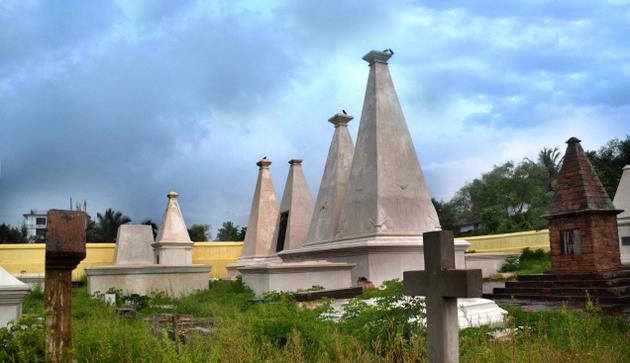
A view of the 17th century Dutch Cemetry at Bheemunipatnam. - Photo:C.V.Subrahmanyam / The Hindu
A view of the 17th century Dutch Cemetry at Bheemunipatnam. – Photo:C.V.Subrahmanyam / The Hindu

The town of Bheemunipatnam, 20 km. from here, is not only the second oldest municipality in the country, but has a rich heritage of both Buddhist and Colonial period. Historians say that the town was a trading centre during the 2 century Buddhist era and the colonial period and was an early settlement both for the Dutch and the British.

Though there are no remnants of the Buddhist period in the town , the excavated Buddhist settlement on the hills near to the town such as Pavuralakonda, Thotlakonda and Bavikonda suggest a link.

But there is still ample evidence of the early Dutch and English settlement. And it is only a few years from now, even that will be erased from the face of the town, thanks to the rampant destruction of the historic edifices.

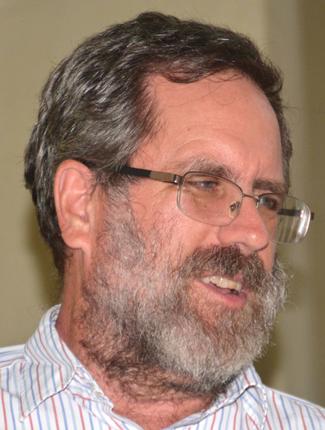
Robert Schick archaeologist from American Center of Oriental Research who is documenting the antiquity of Bheemunipatnam. Photo: C.V. Subrahmanyam / The Hindu

According to Robert Schick, an archaeologist affiliated with the American Centre of Oriental Research in Amman, Jordan, a 1995 study documented the presence of about 40 buildings belonging to the 17 to early 19 century Dutch and English settlement.

Dr. Schick who is on his third visit to the port town along with his colleague and fellow archaeologist Micaela Sinibaldi, to document the latest status on behalf of INTACH, informed The Hindu, at present only 20 are left. “A couple of them are still standing, though in dilapidated condition, the rest are totally rundown and a few have been replaced by modern concrete structures,” he said.

Notable among the ones that have been razed to ground are the magnificent sea-facing bungalow of 116 doors, the Governor’s House and the Gali Medha or the round building.

The archaeologist, expressed surprise on the gross ‘lack of will’ to preserve the structures. “It is not the same in the west. In Europe, many a town have been retained to preserve the core medieval flavour for posterity. Historic buildings are not mere sites, but are laboratories with a wealth of information and they define the character of the town or city,” said Dr. Schick.

The coordinator of INTACH’s Buddhist sites in AP, Rani Sarma, pointed out that with every passing day, the situation is worsening and the land is being encroached upon.

source: http://www.thehindu.com / The Hindu / Home> News > National> Andhra Pradesh / by Sumit Bhattacharjee / Visakhapatnam – September 01st, 2014

The Dutch Connection

Bheemunipatnam still continues to attract tourists, but something has to be done for the upkeep of the ageing structures

Nestled by the bay about 18 km. from Visakhapatnam, this sleepy fishing town was the hub of activity on the eastern coast a few centuries ago. Bheemunipatnam which got its name from the mythological hero Bhima (the second among the five Pandava brothers), has the record of being the second municipal town in India (after Surat) and was once a flourishing Dutch Colony on the east coast. Though its neighbour Visakhapatnam has out beaten it in the course of time to become a sprawling metropolis, Bheemunipatnam continues to bask in its past glories. History points out that when Bheemunipatnam was a flourishing Dutch colony and a major port for import and exports the town of Visakhapatnam was considered to be its subsidiary.

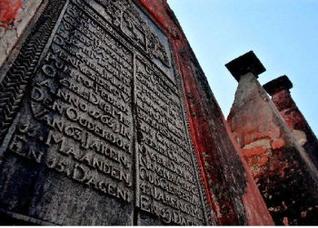
From the past Inscriptions in Dutch on a tombstone at the 18th century flagstaff cemetery in Bheemunipatnam, at left Gaali Meda (The round building) / The Hindu

History

The Dutch moved to this coastal town some time in the mid of the 17th century, when the local areas were under the control of the Golconda kings. Initially the Dutch used the port to export rice and later switched to jute. Two jute mills also sprang up in the vicinity of the town in the mid 19th century. One was called as Chittivalsah Jute Mills and the other was known as Nellimarla Jute Mills, both are operational till date.

The town was besieged and ransacked on several occasions. The marauding Marathas ransacked and burnt the town in 1754, it was again destroyed in the Anglo-Dutch wars of 1781 and 1795 and it was finally handed over to the British in 1825 following a treaty in 1824. Subsequently, it became a peaceful Anglo-Dutch settlement.

Remnants of the past

Though many old buildings have been demolished to accommodate newer structures and a few have just withered away with the passage of time for lack of maintenance, a few moss-stained edifices continue to stand firmly to give testimony of the glorious past.

The oldest among such structures is the cemetery at Kummaripalem, a small hamlet on the northwest side of the town. The oldest grave is that of one Frederick Kesslerus and it dates back to 1661. It is the oldest surviving Christian grave in this part of India. The second oldest cemetery is the Flagstaff Cemetery where the tombstones still stand like monuments against the blue waters of the bay. This cemetery has virtually become the landmark of Bheemunipatnam.

Both the cemeteries would have been lost in the annals of time but for the initiative taken by 73-year-old Roberts, a former officer of Chittivalsah Jute Mills. His timely intimation to the London-based British Association for Cemeteries in South Asia (BACSA) saved the day. The association responded in time with some funds for renovation and restoration. Today the cemeteries are under the Government of AP’s Archaeology and Museum Department and have once again become the subject of neglect.

St. Peter’s Church

The church was consecrated on March 17, 1864 by Bishop Gell, in honour of St. Peter.

The design was made with the help of the draughtsman of the 38 Madras Infantry and it was estimated to cost Rs.4,528 with an additional Rs.2,206 for the tower. Gothic in style and architecture, the church has a unique stained glass painting depicting Christ’s baptism and crucifixion just behind the altar. This piece was specially ordered and imported from London for an additional cost of Rs.1,000 in those days. Every aspect was taken care of, right from the arches to the granite altar and from the handsomely carved teak furnishing to the floor.

Gaali Meda

This was another landmark of Bheemunipatnam till a few years ago. This round shaped building was popularly known as the ‘Gali Meda’ (Tower of air). This building was part of the Dutch Governor’s Bungalow, from where a constant vigil was kept on the sea to determine the likely weather, spot approaching ships and to watch for enemy movements. This building also featured in a few hit films like ‘Maro Charitra’ and its Hindi version ‘Ek Dhuje ke liye’. This 24-feet diameter building was demolished a few years ago.

The town still continues to attract many tourists, but something has to be done for the upkeep of the heritage structures. Otherwise they will soon fade away into oblivion.

SUMIT BHATTACHARJEE

source: http://www.thehindu.com / The Hindu / Home> Features> MetroPlus  / by Sumit Bhattacharjee / August 18th, 2007

A successful man learns lifelong, says Krish Dhanam

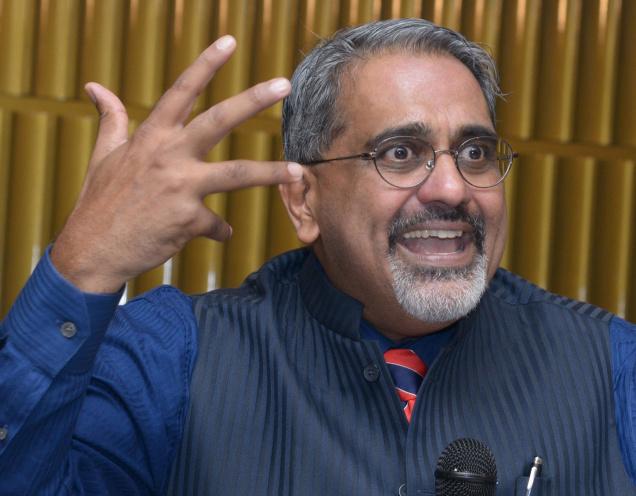
Krish Dhanam / The Hindu

When he migrated to the United States in 1986, he just had few dollars in his wallet. But his success in becoming an acclaimed public speaker helped him become a global ambassador for Ziglar Group of Companies and co-founder of Krish Dhanam Training Intl.

A renowned motivational speaker groomed by famed American author, speaker and salesperson Zig Ziglar, Krish Dhanam who hails from Visakhapatnam, says he is proud of his birthplace and its affectionate people. “This is the biggest city of Andhra Pradesh and it has a bright future. Whenever I come here, I turn nostalgic,” he says in a voice choked with emotion. Giving credit to his success as corporate trainer and philosopher and recognition as a specialist in human engineering to Zig Ziglar, he says nothing comes free.

“I have to do my homework before fulfilling my assignment – be it Europe, Zimbabwe or India,” he remarks.

He has some plans to set up an institute in India though he declines to elaborate on his plan.

Having studied at Visakha Valley School and L.B. Bullayya College, he says wherever he is asked to perform a task – be it off the shelf for a motley crowd of people, customised or private label, he does some spadework. “There is no shortcut to success and preparation and studying the requirement of the target audience will always make the task easy,” he says.

Author of “American Dream from an Indian Heart,” he discloses that his MBA degree from Delhi, telemarketing career and frequent interaction with the customers for 17 years under the guidance of Zig Ziglar helped him gain expertise in soft skills and market psyche.

Everyone in life is a learner.

“We learn lessons from experience. I have a lot to learn ahead to improve my skills,” he sums up, showcasing his simplicity and down to earth nature.

source: http://www.thehindu.com / The Hindu / Home> News> Cities> Visakhapatnam / by Santosh Patnaik / Visakhapatnam – August 31st, 2014

Chess gold medallist calls on Naidu

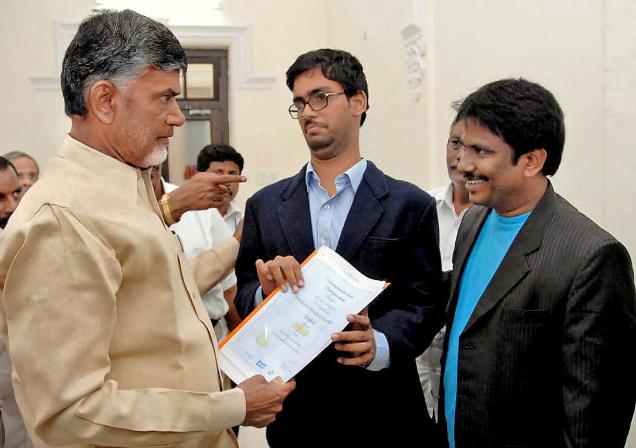
Global chess Academy K.Venkata Krishna Karthik and his coach Shaik khasim met Chief Minister Nara Chandra Babu Naidu at Hyderabad on Assembly premises. / The Hindu

Commonwealth chess gold medallist under physically challenged category K.V. Krishna Karthik along with his coach Shaik Khasim of Global Chess Academy called on Chief Minister N. Chandrababu Naidu at Hyderabad on Tuesday.

Mr. Naidu appreciated the medal-winning achievement of Mr. Karthik, who suffers from an acute orthopaedic disorder and assured all assistance to him in the future. Later, Mr. Khasim narrated Mr. Karthik’s on-board exploits at Glasgow to the Chief Minister and also explained him about his unflinching commitment towards promoting and playing chess, said a press release.

Mr. Khasim said that the Chief Minister had enquired about the support offered by the Sports Authority of Andhra Pradesh and the benefits Mr. Karthik was getting from it. “We told him the fact that SAAP was not financially helping the physically challenged players for which he asked us to put a note with his personal secretary.”

Incidentally, Mr. Karthik is qualified to participate in the World Physically Challenged Chess Championship to be held in Serbia later this year.

source: http://www.thehindu.com / The Hindu / Home> News> Cities> Vijayawada / Special Correspondent / Vijayawada – August 20th, 2014

Lalith creates history in Norway

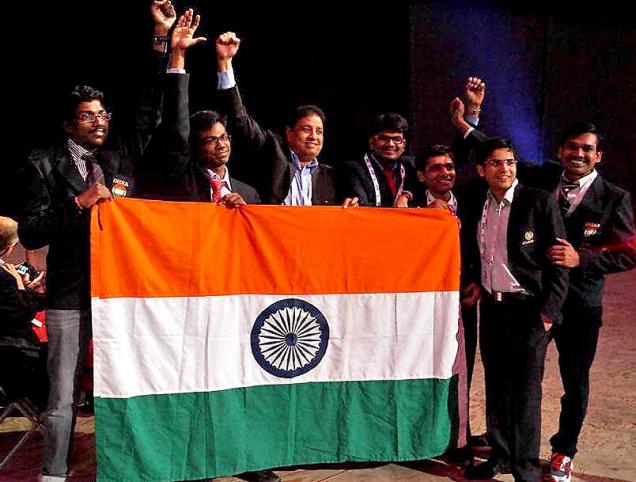
Lalith in Norway with Indian flag / The Hindu

India defeats Uzbekistan to clinch the bronze medal, the first-ever medal in the format

What former world champion Viswanathan Anand could not attain, young Grandmaster from Vijayawada M.R. Lalith Babu achieved at Tromso, Norway by becoming part of the medal winning Indian team at the prestigious Chess Olympiad.

India defeated Uzbekistan to clinch the bronze medal, the first-ever medal in the format and the achievement was possible owing to the on-board exploits of Adhibhan, Sethuraman, Parimarjan Negi, Lalith Babu and Sasikiran Krishnan.

India just lost two games in the 44 games played, which showed the consistency exhibited by the team members.

Lalith played three rounds – against Syria, Cuba and Moldova – and later he was rested by the team management to give a chance for others to perform.

Says Grandmaster B. Ramesh, Indian team’s coach in his blog: “I must apologise to Lalith Babu for not letting him play more than he did. It was just that no one lost any games and I didn’t want to spoil the momentum with frequent changes. Lalith is a great team player and he supported our decisions wholeheartedly. He was helping other players in their preparations.”

Mr. Ramesh in his blog praised Lalith Babu and said he was always positive and affirmative. “He is like liquid. He will take the shape of the role which you put him into. Lalith did not only sit outside but also helped his friends in their preparation. He is truly a team player.”

“India finishing third among 171 countries is a sparkling achievement. The medal is all the more important as we won it for the first time without star players – Anand and Hari,” said Sk. Khasim, chairman of Global Chess Academy.

The medal is crucial for Lalith, who is keen on settling down with a job and his efforts are already on to join one of the oil companies. “Andhra Cricket Association has always been every supportive of Lalith. He needs a job to take care of his chess expenses. This victory will give him the necessary fillip to achieve more laurels,” said Lalith’s mother Padma.

Lalith will come down to Vijayawada on August 17 and would leave for Abu Dhabi to take part in a tough Grandmaster tournament beginning from August 18.

source: http://www.thehindu.com / The Hindu / Home> News> Cities> Vijayawada / by J. R. Sridharan / Vijayawada – August 16th, 2014

Lifetime achievement award for Guntur doctor

V.Phaniendra Kumar
V.Phaniendra Kumar

A Guntur-based phonosurgeon V. Phaniendra Kumar has been presented the Lifetime Achievement Award for his services to the speciality in medicine.

At the 9th National Conference of the Association of Phonosurgeons of India ‘PHONOCON – 2013’ organised at Pinnamaneni Siddhardha Medical College, Vijayawada, he was given away the award, Dr. Phanineindra said in a release on Monday.

Phonosurgery is voice restorative surgery for victims of voice disorder.

The origin of the speciality in India is from Guntur. The national conference was organised on March 8, 9 and 10. Registrar of Dr. NTR University of Health Sciences S. Babulal, chief guest of the inaugural function, gave away the award.

About 100 ENT surgeons from different parts of the country attended as delegates.

International faculty members from the USA and New Zealand, national experts from the State, Kerala, Mumbai and New Delhi conducted technical sessions.

Dr. Phaniendra is the founder of the APSI and developed it over the years.

source: http://www.thehindu.com / The Hindu / Home> National> Andhra Pradesh / Special Correspondent / Vijayawada – March 12th, 2014