Category Archives: World Opinion

City skater for tourney in Columbia

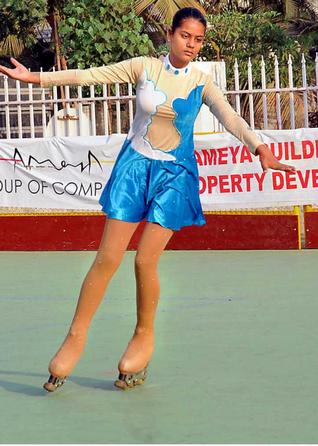
Vijayawada skater Shubhra Tatiya who was selected for the World Artistic Skating Championship in Columbia. —Photo: By Arrangement
Fifteen-year-old city skater Shubhra Tatiya is all set to take wings to Columbia to compete in the World Artistic Roller-skating Championship to be held from September 19 to 25, according to Krishna District Skating Association secretary Durga Prasad here on Wednesday.

He said the event staged at Cali City will feature four more Indian skaters — Boppana Nishank (figure skating), Arun Kumar, Farheen (both free style and pair skating) and Anup Kumar Yama (inline free skating).

“Tatiya will take part in the figure skating event and she will be performing as per the theme given by the judges. She came to us six years ago and from then she has been regularly winning medals for Andhra Pradesh. She hones her skills at the skating rink behind the DRRMC Indoor Stadium,” said Mr Durga Prasad.

The teenager, a junior Intermediate student with Siddhartha Mahila Kalasala, qualified for the world championship by faring well in the selection meet held in Ahmedabad early this year. She also took part in the earlier edition of the world championship in China but could not win a medal. He said Tatiya will be trained by former Indian coach Satyanarayana of Vizag.

SAAP board member B. Hanumantha Rao and District Sports Development Officer P. Ramakrishna congratulated her for making it to the premier event.

Shubhra Tatiya will compete in the World Artistic Roller-skating Championship to be held at Cali City from September 19 to 25

source: http://www.thehindu.com / The Hindu / Home> News> Cities> Vijayawada / by Special Correspondent / Vijayawada – September 10th, 2015

Top Indian scientist awarded 1st Sunhak Peace Prize

Seoul :

Noted Indian agriculture scientist Dr Modadugu Vijay Gupta, who has done pioneering work in aquaculture in India and several other countries, was today awarded the first Sunhak Peace Prize, billed as an alternative to the Nobel Peace Prize, which he shared with the President of Kiribati Islands.

Gupta, 76, shared the USD 1 million prize with President of Kiribati Islands Anote Tong here at a glittering function which was attended by invitees from all over the world.

Tong, 63, the head of the Pacific Ocean island nation which is facing dire prospects of being engulfed by rising sea waters by 2050, was chosen for the award for his dogged fight to end the carbon emissions which are spelling doom for small island nations.

The awards were presented by South Korean religious leader Dr Hak Ja Han Moon, the wife of late Rev Sun Myung Moon, who instituted the awards to recognise and highlight the work of individuals making big efforts for the betterment of the people.

Hailing from Bapatla in Andhra Pradesh, Gupta, a biologist, was also the recipient of the World Food Prize in 2005 for development and dissemination of low-cost techniques for freshwater fish farming.

Before his retirement, he served as the Assistant Director General at WorldFish, an international fisheries research institute under the Consultative Group on International Agricultural Research based in Penang, Malaysia.

Starting his career as a scientist in Indian Council Agriculture Research over three decades ago in Kolkata, Gupta worked in Laos, Vietnam, Bangladesh, the Philippines, Thailand pursuing his belief that the aqua technology which can provide food security and improve livelyhoods of rural poor.

“I believed throughout my career that all the advanced fish farming technology which we created in laboratories should be taken to people, then only it can make a difference to their lives,” he told PTI after receiving the award.

Regarded as a rebel within the ranks of the agricultural scientist community in India, Gupta mostly worked with the UN and agriculture related international organisations in different countries.

His work with rural communities in Bangladesh, a nation bestowed with lot of water resources, has made fish farming a major source of livelihood for millions of rural poor, according to the organisers.

As a scientist advocating sustainable alternatives, Gupta said aquaculture should be seen as a major source of food security.

“There can be no peace without food security in the world. You cannot talk peace to a hungry man,” he said.

source: http://www.timesofindia.indiatimes.com / The Times of India / News Home> India / PTI / August 29th, 2015

GSLV-D6 set to fly GSAT-6 to space on Thursday

GSLVD6ANDHRA27aug2015

Countdown for launch begins

The Indian Space Research Organisation began a 29-hour pre-noon countdown on Wednesday for the launch of GSLV-D6 satellite launcher.

The launch vehicle is powered by the indigenously developed upper cryogenic stage and will be flown at 4.52 p.m. on August 27 from Sriharikota in coastal Andhra Pradesh.

It will put the 2,117-kg GSAT-6 communication satellite into space. The spacecraft will be gradually moved and finally positioned over the country at 83 degrees East longitude in the coming days.

The GSLV is a medium-lift launcher that can put two-tonne satellites into an initial or geosynchronous transfer orbit (GTO) of up to 36,000 km from Earth. The last GSLV was flown in January 2014.

ISRO Chairman A.S.Kiran Kumar, who is also Secretary, Department of Space, said the upcoming event was doubly significant. The ninth GSLV launch, for whose success he said ISRO has taken all necessary actions, would take the 20-year-old GSLV programme almost to fruition and regularise its use.

From the satellite point of view, he said GSAT-6 would try out quite a few novel technologies that very few satellite players have tried out, such as the large, unfurlable antenna of a diameter of six metres.

ISRO’s other launch vehicle, the light-lift PSLV, is a big success after 30 flights in 22 years, lifting Indian spacecraft to Moon and Mars apart from several Earth observation satellites, a national communications satellite and 45 small foreign satellites.

High hopes

ISRO officials have often said the national space programme needs the GSLV badly for launching its communication satellites; many have been put in space on European Ariane launchers at higher costs than on a GSLV.

S.Sivan, Director of Vikram Sarabhai Space Centre, the lead centre for launch vehicles in Thiruvananthapuram, recently said they had retained the configuration of the previous GSLV-D5 of 2014 so as to establish the vehicle’s reliability and robustness.

Flight D6 would fully prove the vehicle and the indigenous cryogenic technology and shift the programme into functional mode. The next GSLV could be as early as the first half of 2016, Dr. Sivan said.

When the GSLV is fully achieved, ISRO plans to have two flights of it a year. Meanwhile, a GSLV-Mark III of twice its capacity is also being developed and will be flown for the first time around December 2016.

source: http://www.thehindu.com / The Hindu / Home> National / by Madhumati D.S. / Bengaluru – August 26th, 2015

A.P. major contributor to marine exports

A major player in the aquaculture sector, Andhra Pradesh contributed 46 per cent of marine exports, valued at around Rs. 35,000 crore, during 2014-15.

The contribution of the fisheries sector to the country’s Gross State Domestic Product (GSDP) is 6.04 per cent, and the total fish and prawn production in brackish and fresh water in the State was 19.78 lakh tonnes, and it was worth around Rs. 21,325 crore.

However, aqua farmers fear a dip in production owing to the prevailing drought situation.

Price fluctuations

“Aqua farmers invest Rs. 5 lakh on an average in an acre of pond for raising shrimp. But, the benefit is marginal, thanks to price fluctuation in the international market and adverse weather,” said V. Sathibabu, a farmer from Gudivada.

Another aqua farmer, G. Venkanna from Undi in West Godavari district, said canals, which were the principal sources of water for aquaculture, had dried up, and that a few tanks were dependent on bore wells.

“Aqua farmers spend lakhs of rupees every season on procurement of seed strock, feed and medicine, not to mention labour and power charges.

Apart from that the lease value is between Rs. 40,000 and Rs. 50,000 per acre a year,” he added.

source: http://www.thehindu.com / The Hindu / Home> National> Andhra Pradesh / by Staff Reporter / Gudivada (Krishna) – August 24th, 2015

A mission for coastal resource conservation

The Sorlagondi Reserve Forest in Nagayalanka mandal of Krishna district.- Photo: T. Appala Naidu

UN body joins Swaminathan Foundation to restore Sorlagondi mangrove forest. The UNFCCC will release the adaptation fund through the National Bank for Agriculture and Rural Development (Nabard).

The United Nations Framework Convention on Climate Change (UNFCCC) and the Chennai-based M.S. Swaminathan Research Foundation (MSSRF) will work together for the conservation of coastal resources, with focus on the restoration of the Sorlagondi mangrove forest cover in Krishna district.

“The UNFCCC has sanctioned Rs. 3.8 crore for the potential adaptation strategy of MSSRF in Krishna district through an ‘adaptation fund’. A roadmap to improve the mangrove forest cover in 200 acres and fish cultivation in around 50 acres of mangrove forest has been prepared, and it will be executed in August,” MSRRF Project Co-ordinator Rama Subrahmanyam said.

“The abandoned land will be brought under fish cultivation, while landless families will be involved in cage cultivation in three villages – Sorlagondi and Nali in Nagayalanka mandal and Basavanipalem in Koduru mandal,” he added.

Mr. Subrahmanyam said cage cultivation would be encouraged in brackish water by setting up as many as 10 cages in the three villages, which had been adopted by MSSRF.

The UNFCCC will release the adaptation fund through the National Bank for Agriculture and Rural Development (Nabard). According to NABARD sources, the objective of the adaptation initiative is to overcome the consequences of sea level rise and seawater inundation following cyclonic storms.

An official release by Nabard reads: “Restoration of degraded mangroves will be undertaken with native multiple mangrove species, which in turn would avoid ingression of seawater”.

The conservation of the mangrove forest becomes significant, as a portion of it has been spared for the proposed Missile Test Launch Facility project of the Defence Research and Development Organisation.

source: http://www.thehindu.com / The Hindu / Home> National> Andhra Pradesh / by T. Appala Naidu / Sorlagondi (Krishna) – August 21st, 2015

Chinese Mobile Maker Xiaomi Gets Set to Drive Into AP for Make in India Push

XiaomiANDHRA11aug2015

Hyderabad :

Andhra Pradesh is expected to make strides globally through its ‘Make in India – Made in AP’ programme by manufacturing smartphones in the State.

Chief Minister N Chandrababu Naidu will launch the first Xiaomi-manufactured phone in India in Visakhapatnam on Monday. The programme will also see Xiaomi making some key announcements about its India expansion plans.

Ahead of this event, a hoarding put up by Xiaomi with ‘Make in India’ logo at Visakhapatnam airport, followed by a Facebook post, led to speculation that the Chinese cellphone maker might set up its first India plant in the port city.

Xiaomi, a Chinese low-cost smartphone-manufacturer, is the third largest smartphone-maker in the world, following Samsung and Apple. “Following the Chief Minister Naidu’s visit to China earlier this year, Xiaomi has come to Visakhapatnam to launch its first made-in-India smartphone and announce its plans for the country. We are expecting a key announcement from the Chinese low-cost smartphone-manufacturer on Monday,” said a senior official.

Given that global smartphone sales are estimated to grow from 1.5 billion in 2015 to 1.7 billion by 2017 and India will become the second largest smartphone market by 2017, Xiaomi is looking to expand its presence and increase its market share in the country. During the programme in Visakhapatnam on Monday, Manu Jain, CEO Xiaomi India, will deliver the welcome address while Hugo Barra, Vice-President (Global) Xiaomi, will brief the audience on the ‘Journey of Xiaomi in India.’

source: http://www.newindianexpress.com / The New Indian Express / Home>States> Andhra Pradesh / by Express News Service / August 10th, 2015

Over 120 start-ups take roots in A.P.

IT Minister to inaugurate incubation tower in Tirupati on Aug. 5

Close to a year after the launch of AP Innovation and Start Up policy, Andhra Pradesh is taking steady and firm steps towards becoming the breeding State for start up companies in the IT and IT enabled services and allied sectors.

With the two incubator towers in Visakhapatnam and Kakinada in place with reputed pilot incubators in charge, the third incubator tower in Tirupati will be inaugurated by IT Minister Palle Raghunatha Reddy on August 5.

In Visakhapatnam incubator tower at Rishikonda built by APIIC started functioning in December, 2014 under the guidance of Kochi based pilot incubator Mob Mee Start Up village which pioneered the start-up concept.

In the last six months, 115 start-up companies have come up working on mobile applications and innovative product development ideas.

The mandate of the empanelled incubators is to promote the culture of innovation among the start-up units while the State is looking at creating world class eco-system and lay strong foundation to make a mark in IT product development, department sources said.

Recently Intel and C-Dac organised training programmes for the start-ups in Visakhapatnam working on ideas and products related to their domain expertise.

The government has also been extending some financial assistance to the pilot incubator on behalf of each start-up unit for organising training programmes and promoting the products and ideas once they reach a certain stage of development to attract venture capitalist and angel investors.

Of 50,000 sft space in the Vizag incubator tower, Mob Mee has taken up 15,000 sft while Govind Capital, Singapore based pilot incubator recently acquired 2,500 sft and has now six start-ups working in the facility. The Vizag facility is named as Technology, Research and Innovation Park.

The IT Department will have another five floor tower to be named Millennium Tower with three lakh sft space that will come up in a four-acre land adjacent to the Rishikonda incubation tower. The first two floors will be for start-up units and the rest of three floors will be allotted for companies.

In Kakinada where the incubation tower was inaugurated on June 30, the Bhubaneswar based private pilot incubator KIIT-TBI, already brought in 25 start-up companies.

A start-up unit comprising fresh and final year engineering graduates will take on an average of one-and-a-half year to two years to work on their product and idea before it attracts the attention of venture capitalists and angel investors, sources said.

IT Minister to inaugurate incubation tower in Tirupati on Aug. 5

source: http://www.thehindu.com / The Hindu / Home> National> Andhra Pradesh / by Special Correspondent / Hyderabad – August 01st, 2015

Jain memorial being planned at Konakondla

With the State government refusing to spend any funds on researching further into the Jain inscriptions at Konakondla and develop the village into a tourist attraction, the Bharat Varsheeya Digambara Jain Thirthakshetra Committee (BVDJTC) has come forward to develop the same spending crores of rupees.

A congregation of over a hundred people belonging to the Jain community at the village in the Vajrakaruru mandal of the district has decided to build a memorial in the name of Acharya Kondakunda besides the construction of a residential vidyapeeth (a place of learning) to teach, research and propagate his teachings.

Speaking to The Hindu , Mr R.V. Chakravarthi, credited with finding out these Jain religious places almost five decades ago in Konakondla, said that Acharya Kondakunda, who wrote the Jain religious texts — Pachastikayasara, Pravachanasara, Samayasara, Niyamasara and Barasanuvekkha — was also the author of the famous Tamil treatise ‘Tirukkural’, otherwise known to be written by famous Tamil poet Thiruvalluvar.

“Since Kondakunda, also known as Padmanandi, born in this village (Konakondla) was a Digambara, of no less a stature than that of the famous Gomata in Shravanabelagola in Karnataka, he sent his disciple Tiruvalla Nayanar to present the treatise to saints including that of the famous Avvaiyar of Sangam period, who mistook Tiruvalla Nayanar to be the author of the treatise,” said Mr Chakravarthi, speaking to a rapt audience at Konakondla.

The Bharat Varsheeya Digambara Jain Thirthakshetra Committee decides to build a memorial in the name of Acharya Kondakunda besides the construction of a residential vidyapeeth (a place of learning) to teach, research and propagate his teachings at the village

source: http://www.thehindu.com / The Hindu / Home> National> Andhra Pradesh / by V.K. Rakesh Reddy / Anantapur – July 07th, 2015

Big and beautiful

Visakhapatnam :

It is without doubt one of the largest and most imposing colonial buildings not just in the Port City but also Andhra Pradesh and was built in 1910-13 when the British Raj was at its height and Vizag was the headquarters of the largest district in British India. Obviously, the imposing collectorate structure was built to reflect this power and glory of the Raj.

The E-shaped, five-winged castle like stone structure bears a strong Gothic influence and consists of large halls in each wing, with verandas on either side on both the ground floor as well as the first floor. The structure has an impressive porch with an internal spiral staircase leading to a watch tower and base pavilions on either side of the front facade.

Built by the district engineering board, the rubble structure has a tiled roof on the first floor, while the ground floor is Madras terraced, with long steel beams imported from England supporting the roof. Built to inspire awe and yet strictly functional, the stone castle spread over roughly 33,000 sq ft, which till date houses the collectorate of Visakhapatnam district, is by far one of the most beautiful colonial structures built in Andhra Pradesh.

While nobody knows who the actual architect of the impressive building is, Prof VK Giduthuri, associate professor, department of architecture, Andhra University, said the structure combines a blend of the Indian and European styles of architecture. “The arches and the high vaulted ceilings are typically European features. However, the Madras terrace and the open courtyards are clearly indicative of the Indian style of design.”

“It is unique in the sense that the proportions are no doubt grand, but the material used, with the exception of the steel beams, were all locally available. The interiors, though large and airy, are stark and functional,” he added.

Edward Paul, an expert on colonial structures in Visakhapatnam, said the scale and size of the district collectorate of Visakhapatnam was in direct proportion to the size of the then Vizagapatam district. “The old Vizag district was the largest in colonial India and comprised of the modern day districts of Visakhapatnam, Vizianagaram, Srikakulam, Koraput (including Damanjodi), Nowrangpur as well as Rayagada.”

Regarding the misconception that the building took a long time in the making and was constructed between 1865 and 1914, Paul said, “It is clearly mentioned in the Presidency archives records that this was not the case.”

Elaborating on the location of the district collectorate and the layout of the town, Giduthuri said that Sir Patrick Geddes, a noted botanist and amateur town planner and architect, had pointed out that Vizag was quite similar to New Amsterdam in terms of layout. “The administrative centre was located just outside the town overlooking the surf-ridden sea to ensure that things could be conducted away from the madding crowds.”

Fondly recollecting his young days when they would run down the dunes from the collectorate all the way to Beach Road, DN Sinha, an old timer, said: “The entire area between the collectorate and RK Beach in the early 1930s barely had a dozen garden bungalows and we used to run down the dunes all the way to the beach.”

For some not so old timers, the spacious collectorate courtyard was a great place to play cricket. P Krishna, a software engineer based in Bangalore, said, “We used to play cricket inside the courtyard during the summer holidays. It’s a pity that some of the collectors, who came in post 1997, did not take to us too kindly.”

source: http://www.timesofindia.indiatimes.com / The Times of India / Home> City> Visakhapatnam / TNN / June 18th, 2015
Masonic temple coming up in Vijayawada

Grand Master of Grand Lodge of India Vasudev Jamnabihar Masurekar on Saturday exhorted the members of Freemasons Lodge to add more love and affection in whatever they gave to the society.What matters is not how much we give but how much care we put while giving it to others, he said while speaking at the foundation stone laying function of the Masonic temple at Ibrahimpatnam.

Mr. Masurekar also inaugurated a Masonic library along with Mr. Arvind Prasad Chitra, Regional Grand Master of the Southern India. He released the members’ directory for the benefit of the lodge members. He inspected the drinking water plant built by Lodge Burroughs Strange No. 87 for the neighbourhood locality and commended the work done by lodge members who generated Rs. 60 lakhs for the Huhhud cyclone victims . Grand Master B. Amarnaath, P.V. Krishnaiah, G. Harisiva Kumar and others took part in the both the functions.

source: http://www.thehindu.com / The Hindu / Home> News> Cities> Vijayawada / by Special Correspondent / Vijayawada – April 05th, 2015