Category Archives: World Opinion

Banganapalle mango gets GI tag

The Andhra Pradesh government is the registered proprietor of the GI tag for mangoes, often hailed as “the king of fruits.” Photo: | Photo Credit: C.V. Subrahmanyam.

Banganapalle mangoes have been grown for over 100 years in Andhra Pradesh.

The succulent Banganapalle mango has received a Geographical Indication (GI) tag, making Andhra Pradesh the proprietor of the variety known for its sweetness.

The Registrar of Geographical Indications Registry, Chennai, O.P. Gupta has accorded the registration following an application from the Horticulture Commissioner, Andhra Pradesh.

The Andhra Pradesh government is the registered proprietor of the GI tag for mangoes, often hailed as “the king of fruits.”

A GI tag indicates that the product comes from a specific region.

Banganapalle mangoes have been grown for over 100 years in the State. It also known as Beneshan, Baneshan, Benishan, Chappatai and Safeda.

Besides, they are also called Banaganapalli, Banginapalli, Banaganapalle.

The fruits can retain their quality under cold storage even up to three months, Andhra Pradesh government said in documents seeking GI.

“The prominent characteristic of Banganapalle mangoes is that their skin has very light spots, stone is oblong in shape and has very thin seed with sparse and soft fibre all over,” it said.

The primary centre of origin of the fruit is Kurnool district comprising Banaganapalle, Paanyam and Nandyal mandals, according to the Andhra Pradesh government which mentioned Rayalaseema and coastal Andhra as secondary centres of origin.

The government has also listed Khammam, Mahabubnagar, Rangareddy, Medak and Adilabad districts in Telangana as secondary centres of origin.

Submitting documents for proof of origin, it also cited historical records like a “war fund seal (Banganapally-State Madras War Fund Seal).”

A logo too is in place — featuring a bright yellow fruit around which the tagline says “Banganappalle Mangoes of Andhra Pradesh,” with images of a man and a woman appearing to be farmers.

According to an affidavit furnished in 2011 by the then Andhra Pradesh Commissioner of Horticulture, I. Rani Kumudini, nearly 7.68 lakh families were involved in the production of Banaganapalle mangoes.

About 5,500 tonnes of Banganappalle mangoes were being exported annually to countries like the U.S. and U.K.

While the annual turnover of Banaganapalle mangoes was approximately ₹461 crore, exports were to the tune of ₹20.68 crore, she had said.

GI is covered under the Intellectual Property Rights and the Trade Related Aspects of Intellectual Property Rights.

A GI tag certifies the origin of a product or produce from a particular region as the quality or other features of the product is attributable only to the place of its origin.

The tag helps farmers or manufacturers, as the case may be, to get a better price in the market.

source: http://www.thehindu.com / The Hindu / Home> Sci-Tech> Agriculture / PTI / Chennai – May 04th, 2017
From Ghana to Vijayawada, just to play cricket

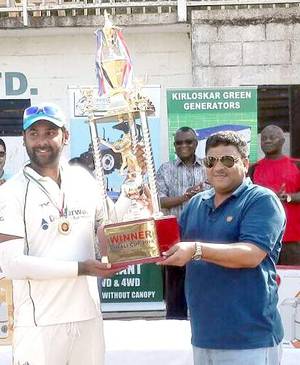
Narra Mahesh receiving a trophy from a Ghanaian cricket official at Accra.

Narra Mahesh literally eats, breathes and sleeps cricket and his irrefutable passion for the game brings him from Ghana to Vijayawada to play in the annual Power League organised by Krishna District Cricket Association.

In fact his club – Everest Cricket Club –won the Power League for three consecutive years and it is his club which introduced professionalism into city cricket by inducting Ranji Trophy players in their team for a price. In a low-scoring final, Everest CC defeated Royal in the final recently at Mulapadu.

Mr. Mahesh, who runs an import and export enterprise – MKNG Traders – at Accra, capital city of Ghana, is also busy developing cricket there by actively participating in local tournaments.

His club – Everest CC – won a couple of major leagues and tournaments in Ghana and it is backed by sponsors like Golden Dragon Casinos and Agarwal Eye Hospitals. “Three Ghanaian national players — David Ankara, Simon Ateeq and Vincent Ateeq — are in our team,” says Mahesh.

He says his club comprised players of Andhra Pradesh settled in Accra for several years. “The local leagues are fiercely competed there. Other communities such as Patels and Malayalis also have their own teams.” Many cricket buffs and administrators feel that the innovative step taken by Everest CC saw many other clubs packing their playing eleven with professional players.

Gets competitive

“Vijayawada’s Power League is no longer a run-off-the-mill competition. Following our footsteps other clubs are spending money to make their outfits competitive with quality players. For youngsters playing and against the experienced players it is a learning curve,” says Girish Varadharajan, who manages Everest Cricket Club at Accra.

Mr. Girish says the professionalism attracted the sponsors to the league. “Hotel Midcity, Chandana Brothers, Twills, Ramyam Intel and MKN Ventures have pitched in enthusiastically. We gave star hotel accommodation to all players and took care of all their travel needs.”

However, Mr. Mahesh wants the announcement of the Power League two months in advance so that clubs can take up their preparation. “Of late there is uncertainty over the league. A prior schedule will be helpful especially for a club which operating away from India.”

Mr. Mahesh came from Australia to Vijayawada, his native place, to hone his cricketing skills and graduate as a first class cricketer. His efforts paid off as gradually he went on play junior State teams and also in Butchi Babu Tournament. He was in the stand-bye in the Ranji Trophy team and unfortunately an injury brought an abrupt end to his fledging career.

source: http://www.thehindu.com / The Hindu / Home> News> Cities> Vijayawada / by J C Shridharan / Vijayawada – February 02nd, 2017

GIET students selected as Stanford varsity Innovation Fellows

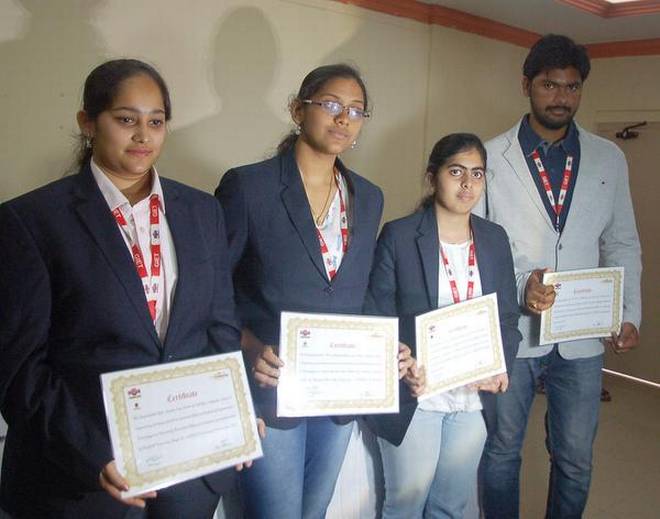
Achievers: The students selected for Stanford University Innovation Fellow programme with their certificates in Rajamahendravaram on Wednesday.

They will leave for U.S. on March 6 for a six-week programme

Three girls and a boy studying third year and second year engineering in the Godavari Institute of Engineering and Technology (GIET) have been selected for the Stanford University Innovation Fellows (UIF) programme. They are part of 224 students from 58 higher educational institutions from seven countries, who have been named University Innovation Fellows.

Rachana Parupudi (III ECE), Grushaker Sahani (III CSE), Sundari Jahnavi (II CSE) and M.V.S Sidhartha (III ECE) have been selected under the UIF programme and they are bound to leave for the U.S. on March 6 for a six-week programme.

Academic Dean Varaparasad said the programme empowers Fellows work to ensure that their peers gain the knowledge, skills and attitudes required to compete in the economy of the future.

Prof. Varaprasad said during the training, Fellows learn how to analyse their campus innovation and entrepreneurship ecosystems and understand the needs of stakeholders to uncover opportunities to enrich the educational opportunities for their peers.

He said that they became change agents and also co-designers of the education experience as they create better educational environment for others.

The the total training programme is 13 weeks and after completing first six weeks, the students will be called for one week and in last another six weeks training will be given to them.

The faculty of computer science and electronics gave online training with the support of team from Stanford to the students with the support of Google and AP State Skill Development Corporation. After competing globally, GIET students stood second and were selected to the UIF programme.

source: http://www.thehindu.com / The Hindu / Home> News> States> Andhra Pradesh / by Special Correspondent / Rajamahendravram / February 23rd, 2017

Lalith Babu all set for Moscow challenge

M. Lalith Babu | Photo Credit: CH_VIJAYA BHASKAR

Vijayawada  :

City-based chess Grandmaster Musunuri Lalith Babu (2593) needs just seven points to enter the coveted 2,600-mark which will enable him to join the illustrious club consisting of players like Adhiban, Sasikiran, Sethuraman and Abhijit Gupta.

To garner the elusive points, he will be travelling to Moscow to take part in the Aeroflot Grandmasters tournament from February 20 to March 3 which will feature the best of brains in the world of sixty-four squares.

After the end of the classic round on March 2, he will take part in the Aeroflot blitz tournament which will contain 18 rounds in which the world top 10 players will feature.

“This is one of the world’s strongest tournaments where a good number of Russian Grand Masters will take part along with top-notch players from Israel, China, Kazakhstan and Azerbaijan,” said Lalith who is working as the Grade 1 Officer in the Indian Oil Corporation in Vijayawada.

Last year, the Moscow sojourn was a forgettable one as he garnered just five points out of nine and finished 42nd in the final rating list. “The tourney assumes importance as the winner will qualify for the prestigious Dortmund Super Grandmaster tournament,” he added.

He said he was playing in ‘Group A’ where players above 2,550 would clash. “I am placed 78th among the 80 entries in the fray.”

He said he was not taking any online coaching this year as he could not afford the Bulgarian coach Vladimir Chuchelov who proved costly. “I am practising all alone.”

He said the tournament was not one to try experimental moves especially with the openings as the rivals were proficient with all sorts of openings. “I do not want to try new things and I wish to play solid chess,” said Lalith who finished fifth in the Delhi International Open that concluded recently.

He further said, “I wish to avoid complicating positions. I am also working out how not to fall in to the opening trap of the rival.”

Lalith Babu is spending the best part of his time improving his fitness as he needed seven hours of playing daily. “One needs to have lot of energy as it is gruelling event,” he added.

source: http://www.thehindu.com / The Hindu / Home> News> State> Andhra Pradesh / by J.R. Sridharan / February 18th, 2017

ISRO launches 104 satellites in one go, creates history

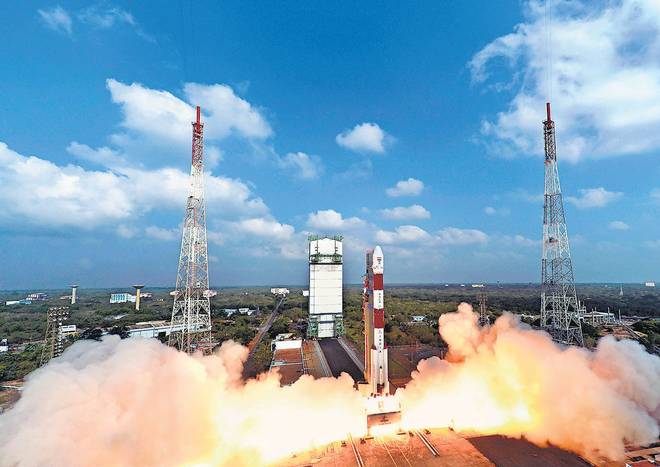
RECORD HAUL: The PSLV-C37 blasting off from the Satish Dhawan Space Centre in Sriharikota with 104 satellites on Wednesday.   | Photo Credit: PTI
RECORD HAUL: The PSLV-C37 blasting off from the Satish Dhawan Space Centre in Sriharikota with 104 satellites on Wednesday. | Photo Credit: PTI

These include the country’s earth observation satellite Cartosat-2 series.

India, a one-rocket fledgling in space transportation compared to its European and U.S. counterparts, created launch history on Wednesday by placing a record 104 spacecraft in their desired orbits.

The feat was performed on the old reliable launch vehicle, the PSLV, numbered C-37, which took off from the first launch pad at the Satish Dhawan Space Centre, Sriharikota, at 9.28 a.m.

Precise launch

C-37 was a largely commercial flight as all but three passenger satellites, small nanosats, belonged to six other countries. The 29-minute launch went off precisely as planned; it took just 11 minutes from the release of the primary Cartosat-2 series spacecraft to the last launch of a client satellite, ISRO said after the mega-payload launch.

The PSLV, in the category of launch vehicles that can lift relatively light loads to space, now marks 38 successful missions in a row out of a total of 39 flights.

This time, it took to space a total of 1,378 kg, of which the primary satellite was 714 kg.

The latest Cartosat is the fifth in the series of six Cartosat-2 spacecraft, starting from Cartosat 2 in 2007 and followed by what were earlier marked A, B, C, D and E. The last one is due.

“After a flight of 16 minutes and 48 seconds, the satellites achieved a polar Sun synchronous orbit of 506 km inclined at an angle of 97.46 degrees to the equator — very close to the intended orbit. In the next 12 minutes, all 104 satellites successfully separated from the PSLV fourth stage in a predetermined sequence, beginning with the Cartosat-2 series, INS-1 and INS-2,” an official communique said.

ISRO’s workhorse lives up to its billing

The PSLV, which created launch history on Wednesday by placing a record 104 spacecraft in their desired orbits, has totally launched 46 Indian spacecraft, most of them Indian Remote Sensing (IRS) satellites.

As many as 180 small satellites of foreign customers contracted by ISRO’s commercial company Antrix Corporation have also reached space on this vehicle.

This time, it took to space a total of 1,378 kg, of which the primary satellite was 714 kg.

The latest Cartosat is the fifth in the series of six Cartosat-2 spacecraft, starting from Cartosat 2 in 2007 and followed by what were earlier marked A, B, C, D and E. The last one is due.

“After a flight of 16 minutes and 48 seconds, the satellites achieved a polar Sun synchronous orbit of 506 km inclined at an angle of 97.46 degrees to the equator — very close to the intended orbit. In the next 12 minutes, all 104 satellites successfully separated from the PSLV fourth stage in a predetermined sequence, beginning with the Cartosat-2 series, INS-1 and INS-2,” an official communique said.

The PSLV, 39 flights old since 1993, also launched the Indian Moon mission Chandrayaan-1 in 2008; and is set to launch a private lunar mission for Bengaluru start-up Team Indus in late December this year.

“It is confirmed that all 104 satellites have been successfully deployed in the orbit,” PTI quoted PSLV Project Director B. Jayakumar at the Vikram Sarabhai Space Centre (VSSC) as saying.

“After separation, the two solar arrays of Cartosat-2 series satellite were deployed automatically and ISRO Telemetry, Tracking and Command Network (ISTRAC) at Bengaluru took over the control of the satellite,” the space agency said.

In the coming days, the satellite will be brought to its final operational configuration.

source: http://www.thehindu.com / The Hindu / Home> News> National / by Special Correpondent / Bengaluru – February 15th, 2017

The forgotten history of Sunkarimetta Church

Sunkarimetta :

It’s impossible to miss sighting a beautiful hilltop church around 108 kilometres from the city on the Vizag-Araku route. Tourists travelling to Araku usually get down to have a look at the scenic church of Sunkarimetta. Especially during Christmas and New Year, the otherwise tranquil church comes alive with prayer services and hundreds of visitors. But not many know the historic and geographic significance of this building that dates back to the 1930s.

The Sunkarimetta Baptist Church, located exactly 12 kilometres from Araku and Ananthagiri, is situated at an altitude of 4,236 feet above sea level. It is considered the highest point of the Eastern Ghats in Visakhapatnam District. Associated with the rajas of Jeypore, it was also from this church that Christianity first started spreading in the Agency areas in the first half of the 20th century.

The three-and-a-half-acre land for the construction of the only church in this area was given by Maharaja Vikramadeo of Jeypore, Odisha, to the Samantha rajas – the Burudi and Karthika families – who were one of the first converts in the region. Built in the backdrop of the Second World War, it was constructed between 1936 and 1939 by the British who were confident of a victory in the world war by defeating the Axis Powers. The chief engineer of Vizag-Araku Road was also instrumental in building the church. The church was designed by Canadian architect Ralph Edward Smith.

Speaking about its history, executive committee member of the church Karthik Raj Kiran said, “There’s not much recorded history about this church though it is the only church in this area catering to about 5,000 members today. In those days, it was a tax collection point. Built in the Gothic style of architecture, no sand was used for construction of the church but it was built using lime mortar and local rocks powdered by bullocks. Some of the seats in the church existing today dates back to the 1940s. The painted glass decoration inside the church is gift from retired Andhra University professor Ratna Raju. It can accommodate around 100 people at a time inside. On Sunday mornings and during Christian festivals, the church gets crowded.”

The church has remained intact in its original form for around 80 years. The bell tower is the only addition that was made nearly a decade ago. Since the hilltop church renders a beautiful view of the scenic surroundings of green valleys and cultivated fields, distant grey-blue hills and winding roads of the Eastern Ghats, shootings of Telugu films have also taken place in its premises.

source: http://www.timesofindia.indiatimes.com / The Times of India / News> City News> Visakhapatnam News / by Sulogna Mehta / December 18th, 2016

In Bapu’s footsteps

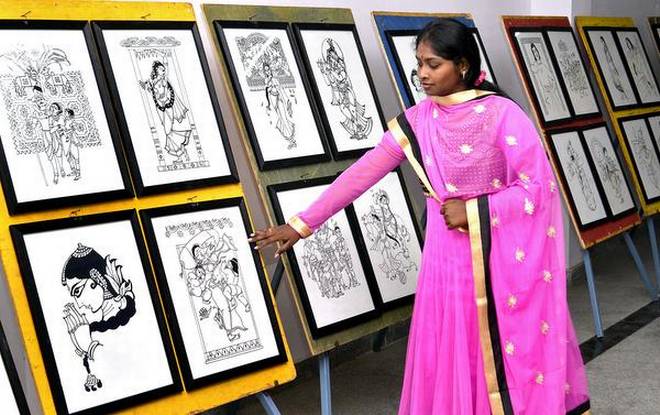
G. Nirmala Tejasri explaining her drawings exhibited at Bapu museum, in Vijayawada on Thursday. | Photo Credit: V_RAJU.

Satthiraju Lakshmi Narayana, popular as Bapu, introduced a style of painting of simple bright colours. His unique style consisted of economy of strokes, freehand drawing and a lack of background clutter.

It was this uniqueness of his art that fascinated Goddeti Nirmala Tejasri, an engineering graduate nurturing art as a passion, and she began to replicate the maestro’s illustrations using only black pen.

Replicas of Bapu bommalu dotted the auditorium on the premises of Bapu Musum on Bandar Road as part of ‘Bapu Chitra Kala Pradarsana’ on Thursday.

“Bapu focussed on Hindu mythological characters. I have done the same but without using any colour,” she explains pointing to the 300-odd illustrations exhibited in a neat row in the auditorium. “I share my birthday with Bapu, and that perhaps is the pull factor,” she says letting out a smile.

The illustrations include Radha enamoured by Krishna while he is playing the flute, Yashoda trying to put a playful Krishna to sleep, and of course myriad moods and postures of achcha Teluginti ammayi. The big eyes, a sharp nose, curvaceous waist and sensual body structure are all intact in the portrayals.

Father being an artist, Ms. Tejasri says she has inherited his talent. Besides participating in various art contests, she has achieved a unique feat and won recognition from the Limca Book of Records. When she was in 10th class, she took to calligraphy and wrote the entire Quran on a 999-ft-long single sheet of paper in a span of two months. In intermediate first year, she repeated the feat and wrote the entire Bhagawad Gita on an 899-ft single sheet and the next year, she wrote Bible on a 999-ft-long sheet of paper. “It was my small attempt to bring down religious barriers,” she explains.

Besides Limca Record Book, her feat has been acknowledged by several other record-registering organisations like India Book of Records, World Amazing Records, Telugu Book of Records and Global World Record. “Of the 16 such existing organisations, 12 have recognised my feat and I plan to apply for remaining four,” she says.

Tejasri has her next plan in place already. “I intend to visit Araku valley, spend time with the tribal people there and capture their lifestyle in my paintings,” she says.

Tejasri is not a trained artist and it is her innate talent that reflects in her works. She wants to crack civils and serve the society. “But art will always remain an important part of my life,” she declares.

source: http://www.thehindu.com / The Hindu / Home> News> States> Andhra Pradesh / Vijayawada – December 15th, 2016

Most knee implants are suitable for whites: Expert

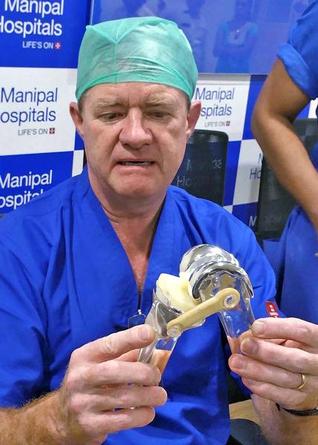
South Africa based knee replacement specialist Rob McLennan Smith explaining the differences in the knees of Asians and Caucasians in Vijayawada on Friday.

Dr. Smith says the lifestyle of Asians makes special demands on the knee joints

Most of the commercially available totally knee arthoplasty (TKA) implants are designed according to the anthropometrics (measurement of human individuals) of Caucasian (white) people, but the knees of the Asian races are different said South African based knee and hip replacement expert Rob McLennan Smith. Using such implants was causing problems for Asians and Indians also, he said.

Talking to The Hindu, Dr Smith, who came to supervise the knee joint replacement using the Anthem Global knee which catered to racial anthropometric differences at the Manipal Hospitals here on Friday, said that the ‘lower extremity’ (technical name) of the thigh bone (femur) was comparatively narrow in Asians and so was the ‘upper extremity’ of the tibia (shin bone).

The sizes of the thigh and shin bones of African and Afro-American were similar to that of the Caucasians, he said.

With suitable implants recipients were able to bend their knees by an additional 15 degrees, Dr Smith said.

The lifestyles and religious practices of Asians made special demands on the knee joints.

People had to sit on their hunches or with their legs crossed to offer prayers and unless suitable implants were used there would be pain and complications, Dr Smith said.

Dr Smith said efforts were being made to reduce the cost of knee replacement procedures.

Seven to eight trays of instruments have to be sanitised and that cost of sanitising itself was huge, he said.

The number of instruments used in the global knee system was also less, he added.

Dr Smith is currently the president of the South Africa Arthroplasty Association.

Manipal Hospitals knee replacement specialists Nallamothu Jagadeesh said that knee replacement using Anthem system had been done today for the first time in the Telugu States.

Clinical services chief Manoj Kumar was present.

source: http://www.thehindu.com / The Hindu / Home> News> Cities> Vijayawada / Special Correspondent / Vijayawada – November 12th, 2016

With love, from Venice to Vijayawada

venetianwomanandhra11nov2016

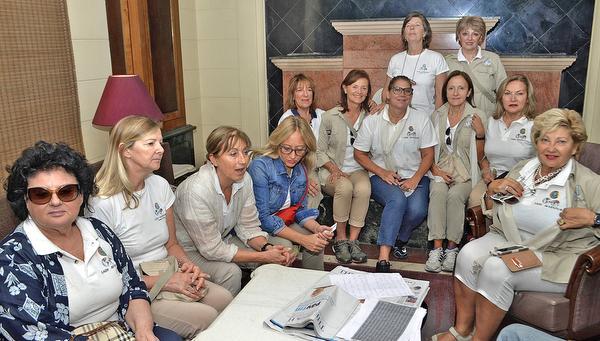
12 Venetian women sponsoring children of an NGO in Vijayawada visit to connect thoughtful links

In the sixteenth century, Niccolo de’ Conti, an explorer from the Republic of Venice, visited India. He found that the words in the Telugu language end with vowels just like those in Italian and referred to the language as the ‘Italian of the East’. The phrase has stuck ever since and is used whenever Telugu is praised. Vijayawada has been the heartland for Telugu from time immemorial, and has become even more so after the bifurcation of the State of Andhra Pradesh.

Many candidates contesting elections from Vijayawada have promised in their manifestoes that they will transform the city, which stands on the banks of the Krishna river and has two canals transecting it, into a Venice, where citizens can sail the waterways in modern gondolas. The incumbent State government has also promised to make Amaravati, the new waterfront capital, a sort of Venice in which boats will be an important mode of transport.

A group of 12 women travellers from the Venetian town of Pordenone visited Vijayawada as if to renew and strengthen the ancient ties between the two regions. Though their journey to Vijayawada is not as arduous as that of de’ Conti, it is nevertheless an “exploration”.

Calling themselves the ‘Lady Avventura’, the women came to spend time with children they have ‘adopted’, that is, they are ‘sponsors’ providing funds for underprivileged children’s food, education and healthcare via the Care and Share Charitable Trust, a non-governmental organisation (NGO) that receives most of its funding from hundreds of Italian sponsors. Several of the children are orphans and over 400 of them are HIV positive. “But for the funds we receive from Italy, these children from the poorest of poor homes would have succumbed to disease,” says Care and Share’s regional director Swati Mohanty.

Members of two working women’s groups — Panathlon International and FIDAPA (Federazione Italiana Donne Arti Professioni Affari) — formed the Lady Avventura group to travel to different countries and reach out to underprivileged children and women. Romanina Santin Nardini, who belongs to both Panathlon and FIDAPA, says that Lady Avventura, which is just three years old, has already made three trips. Beginning with countries in Africa, members went to Sri Lanka the following year, and to Vijayawada this time, drawn by their longstanding connection with the children at Care and Share.

Silvia Gramigna, one of the women, said she had come to Vijayawada more than once. She had been associated with Care and Share for over 20 years, she said, introducing a young man now working for the State Bank of India as her “adopted son”. All other members of Lady Avventura had adopted children in Vijayawada, she said, pointing to the youngsters in tow.

Promise to return

The dozen women spent all of Wednesday with children of different institutions under Care and Share, distributing small gifts and knick-knacks to them. “Giving away the knick-knacks gave us great joy, but we came to see how things were under the new management of Care and Share,” said Ms. Gramigna, referring to the recent change of guard at the NGO. She promised the group would go back to Italy and raise more funds for the children.

source: http://www.thehindu.com / The Hindu / Home> News> Cities> Vijayawada / G. Venkataramana Rao / Vijayawada – November 11th, 2016

AP conservationist wins Disney award

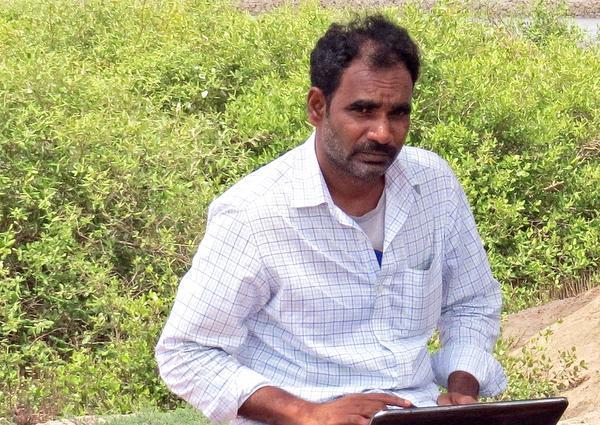
A Appa Rao won the Disney Conservation Hero Award for his contribution in restoration of Krishna mangroves.

Andhra University alumnus Allaparthi Appa Rao of Repalle village in Guntur district won the Disney Conservation Hero-2016 award for his contribution in the restoration of Krishna mangroves.

The mangrove cover including the Krishna Wildlife Sanctuary is a safe haven for Fishing Cat (Prionailurus viverrinus) and smooth-coated otter.

The California-based Wildlife Conservation Network has documented the efforts of Mr. Appa Rao in restoration of the mangroves and nominated him for the Disney Conservation Hero -2016 award.

The Disney Conservation Fund has announced 15 Disney Conservation Heroes globally, including Mr. Appa Rao, for 2016.

“We are impressed by your use of innovation mangrove restoration techniques to reforest mangroves and dedication to educate people in local villages about the importance of Fishing Cats and their mangrove habitat,” wrote Claire Martin of the Disney Conservation Fund in his communication to Mr. Appa Rao.

The Fund honours conservationists who have gone above and beyond demonstrating passion, courage, and tenacity in tackling some of the biggest challenges in protecting the planet’s resources.

“I believe that the global recognition of being Disney Conservation Hero will help in conservation of the mangrove cover in Krishna and Guntur districts as Fishing Cat, smooth-coated otter and other wildlife species are thriving in the mangrove cover,” Mr. Appa Rao told The Hindu .

Mr. Rao was instrumental in documenting the presence of Fishing Cat in the Krishna Wildlife Sanctuary. As coordinator of the village-level Ecology Development Committees active in Krishna and Guntur districts under the Wildlife Wing of the Forest Department, Mr. Rao has been working with local communities in restoration of the mangrove cover since 2003.

“I cherish to spend my days in the mangroves forest. It always fascinates me with diverse life of wildlife. Documentation of smooth-coated otter in the mangroves and study on Fishing Cat became key aspects of my routine life in the mangroves,”added Mr. Appa Rao.

He manages a treasure trove of archives on the wildlife present in the Krishna Wildlife Sanctuary and the rest of the mangrove cover.

The California-based Wildlife Conservation Network has documented the efforts of Appa Rao in restoration of the mangroves.

source: http://www.thehindu.com / The Hindu / Home> National> Andhra Pradesh / by T. Appala Naidu / Machilipatname – November 09th, 2016