Category Archives: Records, All

A reunion to cherish

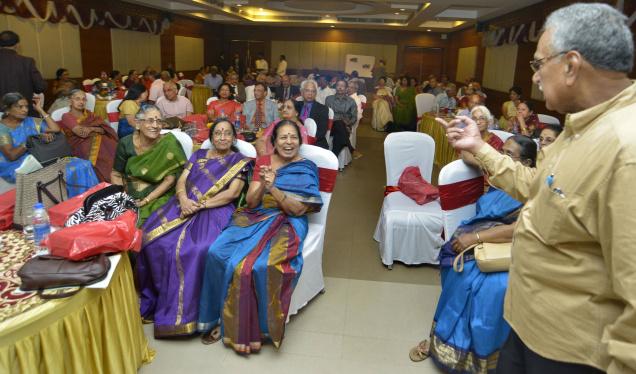
Graduates of Andhra Medical College’s 1959-64 batch recollecting their college days at a reunion in the city on Saturday. / Photo: K. R. Deepak / The Hindu

The 1959 batch of doctors of AMC has a gala time

They are all in their mid-seventies and have held important positions which earned them fame and name. Now most of them are enjoying their retired life. Some of them are still active, practising their profession and providing consultation when needed.

They belong to the 1959 batch of MBBS of Andhra Medical College and are meeting up with their old buddies at a reunion at a star hotel in the city on Saturday. It brought back memories of golden days of college life. The whole day they laughed and generally enjoyed the get-together. They called each other by first names and recalled the fun and happiness they enjoyed during college days.

Spade work

The reunion was planned and organised by Vyakaranam Atchuta Rama Rao, a retired consultant psychiatrist who has settled in the UK some 40 years ago, Prayaga M.M. Krishna, who settled in the city after working in Norway for 25 years as consultant anaesthetist, a leading medical practitioner of Anakapalle and former governor of Lions Club G. Subhram, and others. There were 120 students in that class and 35 of them had passed away. Among the rest, 60 attended the reunion, 40 of them with spouses. One of them N. Gajananda Rao, has done computer-aided medicine course in AIIMS after doing general medicine, and established the Indian Association for Medical Informatics. “We are all feeling happy to meet again. Actually this is the third reunion. We had the first one in 2000. We are recollecting the mischief we have done during our college days, the boys teasing girls and vice-versa,” said the 75-year-old doctor. “We are thoroughly enjoying the reunion. We are not sure of meeting again,” said former HoD of Microbiology of AMC Leela Kumari. Her classmate K. Kamamma came from Sompeta for the programme. A general physician of the city G.V. Krishna Rao said the reunion was a golden opportunity to meet everyone in the class. The former students felicitated their teachers who were in their nineties or thereabouts, such as neurosurgeon S. Bala Parameswara Rao, Prof. K. Somasundaram (physiology), Prof. A.V.S.S. Rama Rao (biochemistry), Prof. Nirmala Kumari (pharmacology), and Dr. S. Srinivasa Reddy (paediatric surgery).

source: http://www. thehindu.com / The Hindu / Home> News> Cities> Visakhapatnam / by Special Correspondent / Visakhapatnam – January 19th, 2014

Lecturer develops low-cost defluoridation of drinking water

Andhra Loyola College chemistry senior grade lecturer Y.Hanumantha Rao / The Hindu

Could this be the answer to the problem of excess fluorine in drinking water? The method developed by Andhra Loyola College (ALC) chemistry senior grade lecturer Y.Hanumantha Rao has worked very effectively at the laboratory-level and is comparatively low cost. But he felt more research should be done to translate the work he has done in the laboratory to the field. He has been teaching at the ALC for over two decades and decided to do some research to help people.

Mr Hanumantha Rao said that he had analysed drinking water from 24 villages in Kandukur mandal of Prakasam district. While the range of fluorine in potable water should be between 0.05 parts per million (ppm) and 1.50 ppm, the level of fluorine in these villages was between 1.50 ppm and 4 ppm.

Using three kinds of “bio-waste” available locally — sorakaya (snake gourd), Tummakaya (prosopis) and Jammu (thick grass) — for developing activated carbon that removes 90 per cent of the fluorine by the process of adsorption, a process that is different from absorption. The fluorine gets physically and chemically bonded to the activated carbon and the water becomes potable.

The bio-waste had to be incinerated in a muffle furnace to 700º centigrade until it was reduced to powder. The powder was then washed with concentrated Nitric Acid to be “activated”. This was comparatively cheaper then the activated alumina that was being used for defluoridation, he said. The activated carbon had to be washed with an alkaline solution to reactivate it from time to time, Mr Hanumantha Rao said.

When he submitted his research work to the Acharya Nagarjuna University for review he was granted a Ph.D., Mr Hanumantha Rao said.

source: http://www.thehindu.com / The Hindu / Home> News> Cities> Vijayawada / by Special Correspondent / Vijayawada – January 19th, 2014

Torch bearers for millet seed security

The National Biodiversity Authority has recognised 30 villages in Zaheerabad of Medak district of Andhra Pradesh that grow traditional and fast-disappearing millets as Agricultural Biodiversity Heritage Site (ABHS).   
 The Andhra Pradesh State Biodiversity Board (APSBB), which finally gave green signal for the rare recognition, has sent its recommendation to the National Biodiversity Board, which has approved the proposal making these villages to become first villages in India to be recognized as ABHS.“The file is now with the agricultural department. By the end of January we will announce these villages as ABHS with or without their opinion,” a determined APSBB Chairman Dr R Hampaiah says. Thus, the dryland villages in four mandals and the 5,000-strong women farmers of the Deccan Development Society (DDS) that grow only “forgotten millets” without fertilisers or pesticides will join the list of 27 such other sites around that world by February.

“Nowhere in the world 60 different varieties are cultivated in 30,000 acres and the seeds are distributed among women farmers, assuring food safety and saving the environment,” says Dr SN Jadhav, Member Secretary, APSBB.

The 500-year-old banyan tree in Pillamarri tree spread on three acres of land in Mahbubnagar district and the rare forest on Tirumala hills are the other two sites in Andhra Pradesh that have such special recognition.

In fact, a few months ago, three members from the Board—Anisetty Murthy, Ashok Kumar and Hampaiah– had visited the farms to see the amazing agricultural biodiversity that was being conserved and propagated by the women of DDS.

The announcement added vigour to the 15th edition of biodiversity festival in Algole, a small village in Zaheerabad mandal in Medak district, from where a month-long bullock cart caravan yatra begins and tours 70 villages in all the four mandals of the heritage site, encouraging people to adopt forgotten crops.

“We are now trying introduce the concept in 18 other states in the country. The DDS even had its impact in Africa, where women  are trying to take back farming from the hands of commercial organisations,” added DDS Director PV Sateesh.

While agriculture in other parts of the country was in doldrums, the sangham farmers were completely self-reliant as far as food, seeds and farming are concerned. When farmers elsewhere were facing the indignity of having to stand in long queues to access government supplied seeds, women of the DDS were staking their claim to the elusive mantle of food sovereignty.

Women of the DDS also succeeded in drawing the attention of the government to the need for including millets in government food programmes like PDS, the mid-day meal scheme and so on; the spate of orders asking for the inclusion of millets in these schemes is a testimony to the extent of success of the women of the DDS.

Some women farmers of the DDS also can handle the latest version of digital camera, the daily narrow cast of the Sangham FM radio and help save bio-diversity by cultivating forgotten millet crops with equal élan. Women camera operators of the Community Media Trust (CMT), probably the only such media house in the country, can handle, shoot, edit and produce short films without any outside help.

The initial toil and success of women was then presented to the outside world through photos and then videos. Then came the launch of the CMT, which has been winning several laurels for its amazing media work over the last decade.

The CMT runs a women’s video collective (WVC) and the first-ever community radio of India called Sangham Radio. While the WVC has been functioning since 1996, the Sangham Radio took up Narrowcasting since 1998 and has been on the air since October 2008,  broadcasting two hours every day. Both these outfits are managed entirely by women from farming communities.

Chinna Narsamma, a small farmer who made a film “Community Conquers Hunger”, said that the sanghams were the first group in India to have started 100 days of employment for the poor, which preceded MGNREGA by 20 years.

Summer employment    

Through this employment programme which they called summer employment, they brought over 5,000 acres of near fallow lands under cultivation, produced more than a million days of employment in 30 villages in 10 years and started producing over 20 million kg food every year. This was the first step in abandoning hunger in their sanghams.

Zaheerabad Punyamma added that the sanghams started leasing lands and launched collective farming groups on these leased lands and produced additional food for their families.

In two decades, the sanghams have leased more than 1,000 acres of land and produced over half a million kg of food for their groups. Dandu Swaroopamma, a community filmmaker and a member of the DDS Food Sovereignty Trust said that the sanghams have brought over 4,500 acres of cultivable fallows under cultivation and produce nearly a million kg or more food every year.

They have done poverty mapping of their villages and identified over 10,000 families as recipients of their jowar-based millet rations.  Each family has received a ration card through which they can draw between 10-25 kg of jowar every month depending on their poverty status. The jowar is sold at 25 per cent of the market price to the identified poor.

Begari Laxmamma, a community filmmaker and a community seed keeper, pointed out that all these villages have their own community seed banks from which any farmer can borrow nearly 50-80 seed varieties.   Thousands of women in these villages have their own household seed banks and never depend upon outside seeds. Thus these villages have become seed sovereign.

Thammali Manjula, filmmaker and a coordinator of the Community Food Sovereignty programme, says “Our films have nothing dramatic but depict our lives and it’s about how we conquered hunger.”

J B S Umanadh in Hyderabad

source: http://www.deccanherald.com / Deccan Herald / Home> Special Features / by JBS Umanadh in Hyderabad / January 19th, 2014
Andhra Pradesh tops in CAT

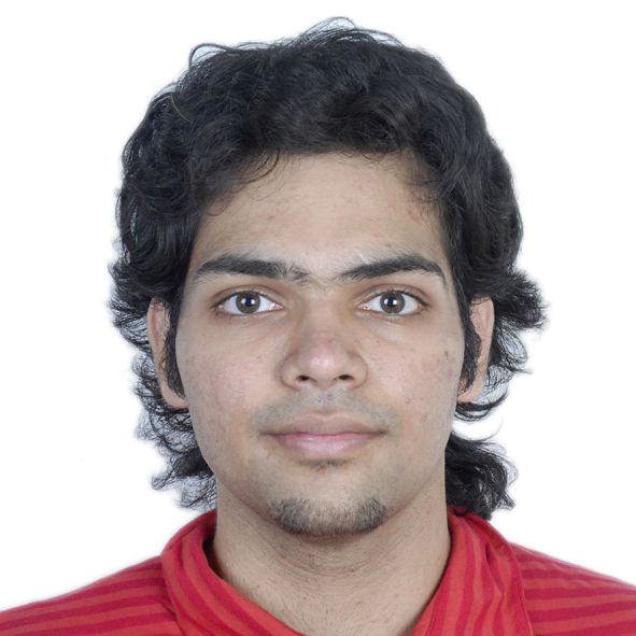
Krishna Pillutla
Krishna Pillutla

After series of good performances in the national level tests in engineering and medical courses students from the State have made a mark in the Common Admission Test (CAT) conducted for admission into IIMs and top business schools in the country.

This year, perhaps the first-time ever, three students from the State scored a perfect 100 percentile figuring among eight such students across the country. It’s an achievement in the sense that State students aren’t as crazy for management courses as they are for engineering and medical courses.

Engineering background

An interesting aspect among these toppers is that they are all from engineering backgrounds and have already proved themselves at various levels. It’s a natural progress from IITs to IIMs these days as a combination of engineering from an IIT and management from IIM is considered a potent weapon for students to market themselves in the national and international arena. These achievers are no different.

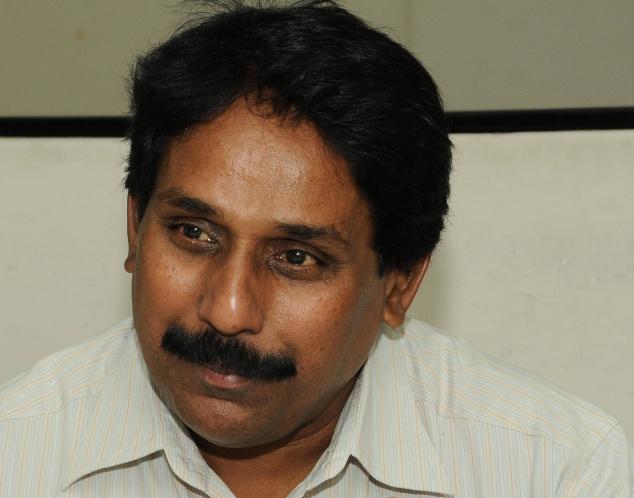
The three toppers from the State, include Krishna Pillutla, Imaneni Kumar Karthik and Siva Surya Teja. Krishna Pillutla, a final year computer science student at IIT-Bombay hails from Trimulgherry in Secunderabad. With his score, Krishna will get a call from all the IIMs, but he prefers to study at IIM-Ahmedabad.

Twenty-four year-old Siva Surya Teja, who secured a perfect 100 percentile is from a small town Samalkot near Kakinada. After graduating from JNTU Anantapur, he joined the Infosys in Hyderabad three years ago. He secured the top score in the fourth attempt. In his second and third attempts, he scored 99 and 96 percentile respectively and aimed at getting the top score this time.

Another 100 percentile, Imaneni Kumar Karthik hails from Vijayawada and secured his B.Tech and M.Tech dual degree from IIT Kharagpur. He is employed with Oracle in Hyderabad as of now.

These achievers are from the TIME group that trains IIM aspirants. In fact, one of the toppers, Krishna is the son of P. Vishwanath Director of TIME group.

Commenting on the toppers, Mr. Vishwanath says that most students from the State prefer to move abroad for MS or a job in a good company. “May be such toppers are now focussing on CAT too,” he says. “The placements at IIMs also matter in students’ preference to write CAT.”

source : http://www.thehindu.com / The Hindu / Home> Features> Education Plus / by R. Ravikanth Reddy / January 19th, 2014

19 antelopes released into Ananthagiri

Hyderabad / Vikarabad :

Picturesque Ananthagiri hill-forest, located only 5 km from Vikarabad, received 19 antelopes on Sunday. Senior officials, chief secretary P K Mohanty, DGP B Prasada Rao and principal chief conservator of forest BSS Reddy were present at the hill resort, 75 km from Hyderabad, to release the animals in the reserve forest. They let into the forest 14 spotted deer – females and 6 males – that were brought from Hyderabad’s Nehru Zoological Park. At the same time, 5 blackbucks – three females and two males – brought from Tirupati’s Sri Venkateswara Zoological Park were also released.

“There are no blackbucks in Ananthagiri reserve forest. This is the first time they are being introduced to the area which is rich in grassland and deciduous forest,” Ramana Reddy, chief conservator of forest, Hyderabad Range, told TOI.

The officials led by A Joseph, chief wildlife warden, gathered at the forest guest house atop Ananthagiri hill overseeing the Haritha Hotel of AP Tourism Development Corporation. They were later taken deep into the forest for releasing the animals.

The reserve forest block is spread over 1,505 hectares, which is chiefly grassland. Its existing wildlife mainly comprises spotted deer (chital), chowsingha, nilgai, wild boar and peacocks etc. “The nilgai had disappeared from the area about five decades ago. It was sighted a few years back again. Now, they are seen roaming in the forest in large groups,” Joseph said.

B S S Reddy said that Ananthagiri RF was chosen for releasing the animals as the department considers it to be the best area close to Hyderabad. “There is resurgence of herbivorous animals in Ananthagiri and its surroundings,” he said.

Ananthagiri forest block is one of the series of RFs in Manneguda and Vikarabad that connects up to Tandore and beyond. They cover a stretch of 20 km and are spread over 6,124 hectares. Except for the wolves and wild dogs, there are no predators in the forest.

source: http://www.articles.timesofindia.indiatimes.com / The Times of India / Home> City> Hyderabad> Animals / TNN / January 20th, 2014

Nonagenarian keeps Gondi language alive

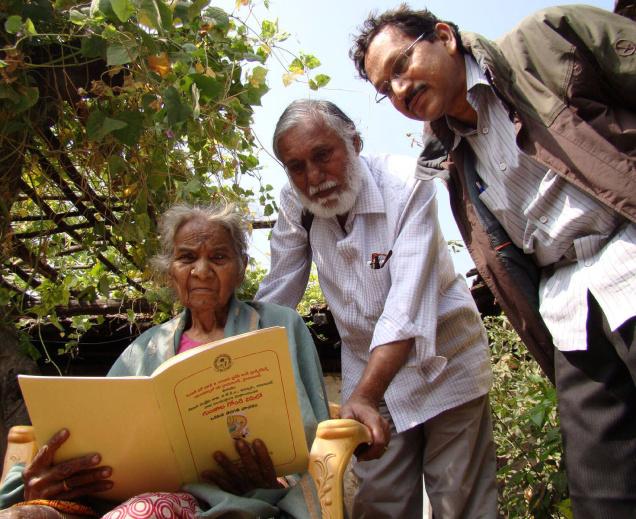
Worth preserving:Professors Jayadheer Tirumal Rao (left) and V. Krishna, University of Hyderabad, watch as Atram Kamalabai reads from a Gondi primer at Gunjala in Adilabad district on Saturday. / Photo: Harpal Singh / The Hindu

Kamakabai, the oldest woman literate in the community, has taught her son and granddaughter the language

Atram Kamalabai, the Gond from Gunjala village in Narnoor mandal of Adilabad district, has a good reason to feel elated as she has been receiving unexpected attention from her compatriots as well as people from ‘outside’ even at the ripe age of 95 years. She is perhaps the oldest woman literate, functional literate to be precise, in the adivasi community having learnt Gondi alphabet and numerals some nine decades ago.

A chance discovery of some manuscripts written in the almost-extinct Gondi script in this sleepy village in 2011 brought her all the attention needed from language aficionados. She has now become a role model as well as a driving force for those who have taken up the task of propagating the ancient script especially within Gondi community.

“My father taught me Gondi at the age of five which helped me assess correctly the quantum of produce in our farm and any transaction thereof. I used Gondi in day-to-day life,” recalls Kamalabai.

“It’s a matter of pride to know your own language,” she observes, as an afterthought. “That’s why I taught Gondi to my son Mohpat Rao and granddaughter Annapurna,” she adds.

“This is a rare occasion in adivasi ethos in the country that three generations in the same family are able to read Gondi script. Kamalabai has stuck to tradition by passing on her knowledge to the future generations,” points out Professor Jayadheer Tirumal Rao, retired Director of the A.P. Government Oriental Manuscripts Library and Research Centre and visiting Professor at the Centre for Dalit and Adivasi Studies and Translation (CDAST), University of Hyderabad, who called on the nonagenarian at her home on Saturday. He, along with CDAST coordinator Professor V. Krishna and Dr. G. Manoja of Palamuru University are currently involved in translation of the Gondi manuscripts found in Gunjala. “Research on Gondi script could lead to deciphering of proto-Dravidian languages,” Professor Jayadheer Tirumal Rao opines.

source: http://www.thehindu.com / The Hindu / Home> News> National> Andhra Pradesh / by S. Harpal Singh / Gunjala (Adilabad District) – January 19th, 2014

NIMS Plans Hospital Information System

Nizam’s Institute of Medical Sciences (NIMS) here is set to become the first government hospital in the state with an established Hospital Information System (HIS). Though the discussions on HIS have been going on for the last five years, the cash-strapped hospital is finally set to begin the process of HIS from January 26.

While private hospitals across the country have a well established Hospital Information System (HIS), government hospitals do not. At least, no government hospital in Andhra Pradesh is equipped with HIS. This, senior doctors say, is due to their keenness to hide corruption and make transparency difficult in administration.

The HIS is a comprehensive, integrated information system designed to manage all the aspects of a hospital operations, such as medical, administrative, financial, legal and the corresponding service processing. This, officials at NIMS say, will be a significant step towards bringing  transparency in the hospital that lacked financial and administrative discipline.

According to them, it had become extremely difficult in tracking down files regarding purchases, material management, patient management, lab investigation and online reporting, records maintenance, etc at NIMS.

A deal was recently struck with the government agency CDAC for installation of the system in the hospital. It is learnt that the same form of systems would be extended by the state government in other government hospitals too.

Speaking about the new integrated system, NIMS director Dr L Narendranath said, ‘’We plan to make it fully operational in a year. The state government will pay for the software and NIMS for the hardware and customisation of software. The process will take place department by department,” he said.

The new system, estimated at Rs 15 crore, is meant to plug all the loopholes in revenue losses, provide better monitoring and efficient healthcare. ‘’All machines will be interfaced with computers. The minute one sample goes into the machine, all the details and reports relating to that will be available on the computer which can be accessed centrally. This would save all the paper work and the manpower used in different stages of data entry could be better utilised,” said an official.

source: http://www.newindianexpress.com / The New Indian Express / Home> Cities> Hyderabad / by Rahul S. Pisharody  – Hyderabad / January 18th, 2014

Zesty Zareen lands gold in Serbia

Hyderabad :

After Mary Kom’s fabulous effort in London Olympics, yet another woman boxer from India did the country proud.

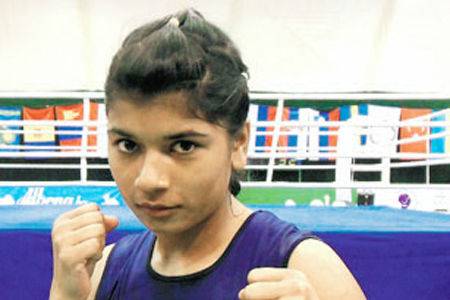
Nikhat Zareen, the 17-year-old Andhra Pradesh pugilist, won a gold medal in the third Nations Cup International Boxing Tournament in Novi Sad, Serbia.

She defeated Paltceva Ekaterina of Russia 3-0 in the 51kg final to follow up on her success in the Youth World Boxing Championship in Bulgaria in September, when she had finished runner-up.

(Nikhat Zareen defeated…)

Such was Nikhat’s mastery that none of her opponents logged a point against the Indian in the knockout rounds. Nikhat blanked Abdi Malika of Algeria 3-0 in the quarterfinals and Ballentine of the Netherlands 5-0 in the semifinals.

The pre-quarterfinals was no different as she defeated a Russian 3-0. “I’m happy,” was Nikhat’s first reaction when she called her parents to confirm the good news.

“It was an easy bout but the achievement is yet to sink in,” Nikhat told her sister.

It was Nikhat’s father, Jameel Ahmed, a real estate businessman in Nizamabad, who noticed the spark in her and enlisted her in athletics when she was 12.

During her brief stint as an athlete, she caught the eye of Dronacharya boxing coach I Venkateswara Rao of Visakhapatnam.

She joined Rao at the Sports Authority of India (SAI) training centre in Visakhapatnam. And the rest, as they say, is history. Within a year, she was declared the `golden best boxer’ at the Erode Nationals in 2010.

She went on to clinch gold in the flyweight division at the AIBA Women’s Junior and Youth World Championship in Turkey in 2011.

The bright young talent from the state is now targeting a gold at the Youth Olympics to be held in China. “My goal is to win gold at the Youth Olympics and qualify for the 2016 Olympics,” she told TOI.

Considering the progress she’s made in quick time, and her steely determination, it will be no surprise if Nikhat gets more laurels to the country.

source: http://www.articles.timesofindia.indiatimes.com / The Times of India / Home> Sports> Boxing> London Olympiancs / by M. Ratnakar, TNN / January 13th, 2014

Police Launch Apps to Help Women

The State police have introduced a new device called ‘RAKSHITA APPS’ to help women in distress/trouble/danger, according to DGP Prasada Rao.

The police chief who visited Mahabubnagar and Kurnool districts on Saturday on an foundation laying/ inauguration spree, told newsmen that any woman in distress/trouble/danger could just dial 119 and seek help from police.

The call would be passed on to the police station/ set-up through the ‘RAKSHITA APPS’ so that the police could rush to the trouble spot and rescue the woman. The DGP said that due to better awareness among the women now about the Nirbhaya Act more cases under the Act were being registered in the State.

Referring to the increasing number of highway accidents in the two districts, the DGP said that that most of these accidents were occurring due to over-speeding and rash driving. He said that to curb the accidents, speed-recording gauges would be installed at the tollgates to check the speed of the vehicles between one tollgate and another.

Answering newsmen’s questions on the Palem bus blaze incident, Prasada Rao said that there was only a single driver in the ill-fated bus on that day. He also ruled out any possibility of sabotage in the blaze.

source: http://www.newindianexpress.com / The New Indian Express / Home> Cities> Hyderabad / by Express News Service – Mahbubnagar/Kurnool / January 12th, 2014

Narahari nails his colours to the mast

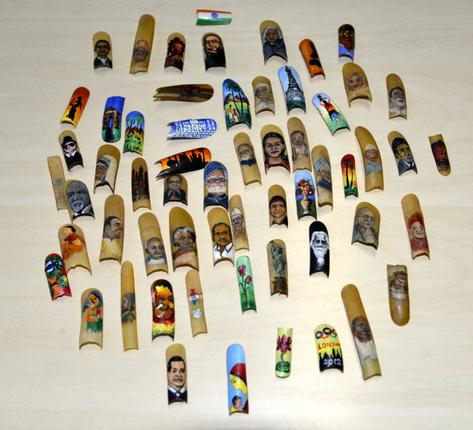
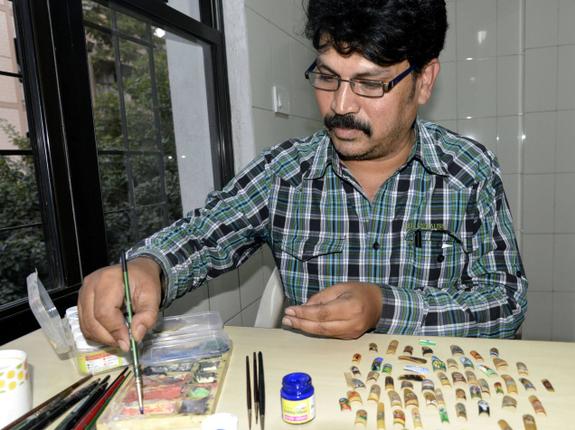
M. Narahari's collection of painted nails./  Photo: K. Ramesh Babu / The Hindu
M. Narahari’s collection of painted nails./ Photo: K. Ramesh Babu / The Hindu

The artist is the proud owner of a jewellery box which has nails of all colours, painted and preserved over the last 23 years

M. Narahari cannot afford to bite his nails. For this artist from the city, fingernails amount to a treasure. In a jewellery box he carries around, one finds nails of all ‘colours’, painted and preserved over the last 23 years.

Dabbed with more hues than can be imagined on their diminutive surfaces, the fingernails sport not only simple depictions such as the national flag, but also carry intricate portraits of national leaders. Adorning the nails in oil and acrylic are distinguished personalities such as Ambedkar, Mother Teresa, Sarvepalli Radhakrishnan, Mahatma Gandhi, Rabindranath Tagore and Pranab Mukherjee.

“I got the idea when I was just about 20 years old. I began to grow the nails of my thumb and little finger, and suddenly it occurred to me that I could paint on them. Thus began my hobby,” the Fine Arts graduate recalls. Soon, he decided to paint on his own nails and become the first to do so to get into the Guinness Book of World Records.

M. Narahari at work during a demonstration at The Hindu office in Hyderabad on Friday. - Photo: K. Ramesh Babu / The Hindu
M. Narahari at work during a demonstration at The Hindu office in Hyderabad on Friday. – Photo: K. Ramesh Babu / The Hindu

Narahari, who also teaches art at a private school, allows the nails on his left hand to grow for up to two years. So far, he has stored away 85 well-grown nails, besides painting most of them. Apart from portraits, he has also depicted vivid sceneries and monuments such as the Eiffel Tower, Taj Mahal and the Charminar on nails.

Though he also paints larger canvasses, nail care has become an integral part of his life – be it positioning the arm while asleep or changing the grip so as not to break the nails.

“I refrain from hard work, too. Sometimes cracks do develop on nails, but I glue them up quickly. I take calcium tablets once or twice a month, so that the nails grow strong.”

For now, he is trying hard to find place in the India Book of Records. The Guinness Book will have to wait till he finishes a hundred.

source: http://www.thehindu.com / The Hindu / Home> News> Cities> Hyderabad / by Swathi V. / Hyderabad – January 04th, 2014