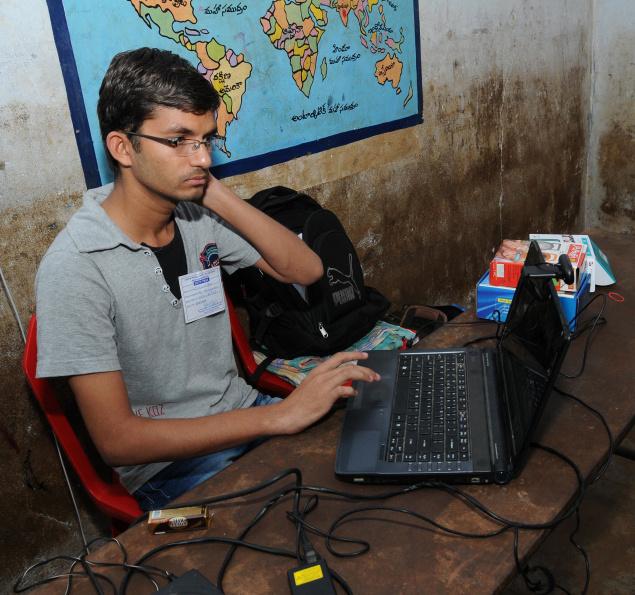
A file photo of a student webcasting the poll proceedings during the panchayat elections held in Krishna district. / The Hindu
The students will cover nearly 5,000 polling booths in Telangana and Seemandhra region during the general elections
As many as 3,000 students of the Rajiv Gandhi University of Knowledge Technologies (RGUKT) have been roped in for the Assembly and Lok Sabha polls due on April 30 and May 7, in Telangana and Seemandhra region respectively.
The students will be at the polling booths to webcast or live stream the poll proceedings in various districts. Students deputed to Telangana districts moved for poll duty on April 29.
Students of the Nuzvid International Institute of Information Technology (IIIT) have been webcasting the election proceedings in sensitive polling stations for the last few years. They were roped in for the by-elections and the panchayat polls last year.
Speaking to The Hindu on Tuesday, Nuzvid IIIT Director Ibrahim Khan said that Collectors of Krishna, Guntur, West Godavari, Nalgonda and Khammam districts had sent requisitions asking to depute students for webcasting of the general elections. “Election officers of other districts too asked to send our students webcasting, but we will depute the students as per the availability of strength,” he said, adding that the students would cover nearly 5,000 booths in Telangana and Seemandhra region.
“We are deputing students to Khammam, Guntur, Krishna and West Godavari districts. This will certainly be a good experience for them,” said Prof. Khan.
Strict vigil
“In addition to the IIIT students, we asked some private universities and institutions to depute their students for webcasting so that the poll officials can observe the election proceedings from the district collectorates and State Election Commission in Hyderabad live,” said the election officers.
“I took part in the webcasting for panchayat elections last year. It is a good system to keep a close watch on trouble mongers, arrest rigging and conduct elections peacefully,” said a third year engineering student P. Sharat.
source: http://www.thehindu.com / The Hindu / Home> News> Cities / by Rajulapudi Srinivas / Vijayawada – April 30th, 2014
Varre Aditya Vardhan of the Narayana Srichaitanya Junior College, Visakhapatnam, Andhra Pradesh, secured the first rank in the VIT Engineering Entrance Examination (VITEEE) 2014, conducted by VIT University, Vellore, last month for admission to 3,500 seats in 13 B.Tech. programmes on its Vellore campus and 500 seats in five B.Tech. programmes on the Chennai campus.
According to a VIT release, 1,84,483 candidates took the test across 112 Indian cities and in Dubai from April 9 to 20. Releasing the results on Thursday, G. Viswanathan, VIT Chancellor, said students from Andhra Pradesh, Jharkhand, Mumbai, Shimla and Ahmedabad bagged the first 10 ranks. Mayank Sharan from Jharkhand secured the second rank“Our admission is merit-based, being based on the marks secured by the candidates in the entrance examination which we conduct,” he said.
Counselling for admissions would be held on May 19 for ranks up to 8,000, on May 20 (for ranks 8,001 to 12,000), on May 21 (ranks 12,001 to 16,000) and on May 22 (16,001 to 20,000). Counselling would be held at the Vellore and Chennai campuses.
source: http://www.thehindu.com / The Hindu / Home> News> National> Tamil Nadu / by Special Correspondent / Vellore – May 01st, 2014
Books restored from different Asaf Jahi dynasties are in the Chowmahallah Palace library./ Photos: Nagara Gopal / The Hindu
The Mehtab Mahal library at Chowmahalla Palace throws open a treasure trove from the Nizam’s era
The Nizams, it turns out, had an eye for everything exquisite. From the jewellery they wore to the silks that adorned their wardrobe, the cars they rode in, and the cuisine they partook, everything simply spelt royalty. While these indicate their lavish lifestyle, their interest in books and literature is less known.
Throwing light on their urge to discover and relate to the world around is the Royal Library in Chowmahalla Palace; its collection of books includes The Life of Samuel Johnson, History of Don Quixote, John F Kennedy – Portrait of a President, Glimpses of India,The Princes of India and an array of Encyclopaedias and much more .
Situated in the Mehtab Mahal of the Chowmahalla, the Royal Library houses more than 10,000 books and “is a haven for researchers and book lovers.”
The library that was thrown open to book lovers last year has been digitized recently, not only to help book lovers but also ensure safety of the royal treasure.
The idea of the library is to protect and preserve the valuable collection of the Asaf Jahi kings. The collection mostly belonged to the Mir Mahboob Ali Khan (VI Nizam), Mir Osman Ali Khan (VII Nizam) and Nizam Mukarram Jah. The books have been sourced from different Asaf Jahi palaces like the Nazri Bagh, Chiran Palace and Chowmahalla to be housed in the Royal Library here.
The books thus collected were sorted and segregated into various categories.
Books restored from different Asaf Jahi dynasties are in the Chowmahallah Palace library. / The Hindu
“A lot of work went into making them ready to be put in the cases for readers to read them in the library. Various professionals worked to clean, bind and make the books fit for reading. We have applied all preservation techniques, including fumigation, to protect the books,” informs G. Kishan Rao. He adds, “The collection of books range from history, literature, poetry, philosophy, geography, culture and religion. This library also houses the exclusive collection of Qurans by the Nizams which was inaugurated recently.” A few books also hint at the Nizam’s passion to learn languages. The number of English books is close to 3000, followed by Urdu, Persian and Arabic.
“There is also a good number of Persian manuscripts containing the firmans issued by the Asaf Jahis as well as several volumes of Mir Osman Ali Khan’s poetry,” informs the librarian. Qurans of different sizes are in the process of being restored and will find place in the library after that.
source: http://www.thehindu.com / The Hindu / Home> Features> MetroPlus / by Prabalika M. Borah / Hyderabad – April 25th, 2014
Burgula Narsing Rao. / Photo: G. Ramakrishna / The Hindu
From pelting stones at the cops to hiding under Nayapul bridge, rocks were an integral part of Hyderabad’s history, says Burgula Narsing Rao
“In all Indian agitations, stones are very important!” laughs Burgula Narsing Rao. In one of the most riveting conversations we have had in our research for the documentary on the rocks and Hyderabad, he describes why he, an eminent Hyderabadi senior citizen, once threw stones!
His ancestral village is Burgula, 68km from Hyderabad. He served as its Sarpanch from 1976 to 1995. A student leader and freedom fighter himself, he has the regions’ political movements committed to a memory that is razor-sharp even at 84. I will recount here just one part of a dense, personally annotated account of the region.
To transition from the Nizam’s government, during the gap between joining the Indian Union in 1948 and the democratically elected state government of 1952, a parallel bureaucracy with officers from outside the state was brought into Hyderabad. Andhra was still a part of Madras presidency then, so Andhra officers came from there. There was simmering discontent with this Andhra bureaucracy that, in September 1952, broke out on the streets in the form of the Mulki/Non-Mulki agitation.
“It started from Warangal. I was President of Nizam College Students Union. We also called for agitation. We were not parochial and did not favour slogans like “Andhras go back”. We wanted Mulkis to be given preference in employment. We wanted officers who came after Police Action to be repatriated to their native states. We wanted education and employment opportunities.”
On September 3rd, students of City College came out agitating, were fired upon and 3 persons were killed. Students added the immediate demand, that the government hand over the bodies, to earlier demands.
On 3rd evening when Narsing Rao went home, there were summons from the Chief Minister. “I woke up Bharat Vajpayee (Secretary of Arts College Union) and took him along. Almost the entire cabinet was there and very disturbed. I reiterated that they had to hand over the bodies. My uncle, Chief Minister Burgula Ramakrishna Rao, became very emotional and promised to do so.”
Next day, September 4th about 20,000 people gathered at Osmania Hospital. “There were emotional speeches. Trouble erupted. I saw armed police all over: at the hospital, across the Nayapul Bridge (made of stone masonry, after the terrible 1908 Musi flood, under Mehboob Ali Khan’s rule). Police started firing and people scattered. We went under the bridge for protection, emerged to throw stones we found there at the police, went back under it for protection.”
“All schools, colleges were closed for one month curfew. We regrouped and demanded an inquiry into firing. The Government responded with an inquiry and the outsiders being repatriated.”
“But the one month turmoil shook the government. Nehru and Maulana Azad came to Hyderabad. At the Fateh Maidan public meeting, Nehru assured us about our demands. Next day he addressed students at Nizam College grounds: a 45-minute class on the meaning of democracy. As Chairman of the Action Committee and President of the Students Union, I was on the dais and began a vote of thanks, ‘Thanks Panditji for your advice and guidance, we will try and restore normalcy…’, when I suddenly found myself being lifted up high. It was Nehru! There are many Hyderabadis around the world, who were there that day, who still remind me of that! My mike had failed, the audience could not hear and was restive. Nehru simply lifted me and put me onto the other mike! It was one of the most exciting moments of my life.”
“Seriously though, the Telangana agitation against denial of opportunity to the Telangana people began there: in the 1952 student movement.”
Narsing Rao had a book-worthy amount of invaluable information to share. There is space here for just so much. Clearly though, those were times of passionate action for socio- political justice. Inspiring times! Somewhere in all this excitement, the stone masonry of Naya-Pul culled from our rocks gave young agitating students shelter and a means of self defence. Our rocks have been sentinels in our history and enduring protectors. They are as inspiringly strong and remarkable as the history of our region. Etched in various ways into memories of our city, they must be protected in our current development in order to remain unique markers of our city’s human and physical geography.
(The writer is a documentary filmmaker, writer and teacher.)
source: http://www.thehindu.com / The Hindu / Home> Features> MetroPlus> Rockspace / by Uma Magal / Hyderabad – April 24th, 2014
Siva Sivani Institute of Management was nominated for the Indian B-School Awards – MBA by Choice, and amidst high competition has been the proud winner of two prestigious awards – B-School Intellectual Capital Award and B-School Learned Faculty Award.
Having won several other prestigious awards in the past, these two new awards are added feathers in SSIM’s cap. The awards mark a spectacular period of change for the institution, representing genuinely remarkable progress towards achieving a set of transformational objectives.
The awards recognize the institution’s endeavour to take noteworthy steps towards its ambition of being a truly international quality business school. Welcoming the award, SSIM’s leaders feel that they are honoured to receive this accolade and it certifies all the hard work from the dedicated staff and students.
SSIM is fast moving towards being the best B-School in India with the collective success of the staff and students. The awards are a significant acknowledgment of SSIM’s focus on striving to offer quality education, research and student experience, and improving student employability.
source: http://www.smetimes.in / SME Times / Home> PR Newswire / April 24th, 2014
Expressing fears and doubts regarding what the bifurcation of the state will bring for heritage sites across Andhra Pradesh, the Indian National Trust for Art and Cultural Heritage (INTACH) has demanded a heritage audit to be conducted on all historically valuable buildings and artifacts to ascertain the damage done and recommend steps to be taken for division of cultural assets post-bifurcation.
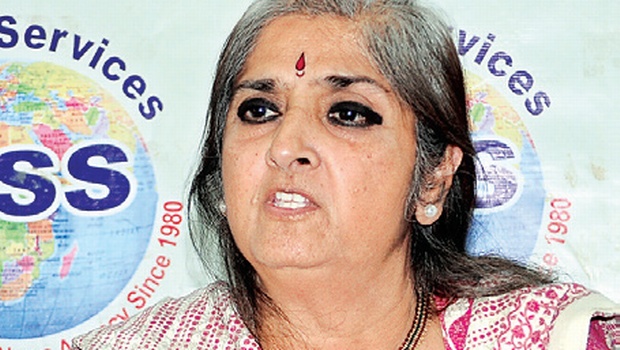
Addressing a press conference here on Tuesday, convener of the Hyderabad chapter of INTACH P Anuradha Reddy said this audit must be conducted with the involvement of the Department of Archeology of Andhra Pradesh. ‘’The audit will help in determining the basis on which these artifacts will be divided,’’ she said.
The creation of the Telangana state, the convener feels, will do more harm to monuments, historically significant buildings and culturally important artifacts than the last 66 years have done.
Citing the example of the old Andhra Pradesh Legislative Assembly built in 1913, she said that the building will be renovated and this will destroy its identity as an important cultural landmark of Hyderabad.
‘’The old Assembly has not been given the official status of a heritage site because it makes it easier to destroy it because there will be less resistance from the people’s bodies,’’ she felt.
Anuradha Reddy, along with co-convener, Sajad Sahid, pointed out that no committee has been set up to look into the repercussions of bifurcation on heritage sites.
Bringing to light an alarmingly true trend, Anuradha Reddy said that no political party has mentioned the protection of historic sites and culturally significant artifacts in their manifestos.
source: http://www.newindianexpress.com / The New Indian Express / Home> Cities> Hyderabad / by Express News Service – Hyderabad / April 23rd, 2014
The Hyderabad based Global Hospital has made a record by registering more than 300 successful liver transplant surgeries in the country.
With the 300th liver transplant conducted successful on a Nellore based patient, doctors at Global hospital celebrated their success commemorating the World liver day on 18th April 2014.
According to Dr. K Ravindranath, chairman and managing director Global Hospital Group, lack of awareness and drastic lifestyle changes are some of the major reasons that are pushing the liver related disorders to endemic proportions in India. At present the country is home to 11 per cent of the world’s patients affected with chronic Hepatitis B and about one to two lakh people die due to liver cancer or cirrhosis in the country. “It is estimated that about 0.02 per cent of population i.e., about 25000 persons need liver transplants every year. The need of the hour is to remove the myths and increase awareness about organ donation among public,” said Dr. K. Ravindranath.
So far, the Global Hospital Group has conducted a total of 600 liver transplantation surgeries at its four centers viz., Hyderabad, Bangalore, Chennai and Mumbai across India. Among all the centers Hyderabad Global Hospital has reached the record of performing 300 successful liver transplant surgeries in the country.
Dr. Tom Cherian, who is a leading liver transplant surgeon at Global hospitals, opined that detecting the liver disease at early stage will help avoid liver transplant. The cost of liver transplant ranges from 18 lakh to 25 lakh depending up on the complexity of disease. Though the state government had initiated cadaver donation schemes like Jeevandan, it is lacking adequate infrastructure facilities and fund crunch.
The major reason for liver disorders and liver cancer in India is attributed to smoking, hypertension and drinking alcohol. Doctors expressed concern as there is huge rise in the number of paediatric liver cases. Children with end stage liver disease have a very short and miserable life. “Children with liver transplant can lead normal lives and become adults. But it is unfortunate that paediatric liver transplantation services are limited in India,” Informed Dr. Tom
Acute liver failure is another rising concern among the healthy population these days. It strikes young people in their prime. High fever, jaundice and unconsciousness are the major symptoms of acute liver failure. This disorder has high mortality rate with 70-80 per cent chance of death if not treated properly.
The doctors also viewed that in India, the cadaver donor rate is only 0.3 per cent and only 800-900 transplant surgeries are happening in the country annually, while in western countries like USA and UK, annually 5000 to 6000 organ transplant surgeries are conducted. For India to reach that stage the cadaver donation rate should at least reach 3 per cent so that it will facilitate doctors to perform organ transplant surgeries to 18000 to 25000 patients annually without having to wait for the donor.
source: http://www.pharmabiz.com / Pharmabiz.com / Home> Top News> Hospitals & Clinics / by Pharmabiz.com Bureau – Hyderabad / Tuesday – April 27th, 2014
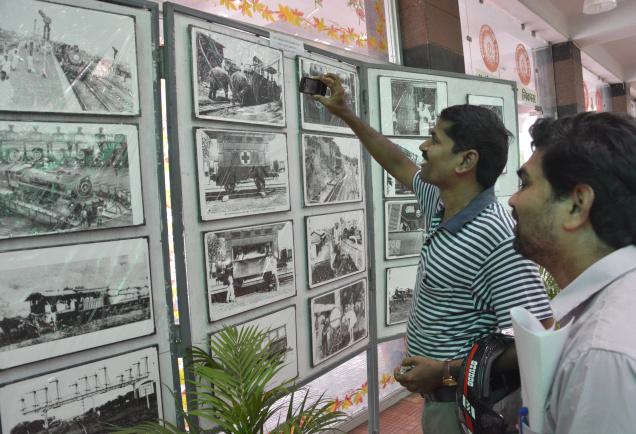
A visitor records the exhibits on his mobile at the exhibition organised as part of the Railway Week celebrations, in Visakhapatnam on Wednesday. / Photo: C.V. SUBRAHMANYAM / The Hindu
It was a trip down memory lane for some of the visitors as they went through old photographs and stamps on locomotives, rail bridges, and our national leaders like Mahatma Gandhi, Lal Bahadur Sastry, and Jawaharlal Nehru travelling in trains.
The exhibition was organised by the Waltair Division of East Coast Railway as part of the 59 Railway Week celebrations here on Tuesday and Wednesday.
There were stamps issued on Howrah, Chennai, Mumbai CST, and Old Delhi stations with the imposing vintage buildings, the BNR locomotive, built by the North British Locomotive Company, introduced by BNR in 1913. It was continued till 1921 for heavy shunting and coal traffic.
Later in the evening, cultural programmes were organised by the Personnel Branch of Waltair Division as part of the celebrations.
In his inaugural address, Divisional Railway Manager Anil Kumar listed the achievements of the Division during the financial year 2013-2014.
The Division achieved an originating loading of 52.56 MT, thereby becoming one of the few divisions in the country which had an originating loading in excess of 50 MT. On the passenger front, the originating traffic increased to 33.80 million, which was 3 per cent more than the previous year, and passenger earnings increased to Rs.366.51 crore, which was 17 per cent higher than the previous year. The Division has earned the highest ever total earning of Rs.6,265.58 crore.
Mr. Anil Kumar spoke on the development works initiated at Visakhapatnam railway station like commissioning of escalators on platforms 2 and 3 and 4 and 5, and works on improvement of Gnanapuram-side to ease traffic congestion.
Additional DRM M.L. Meena, ECoRWWO president Anju Anil Kumar, and Divisional Personnel Officer B. Mondal were among those who attended.
source: http://www.thehindu.com / The Hindu / Home> Cities>Visakhapatnam / Special Correspondent / Visakhapatnam – April 16th, 2014
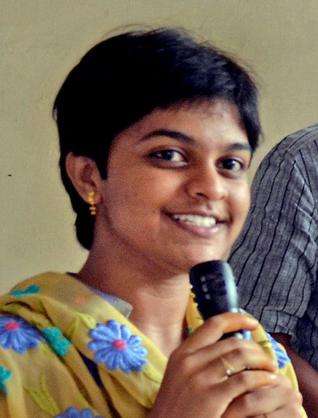
K Nikita who won the Leo of the Year award at a function in Visakhapatnam on Thursday
Being a civil engineering student doesn’t stop her to reach out to the deprived lot and serve society in the best possible manner.
It is this selfless attitude that made K. Nikita, III year student of Dr. L. Bullayya College, stand out from the crowd and win an international award ‘Leo of the Year 2012-2013’. As part of Leo Club Visakhapatnam Greater, a community-based youth wing of Lions Clubs International, Nikita got selected for her consistent effort serving diverse communities. Nikhita is the first person to win the award from the State and second in the country, says her father K.L.V. Krishna Rao.
Apart from being a brilliant student and an NCC cadet, Nikita has designed several projects that heighten the happiness quotient of the needy. “The club, involving 20 youngsters, provides me a platform to meet different people and understand their requirements. Visiting places such as Central Jail, Juvenile Home for Girls, old age homes and slum areas made me think beyond classrooms,” she says.
Community projects
Nikita feels creating tailor-made community projects provide an avenue to foster leadership qualities. She says, “service is contagious. It gives me immense pleasure when people benefit out of our programmes and spread the smile. The recent week-long workshop at the Central Jail saw inmates participating in a series of sports and quiz contests. I feel these people have been brushed aside by society due to varied reasons. And it is our responsibility to bring change in their lives.”
Drawing inspiration from her parents and team-mates, Nikita is confident about living her dream by utilising her time efficiently. Shuffling between studies and community work, according to her, is an art that one nurtures over a period of time. “Everything is time bound in life. It is important to plan your day. With so much to do in life, the art of living lies in enjoying what you do. And in the process, you will end up finding time for anything you want to do,” she adds.
source: http://www.thehindu.com / The Hindu / Home> National> Andhra Pradesh / by Rani Devalla / Visakhapatnam – January 31st, 2014
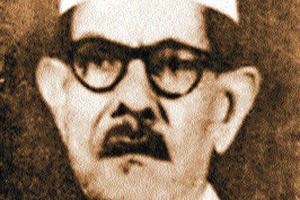
He played cricket and football for St Stephen’s Delhi with distinction. He did his masters in English as well as Arabic and he topped Punjab University in Persian. And if you are to name a saviour of the cave art of Ajanta and Ellora it is him: Ghulam Yazdani, a Padma Bhushan awardee as well as a recipient of OBE (Order of British Empire).
Remembering a titan of Hyderabad’s heritage
As the Archaeology Department of Andhra Pradesh marks its 100 years the coming Friday, it is time to remember the man who created the department out of nothing.
If Hyderabad has a vestige of its heritage left, it is thanks to him. Deputed to Hyderabad as a Superintendent in 1914, he brought with him his expertise, energy and accountability. Not for him the claptrap of archaeology department doing the job of cataloguing and executing conservation work, Yazdani was a hands on man who got a road laid between Hyderabad and Bidar to protect the Bahamani heritage of Bidar and also between Toli Masjid and Golconda.
A man of sharp wit, he dismisses the decorative motifs of Toli Masjid as: “The impression made by such buildings overloaded with decorations is like the impression left by the ostentatious and lavish display of personal adornment, generally favoured by lowly persons suddenly become rich.”
For the restoration of the Ellora cave art, he tried to get Luigi Cavenaghi, the man linked to restoration of Leonardo’s Last Supper, to work on the paintings. Unfortunately, he could get only Lorenzo Cecconi, who applied shellac on the paintings, ruining them further. Ghulam Yazdani published a series of photographs and reproductions of the cave art with his explanations.
And by the way, Ghulam Yazdani’s salary was ` 560 per month. And just recently, the Archeology Department found it fit to name its museum after YS Rajasekhara Reddy!
source: http://www.timesofindia.indiatimes.com / The Times of India / Home> Life & Style> People / by Serish Nanisetti, TNN / April 21st, 2014