Category Archives: Records, All

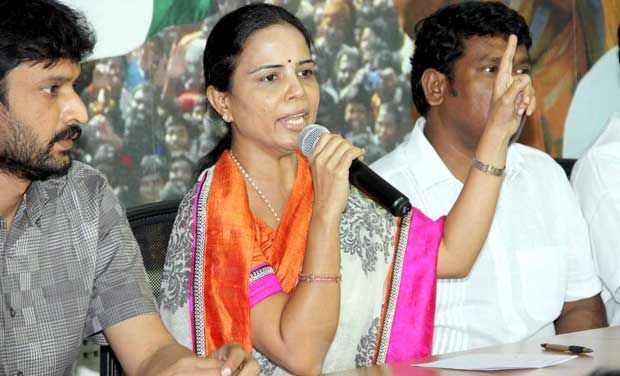
Shobha Nagi Reddy India’s 1st posthumous MLA

Shobha Nagi Reddy. (Photo: DC/File)

Hyderabad:

Deceased YSR Congress spokesperson, B. Shobha Nagi Reddy, became the first posthumously elected member to a Legislative Assembly in the country.

Ms Reddy won with a huge majority of more than 47,000 votes in an electorate of about 2 lakhs where there are more women voters than men.

Her majority this time is about 10,000 votes more than that she secured when she successfully contested the last time in the by-elections. A re-poll in the segment will now be held in the next few months to elect the next MLA. But, it is unclear as to who would contest on behalf of YSRC.
Riding on the sympathy wave, Ms Reddy’s husband and former MP, Bhuma Nagi Reddy, won from Nandyal, while her brother too tasted victory in Kurnool.

Ms Reddy had died in a road accident in April while coming back to the city, but the EC allowed her to remain in fray.

source: http://www.deccanchronicle.com / Deccan Chronicle / Home> Nation> Politics / by DC Correspondent / May 17th, 2014

The Ground Beneath her Feet

SUMMARY

Shantala Shivalingappa,a Kuchipudi dancer from Paris,on her art and winning a Bessie,the Oscars of dance.
____________________________________________________________________________________
In New York City,news of a promising performer spreads quickly. When Shantala Shivalingappa arrived there to dance at a festival in October 2012,more than 2,000 people were waiting in the hall. Among them were students,families and newspaper critics,who had heard of her past concerts in the city. The largely American audience was unaware of Kuchipudi,a classical dance form from Andhra Pradesh,or the story Shivalingappa was about to tell,a legend titled Shiva-Ganga.
Shivalingappa, 37, danced solo, alternating between Shiva, with his feet rooted to the ground and matted hair open to the wind,and Ganga, swaying towards earth with light, easy strides. “All I could think of was that an Indian dance form had managed to strike a chord with so many people in the hall,” says Shivalingappa. The dancer from Paris who is relatively unknown in India had taken another step in her effort to “take the dance form to the Western audience”.
That performance garnered Shivalingappa more than a host of new fans. A year later,in October 2013,  Shiva-Ganga won an award for Outstanding Performance at the New York Dance and Performance Awards,popularly called the Bessies,and known as the international dance world’s version of the Oscars. It was a first for Indian classical dance or for any South Asian dance form. In India the event went unnoticed. “It was an exciting experience because there are many dances nominated for the Bessies,from street dance to ballet to Western contemporary. The award for an Indian classical dance showed that art has no boundaries,” says Shivalingappa.
Shivalingappa says her story begins even before she was born. Her parents met in Paris as students and have lived there since 1967-68. Shivalingappa’s mother,Savitry Nair,was a Bharatanatyam dancer,and her father worked with Unesco. “I have no other city to compare the Paris of my childhood to,so I could be biased. Paris has a strong cultural tradition,with people visiting museums and musical evenings from a young age,” she says.

Their home was a meeting point for dancers,artists and performers. Among those who would drop by for a meal or an impromptu home concert was the German pioneer of dance-theatre,Pina Bausch,Maurice Bejart,a Swiss-French neo-ballet choreographer,vocalists Bhimsen Joshi and M Balamuralikrishna,and mandolin maestro U Shrinivas. “In 1985,Mandolin Shrinivas was to perform at a festival of India in Paris. Unlike the other artistes,he was very young,only 15. I was a child so I quite liked to listen to him play. It opened my heart to Carnatic music,” she says.

Shivalingappa began training in Bharatanatyam and began taking singing lessons from her mother when she was five years old. Unsurprisingly,these were just a part of life,like going to school. “Dance and music weren’t more special than anything else I was doing,” she says. Until one day,when her mother took Shivalingappa to the academy of her guru Vempati Chinna Sathyam in Chennai,to “learn a few kuchipudi steps for a project she was doing in London”. “The master’s son demonstrated the shiva tandava for me,and it was like nothing else I had known. I wanted nothing,other than to learn this dance form and share it with others. I thought,‘Everybody should know about Kuchipudi in the West. 

She turned to Sathyam to learn Kuchipudi,staying in Chennai for six months at a time. “There were endless hours of classes,steps,jatis and choreographies. My master’s style of Kuchipudi was a combination of strong and powerful footwork and graceful,full-of-curves upper body moves. The impact was not only intellectual; I felt it all through my body,” she says.

Shivalingappa didn’t need to be told that the secret to mastering a classical dance is “time,time and time”. “I had come from Bharatanatyam,so my posture was angular and geometrical,which was a good thing. Kuchipudi,however,is as much about crisp lines as fluidity and sway and this was very difficult for me,” she says. The coexistence of contrasts in Kuchipudi is also what attracted Shivalingappa — the balance between geometric precision and graceful curves. “I gave it all the time I could,learning at the academy from 9 am to 1 pm,then again from 5 pm to 7 pm,and putting in extra hours before,after and in between classes,” she says. She was 16 and dance occupied her every waking moment. ; “When I wasn’’t practising,I was observing the master and his senior disciples. I wasn’’t interested in anything else,” she says.

Since her teens,Shivalingappa had been performing for some of the biggest names in the international dance and theatre circuit. Peter Brook cast her as Miranda in in his adaptation of The Tempest (1990) and Ophelia in Hamlet (2000). Bausch featured her in a series of shows,such as O Dido (1999),Nefes (2003),Bamboo Blues (2007) and Solo (2007); and Bejart directed her dance solo,1789…et nous,for the bi-centenary celebrations of the French Revolution in 1989. Crowds and critics alike,woke up to the dusky Indian dancer with lyrical movements. Alastair Macaulay,chief dance critic of The New York Times,was among those impressed by Shivalingappa’s “witty charm”. “In many ways,my Western collaborations have nourished my Kuchipudi. My sense of how to use space,approach body language,isolate and refine every element in a dance and control the speed of various sequences,all these can be traced back to the Western artistes I worked with,” says Shivalingappa.

In time, Shivalingappa used her Western shows and her growing popularity with audiences to stage pure Kuchipudi shows in Paris,Venice,Madrid,Barcelona,New York,Seattle and San Francisco,among others. “The concerts would always be held in big theatres,rather than at Indian festivals and be of very high quality. That put Kuchipudi in a high arena,and I banked on the fact that if people liked what I was doing,they would give me a chance and open more doors,” she says.

Among her popular pieces are Gamaka (2007) inspired by Indian classical music and describing “the oscillation or vibration of sound between two musical notes”,Swayambhu (2010) in which “the dancer becomes an artisan-alchemist,who seeks the right combination of material to give rise to pure expression”,and Akasha (2013),from the Sanskrit word for sky or space.
Currently in Sydney,she is busy rehearsing with Australian choreographer Shaun Parker for a piece that will open at the Sydney Opera House on January 9. She is also looking forward to showcasing her solo work at the Park’s New Festival 2014 in the four metros,Bangalore and Hyderabad in August and September. “Though I was born in India,and have performed twice at Kalakshetra (a training and performance centre started by Rukmini Devi Arundale in Chennai),this will be the first major tour of my solo shows,” she says over the phone.
Shivalingappa often cites the example of Pt Ravi Shankar who took Indian music to foreign audiences and created a worldwide impact. She herself represents a small group of artistes who live abroad and have mastered an Indian art — thus expanding its definition. “Living away from India actually sharpens our senses to Indian elements and arts. For me,both the East and the West coexist in a performance,” she says.
source: http://www.indianexpress.com / The Indian Express / Home> News-Archive> Web / by  Dipanita Nath / January 05th, 2014

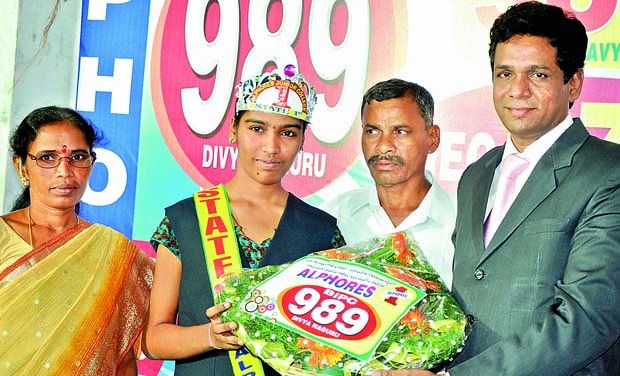
BPC ranker, daughter of mill worker

N. Divya (Photo: DC)

Karimnagar:

Daughter of a labourer, 18-year-old N. Divya, has secured first rank in the state in Intermediate II Year.

Divya, a student of Alphores Junior College of the city, scored 989 out of 1,000 in her Intermediate BiPC. Her father, Sattaiah, works in a Kollapur-based textile unit, while her mother, Laxmi, prepares bamboo fencings. Speaking to this newspaper, Divya said that she wanted to become a doctor and help the weaker sections.

source: http://www.deccanchronicle.com / Deccan Chronicle / Home> Nation> Current Affairs / by DC Correspondent / May 05th, 2014

Picture-perfect history

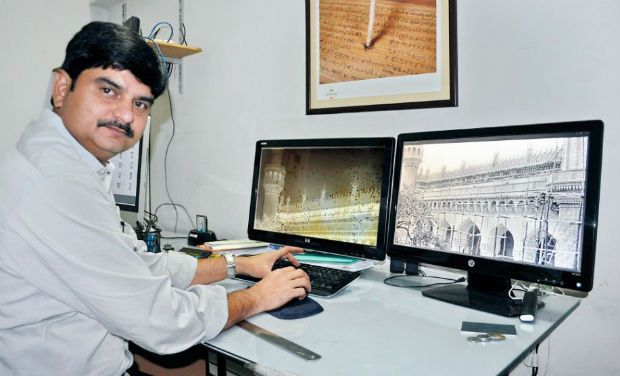
Paulus Raveendra Eduri shows how the photographs are digitised.

Hyderabad: 

Bruno Jehle arrived in India in 1983, “when India was still taking shape”. Soon after his arrival in Mumbai, the tall Swiss hopped on a train and embarked on a very long, 30-hour trip to what was then, the grand city of Madras.

“I remember the slums around Adyar. People looked at me and immediately assumed that I had lots of money and that I could help them out of their many problems. But I didn’t have a penny and yes, life in the slums was tough, demanding and challenging.”

But Jehle soon started helping out in a business selling eggs, dealt with thugs and made life-long friends. It is that very link with “that true India” that left an indelible mark, which was clearly evident during his meeting with the DC, where he explained what the Switzerland-based BJ Institute is doing in the bylanes of West Marredpally.

The Nizam’s photos

One of the founders of the institute, Jehle, a lithographer by trade, has over the past seven years, managed to train a small team of Hyderabadi photo specialists to restore and digitise some of the first photos taken of the city and beyond.

These photographs, dating back at least a 100 years, were taken by the Hyderabad Department of Archeology — a rag-tag bunch of photographers commissioned by the erstwhile Nizam’s government to shoot and document historical structures, artifacts and excavations across the dominion and the neighbouring regions. What the photographers did then, was the first ever photo survey of the region, taking over 60,000 photographs of structures ranging from the 1,000-pillar temple at Hanamkonda to the Ajanta Elora caves of Maharashtra.

The  photographs were stored as negatives, inside crates that piled from floor to roof. When the state of Andhra Pradesh was formed in 1956, the photos moved into the hands of the newly-designated Department of Archae-ology of Museums and the officials then moved the precious photos into a room, where they rested for 99 years, subject to heat, dust and the elements.

That’s until Jehle’s and his Indian partner Paulus Rave-endra Eduri pitched to the government that they had the means and motivation to restore and preserve the photographs, with a 300-year warranty.

Paint and polish

So in the October of 2012 began the task of sorting and cataloguing the thousands of photo negatives. An entire ‘clean room’ was built from the ground up, equipment was brought in, personnel were hired, documents were signed and a small, tight team, along with representatives from the government, went to work.

“We had to guard the room against natural light, clean it up and then take photos of the negatives. But then we knew what the challenges were and this was not the job where we could’ve cut corners,” said Eduri.

The final product is stunning. Printed on the choicest of paper, the collection of restored photographs offer a never-seen-before insight of the monuments and people from an era that’s mandatory study for several experts. The photographs show clothing, modes of transport, trade, layouts of towns and much more.

“This is what I want people to see. Our small team in Hyderabad has managed to bring out the life and times of a forgotten people,” adds Jehle.

And in that little house in West Marredpally is also where the Indo-Swiss collaboration has come full circle. In 1948, just after India’s Indepen-dence, the nation’s leading lights had sent out a sort of SOS to the Swiss government, asking for help in infrastructure development. Jehle and Eduri’s work then is the coming together of a 65-year-old idea, an initiative… that is finally taking form in Hyderabad.

source: http://www.deccanchronicle.com / Deccan Chronicle / Home> Nation> Current Affairs / DC /  by Govind Vijaykumar / December 15th, 2014

Bhainsa girl gets UGC scholarship

BhaisnaGirlHF14may2014

Kadam Manoranjana, a MSc Botany student of Satavahana University, Karimnagar, has bagged the UGC sponsored prestigious Indira Gandhi National Scholarship for Women at Post Graduate level.

She belongs to Hasgul village in Bhainsa mandal of Adilabad district and was congratulated by University Registrar B. Bhadraiah, University Science college principal Dr. V. Namratha, Head of Department Dr. N. Venu Madhav and Faculty member Dr. E.N. Murthy.

source: http://www.thehindu.com / The Hindu / Home> News> National> Andhra Pradesh / by Special Correspondent / Adilabad – May 04th, 2014

With a score of 355 out of 360, Andhra student tops JEE

Hyderabad :

Andhra Pradesh again bagged the top position in the country in the JEE (Main) exam, with Pramod Vakacharla scoring 355 of a total 360. Last year too, 16-year-old M Viswa Virinchi, a resident of Kukatpally in city, secured the first rank with 345 marks.

In second position this year were Mohammad Akram Khan, also from Andhra Pradesh and Krishlay Raj from Jharkhand at 350. While Vakacharla hails from Sullurapeta in Nellore district, Khan’s family is from Adilabad district but now lives in Kothagudem. Incidentally, both are classmates at Narayana Sri Chaitanya IIT Academy, Vijayawada, and bagged nearly the same score in their Intermediate exams. Both want to enroll in the computer science engineering course in IIT-Bombay.

“I was confident of a good score but was pleasantly surprised to hear I that I had bagged the top spot. I would like to pursue computer science engineering at the Indian Institute of Technology in Mumbai,” said 17-year-old Pramod.

K Vinod Reddy studying at Hanmakonda secured 3rd position along with some others scoring 345.

While most top scorers were boys, girls too made their presence felt. “I had to put in about eight hours of study to score well. I’d love to study computer science at one of the IITs and then work for Isro,” said Manisha Bandi who hails from Pulivendula in Kadapa district.

The cut-off for the entrance test to the Indian Institutes of Technology is a tad higher this year, at 115 for general category candidates compared to 113 last year. For OBC candidates, it stands at 74, compared to 70 in 2013, at 53 for scheduled caste students and 47 for scheduled tribe candidates. A total of 13.57 lakh students registered for JEE (Main) this year across the country.

Students qualified in JEE (Main) are eligible for admissions to NITs, IIITs and other private institutions besides being eligible to sit for the JEE Advanced examination scheduled for May 25 for admission to IITs.

source: http://www.timesofindia.indiatimes.com / The Times of India / Home> Education> Entrance Exams / by Hemali Chhapia Shah, TNN / May 04th, 2014

Of passion and pure thrill of flying high

Hyderabad :

The Air Force Station at Begumpet was one of six heritages of the city to be acknowledged with an award by the Indian National Trust for Art and Cultural Heritage (Intach) on the occasion of World Heritage Day 2014. The event brought into focus little known facts about Hyderabad’s history, including the city’s pioneering efforts in the field of aviation which commenced in 1911 when a Belgian aviator, Baron de Caters, along with his assistant Jules Tyck, arrived with a fleet of planes to give demonstration at the Secunderabad Parade Ground.

The three-day affair received wide publicity and drew large crowds of onlookers including quite a few women. A newspaper report preceding the event announced that “a popular society lady will be taken up by the Baron on the first day”. Unfortunately the identity of this enigmatic passenger remains unknown and it is believed that it must have been a member of the European community then living in the cantonment.

The first direct association of Hyderabad with aviation was established a few years later when during World War I, a British pilot challenged the enemy while flying an aircraft bearing the name of ‘Hyderabad’ over the skies of Germany in 1917. In recognition of contributions to the Imperial war effort, the names of native states had been inscribed on the aircraft of ‘Gift Squadrons’ raised and maintained with funds donated by the Indian rulers. Subsequently, the British formed two more Hyderabad Squadrons during World War II with public contributions raised at Hyderabad, and the Spitfires and Hurricanes of these units had the legend “Presented by His Exalted Highness, the Nizam of Hyderabad” emblazoned on their fuselage. Among the three Hyderabad Squadrons of the Royal Air Force, the 152nd had the Nizam’s crown, the distinctive ‘dastar’, displayed prominently on its insignia.

The credit of introducing Hyderabad to flying as a hobby goes to two adventurous youngsters, Babar Mirza and Pingle Madhusudhan Reddy, who developed a keen interest in flying while pursuing their studies in England. While Reddy managed to keep his passion for flying in check long enough to obtain a degree in mechanical engineering from Leeds, Mirza concentrated more on developing an expertise in handling aircraft. Reckless by nature, he purchased a Simmonds Spartan and set out from Croydon in late 1932 with the sole obsession of reaching Hyderabad within the shortest possible time despite his father having explicitly banned him from undertaking such a “perilous and foolish adventure”. Without giving a second thought to the logistics involved in undertaking such an arduous journey and despite refusal of permission to transit Turkey, Mirza successfully bluffed his way out of tricky situations including some perilous moments at Konya where he inadvertently landed on a military parade ground and was promptly marched off at gunpoint! Unable to take the punishment of the “Air Mad” Hyderabadi anymore, the plane’s engine gave way over the Iraqi desert. Rescued by Bedouins, he was packed off to India along with the wreckage of his aircraft.

Within a year of the mishap, Babar Mirza had somehow convinced his father Manzoor Jung to support his plans of establishing an Aero Club at Hyderabad. Laying out a landing strip on the polo ground of the family estate at Habsiguda, he flew in the now restored Spartan from Karachi and applied to the Nizam’s government for permission to start a private Flying Club and ordered another aircraft from London. Meanwhile Reddy, having purchased an Avro Avian in England in 1933, flew it to Hyderabad and touched down at Habsiguda to join the Deccan Aero Club. Official permission still pending, Babar Mirza took it upon himself to garner support and went about it in a unique way. Inviting the then Prime Minister of Hyderabad Maharaja Kishen Pershad and other elite to Habsiguda for an evening of flight demonstrations, he put on a show that they would never forget. After his colleagues had shown their skills in performing ‘loops’ and ‘rolls’, Mirza swooped down low over the heads of the visiting dignitaries creating ‘quite a sensation’! The dare seems to have had little effect on the administration as it was another three years before the Hyderabad State Aero Club was formally inaugurated in 1936. Mirza’s antics though, seem to have set a precedent for disgruntled aviators. Old-timers of the city narrate the exploits of another pioneer, a scion of the Bilgrami family who, jilted by his beloved because of a stubborn refusal to give up his ‘dangerous’ passion for flying, made repeated low passes over her wedding venue; blowing away the shamiana, scattering the guests and turning a lavish spread inedible with a coating of dust!

(This is the first of a two-part series on Hyderabad’s aviation. The writer is a heritage activist)

source: http://www.timesofindia.indiatimes.com / The Times of India / Home> City> Hyderabad / by Sajjad Shahid, TNN / April 27th, 2014

____________________________________________________________________________________


PM Reddy: An aviator and engineer par excellence

The founding of the Hyderabad State Aero Club ushered in an era of relative decorum and the unchecked exploits of buccaneering aviation pioneers of the city were finally tamed to a large extent. Over succeeding years Babar Mirza and P M Reddy, matured into serious aviators who took on the task of ensuring that aviation in the Deccan kept pace with international trends. Their enthusiasm for flying inspired others to take up the hobby and also hastened the plans of the Nizam’s government to establish an airline. Aban Pestonji Chenoy, the teenaged daughter of the Nizam’s Mint Master, became the first woman member of the Hyderabad State Aero Club to qualify for an aviator’s license in 1938, a year in which 55 of the club’s 70 members were Indians.

The club’s operations were suspended during World War II and its pilots, aircraft and facilities were commandeered for use by a training squadron. The association of Begumpet with the Air Force has continued ever since. The acute need for pilots during the war resulted in the establishment of a center of the Indian Air Training Corps on the Osmania University campus in 1945. Trained by Hyderabad’s own pilots along with British officers, cadets of the very first batch passing out from the Osmania University made such a strong impression on the recruiting board that a majority of them were recommended for a commission in the Air Force.

Princess Durru Shehwar laid the foundation stone for the passenger terminal at Begumpet in 1936 as part of the Nizam’s Silver Jubilee celebrations and Deccan Airways Limited was incorporated in 1945, becoming the first airline to be promoted by a native State. A joint venture of Hyderabad State and Tata Airlines, Deccan Airways had a fleet of a dozen Douglas DC-3 ‘Dakota’ aircraft when Hyderabad was absorbed into the Indian Union in 1948.

It was with Pingle Madhusudhan Reddy’s encouragement that the last Nizam, Mir Osman Ali Khan, first boarded an aircraft for a sortie over the city intended to check out his reactions to flying. Initially thrilled at being able to view from the skies, the Nizam is said to have later issued orders prohibiting any aircraft from flying over his palace. On one of his later flights in a twin engine aircraft, he enquired from PM as to what would happen if an engine conked off during flight. “Not a problem Your Exalted Highness”, PM replied, “We can safely carry on with the remaining engine”.

Years later when boarding a flight for Delhi, he pointed to the four engines of the Super Constellation and exclaimed; “Now that is what I call a safe aero-plane!”

By 1947 Deccan Airways had a fleet of sturdy Douglas DC-3 ‘Dakota’ aircraft which connected Hyderabad with key cities through regular services. Apart from scheduled flights, the airline also took on charters and diplomatic sorties on behalf of the Nizam and his government. The airline continued to serve the ruler of Hyderabad in his capacity as the Rajparmukh subsequent to merger and one of the tasks personally supervised by PM was to ensure a daily supply of fresh water for the Nizam during his sojourns away from Hyderabad. Drawn from a protected source which had supplied his ancestors, the waters of the Bam Rukn-ud Dowlah, a spring near the Mir Alam Tank, were shipped under guard in special sealed containers for the Nizam and his family.

Pingle Madhusudhan Reddy saw the airline through its most difficult phases of existence including a ban imposed by the Indian government just prior to the Police Action and later when Deccan Airways along with all other private airlines of the country, was nationalized in 1953 becoming part of the Indian Airlines Corporation. Having been appointed the first Operations Manager of Deccan Airways in 1945, he rose to become its General Manager and later Managing Director. Under his dynamic leadership Deccan Airways gained the reputation of being one of the best and the most efficient airlines in the country. Despite being named Regional Director of Indian Airlines, PM resigned and opted to revert to Hyderabad State service in 1954 and was put in charge of the Industrial Trust Fund and its operations; Praga Tools and Hyderabad Asbestos which was eventually handed over to the Birlas. At the request of the defense ministry, PM was released from state service and took charge of HAL Bangalore in 1957 to set up the jet engine factory from where he retired in 1967. After a long and eventful life PM passed away in Hyderabad in 1986.

(This is the second and concluding part of the column on pioneers of aviation in Hyderabad. The writer is a well known heritage activist)

source: http://www.timesofindia.indiatimes.com / The Times of India / Home> City> Hyderabad / by Sajjad Shahid, TNN / May 04th, 2014
Hard work key to his success


V. Surendra / Handout / The Hindu

Where there is a will, there is a way, goes the saying and a poor student has proved it true with his hard work and determination. He secured 455/470 marks in the Intermediate first year.

Meet, V. Surendra of Vizianagaram who doubles up as a paper boy, distributing newspapers, to supplement his family income. His father, Gouri Shankar, is a daily wage labourer and his mother a homemaker. His sister Supriya is studying in class VII.

A student of RK Junior College in Vizianagaram, he aims to get a good rank and secure a seat in mechanical engineering. His routine: “I wake up at 4 a.m. every day and distribute newspapers for one-and-a-half hours. I return home and study till 7 a.m. I reach my college by 8 a.m. and return home by 7 p.m. and study till 10 p.m.”

“During examinations I used to sleep for not more than five hours a day. During the examinations I had a substitute to deliver the newspapers,” he says.

“A couple of months ago, I lost my bicycle when my father took it to the bus complex area and on return, he found it missing. I had to go to college on an autorickshaw and I borrowed my uncle’s bicycle for distribution of newspapers,” he says.

In recognition of his merit, The Hindu rewarded him with a bicycle and a college bag, and felicitated him in the presence of other delivery boys at a simple function in Vizianagaram. Newspaper agents and delivery boys applauded this gesture of The Hindu.

source: http://www.thehindu.com / The Hindu / Home> News> Cities> Visakhapatnam / by Special Correspondent / Visakhapatnam – May 02nd, 2014

VSP ex-librarian selected for award

P.S.N.Murthy
P.S.N.Murthy

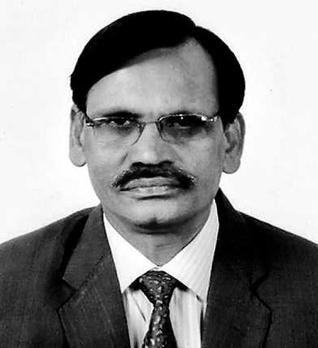
Former library manager of the Visakhapatnam Steel Plant and president of Society for the Promotion of Public Libraries P.S.N. Murthy has been selected for Dr. Ranganathan – Kaula Award for the year 2011 in recognition of his service for the cause of library and information science.

Since 1980, Prof. Kaula Endowment for Library and Information Science is giving the award which comprises Rs. 5,000 and a citation, to persons who have rendered eminent service to the cause of library science. The award would be given away by Minister Ganta Srinivasa Rao at a function being organised on the occasion of Librarians’ Day here on Sunday.

source: http://www.thehindu.com / The Hindu / Home> National> Andhra Pradesh / Visakhapatnam – August08th, 2012

Hyderabad University students display their work

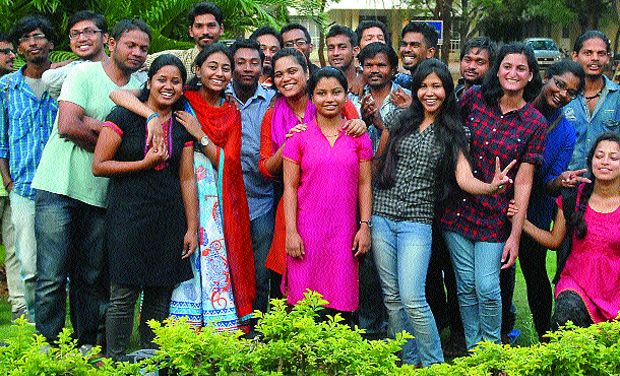
Passing out: Students strike a pose at the University of Hyderabad (Photo: DC)

Hyderabad:

The graduating class of Sarojini Naidu School of Arts showcased the best from their body of work from their years in the University. The Flight — Up Up and Away was a coming together of students practising different forms of art and therefore it was a multimedia delight with students presenting works in varied media to video installations. Most importantly, the subjects of expressions were personal thoughts and social observations.

The show started even before you entered the auditorium with Diptej’s video installations — Sinking Titanic and Lost in Time. The student, who hails from Goa, explains, “The  Sinking Titanic depicts the kind of situation where we are stuck in between, like pendulums. In Goa, because of a sudden change in politics, cargo ships were affected. I connected that with the Titanic.”  Diptej’s other installation Lost in Time projects visuals on an easy chair, while features are in motion in the backdrop, to signify “the frustration of losing things in cultures that we once valued”

Inside, the floor was used by rather riveting installations, including a strong expression using the media of wooden crates and plaster of Paris brains. Among the other brilliant works were Barun Mandal’s tea wash and benzene print, Dhiraj Pednekar’s video installation on graffitti that grew out of his love for observing architecture, Faiza Hasan Uzzal’s expressions questioning concepts created by society that women have to abide by and Radhika Ramamurthy’s work with termite wings.

Monika Bijlani worked on a public art project. Build Unbuild is an inquiry into how people would react to everyday things. “I invite the visitor to build something out of these cement blocks. These objects that we all come across everyday have begun to have a different effect on me as an artist and I want to see how others respond to it,” she says, adding that she will also be documenting the project to study how people react to or choose not to react to the ordinary and mundane.

source: http://www.deccanchronicle.com / Deccan Chronicle / Home> Lifestyle> Books-Art / by Samyaktha K / May 04th, 2014