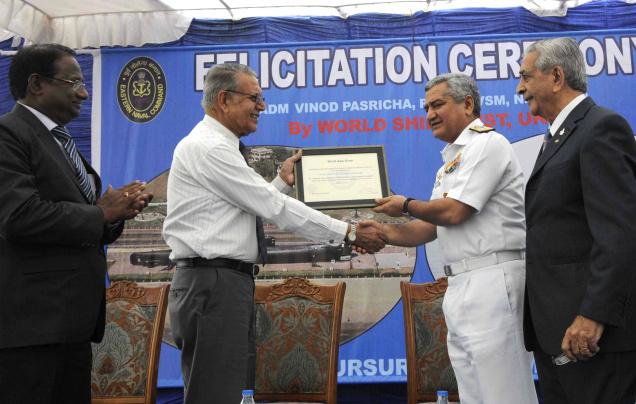
Vice Admiral (retd) Vinod Pasricha receiving ‘Individual Achievement Award’ of World Ship Trust of UK from Flag Officer Commanding-in-Chief Eastern Naval Command Vice Admiral Satish Soni at a felicitation function organised at INS Kursura Submarine Museum on the Beach Road in Visakhapatnam on Wednesday. Photo:C.V. Subrahmanyam / The Hindu
World Ship Trust of UK honours Vice Admiral (retd) Vinod Pasricha with ‘Individual Achievement Award’. Visakhapatnam is the home of submariners of the Indian Navy and it is befitting that such an iconic museum is part of the city landscape, Vice Admiral Satish Soni said.
Recognising the unstinted efforts of Vice Admiral (retd) Vinod Pasricha, who as then Flag Officer Commanding-in-Chief of Eastern Naval Command, saw INS Kursura beached and converted into a museum World Ship Trust of UK honoured him with ‘Individual Achievement Award’.
Very appropriately he received the award aboard the decommissioned INS Kursura from Flag Officer Commanding-in-Chief Eastern Naval Command Vice Admiral Satish Soni at a simple ceremony here on Wednesday.
The first submarine museum in South East Asia and probably the best in the world became a reality thanks to the efforts of a team of committed Naval officers and others from civil society who worked hard for it, Vice Admiral (retd) Pasricha said in his acceptance speech.
INS Kursura, the ex-Soviet Foxtrot class submarine, was one of the first four submarines acquired by the Indian Navy and commissioned in the late 1960s saw action in the 1971 Indo-Pakistan war. It served the Indian Navy for 31 years before being beached and decommissioned in 2001. On August 14, 2002 the submarine museum was dedicated to the nation by then Chief Minister Nara Chandrababu Naidu and since then has become one of the main tourist attractions of the city.
Visakhapatnam is the home of submariners of the Indian Navy and it is befitting that such an iconic museum is part of the city landscape, Vice Admiral Satish Soni said.
The felicitation speech was read by president Indian Maritime Foundation and representative in India of World Ship Trust of the UK Commodore (retd) Rajan Vir. Visakhapatnam Urban Development Authority which maintains the museum was represented by its Vice Chairman M V Satyanarayana. A number of flag officers and serving and retired officers who were part of the task were present.
source: http://www.thehindu.com / The Hindu / Home> News> National> Andhra Pradesh / by G.S. Subrahmanyam / Visakhapatnam – September 10th, 2014
Branding the Krishna valley diamonds as Golconda diamonds resulted in depriving the Guntur-Vijayawada area the credit of being the land of the legendary diamonds. (Photo: DC/File)
Hyderabad:
Guntur and Vijayawada lost their diamond hub status due to the rise of Golconda under Qutub Shahi rule, says Prof. Madhavan. Emphasising that the 350-km NH 9 connecting Hyderabad and Bandar via Vijayawada as the ideal model of a corridor, Prof. Madhavan, a renowned geologist and academic, said that it qualifies to be called the diamond corridor.
Guntur and Vijayawada occupy a unique position in the world of diamonds. The geologist said that branding the Krishna valley diamonds as Golconda diamonds resulted in depriving the Guntur-Vijayawada area the credit of being the land of the legendary diamonds, and in glorifying Golconda which was about 300 km away from the mining scene. The world now has a wrong impression that diamonds were found near Golconda which is far from the truth.
He said that Guntur-Vijayawada and the corridor connecting Bandar and Hyderabad should be given heritage status.
source: http://www.deccanchronicle.com / Deccan Chronicle / Home> Nation> Current Affairs / by DC Correspondent / September 07th, 2014
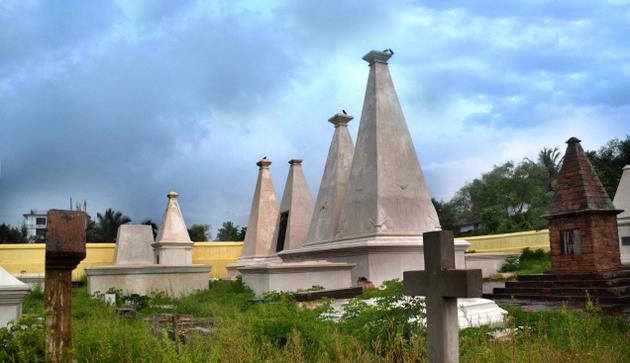
A view of the 17th century Dutch Cemetry at Bheemunipatnam. – Photo:C.V.Subrahmanyam / The Hindu
The town of Bheemunipatnam, 20 km. from here, is not only the second oldest municipality in the country, but has a rich heritage of both Buddhist and Colonial period. Historians say that the town was a trading centre during the 2 century Buddhist era and the colonial period and was an early settlement both for the Dutch and the British.
Though there are no remnants of the Buddhist period in the town , the excavated Buddhist settlement on the hills near to the town such as Pavuralakonda, Thotlakonda and Bavikonda suggest a link.
But there is still ample evidence of the early Dutch and English settlement. And it is only a few years from now, even that will be erased from the face of the town, thanks to the rampant destruction of the historic edifices.
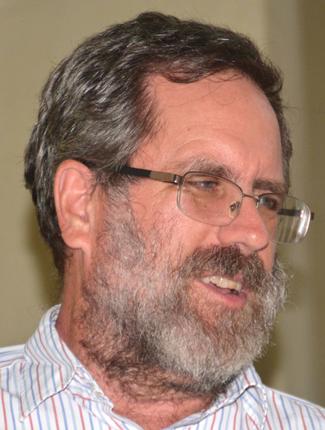
Robert Schick archaeologist from American Center of Oriental Research who is documenting the antiquity of Bheemunipatnam. Photo: C.V. Subrahmanyam / The Hindu
According to Robert Schick, an archaeologist affiliated with the American Centre of Oriental Research in Amman, Jordan, a 1995 study documented the presence of about 40 buildings belonging to the 17 to early 19 century Dutch and English settlement.
Dr. Schick who is on his third visit to the port town along with his colleague and fellow archaeologist Micaela Sinibaldi, to document the latest status on behalf of INTACH, informed The Hindu, at present only 20 are left. “A couple of them are still standing, though in dilapidated condition, the rest are totally rundown and a few have been replaced by modern concrete structures,” he said.
Notable among the ones that have been razed to ground are the magnificent sea-facing bungalow of 116 doors, the Governor’s House and the Gali Medha or the round building.
The archaeologist, expressed surprise on the gross ‘lack of will’ to preserve the structures. “It is not the same in the west. In Europe, many a town have been retained to preserve the core medieval flavour for posterity. Historic buildings are not mere sites, but are laboratories with a wealth of information and they define the character of the town or city,” said Dr. Schick.
The coordinator of INTACH’s Buddhist sites in AP, Rani Sarma, pointed out that with every passing day, the situation is worsening and the land is being encroached upon.
source: http://www.thehindu.com / The Hindu / Home> News > National> Andhra Pradesh / by Sumit Bhattacharjee / Visakhapatnam – September 01st, 2014
Bheemunipatnam still continues to attract tourists, but something has to be done for the upkeep of the ageing structures
Nestled by the bay about 18 km. from Visakhapatnam, this sleepy fishing town was the hub of activity on the eastern coast a few centuries ago. Bheemunipatnam which got its name from the mythological hero Bhima (the second among the five Pandava brothers), has the record of being the second municipal town in India (after Surat) and was once a flourishing Dutch Colony on the east coast. Though its neighbour Visakhapatnam has out beaten it in the course of time to become a sprawling metropolis, Bheemunipatnam continues to bask in its past glories. History points out that when Bheemunipatnam was a flourishing Dutch colony and a major port for import and exports the town of Visakhapatnam was considered to be its subsidiary.
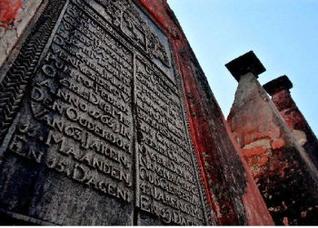
From the past Inscriptions in Dutch on a tombstone at the 18th century flagstaff cemetery in Bheemunipatnam, at left Gaali Meda (The round building) / The Hindu
History
The Dutch moved to this coastal town some time in the mid of the 17th century, when the local areas were under the control of the Golconda kings. Initially the Dutch used the port to export rice and later switched to jute. Two jute mills also sprang up in the vicinity of the town in the mid 19th century. One was called as Chittivalsah Jute Mills and the other was known as Nellimarla Jute Mills, both are operational till date.
The town was besieged and ransacked on several occasions. The marauding Marathas ransacked and burnt the town in 1754, it was again destroyed in the Anglo-Dutch wars of 1781 and 1795 and it was finally handed over to the British in 1825 following a treaty in 1824. Subsequently, it became a peaceful Anglo-Dutch settlement.
Remnants of the past
Though many old buildings have been demolished to accommodate newer structures and a few have just withered away with the passage of time for lack of maintenance, a few moss-stained edifices continue to stand firmly to give testimony of the glorious past.
The oldest among such structures is the cemetery at Kummaripalem, a small hamlet on the northwest side of the town. The oldest grave is that of one Frederick Kesslerus and it dates back to 1661. It is the oldest surviving Christian grave in this part of India. The second oldest cemetery is the Flagstaff Cemetery where the tombstones still stand like monuments against the blue waters of the bay. This cemetery has virtually become the landmark of Bheemunipatnam.
Both the cemeteries would have been lost in the annals of time but for the initiative taken by 73-year-old Roberts, a former officer of Chittivalsah Jute Mills. His timely intimation to the London-based British Association for Cemeteries in South Asia (BACSA) saved the day. The association responded in time with some funds for renovation and restoration. Today the cemeteries are under the Government of AP’s Archaeology and Museum Department and have once again become the subject of neglect.
St. Peter’s Church
The church was consecrated on March 17, 1864 by Bishop Gell, in honour of St. Peter.
The design was made with the help of the draughtsman of the 38 Madras Infantry and it was estimated to cost Rs.4,528 with an additional Rs.2,206 for the tower. Gothic in style and architecture, the church has a unique stained glass painting depicting Christ’s baptism and crucifixion just behind the altar. This piece was specially ordered and imported from London for an additional cost of Rs.1,000 in those days. Every aspect was taken care of, right from the arches to the granite altar and from the handsomely carved teak furnishing to the floor.
Gaali Meda
This was another landmark of Bheemunipatnam till a few years ago. This round shaped building was popularly known as the ‘Gali Meda’ (Tower of air). This building was part of the Dutch Governor’s Bungalow, from where a constant vigil was kept on the sea to determine the likely weather, spot approaching ships and to watch for enemy movements. This building also featured in a few hit films like ‘Maro Charitra’ and its Hindi version ‘Ek Dhuje ke liye’. This 24-feet diameter building was demolished a few years ago.
The town still continues to attract many tourists, but something has to be done for the upkeep of the heritage structures. Otherwise they will soon fade away into oblivion.
SUMIT BHATTACHARJEE
source: http://www.thehindu.com / The Hindu / Home> Features> MetroPlus / by Sumit Bhattacharjee / August 18th, 2007
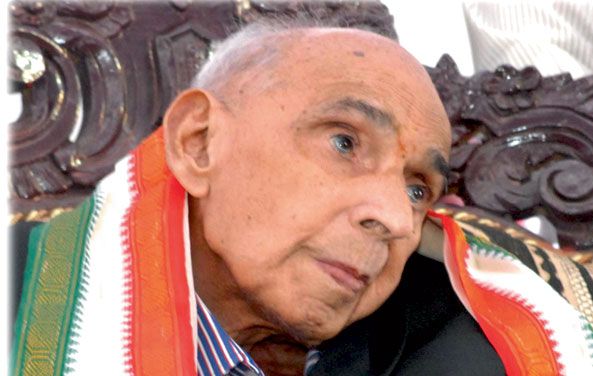
Several politicians expressed their condolences at the passing away of former Union minister Mallipudi Srirama Sanjeeva Rao, 86, on Wednesday afternoon at his residence in Kakinada.
He is best known as the man who brought TV telecast to India, when the Asian Games were held in 1982. He is the father of former Union minister M.M. Pallam Raju and son of former PCC president and freedom fighter late Mangipudi Pallam Raju.
The second generation Congress leader had been suffering from cerebral paralysis for the past two decades. He is survived by two sons, former Union minister M.M. Pallam Raju and businessman M. Anand. His wife Raja Rajeswari passed away 35 years ago.
His family had close political relations with the Nehru family for several decades. His father Mallipudi Pallam Raju had participated in freedom movement along with Pandit Jawaharlal Nehru.
Sanjeeva Rao studied BE in Gundy Engineering College at Madras and Imperial College of Science and Technology at London. He also worked as a research scientist in AII Research Laboratory in London and developed a sophisticated secrecy system for the Army.
He was elected as an MLA in 1970 from Ramachadrapuram constituency and later he was elected as member of Lok Sabha from Kakinada constituency thrice from 1971 to 1984. He held the post of Union minister for electronics and communication. Television in India was first introduced during Mr Rao’s regime and he inaugurated the first TV tower at Kakinada.
source: http://www.deccanchronicle.com / Deccan Chronicle / Home> Nation> Current Affairs / DC Correspondent / September 04th, 2014
From a glorified village to the capital city of Andhra Pradesh, Vijayawada region has come of age and it is time it changed its profile, according Rajesh Berry, hotelier and vice-president of Hotel DV Manor.
Speaking to The Hindu on Thursday, he said the city should prepare to welcome people from all parts of the country with open arms. “More number of corporates will come and more number of professionals will prefer to make the city their second home. It is time the locals changed their attitude and lifestyle,” Mr. Berry says.
However, K. Pattabhi Ram, president of Vijayawada Hotel Owners Association, felt the social life would remain the same as the region was surrounded by villages. “Vijayawada and Guntur, will witness spurt in hospitality sector as several projects are in the pipeline. Though number of star hotels will come up it will take some time for pub and discotheque culture to make its way in the region.”
He said Vijayawada region, unlike Hyderabad, was known for its restrained behaviour and gave more importance to customs and traditions. “Rural background dominates the ethos of the region.”
Race course
The region also yearns for a new race course. “The Hyderabad Race Club tote centre at Yalamanchalli complex is getting many enquiries about the possible new race course. We need at least Rs.100 crore for a full-fledged one. We need to have space for 18 to 24 horses to run in tandem in the circle. Provisions like swimming pool for the horses, veterinary hospital, jockey training centre, administrative block, cash counters, galleries with VIP boxes and cafeteria are a must. Race course maintenance is an expensive affair,” said Phani Babu, tote in-charge.
Golf course
There is also a need have a golf club for an emerging capital city. “With the city expected to attract foreigners and tourists in the days to come, the need go have a golf club is must,” said K.P. Rao, Krishna District Olympic Association. “We need around 100 acres to establish a full-fledged 18-hole course with all facilities,” said G. J. J. Raju, a member of century-old East Point Gold Club at Visakhapatnam.
source: http://www.thehindu.com / The Hindu / Home> News> Cities> Vijayawada / by J R Sridharaan / Vijayawada – September 05th, 2014
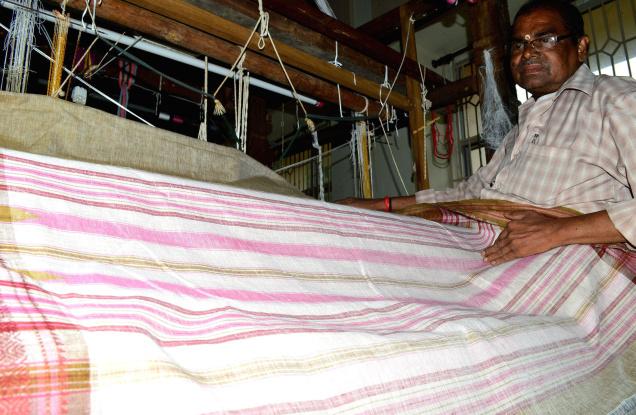
G. Pulla Rao of Weavers’ Service Centre, Vijayawada, displays the linen saree woven by him. / Photo: By Arrangement / The Hindu
In a major breakthrough in the handloom sector, Vijayawada-based Weavers’ Service Centre (WSC), under the Government of India, has come up with the country’s first linen saree, also known as Extra Warp Dobby Design Saree, in the range of 120s lea Linen X 120s lea Linen.
“The saree, which was designed and woven by a WSC team led by our weaver G. Pulla Rao on handloom at the WSC, is meant to make waves on the fashion scene. Another saree (100s lea Lenin X 100 lea Lenin – Muttu Extra Warp Design) available with us may also tempt fashion designers,” WSC Deputy Director Vishesh Nautiyal said.
In fact, the experiment began in October 2013, and it took nearly a year for the WSC to come out with the variety. “Weaving the saree was the toughest part, as we had to overcome several technical problems owing to the nature of the linen yarn,” Mr. Vishesh added.
The team of experts included Mr. Vishesh, Superintendent (weaving) M. Joga Rao and the weaver Mr. Pulla Rao. The trio claimed that the power loom sector could not compete with the handloom sector in the making of the saree, given the techniques involved.
The WSC solely aims at product development and is prepared to extend technical support to interested parties for the manufacture of the saree. However, the WSC has just one saree to their credit. But, experts, including Mr. Pulla Rao, predict it can be woven in three days.
source: http://www.thehindu.com / The Hindu / Home> News> Cities> Vijayawada / by T. Appala Naidu / Machilipatnam – September 02nd, 2014
Matta Tarun Kumar of Yuva Bharati Public School, Vijayawada, and his uncle G. Lakshman emerged winners at the city-level “Dell Champs – 2014 School Programme, conducted by Dell India.
The duo will now represent Vijayawada in the national finals to be held in September this year. The programme is an interactive technology-based quiz contest that provides a unique platform to parents to be partners in their children’s success.
Dell India, the end-to-end technology solutions provider, has embarked on a 20-city student outreach programme woven around the theme, ‘Education, Empowerment and Entertainment’. The quiz programme was conducted at 20 city schools, and 2,398 students and 361 parents participated.
The programme highlights the benefits of exposing young minds to the role that technology can play in providing a competitive edge.
source: http://www.thehindu.com / The Hindu / Home> News> Cities> Vijayawada / by P. Sujatha Varma / Vijayawada – August 27th, 2014
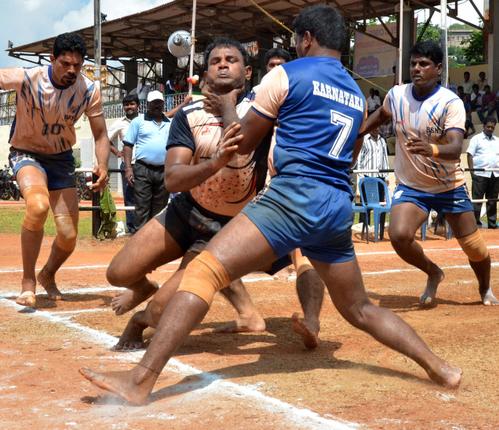
Andhra Pradesh and Karnataka Players in action in the final match of the 14th All India BSNL Kabaddi tournament in Vijayawada on Friday. _ PHOTO: V_RAJU. / The Hindu
A.P. Telecom team beats Karnataka team with a margin of 48-25. Both Haryana and Rajasthan were declared joint third place in the three-day tournament in which seven teams took part.
Amidst bursting of crackers and warm round of applause, host Andhra Pradesh telecom won the prestigious 14th all India Bharat Sanchar Nigam Limited kabaddi tournament by defeating Karnataka 48-25 at Railway Stadium here on Friday.
The one-sided final, which was dominated by A.P., saw the host finishing the first half breather at 22-13. AP team posted four lonas, one in the first half and three in the second. It maintained the nine-point lead in the second half and emerged winners to pocket Rs. 50,000. Karnataka carried home Rs. 20,000.
Both Haryana and Rajasthan were declared joint third place in the three-day tournament in which seven teams took part.
“A.P. team excelled both in offence and defence,” observed N. Arjun Rao, Sports Welfare Officer, and Vijayawada Division, who represented Indian in kabaddi in the 90s. Chief Referee S. Yadav appreciated the teams taking part in a sportive spirit by following the rules and regulations.
Speaking at the prize distribution function, Vijayawada Municipal Commissioner C. Harikiran lauded the efforts of A.P. telecom in hosting the national event and pointed out the importance of indulging sports and games to stay fit and healthy.
The organising committee gave away mementoes to all the technical staff and team management for their support for conducting the tournament in a successful manner.
A.P. telecom senior General Manager V. Sundar and several officials from the telecom sector attended the valedictory function.
source: http://www.thehindu.com / The Hindu / Home> News> Cities> Vijayawada / by Special Correspondent / Vijayawada – August 23rd, 2014
Two police officers from North Coastal Andhra region Police Training College (PTC) principal ET Srinivas and city harbour police station inspector D Rajeswara Rao will be receiving the Indian Police Medal (IPM) from Andhra Pradesh chief minister Nara Chandrababu Naidu on Independence Day on Friday at Kurnool.
The additional SP rank officer ET Srinivas has received around 143 departmental awards and rewards so far.
He has been working as the principal of PTC Viziangaram since 2011 after he was promoted to additional SP rank.
City-based inspector D Rajeswara Rao, a native of Tallavalasa in Julumuru mandal of Srikakulam district, played a key role in bringing down the accident rate to 38% while he was serving as a traffic inspector in the East traffic circle in the city.
He too has received nearly 60 departmental awards and rewards for his exemplary work.
source: http://www.timesofindia.indiatimes.com / The Times Of India / Home> City> Visakhapatnam / TNN / August 15th, 2014