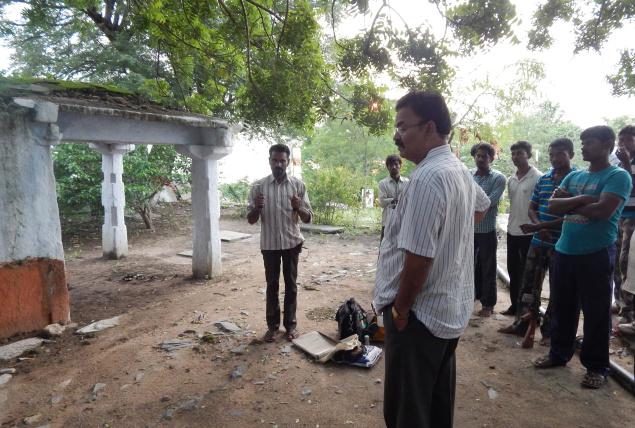
Archaeological Department Assistant Director K. Chittibabu inspecting the site where a five-member gang was arrested at the Lord Shiva Temple at Kethavaram in Guntur district. – Photo: By arrangement
Monuments in the submergence area of Pulichintala project have become a haven for them. The prime accused — D. Ramakrishna along with his associates — D. Venkateswar Naik, B. Somla Naik, Narasimha Naik and K. Ramesh Naik started scouting for the trove from a tribal fort and reached the ancient Lord Shiva temple at Kethavaram village.
Ancient temples located at villages that come under the submergence area of Pulichintala project in Guntur district have become a haven for treasure hunters.
Treasure hunters are thronging these temples with latest gadgets to locate “hidden” treasures. Police are on tenterhooks with the hunters making their presence felt in the district. Police intensified patrolling to keep a tab on them. In order to confirm whether any troves are present in villages at Kethavaram, Kolluru and Gollapeta that are set to submerge once Pulichintala project is completed, the district police roped in senior officials from the Archaeological and Museums department for a detailed inspection of the spot.
The police also wrote a letter to the Endowments Department seeking its intervention and allay fears of people. A few days ago, the Piduguralla police nabbed five persons for allegedly attempting to find out a treasure trove using a long-range detector brought from Bulgaria.
The prime accused — D. Ramakrishna along with his associates — D. Venkateswar Naik, B. Somla Naik, Narasimha Naik and K. Ramesh Naik started scouting for the trove from a tribal fort and reached the ancient Lord Shiva temple at Kethavaram village of Bellampally mandal in Guntur. Based on signals received from the detector, the gang members searched for the trove which they anticipated contains gold and silver coins.
Acting on a tip-off, the police rushed to the spot and nabbed the gang members. “It has become a nuisance for us for the last few months. To verify the gang’s claim, we took the help of officials from Archaeological and Museums department and confirmed that there are no traces of treasure troves,” explained Piduguralla Town Circle Inspector Y. Sridhar Reddy.
The hunt for treasure troves began when the main idols in these old temples were shifted to other places after administration declared Kethavaram, Kolluru, Gollapet and other areas as submergence villages, he said. When contacted, Archaeological and Museums Department Assistant Director K. Chittibabu, who visited the spot, confirmed that no traces of treasure troves were found.
“We advised the police to seek the assistance of Mines and Geology Department to know more about the detector used by the gang” he added.
source: http://www.thehindu.com / The Hindu / Home> News> Cities> Vijayawada / by M. Srinivas / Vijayawada – October 08th, 2014
The long-abandoned air strip in Kadapa that has been given a facelift and developed into an airport will be brought into operation in a week.
Arrangements are being made for the inauguration of Kadapa airport by Chief Minister N. Chandrababu Naidu on October 14. Union Minister for Civil Aviation P. Ashok Gajapathi Raju will take part in the inauguration.
History
Kadapa aerodrome was constructed in 1953 on a 229-acre site. Vayudoot operated services from Kadapa to Hyderabad in the 1980s. The aerodrome built on a 229-acre stretch was subsequently used by Chief Ministers for making transit halt of the Government helicopters and for refuelling.
About 15 light and microlight aircraft and helicopters landed in Kadapa aerodrome and took off in Air Race India Show organised by Aeronautical Society of India in 2003, as a prelude to the first centenary of aviation history created on December 17, 1903, when the Wright Brothers flew the first-ever powered flight. It was an enthralling experience for the massive audience to watch light and microlight aircraft and helicopters land and take off over a three-hour period, 11 years ago.
The YSR government had entered into a MoU in March 2007 for developing the aerodrome into an airport and allocated an additional 440 acres, located about 10 km from Kadapa town.
In accordance with the MoU, the government had offered to supply drinking water and power free of cost for five years.
It also granted property tax exemption for land used for the airport, navigation and related purposes and the airport staff colony, besides granting exemption from Kadapa Municipal Corporation taxes.
Under the Build, Operate and Transfer (BOT) basis, a new two km. Runway was completed at a cost of Rs. 21 crore.
In addition, a 11-km long compound wall was constructed with an outlay of Rs. 24 crore. In the second phase, an Air Traffic Control (ATC) building, passenger terminal, parking bays and internal roads were built at a cost of Rs. 13 crore.
Officials are holding discussions with some air travel agencies such as Spice Jet.
source: http://www.thehindu.com / The Hindu / Home> News> National> Andhra Pradesh / by M. V. Subrahmanyam / Kadapa – October 07th, 2014
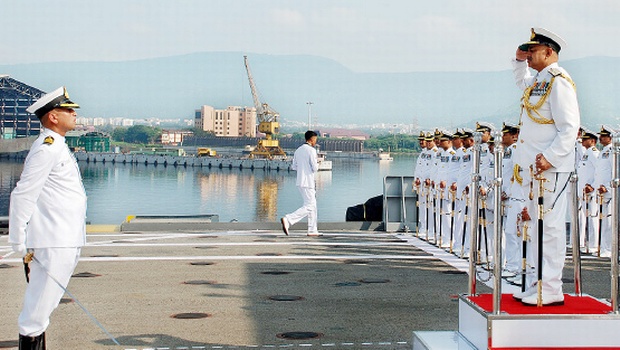
Rear Admiral Ajendra Bahadur Singh at the change of guard ceremony held in Visakhapatnam on Tuesday | EXPRESS PHOTO
Visakhapatnam :
Flag Officer Commanding Eastern Fleet Rear Admiral Atul Kumar Jain has handed over the Command of the Eastern Fleet to Rear Admiral Ajendra Bahadur Singh. The change of guard took place at an impressive ceremony onboard Flagship INS Jalashwa here Tuesday. Rear Admiral AK Jain will now assume the duties of Chief of Staff, Southern Naval Command at Kochi.
Rear Admiral AB Singh is a specialist in navigation and aircraft direction, and a graduate of National Defence Academy Khadakvasla and Defence Services Staff College, Wellington. He also holds a masters’ degree from Cranfield University, UK. He commanded Indian Naval Ships Veer (Missile vessel), Vindhyagiri (Frigate), Trishul (Frigate) and Viraat (Aircraft Carrier).
He also held various prestigious staff and operational appointments and was awarded the Vishisht Seva Medal in 2011. Prior to taking over as Flag Officer Commanding Eastern Fleet, he was serving as Assistant Chief of Naval Staff (Policy and Plans) at Naval Headquarters, Delhi.
Fully Loaded
The Eastern Fleet comprises 30 ships including amphibious platform Jalashwa, destroyers, stealth frigates, anti-submarine warfare corvette Kamorta, missile corvettes, landing ship tanks, offshore patrol vessels, missile boats and tankers.
source: http://www.newindianexpress.com / The New Indian Express / Home> States> Andhra Pradesh / Express News Service / October 08th, 2014
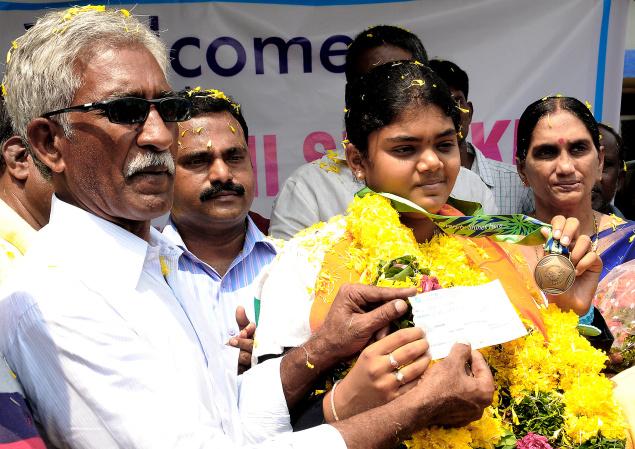
CBR Sports Academy chairman Chalasani Balaramaiah handing over a cheque for Rs. 5 lakh to Asian Games bronze medallist Jyothi Surekha on her arrival at Gannavaram Airport on Saturday. – Photo: Ch.Vijaya Bhaskar
Incheon bronze-medallist accorded a warm welcome
A warm welcome was accorded to teenage archer Vennam Jyothi Surekha on her triumphant return from Incheon after winning a bronze medal in the women’s team compound segment, at Gannavaram airport on Saturday.
On Friday, Purvasha Sudhir Shende of Volga Archery Academy, the other member of the Indian team, along with coach L. Chandrasekhar, arrived in the city.
The medal won by the archers assumes significance, as the city athletes had won an Asian Games medal after a gap of 63 years.
“In the 1951 first-ever Asian Games held in New Delhi, Krishna District’s Kamineni Eswara Rao (90kg) and Dandamudi Raja Gopala Rao (95+kg) won silver and bronze medals respectively in the weightlifting event,” said District Sports Development Officer S. Ramakrishna. Meanwhile, Kethanakonda-based CBR Sports Academy chairman Chalasani Balaramaiah alias C.B.R. Prasad handed over a cheque of Rs. 5 lakh to the eighteen-year-old archer, pledging support for her preparations for the 2016 Rio Olympics.
“This girl faced a lot of hardship to achieve the medal. She is a fine example to modern-day youngsters, as she made many sacrifices to realise her goal with a singular motto. She can make use of my academy for her future preparations,” Mr. Prasad said.
Congratulating Surekha, Gannavaram legislator Vallabhaneni Vamsi Mohan promised to take to the notice of Chief Minister Chandrababu Naidu the importance of quality sports infrastructure in Andhra Pradesh.
“Hyderabad was nurtured as an international sports hub during the Afro-Asian Games. We need such a mega event to develop a new sporting culture in Andhra Pradesh,” he said.
Amid ‘Bharat Mata ki Jai’ slogans, a visibly tired Surekha thanked Andhra Cricket Association, Laila Group of Companies chairman Gokaraju Ganga Raju, Bhima Cements, Nalanda Educational Institutes, Koneru Lakshmaiah University and Vennam Foundation for their supportin helping her realise her dream.
Surekha’s father Vennam Surendra thanked the Archery Association of India for giving his daughter direct entry.
Several coaches, sports administrators, students of K.L. University visited the airport to accord a warm welcome to the medal-winning archer.
source: http://www.thehindu.com / The Hindu / Home> News> Cities> Vijayawada / by J.R.Sridharan / Vijayawada – October 05th, 2014
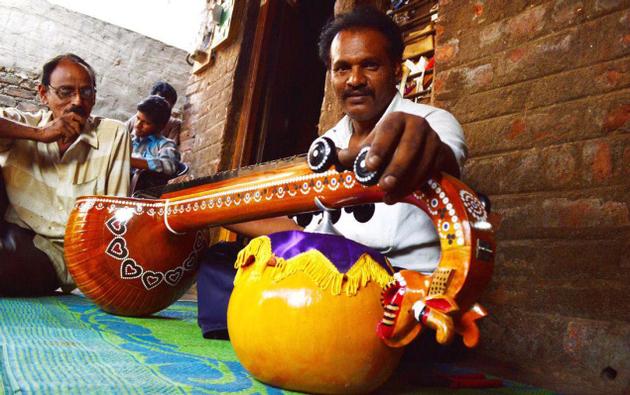
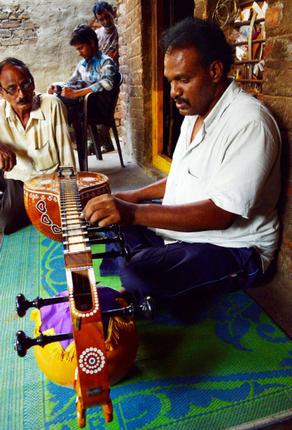
TOUCH OF CLASS:Artisans at work at the Craft Development Centre in Gollapalli.Photo: K.R. Deepak / The Hindu
As the sombre strains of the Bobbili veena fade into the sunset, Sumit Bhattacharjee takes a look at the indigenous instrument’s storied history and sad present.
Pedda Rayudu, the 15th descendant of the Rajah of Venkatgiri and the founder of the town and the kingdom of Bobbili, was a connoisseur of the arts. The royal instrument was the veena and it was the men of Bobbili who played the instrument in court. The veenas, then, were imported from Thanjavur. They were, in other words, Thanjavur veenas.
The Bobbili veena came much later, during the 19th century, and its birth is believed to hark back to a concert at the royal court, after which the king showered compliments on his highly regarded master craftsman Sarvasidhi Achanna, saying that he had the ability to create anything. This prompted a challenge from Ch. Musanana, a maker of veenas from the Vizianagaram kingdom. Would Achanna be able to craft a veena? Within two months, Achanna responded with an instrument that came to be known as the Bobbili veena.
The story now shifts to the present day, to the Sarvasidhi family in Gollapalli village, near Bobbili in Andhra Pradesh. Forty families, all from the Sarvasidhi clan, make a living by manufacturing the musical instrument. Sarvasidhi Achutanarayana, the great grandson of Achanna, says, “There is no formal training involved. The children get drawn towards it, as they grow up watching the elders carve and create the masterpieces. As in the guru-sishya tradition, each child is put under the tutelage of one senior member. The induction normally happens when they are five years old. They pick up the art by making small wooden toys, initially. There is no compulsion or restrictions. Even girls learn the art.” This is how it has been for seven generations.
Bobbili veenas are made from jackfruit wood, and a full-size veena stands out from the ones made at Thanjavur, Mysore, Kerala or Nuzvid because of the lion’s head carved at one end. The frets of Bobbili veenas are made of bell metal, while other veenas use brass. Earlier, the Bobbili veenas were known as “ekanda veena”, as they were made or carved out of one single piece of wood. But due to the paucity of good jackfruit wood, the veenas now have two joints. The other veenas have two or more joints.
Veena exponent Jayanthi Kumaresh says, “Bobbili veena is known for its quality of wood. Other veenas like the ones manufactured in Mysore are made of rose wood. I buy veenas from a maker in Bangalore who owns a jackfruit farm.”
Jackfruit wood
Achutanarayana agrees that wood is the most important ingredient. “The wood has to come from a jackfruit tree which is at least 20 years old. It should be seasoned and it should have the required kind of grain to suit the manufacturing.” For the Sarvasidhi family, procuring good jackfruit wood has become a problem and the government does not encourage jackfruit farming. “That’s the reason why we have stopped manufacturing the Ekanda veena.”
The Bobbili veena also stands out from other veenas because it is smaller in size. Jayanthi says, “The casing is much thinner compared to the others and the sound is shriller and more aristocratic. The treble is more in Bobbili veenas when compared to the others, where the bass is more. But now, many professionals tend to customise their instruments. They pick up the best from each variety and tailor-make veenas to suit their need.”
It was Chitti Babu Challapally and Dr. Emani Sankara Sastry from Andhra who gave the Bobbili veena international recognition. Jayanthi says, “The Andhra style of playing on Bobbili veena is considered attractive. The technique is different and the speed is more.”
Declining fortunes
Achutanarayana echoes the strain of concern found in older practitioners of other arts and crafts, who fear that their traditions might vanish. “The present generation is not very keen on taking up the craft. They are well educated and they intend to take up jobs in cities. Unless the government finds a way to make the trade lucrative, it will be difficult to hold them back,” says Achutanarayana.
The trade has never been lucrative. To keep the home fires burning and to save the art from sinking into oblivion, these veena makers started their own co-operative, the Sharada Veena Society, in 1959. But the orders were still dwindling, due to the declining patronage of the wealthy. Finally, with the intervention of the state government, a Craft Development Centre (CDC) was set up in 1994 at the Bobbili Fort, and it was later shifted to its present building at Gollapalli village.
Veena exponent and teacher Ramavarapu Vijaylakshmi feels that the demand is shrinking as the love and passion for classical music is dwindling. “Earlier, parents would send their children, especially the girls, to learn some form of music, be it instrumental or vocal. But today, they would like to see their children as dancers, cricketers and academic scholars. This confuses children, who are already bombarded with pop music and dance through the television.” The drop can be attributed to other reasons like academic pressure, says veena exponent Pappu Padmavathi. “Also, the veena is one of the most difficult instruments to learn. It takes at least 10 to 12 years to reach the first level of professional playing.”
At a time the craftsmen were finding it difficult, T.V.K. Sastry of Bharat Cultural Integration Committee came to their rescue. He placed orders for miniature veenas, which the Madras Telugu Academy started presenting as mementos during its cultural shows and festivals. “The tradition of gifting the instrument was initiated by the kings of Bobbili,” says Achutanarayana. “The veena was the royal gift to visitors from neighbouring states and the United Kingdom.”
Today, there are more orders for miniature veenas than for the full-size ones. The CDC manufactures 200 to 300 miniatures a month and earns to the tune of Rs. 1 lakh. The craftsmen make them in four sizes — 9 inches, 13 inches, 18 inches and 24 inches long — and the veenas are marketed by the AP Handicrafts Development Corporation (Lepakshi).
But this isn’t enough. To sustain this great tradition at Gollapalli, the Government needs to look into jackfruit plantations and add value to the CDC. More veena schools need to be started in order to increase patronage. But who, and how will you tell youngsters to take up the profession?
a full-size veena stands out because of the lion’s head carved at one end.
source: http://www.thehindu.com / The Hindu / Home> Features> Sunday Magazine / by Sumit Bhattacharjee / April 29th, 2012
Nuzvid Veena maker Sheik Mabu Saheb training youths at his residence in Nuzvid in Krishna district. Photo: T. Appala Naidu / The Hindu
Sheik Mabu Saheb, a renowned Nuzvid veena maker of Krishna district, has received the Best Artisan Award-2013 from the Andhra Pradesh Handicrafts Development Corporation Limited for his work – Veena with peacock design.
He bagged the award in the category of Veena Making in which artisans from Bobbili were also in the competition. Mr. Saheb had stolen the hearts of the jury members with his small size veena that produces vibrations and sound like any other professional-size veena. “The award is recognition to the art rather than an individual artiste. Despite having a great demand for veena from the world of Indian classical music, shortage of veena makers is still creating problems for the industry’s growth,” Mr. Saheb told The Hindu.
Nuzvid Veena maker Sheik Mabu Saheb training youths at his residence in Nuzvid in Krishna district. Photo: T. Appala Naidu / The Hindu
Handicrafts Department Assistant Director K.N. Murali Krishna said plans were afoot to use the services of Mr. Saheb in training youth in veena making and designing. In a guru-shishya parampara, Mr. Saheb learnt that art from his father Sheik Meera Saheb, one of the first generation veena makers alive. According to Mr. Mabu Saheb, there were only nine veena makers engaged in the profession, spreading the art.
source: http://www.thehindu.com / The Hindu / Home> News> Cities> Vijayawada / by T. Appala Naidu / Nuzvid – July 10th, 2014
Petite Malipeddi Praneeta did her hometown proud by clinching the silver medal in the 16th Asian Roller Skating Championship held at Haining, China, from September 19 to 24. The second-year MBBS student, studying at the Andhra Medical College, won the silver in the Pair Dance Category (artistic) along with her Hyderabad-based partner Anup Kumar Yama, who is the current world champion in artistic skating.
Speaking to TOI here on Saturday, 18-year-old Praneeta however sounded a bit disappointed despite her success. “I was expecting to win a medal in the individual figure skating event, but I missed out and stood fourth. However, I’m happy that I did well in the pair event.”
Praneeta, who has been a national champion in figure skating for the last four years, both at the junior and senior levels, started skating at the Shivaji Park rink from 2005-2006 and since then has been rigorously trained by her coaches, P Satyanarayana, Chitti Babu and Mahesh.
Praneeta had earlier participated in the junior category of the World Artistic Roller Skating Championship in 2009 that was held at Freiberg, Germany, and is now ranked 18th in the world in the senior category. Talking about her immediate priorities, Praneeta said, “I wish to break into the top-10 in the figure skating event by next year.”
The daughter of a cardiologist, Dr M Bhaskar Rao, Praneeta too dreams of becoming a cardiologist like her father. However, she made it clear that she it would not be at the cost of roller skating.
source: http://www.timesofindia.indiatimes.com / The Times of India / Home> City> Visakhapatnam / TNN / September 28th, 2014
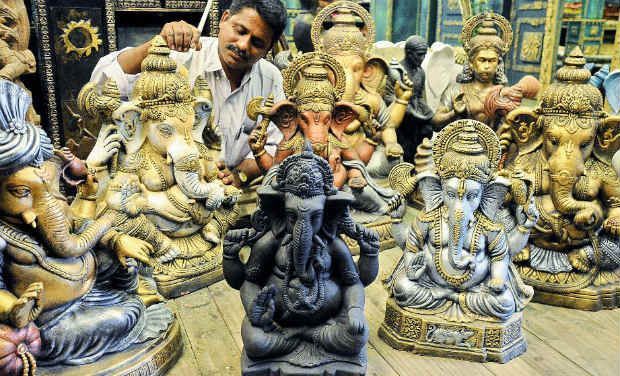
Sri Balaganapathi Uddanam Youth Club members of Borivanka village got recognition from the India Book of Records for worshippinge eco-friendly Ganesh idol on the occasion of Ganesh Chathurdhi this year. The youth club members made Ganesh idol with paddy seeds which was eco-friendly and innovative. “We used 50 kgs of paddy seeds and made 10 feet high Ganesh idol and worshipped it,” said the youth club member B. Tirupathi Rao on Monday. “We communicated our novel idea to India Book of Records and the records team of Faridabad recognised our effort and sent a communication to us for its inclusion in their coming edition,” he added.
By the time of immersion of Ganesh idol, germination of seeds started, the member explained.
source: http://www.deccanchronicle.com / Deccan Chronicle / Home> Nation> Current Affairs / DC Correspondent / September 30th, 2014
Doordarshan’s regional language channel for residuary Andhra Pradesh would be launched in Vijayawada, the proposed capital region of the State, on September 27.
Andhra Pradesh Chief Minister N Chandrababu Naidu would launch the channel, Doordarshan Saptagiri, in the presence of Union Ministers Prakash Javadekar (Information & Broadcasting) and M Venkaiah Naidu (Urban Development), an official release said today.
The channel is being launched in the wake of bifurcation of Andhra Pradesh. The newly-formed Telangana would have its own channel.
The release quoted Doordarshan Deputy Director General Sailaja Suman as saying the channel would have programmes blending cultural, political, economic, science and technology issues and aim at attracting the substantial population of youth.
source: http://www.dnaindia.com / DNA / Home> News> India / Place: Andhra Pradesh, Agency:PTI / Thursday – September 25th, 2014
City chess player K.V.K. Karthik receiving FIDE Master title from IPCA president Pilimon Zbigniew at Serbia. Also seen is Karthik’s coach Shaik Khasim. Photo: By Arrangement / The Hindu
The Andhra Pradesh Chess Association will felicitate Karthik during the State Open tournament which will be held at Chennupati Ramakotaiah Stadium on September 27
A gold medal at Commonwealth chess championship at Glasgow (Scotland) and a bronze at the World championship at Apatin – Banja Junakovic, Serbia. Twenty-seven-year-old K. Venkata Krishna Karthik is on cloud nine as 2014 is proving to be lucky to him.
The youngster, who is down with a peculiar orthopaedic disorder and poor vision, these two titles in the international tournaments in the physically challenged category has made him realise that his dream of becoming a Grandmaster is not far away.
“We need to thank all those people who stood by Karthik by offering their support both financially and emotionally. Associations like Andhra Cricket Association, Sri Chaitanya Educational Institutes, ARKS Group based at United Kingdom and parents of several players pitched in to give a new dimension to Karthik’s life,” said coach Sk. Khasim of Global Chess Academy.
Karthik not only won FIDE Master title but also earned his first International Master (IM) norm. The chess fraternity went into raptures as Karthik set a fine example to the able-bodied players that what was required to success was hard work and dedication.
“Had Karthik won the eighth round he would have won the title,” felt D. Srihari, secretary of Krishna District Chess Association. Dronacharya Koneru Ashok, Grandmaster Lalith Babu, senior coach and administrator V. R. Bobba and others congratulated the tenacity of Karthik despite his failing health.
Karthik won the hearts of many in the 14 International Physically Challenged World Chess Championship for he played against six talented and higher-rated Russians. A total of 36 players, including International Masters and FIDE Masters from 15 countries, participated in this tournament in which Karthik is seeded the 19th player.
The Andhra Pradesh Chess Association will felicitate Karthik during the State Open tournament which will be held at Chennupati Ramakotaiah Stadium on September 27.
source: http://www.thehindu.com / The Hindu / Home> News> Cities> Vijayawada / by J.R.Sridharan / Vijayawada – September 25th, 2014