Andhra Pradesh Chief Minister Nara Chandrababu Naidu, who was on a “capital building mission” to the island nation of Singapore from November 12 to 14, announced that the master plan for the 35,000 acre new capital to be built on the banks of the Krishna river near Guntur will be prepared by the Singapore government itself.
“They have not formally okayed our proposal yet as it has to be ratified by the Cabinet. Once the master plan is prepared then the AP government will announce its time bound action plan for the construction of the capital city,” Naidu told reporters at his residence here on Sunday.
Naidu said that his government also offered Singapore to build 2,400 mw power stations near Krishnapatnam which will have forward linkages with special economic zones in which the AP government will also have stake through special purpose vehicles.
“I met 200 business entities in Singapore and explained them that AP is ready to provide them excellent business opportunities in the public-private partnership mode,” Naidu said adding that building a capital on the lines of Singapore was his poll time promise.
Allaying fears about farmers of the two mandals in Guntur district rejecting the government’s land pooling proposal, Naidu said that pooling is the best way out compared to land acquisition as farmers will have no stake in the fruits of development after the capital is built.
“I will try to meet farmers from Tuesday and convince them,” Naidu said. He blamed opposition parties for instilling fear in villagers. Naidu is also visiting Japan from November 23 for a week to explore possibilities to get assistance to build smart cities in the state including that of the new capital city.
source: http://www.deccanherald.com / Deccan Herald / Home> National / DHNS – Hyderabad , November 16th, 2014
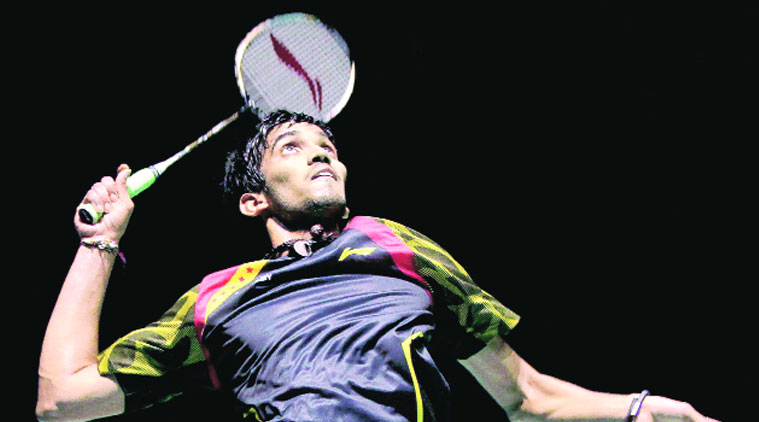
Kidambi Srikanth defeated five-time world champion Lin Dan to win the China Open in Fuzhou. Earlier, Saina Nehwal (below) beat Japan’s Akane Yamaguchi in the women’s final. (Source: AP)
At his best, Lin Dan is the greatest badminton player of all time and deemed invincible by all contemporaries. But even at his worst — when injury makes him wobble — the five-time World Champion is considered shuttling divinity’s Lazarus, the man who can rise from the dead any moment of the match.
Only two men have snatched matches from the twice Olympic champion since the 2012 London Games — Jan O Jorgensen and Sony Dwi Kuncoro. And China has not seen him lose at home in a decade. So when Lin Dan, recovering from an ankle injury, turned up at Fuzhou this week, it could only mean one thing: Kidambi Srikanth of India stood no chance even if he suddenly found himself in the finals of the Premier Super Series at China.
Except, Srikanth upturned all logic and calculation by beating Super Dan 21-19, 21-17 at the spaceship-like futuristic stadium in eastern China. In achieving that, he even pushed to the back pages Saina Nehwal’s heart-warming return as champion after she beat Japanese Akane Yamaguchi 21-12, 22-20 for her eighth Super Series title.
Srikanth, a brooding 21-year-old from Guntur in Andhra Pradesh, who grew up watching his father manage many acres of farms that grew paddy, had climbed the rankings ladder of men’s singles painstakingly to World No.16 and done nothing more spectacular than winning India’s first Grand Prix title in men’s singles at Thailand two years ago.
In fact, he reluctantly started playing singles a few years ago, and needed to be told by coach Pullela Gopichand that making the national doubles semis in U-19 did not constitute ‘ambition’.
On Sunday, the laidback shuttler confidently stuck to no fixed plan whatsoever (“It’s the only way to beat Lin Dan,” coach Gopichand said), improvised on his unorthodox strokes, and scored a tactically brilliant and historic title triumph for himself and India.
Considered India’s most talented player for some time now – talented, not always consistent – Srikanth had told his coach in his characteristically crisp fashion that he would only wish Gopichand on his birthday Sunday, if he could beat Lin Dan. And the Hyderabad coach, though happy at how his ward had been playing, wasn’t expecting to be wished.
Till the very last point, and given the number of times the world had seen Lin Dan defy defeat eventually, Gopichand waited nervously for the Chinese champ’s revival. “I jumped when Srikanth got the last one through. There’s disbelief because you never expect Lin Dan to lose, he always makes a comeback,” the coach said.
Srikanth had given the coach many reasons to be optimistic over the 45 minutes. He was commanding in the way he started with assurance (“not tentative at all taking the lead in the opening set for someone playing his first Super Series final of his career”); he was making Lin Dan run, catching him off-guard at the net; and he was playing his shots unhindered till the end.
“But you know how Lin Dan can turn it around. He might be coming off an injury but you never write him off,” the coach persisted an hour after he’d secured his biggest win as mentor. “Biggest, I don’t know, I’m just very, very happy,” he said.
Only one Indian has beaten Lin Dan – and that was when the Chinese was a rookie. “I’d beaten him 15-4 or 15-3 in the decider when he was very young. But over the years, he’s turned into quite a monster. He’s better, faster and more versatile than anyone else,” Gopichand said.
His assessment of what Srikanth achieved was unabashedly complimenting. “Srikanth dominated him early, but Dan was reading his game. That Srikanth changed his tactics and used the right ones at the right time, and kept calm makes it a brilliant win,” the coach added. Srikanth’s poise, his 6 feet frame, and tactical nous mirrors Gopi’s, who was the last Indian to win a comparable title – the 2001 All England.
It was an intuitive call based on the same mental maturity he saw in the boy that made him convince Srikanth that he would be better off at singles. “Good thing about him is he doesn’t think too much, he’ll do what he’s told. And if he’s told nothing, he won’t do anything which can be a problem,” the coach half-joked.
Moving to the Hyderabad academy was a choice Srikanth made, following elder brother Nandakumar – a far more energetic, outgoing and driven youngster. While Nandu had the spectacular jump smash and all the ambition, Srikanth dawdled about till the coach saw his malleable mind and wrists, and wide range of strokes and decided to put an end to doubles, the closest the reticent boy chose to being a wallflower while playing badminton.
“He only speaks to Gopi about his game. The maximum I’ve heard him speak about sport is about Roger Federer in tennis. Otherwise, he trains, sleeps, watches movies alone, and never discusses the game with me. I was told by our parents that I had to look after my kid brother at the academy, and I don’t clutter his mind about the game either. When I spoke to him last night, I knew he didn’t need to be told what to do against Lin Dan,” brother Nandakumar said.
“He liked looking at big stadiums, but as a kid he was very quiet and would follow his mother around everywhere. Studies happened alongside, but it’s not like badminton was life-and-death for him. He’s turned into a good player now, no?” father Krishna said. A spectacular understatement if there ever was any, about one of the greatest wins in Indian badminton.
source: http://www.indianexpress.com / The Indian Express / Home> Sports> Badminton / by Shivani Naik, Mumbai / Monday – November 17th, 2014
They had originated and proliferated in India, possibly in Tanjore, in the late 16th or early 17th century under the patronage of the Mughal emperors. But, with the passage of time, Kalamkari paintings on textiles faded into oblivion.
Thousands of miles away, a museum in France on the Swiss border has preserved some of the oldest specimens of Kalamkari paintings on textiles. These are very rare to find even in museums within the country.
For a fortnight starting on Wednesday, the textile gallery of the Indian Museum will showcase the world famous ‘Tapis Moghol’ — some of the most elaborate designs replete with mysterious animals, birds, foliage and flowers — that hold the key to many stories of the times. The ‘Tapis Moghol’, that dates back to the late 16th or early 17th century, has been preserved for the world at the En Musea De L’Impression Sur Etoffes De Mulhouse or the Museum of Printed Textiles at Mulhouse, France.
Kalamkari paintings in its earliest form were motifs painted on large wall hangings that were used to decorate the altar behind the deity. Kalamkari, though, is not a lost art form in the sense that it is still practised in both the painted and block printed versions. But, we have lost most of the original designs that were popular when it was used as an altar backdrop in South Indian temples.
“A gentleman called Funffrock, who was an employee of the French East India Company, was posted in Tanjore. The Frenchman was immensely interested in the traditional art form and got a cotton cloth, measuring eight feet by eight feet, done up with rich intricate designs that showcased the best motifs of that time. With time, this became the focal exhibit, around which the other collections of the period grew. The exhibition will give the city a glimpse of the Funffrock collection,” explained Ruby Palchowdhury, spokesperson of the Crafts Council of West Bengal, which is a wing of the Crafts Council of India and is funded by the Centre.
Textile and culture ministries and the Alliance Francaise have funded the expo that will have 25 panels to show off design details and the stories underneath. The exhibition has been curated by ethnic historian Lotika Varadarajan.
source: http://www.timesofindia.indiatimes.com / The Times of India / Home> City> Kolkata / by Jhumli Mukherjee Pandey, TNN / November 16th, 2014
Rice being loaded into a ship with the help of a shore crane by Food Corporation of India for transportation to Tripura from Visakhapatnam.
Multi-modal transport being used to dispatch stocks
Andhra Pradesh region of Food Corporation of India has undertaken the challenging and novel task of dispatch of raw rice stocks from Visakhapatnam to Agartala in Tripura through multimodal transportation to meet PDS requirement.
The task involves transportation of stocks from Visakhapatnam Port to Diamond Harbour in Kolkata by a ship. At Diamond Harbour the stocks will be trans-shipped into barges and taken through river movement up to Bangladesh. Thereafter the stocks will transit Bangladesh through trucks and again from Bangladesh border to FCI depots in Agartala by trucks.
The entire movement is regulated by Protocol on Inland Water Trade and Treaty (PIWTT) signed between India and Bangladesh.
Movement of more rice consignment is likely in future through multimodal transportation due to gauge conversion work undertaken by Northeast Frontier Railways from October 1. Normalcy in train services are expected to be restored from March 2016.
Tripura Minister for Food and Civil Supplies Bhanulal Saha was quoted as saying in Agartala that they were expecting 35,000 tonnes more from Visakhapatnam in future.
FCI had awarded the multimodal transportation work for carrying initial quantity of 10,000 tonnes to Sarr Freights Corporation, a New Delhi-based firm.
Challenging task
The challenging task was achieved by FCI here by way of arranging priority berthing and loading facilities at Visakhapatnam Port and the ship m.v. Allcargo Laxmi with first consignment of 5,000 tonnes of rice sailed from the port on July 3. Subsequently, the second consignment of rice was dispatched on September 22 which was successfully delivered in Tripura, FCI Area Manager Senthil Kumar told The Hindu.
The novel venture opens up an alternate route when compared with conventional dispatch of stocks by rail-road movement hitherto done from Pubjab/Haryana to Tripura in view of frequent disruption due to various reasons.
source: http://www.thehindu.com / The Hindu / Home> News> Cities> Visakhapatnam / by Santosh Patnaik / Visakhapatnam – November 16th, 2014
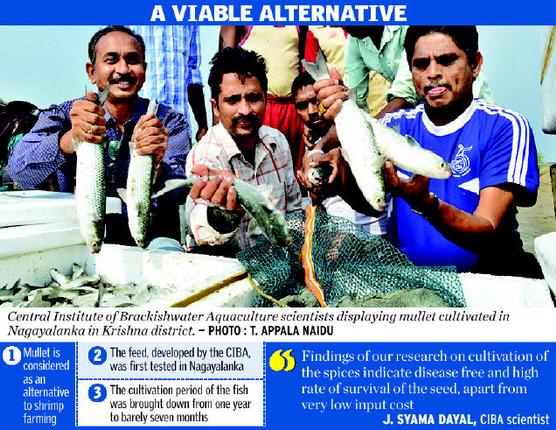
The cultivation period of the fish, which is considered an alternative variety to shrimp, was brought down from one year to barely seven months
The Central Institute of Brackishwater Aquaculture (CIBA), Chennai, in collaboration with Nagayalanka-based progressive farmer has scripted a success story by bringing down the cultivation period of Gold Mullet (Liza Parsia) and Grey Mullet (Mugil Cephalus) fish with the help of ‘formulated feed’.
The feed was developed by the CIBA and tested for the first time in Nagayalanka in Andhra Pradesh in the country. The cultivation period of the fish, which is considered an alternative variety to shrimp, was brought down from one year to barely seven months, drawing the attention of the worried shrimp farmers.
On Wednesday, CIBA Principal Scientists K. Ambasankar and J. Syama Dayal came with up their findings following harvesting of the mullet species on an acre of pond here.
The seed grown in the pond was collected from estuary and brackish water canals.
“Findings of our research on cultivation of the spices indicate disease free and high rate of survival of the seed, apart from very low input cost,” Mr. Syama Dayal told The Hindu. However, the CIBA scientists experimented on these two species in their quest to come out with alternative to the shrimp, which was driving the farmer into irreparable loss in recent years.
Experiment
“The experiment on Liza Parsia and Mugil Cephalus in abandoned ponds where earlier shrimp was cultivated is a way for those failed to reap profits in shrimp cultivation. Farmers have already begun slowly inquiring about details such as input cost,” said Mr. Ambasankar.
Beyond expectations
According to Raghu Sekhar who cultivated the fish in his pond, growth of the mullet species was beyond expectations, wooing other farmers to try their luck. “No disease is found during the seven-month cultivation period, withstanding changes in the weather and the soil of the pond,” added Mr. Sekhar.
Given the market value for value added to the Mullet Roe (egg) of the species, European countries and Japan are importing it in a large scale.
On the other hand, the CIBA was engaged in developing seed of the mullet species by the end 2016, according to scientists.
source: http://www.thehindu.com / The Hindu / Home> News> Cities> Vijayawada / by T. Appala Naidu / Nagayalanka – November 13th, 2014
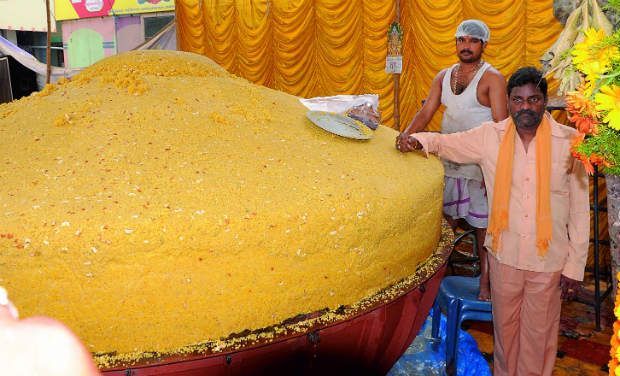
A huge ‘laddu’weighing 7,858 kg, prepared by a shop owner from Tapeswaram in Andhra Pradesh, which was offered to Lord Ganesha during Ganesh Chaturthi, has found a place in the Guinness World Records.
Sri Bhaktanjaneya Sweets bagged a place in the Guinness World Records for the fourth consecutive time for preparing the biggest ‘laddu’, offered to Lord Ganesha on August 27 during the eleven-day festival this year.
Speaking to PTI today after receiving his new Guinness certificate, shop owner S Venkateswara Rao said that he could achieve this feat only with the blessings of his family and the cooperation of his 25 staff members at Bhaktanjaneya.
Rao, who is a school drop out and joined his father S Satyanaraya Murthy in running the then small hotel after completing his sixth grade studies, said that his aim is to outdo his own record every year.
Previously, in 2011 he prepared a laddu weighing 5,570 kg, and followed it up with 6,599.29 kg laddu in 2012; 7132.87 kg in 2013 and 7,858 kg this year.
“My father (Murthy), who came here in 1942 to earn a livelihood started a small hotel, which initially served coffee and tiffin items along with sweet products.
Gradually, the shop in Tapeswaram began catering to travellers en-route, after buses and other vehicles began halting there for a small snack,” Rao said.
Subsequently in 1972, they expanded the hotel into a full-fledged sweet mart and have been famous for serving their patent ‘Kaza’ sweet.
Rao now intends to open outlets of his shop in Vijayawada and Visakhapatnam, with the help of his children, who are now pursuing higher studies.
The sweet mart has earlier received State-level awards for its ‘Kaza’ preparation before entering the Guinness Records. “Our range of products start from ‘laddus’ of small size to bigger ones as huge as 60-1000 kg,” Rao said.
For bigger orders like those weighing 5,000 kg, the makers have to be intimated six months in advance although the preparation will commence only 1-2 days before the festival as the product (laddu) is kept for 14-15 days during the event.
source: http://www.deccanchronicle.com / Deccan Chronicle / Home> Nation> Current Affairs / PTI / November 12th, 2014
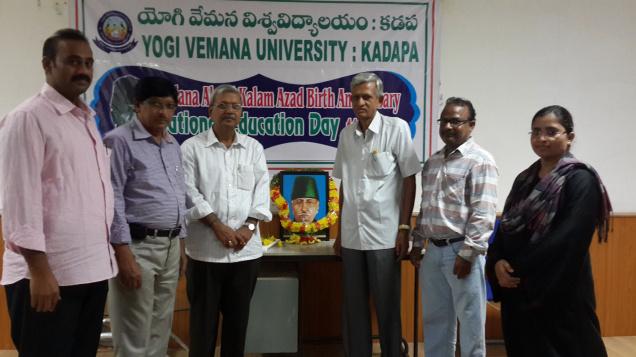
Yogi Vemana University Vice-Chancellor B. Syamasundar and faculty members paying tributes to Abul Kalam Azad in Kadapa on Tuesday. / Photo: By Arrangement / The Hindu
The invaluable contribution of India’s first Education Minister Maulana Abul Kalam Azad for expansion of reach of education to masses and improvement of its quality was recalled on the occasion of his birth anniversary on Tuesday.
Participating in the National Education Day observed in this connection, educationists and other dignitaries paid rich tributes to the man who played an instrumental role in the establishment of the University Grants Commission and the Indian Institutes of Technology. Addressing the faculty and students of Sri Padmavati Mahila Viswa Vidyalayam (SPMVV) at Tirupati, School Guru Eduserve’s Project Manager Prabhakaran predicted a rise in number of courses offered online and said that the online mode of education would facilitate expansion of learning to the grass-root level rather than the face-to-face mode of instruction. The programme was held by SPMVV’s Department of Communication and Journalism.
In a separate event, the members of Muslim Joint Action Committee (MJAC) paid homage to Maulana Abul Kalam Mr. Azad and recollected his contributions to the country. Yogi Vemana University (YVU) Vice-Chancellor B. Syamasundar garlanded Mr. Azad’s portrait in a function held at Kadapa. On the occasion, Mr. Syamasundar pointed out that Azad had rightly accorded more priority to education policy than the industrial policy. YVU Registrar C. Sambasiva Reddy said Azad had strove for national integration and tolerance to all religions. Coordinator of History and Archaeology Ramabrahmam explained Mr. Azad’s role in the independence movement and his support to reservations.
Paying tributes to Mr. Azad at the Congress office, District Congress Committee president Shaik Nazeer Ahmed said Azad had strived for the poor, weaker and downtrodden sections.
At Chittoor, the district administration celebrated the birth anniversary of Azad in a grand manner with the participation of a big number of students, teachers and officials. Mayor Katari Anuradha flagged off the rally with about one thousand students at Gandhi Circle and it passed through arterial junctions culminating at Ambedkar Bhavan.
source: http://www.thehindu.com / The Hindu / Home> News> National> Andhra Pradesh / by Andhra Pradesh Bureau / Tirupati-Kadapa-Chittoor, November 12th, 2014
Asserts that farmers will greatly benefit by parting with their land
Andhra Pradesh Chief Minister N Chandrababu Naidu on Saturday defined the boundaries for the state’s new capital on the Krishna Riverfront in Guntur district and sought to allay the fears of farmers whose land falls in the area.
With the common capital of Hyderabad set to go to Telangana in ten years, Naidu held a meeting with members of his Cabinet subcommittee at his Banajara Hills residence to discuss land acquisition for the construction of Andhra Pradesh’s new capital.
The chief minister addressed a press conference later, where he asserted that villages that fall under the boundaries of the future capital will benefit greatly by volunteering their land.
“I will see to it that farmers who part with their land for the construction of this world class capital benefit in many ways,” Naidu said, and added that opposition partiers were misguiding people.
Putting and end to speculation by defining the boundaries, he said: “The new capital will extend 10.5 km from Guntur Autonagar in the east to Prakasam barrage, from Borupalem in the west to Prakasam barrage and in the south from Autonagar Y Junction to the 75 km Ring road, covering almost 16 kilometers.”
The chief minister also promised that he would stop unscrupulous realtors from cheating farmers in the villages around the Mangalagiri and Tullur mandals, which form the core of the capital.
The cabinet subcommittee, comprising Municipal Minister P Narayana, Agriculture Minister P Pulla Rao, Irrigation Minister Devineni Umamaheswar Rao and Tadikonda MLA Shravan Kumar, will begin their tour to the two mandals on Tuesday.
They will explain to farmers the mode of land acquisition and try to convince those in five villages, including Venkatayapalem and Rayapudi on the river front, who have decided not to contribute, to part with their land for the development of the capital.
For each acre of their land, farmers of these five villages are demanding 1,200 square yards of residential land, 200 square yards in the commercial zone and employment for one eligible person.
Other demands were complete liquidity and legal sanctity in transfer documents, alternative sources of revenue for temples in case of endowment land, higher price for land near highways and village-wise meetings before a final decision is taken.
source: http://www.deccanherald.com / Deccan Herald / Home> National / DHNS – Hyderabad, November 09th, 2014
The eco-friendly bio-toilets, jointly developed by the Railways and DRDO, have been introduced on Visakhapatnam-Shiridi-Visakhapatnam and Visakhapatnam-Chennai-Visakhapatnam weekly express trains. The bio-toilets were fitted on the trains on Thursday and the trains titled Green Trains.
The specially designed toilets use anaerobic bacteria culture which converts the collected waste into biodegradable matter as gases like methane, carbon dioxide and water which were then discharged in specified discharge pits ensuring clean and hygienic environment.
According to divisional railway manager Anil Kumar, rail users have to be aware of utilisation of the bio-toilets as they are unlike the normal ones. Passengers should not dump things like plastic, empty bottles, paper and other garbage into the pans as otherwise they get choked and become unfit for use, the DRM said.
source: http://www.newindianexpress.com / The New Indian Express / Home> States> Andhra Pradesh / by Express News Service / November 07th, 2014
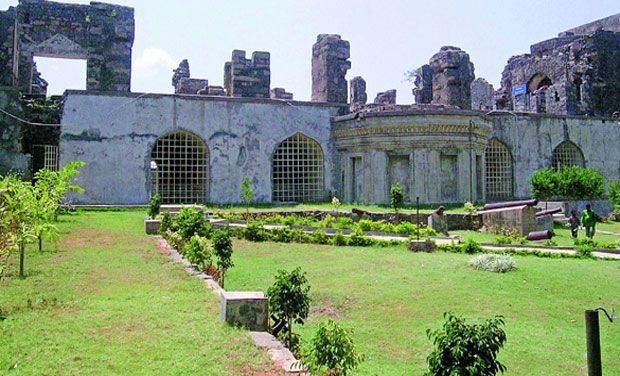
A view of the Kondapalli fort, 20 km away from Vijayawada.
VIJAYAWADA:
The historic Kondapalli fort, 20 km from Vijayawada city, is getting a facelift so that more tourists are attracted towards it. The archaeology department took up the renovation of the 14th century fort, built by king Prolaya Vema Reddy. However, due to denial of permission from the forest department, the Andhra Pradesh Tourism Development Corporation officials are said have failed to provide basic amenities at the fort.
Archaeology officials have completed a major part of the renovation work, including administering chemical treatment to Ranimahal, Nartanasala and jail khana. Some walls that had collapsed have been rebuilt, while other walls and arches repaired and given a fresh coat of water to prevent rainwater seepage. Deputy executive engineer, archaeology department, S. Koteswaran said that granite has been laid along the pathways for the convenience of tourists and the damaged arches repaired. The Central government has sanctioned funds from the 13th Finance Commission for renovation of the fort. Officials plan to complete the renovation work within the budget of Rs 3 crore.
Meanwhile, the APTDC is working on attracting more tourists to Kondapalli fort by providing basic amenities and developing a craft bazaar to market the world famous Kondapalli toys and other handicrafts of the district.However, the APTDC has been unable to implement its plans as the forest department has denied permission for construction activity near the fort, citing protection of reserve forest, said APTDC divisional manager T. Baboji. “Kondapalli has immense tourism potential.
Being Kartika masam, thousands of people are visiting the fort on weekends to participate in Vanamahotsavam,” he said. Most of the visitors complain of lack of basic amenities at the site and appeal to the authorities to provide minimum facilities.
source: http://www.deccanchronicle.com / Deccan Chronicle / Home> Nation> Current Affairs / by DC Correspondent / November 02nd, 2014