Category Archives: Records, All

Visakhapatnam Co-op Bank steps into centenary year

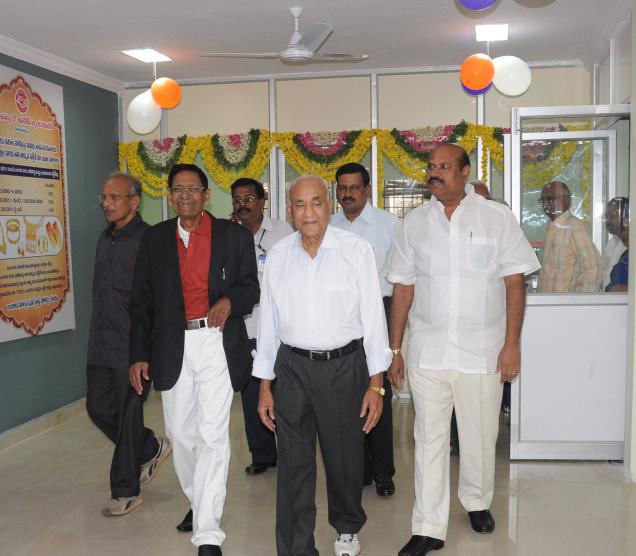
A file photo of M. Anjaneyulu, Chairman of The Visakhapatnam Cooperative Bank Ltd walking into the bank’s new branch premises inaugurated in Tirupati in 2011. Photo: K.V. Poornachandra Kumar  / The Hindu
A file photo of M. Anjaneyulu, Chairman of The Visakhapatnam Cooperative Bank Ltd walking into the bank’s new branch premises inaugurated in Tirupati in 2011. Photo: K.V. Poornachandra Kumar
/ The Hindu

Scripting a success story one after another, Visakhapatnam Co-operative Bank Ltd (VBCL) will achieve a major landmark by launching its year-long centenary celebrations from February 5.

The bank which was set up in 1916 and remained a single-branch bank with deposits of Rs.69 lakh and advances of Rs.50 lakh till 1983. It has grown in strength year after year following a major revamp and expansion drive later.

The bank at present has 35 branches spread over 11 districts in Andhra Pradesh and Telangana and has plans to expand its business to Tamil Nadu, Karnataka and neighbouring Odisha. The bank at present has deposits to the tune of Rs.2,000 crore and advances of Rs.1400 crore with its plans to expand to 55-branch bank with deposits to the tune of Rs.4,500 crore and advances Rs.3,000 crore.

“We are among few cooperative banks with a 100-year-old history with efficient management. We weathered a storm when the bank due to rumours had to face withdrawal of deposits to the tune of Rs.204 crore out of total deposits of Rs.308 crore during 2003-04. At that time, our old customers withdrew their savings from other banks and kept it with us due to their faith in us,” VCBL Chairman Ch. Raghavendra Rao told reporters on Wednesday.

Minister for Cooperation B. Gopalakrishna Reddy will inaugurate the centenary year celebrations at Andhra University Convocation Hall on Thursday.

VCBL Chairman Emeritus and former MLA Manam Anjaneyulu said that they had proved that through efficient management, healthy management practices and brand loyalty, a cooperative bank could serve the customers better than other banks. He said that within nine months of taking over as bank’s chairman, he could enable the bank to achieve Rs.1-crore deposit-mark in 1983, 67 years after its establishment.

VCBL CEO P.V. Narasimha Murthy and Directors G. Bhaskar Rao, A.J. Stalin, R.V. Jagga Rao, G. Janardhan Rao, K. Bhavani, D. Babu Rao, N. Kama Raju, C. Adinarayana Sastry and T. Padmavati were present.

source: http://www.thehindu.com / The Hindu / Home> News> Cities> Visakhapatnam / by Santosh Patnaik / Visakhapatnam – February 04th, 2015
National award for Chittoor Çollector

Chittoor Collector Siddarth Jain on Monday received the National Award for the successful implementation of the Mahatma Gandhi National Rural Employment Guarantee Scheme (NREGS), registering 99.88 per cent target in linkage of Aadhar for payment of wages to workers for the year 2013-14.

Mr. Jain received the award from the Union Minister for Rural Development Chowdary Birendra Singh at a function held at New Delhi.

The officials from the district water management agency (DWMA) were also present.

source: http://www.thehindu.com / The Hindu / Home> News> National> Andhra Pradesh / Chittoor – February 03rd, 2015

Jokes, skits enthral audience

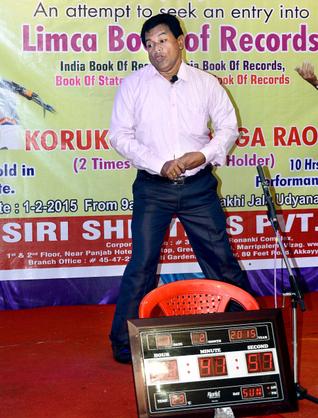
K. Ranga Rao presenting skits as part of his endeavour to get into the Limca Book of Records in Visakhapatnam on Sunday. —Photo: C.V. Subrahmanyam

What happens when you add zero between ‘padi’ (ten)? It becomes ‘pandi’ (pig). What do you call a ‘vantavadu’ these days in English? The answer is: husband. What follows after alphabet ‘T’? It is ‘biscuits’. The most sought-after word is — ‘free’.

Husband: Why did you stop the housemaid from work all of a sudden?

Wife: She started calling me akka !!

If Ravan becomes a singer, he doesn’t need a chorus.

Woman: Will you love me even after your marriage?

Man: Only if your husband permits.

Doling out a total of 37 jokes in one minute, Korukonda Ranga Rao, a foreman in Visakhapatnam Steel Plant, completed his first mission of narrating ‘Most jokes told in one minute’ in his attempt to get into the Limca Book of Records at Vysakhi Jala Udyanavanam on Sunday.

Organised by the Laugthers Fun Club, the first event covered a wide range of topics.

After a break, Mr. Ranga Rao started off his 10-hour-long journey of solo performance of skits with uniform energy levels and perfect timing from 10.13 a.m. From lethargic employees to conversations between husband and wife, and how police personnel swing into action after they receive a complaint, the skits kept the viewers spellbound throughout the show. Sporting wigs, changing costumes, and donning about 40 roles in a split second, Mr. Ranga Rao treated the audience to a number of skits that lasted a few minutes each.

“I am very passionate about acting. It drives me to bring the best out of me. Apart from attempting to break the record, participating in such events helps me quench my thirst for acting,” he said.

AU Vice-Chancellor G.S.N. Raju inaugurated the programme. VSP General Manager in-charge (Maintenance) O.R. Ramani, CID Inspector Nagesh Kumar, and joint secretary of the club P.K. Durgaprasad were among those present.

In an effort to enter the Limca Book of Records, VSP employee K. Ranga Rao narrates 37 jokes in one minute and begins his 10-hour solo performance of skits

source: http://www.thehindu.com / The Hindu / Home> News> Cities> Visakhapatnam / by Staff Reporter / Visakhapatnam – February 02nd, 2015

She cherishes R Day moments

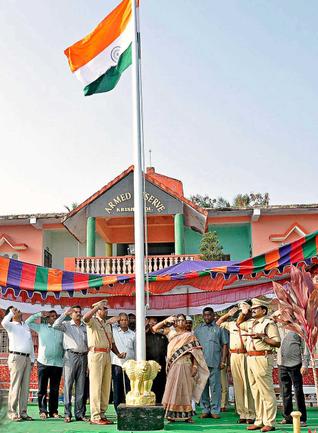
Krishna District Revenue Officer A. Prabhavathi hoisting the national flag at Machilipatnam on Monday.— photo: by arrangement

Krishna District Revenue Officer A. Prabhavathi became the first woman officer from the State services to hoist the national flag since Independence in the history of Krishna district. Ms. Prabhavathi got the rare opportunity to hoist the tri-colour national flag at the 66th Republic Day celebrations in the absence of Krishna district Magistrate and Collector Babu.A, who accompanied Governor E.S.L. Narasimhan in Vijayawada.

“I cherish the memory of participating in the 66th Republic Day celebrations. This is the proudest moment in my twenty-years of service in the State revenue department,” Ms. Prabhavathi told The Hindu . “Each aspect of the celebrations including receiving guard of honour by police and delivering Republic Day speech are memorable,” she added.

Addressing the gathering at the Police Parade Grounds here, Ms. Prabhavathi announced that everything was in place for construction of bio-toilets as a pilot project in Krishna district, using the bio-digester concept of the Defence Research and Development Organisation. On K.L. Rao Sagar project at Pulichintala on Krishna river, she assured of releasing irrigation water by June in order to meet irrigation needs in the kharif season. She also promised to place stringent measures to curb infant mortality rate and school drop-out rate in Krishna district. Accompanied by senior police personnel, she interacted with women and differently challenged persons on their issues and livelihood options. Above 450 persons belonging to government departments, NGOs and others fields were presented with ‘Best Performance’ awards, following cultural performances by the students.

source: http://www.thehindu.com / The Hindu / Home> News> National> Andhra Pradesh / by T. Appala Naidu / Machilipatnam – January 27th, 2015

Man attempts to create record by standing still for 36 hours

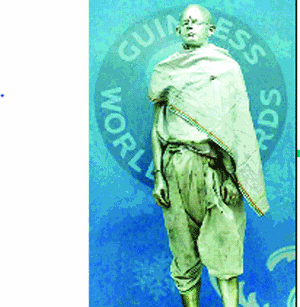
STILL AS STONE: Akshintha La Se Shu Babu has already entered the Limca Book of Records

Madurai :

On Monday, people attending the Republic Day celebrations at NMSS Vellaichamy Nadar College were surprised to find what was, at first glance, a brand new statue of Mahatma Gandhi. Till Sunday evening, no such statue had been spotted on the premises, and many believed that an Aluminium structure had been mounted for the special occasion.

In fact, the Gandhi ‘statue’ was Akshinthala Seshu Babu, a 44-year-old man from Vijayawada in Andhra Pradesh, who is attempting to set a new record by standing still for at least 36 hours at a stretch. Dressing in Bapu’s attire, Seshu Babu began his stillness feat at 10.30 am on Monday here, and is aiming to continue in the pose till 10.30 pm on Tuesday.

Sesha Babu, who began standing still in public in 1993, when he stood motionless for four hours at a function in Vijayawada, has already entered the Limca Book of Records and has won several competitions. With the latest stunt, he is hoping to break his own record of 35 hours which again, he performed dressed as the Mahatma.

According to Sesha Babu, standing still is not as easy task. It requires painful preparation, and being a regular yoga practitioner has helped him a lot, he said. Moreover, he tried to keep his physique fit by running and cycling, he said.

He had been fascinated by Gandhi since childhood, Babu added, and the objective of his performance was to demonstrate the principles of Gandhi to the nation’s youth, which he hoped might influence them to fight the evils in the society in a non-violent way.

“Most people know about Gandhi but remain ignorant of the principles he stood for. Since there is a lot of violence in the world today, I want to create this record and spread the message of living in harmony,” he said.

Besides, the performance would also demonstrate the importance of leading a healthy life, he said, without which such a feat would be impossible to achieve.

source: http://www.timesofindia.indiatimes.com / The Times of India / Home> City> Madurai / TNN / January 27th, 2015

NEIGHBOURHOOD WATCH : A landmark structure

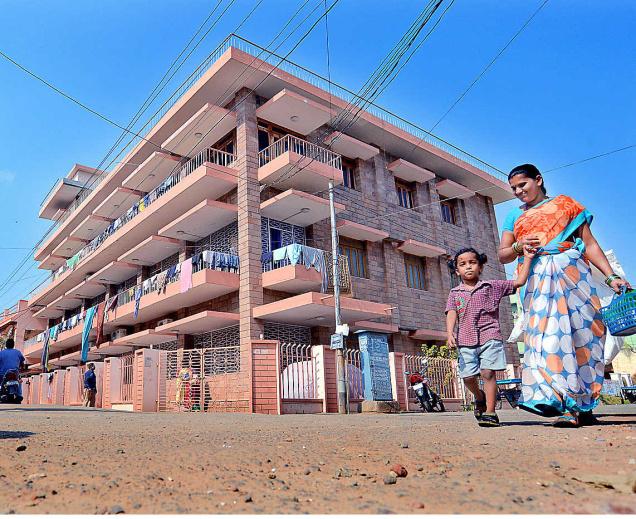
The famous ‘chekkudurayi’ building at Akkayyapalem in Visakhapatnam.— PHOTO: K.R. DEEPAK

One of the famous landmarks of Nandagiri Nagar in Akkayyapalem is ‘chekkudurayi’ building. The first-of-its-kind stone-studded façade was built in 1978 by Boddeti Appa Rao (I), a former railway employee and trade union leader.

The attractive building has now turned into a group house where 16 families reside.

With its impressive architecture, the building, located adjacent to the Saibaba temple in the colony, exudes a pristine charm.

“A lot of hard work had gone into the construction of the structure. From picking up similar stones to interior designing, care was taken in every aspect of the construction,” says B.S. Kanta, daughter of Mr. Appa Rao.

When cyclone Hudhud had ravaged the city on October 12, the residents of ‘chekkudurayi’ building say that they did not face any inconvenience.

“Quality construction techniques helped us stay intact in our homes. All we had to do was to shut the doors and windows and stay indoors for the entire day,” say the residents.

Besides its rustic appeal, what appears to be unique about the building is its maintenance-free feature.

“The building looks as new as it was three decades ago. It is one big advantage of the stone structure. Apart from feeling absolutely secured during calamities, the stone structure is hassle-free and gets cleaned every time it rains,” adds Ms. Kanta.

Initially, the ‘chekkudurayi’ building had only one floor, apart from the ground floor. In 2007, another floor was added where a total of 16 families live together.

source: http://www.thehindu.com / The Hindu / Home> News> Cities> Visakhapatnam / by Rani Devalla / Visakhapatnam – January 14th, 2014

Forts reflect rich cultural heritage

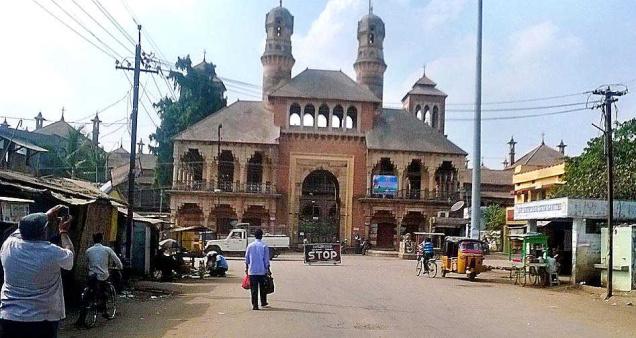
A view of fort in Parlakhemundi, adjacent to Patapatnam of Srikakulam district.—Photo: K. Srinivasa Rao

Historic structures are in a dilapidated condition in Kalinga region

Kalinga region spreading over north Andhra region, and parts of Odisha, may be backward economically but rich in heritage and culture. Forts in several places such as Mandasa, Tekkali, Itchapuram, Parlakhemundi, Vizianagaram and Bobbili have become major tourist attractions. They reflect the history of the region which has witnessed many battles, conquers and treaties. Majority of the forts were built between 1700 and 1850 AD and many of them are in a dilapidated condition due to lack of proper maintenance.

According to experts, three major methods were used for the construction of forts in Kalinga region. The first consisted of earthen ramparts. Often they were constructed of the sand which was dug out of the ditch surrounding the fort. Mandasa Raja Damodara Champat Dev constructed the fort in 1710 and it still catches the attention of every one. Gajapati Kings of Eastern Ganga Dynasty built the wonderful fort in Parlakhemundi, which is adjacent town of Patapatnam, Srikakulam district.

Tekkali Zamindar Ramakrishna Jaggadev and his Diwan Venkatapati Naidu ruled the region by staying in the Haveli which was constructed between 1750 and 60. Vizianagaram district also has fabulous places, architectural wonders and forts. Vizianagaram Fort is relatively well maintained as PVG Raju’s family converted it into an educational hub by establishing women’s college and B.Ed. college. The ancient fort in Bobbili has witnessed historic battle between Rajas of Bobbili and Vizianagaram. The fierce war has established the town as a land of heroism, bravery and courage.

Many small forts in Itchapuram, Palakonda and other places are in a dilapidated condition. Indian National Trust for Art and Cultural Heritage convener of Srikakulam Dusi Dharma Rao said the protection of old forts was need of the hour since they were the cultural properties for next generations.

“Majority of the forts are in the hands of respective Raja families. But many of them are not in a position to renovate them by spending lakhs of rupees. We will write to the INTACH higher-ups for financial assistance so that they can be maintained at par with structures of Rajasthan and other States.”

Srikakulam District Tourism Officer N. Narayana Rao said that the department was giving wide publicity for those forts to attract more number of visitors.

source: http://www.thehindu.com / The Hindu / Home> News> National> Andhra Pradesh / by K. Srinivasa Rao / Srikakulam – January 13th, 2015

Andhra man who wowed Tamil Nadu

Arikapudi Ramana Rao is a rarity in Indian volleyball.

Not only did he excel for his native state (Andhra Pradesh), Rao also shone in Tamil Nadu, his `second home’.Rao carved a niche for himself as a coach too, becoming in 1986 an FIVB (Federation Internationale de Volleyball) instructor, the first Indian to do so.

It is no surprise then that Rao, the national team’s head coach during the Asian volleyball championships in Perth, Australia, in 1991, is among the chosen few to have won both the Arjuna award (in 1977-78) and the prestigious Dronacharya award (in 1990-91).

Born in Chamallapudi village near Guntur in Andhra Pradesh, volleyball caught Rao’s attention relatively late, at college.”While studying at Hindu College in Guntur, I used to play both basketball and volleyball regularly since both courts were side-by-side,” recalls Rao.He did well for the college in both disciplines. “There came a point when I had to choose between the two, and I went with volleyball,” says Rao. It was a master-stroke because soon after his graduation, Rao got an offer to join the Southern Central Railway (SCR) team in Hyderabad. “At SCR, I had an opportunity to play in various nationallevel tournaments which gave me the exposure. Soon, I featured in the Indian team which was a huge high,” he says.

In 1970, Rao shifted base to the erstwhile Madras, courtesy an offer from State Bank of India (SBI) “They (SBI) had to wait for about six months before I joined, since Railways were reluctant to relieve me. I had to report on April 30, 1970, and I got my relieving order only a day prior to that,” says Rao. But that didn’t affect Rao’s performance and he soon made his mark with his new employers in his new home. “SBI had a great side, and most of the members were part of the state side.”

He may have been a part of numerous victorious squads throughout his glittering career, but winning the maiden national title for his adopted state remains close to Rao’s heart. “The 1975-76 nationals in Trichy where we won the title were special. We were two sets down in the final, and the crowd, which had gathered in large numbers, left the stadium disappointed. By the time we pulled things back, there were very few left to cheer us,” says Rao.

However, many fans came to congratulate Rao the next day after learning about Tamil Nadu’s spec t a c u l a r w i n through the newspapers. “Be it during a practice session or during a game -we were always cheered by the spectators in Madras.

If not for the crowd, I don’t think there will be volleyball or the players,” he says.

It is thanks to the efforts of the likes of Rao and G E Sridharan, another stalwart from the state that Tamil Nadu remains a force to reckon with in volleyball in the country .

(A weekly column on famous sport spersons whose first playing field was Chennai and its neighbourhood)

source: http://www.timesofindia.indiatimes.com / The Times of India / Home> City> Chennai / by Prasad RS, TNN / January 10th, 2014

Catholics Contributed a Lot to Country, Says Sangma

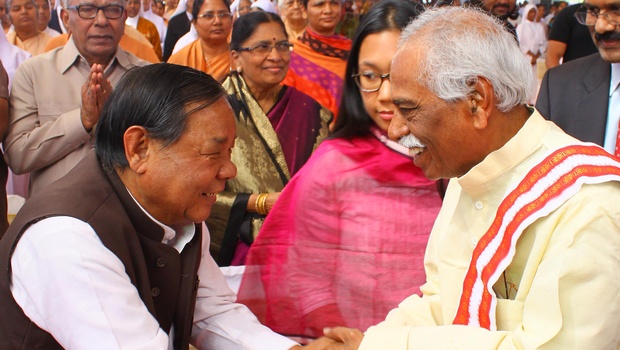
Union minister Bandaru Dattatreya greets former Lok Sabha speaker PA Sangma during the celebration of 300 years of Catholic Faith in AP and Telangana at a function held in Hyderabad on Sunday | NEERAJ MURALI

Hyderabad :

Although the Catholic community in the country is in a minority, it has contributed enormously to the development of the nation on all fronts, former Lok Sabha speaker PA Sangma has said.

To commemorate the 300 years of Catholic faith in Telangana and Andhra Pradesh, a grand ceremony was organised by Catholic Reddy Association (CRA) at Loyola Academy here on Sunday. It was in 1715 that the Telugu Catholic faith had begun when Thumma Hanumantha Reddy of Anantapur was baptised by French Jesuit Fr Le Gac. Addressing a large gathering of Catholics, Sangma said the educational institutions run by the community had produced some of the greatest minds in the country in all fields. “Be it politics, industry or bureaucracy, the people who matter the most to this country are proud products of Catholic educational institutions,” he remarked referring to some top names including BJP leader LK Advani.

He requested the central and state governments to accord minority status to all Catholics and Christians in the country. To take up the issues of community in Parliament, he said, the Christian MPs Forum in Delhi would be revived.

Union minister of state for labour and employment Bandaru Dattareya he would strive to protect minority communities as per the constitutional rights provided to them. “Only when there is harmony between peoples of different faiths can the country surge ahead with development. Each community representing a faith should respect and protect other faiths,” he said.

CRA president Gopu Bala Reddy said the Catholic community believed in service and not in conversion. He sought both AP and Telangana governments to extend SC status to Dalit Christians and Muslims besides providing space for burial grounds and extending old-age pension scheme to Catholic fathers and nuns.

source: http://www.newindianexpress.com / The New Indian Express / Home> States> Andhra Pradesh / by Express News Service / January 12th, 2015

Institute of Science fetes botanist who found coal in Andhra

Nagpur :

The finding of 3000 million tonnes of good quality coal reserve in Andhra Pradesh a few months back by Omprakash Sarate, a scientist from the Birbal Sahni Institute of Palaeobotany in Lucknow, continues to bring appreciation and laurels for this botanist who originally hails from Nagpur.

Since Sarate did his doctoral research in the Institute of Science in palaeopalynology and coal petrology, the Institute felicitated him on Monday for his finding that has brought not just the Chintalapudi district in Godavari valley on the coal map of the entire country. He was honoured by the Institute director R G Atram on behalf of Alumni Association of the Institute and the Botany Society. He had been working in all the lower Gondwana formations of Wardha Valley and Godavari valley coalfields.

Sarate later told TOI that the AP government picked up the finding of coal reserve from his publication in the Journal of Palaeontological Society of India in December 2013. The government noticed the finding in September this year after which it got an independent survey done and was delighted to realize the size and quality of the reserve. “For AP, it is a jackpot as most of the coal reserves of undivided Andhra Pradesh were in Telangana region that is now a separate state,” he said.

Sarate’s study found good quality coal within 500m depth from Somavaram in Krishna District to Rajamundry in east Godavari district. The quality of Chintalapudi coal as compared to the Ramagundam and Talcher was better, especially its calorific value was much higher. Most of the coal is located between Aswaraopet, Chinthalapudi and Jangareddy Gudem fall in West Godavari district. The reserves are good for thermal generation as well as for steel plants.

Explaining palaeopalynology, Sarate said 10m of grass trough in a region generally got converted into 1m of coal got converted into carbon only due to bacterial and fungal activity. This initially must have resulted in brown coal and on compaction got converted into lignite that metamorphosed to coal. All this coal is about 260-270 million years old and was formed due to cold and humid conditions prevailing in the area.

Since these are deep seated deposits there could be even coal belt methane at the bottom. It will be possible to extract them only through underground mining.

Dr Surekha Kalkar, head of botany department, gave introductory remarks and introduced the guest. Atram explained how a particular kind of pollen grain can form the basis of presence of coal. Former Institute director M T Bharambe, M R Thosar, president of Alumni Association and Prof P S Jakhi, Incharge and secretary of the association also spoke . Roshani Singh, secretary of Botanical Society, conducted the programme.

source: http://www.timesofindia.indiatimes.com / The Times of India / Home> City> Nagpur / by Snehalata Shrivastav, TNN / December 30th, 2014