Category Archives: Records, All

The living legend of Chodavaram’s Karya Siddhi Vinayaka temple

Visakhapatnam :

The Karya Siddhi Vinayaka temple at Chodavaram is considered one of the two self-originating Vinayaka temples in AP, the second one being the Kanipakam temple in Chittoor district.

According to archaeological experts, both the temples were constructed roughly during the same time by the Chalukya Cholas (roughly 1200 AD).

The original Vinayaka temple and idol were discovered over 200 years ago at the spot where the present temple was built. According to the village elders, much effort was then put into shifting the idol to a nearby sivalayam. However, they were unable to do so as, according to a well-known local story that has gained mythical proportions, the snout of the Vinayaka was so long that they could not unearth it.

M Jagannadham, a local history buff, native and old timer, said, “The remains of the old temple were unearthed in 1850. However, the idol continued to remain sunk as it could not be propped up. Even today the Mula Virat, Lord Ganesh’s idol, cannot be completely seen. Only the upper portion of the torso can be properly seen and the rest lies buried.”

According to heritage conservationist Rani Sarma, not much may ever be known about the origins of the temple as the new temple built on the old premises has been repaired and reconstructed beyond recognition in the last 200 years. “One cannot go against the beliefs of the people for the Vinayaka here is said to be the Karya Siddhi Vinayaka, one who helps us achieve what we set out to do. It is people who wanted the temple to be built and rebuilt in the name of development and betterment,” she said.

Pointing out that the temple was built during the Chalukya-Chola period she said: “The Eastern Chalukya-Chola period saw a resurgence of Shaivism in the region and hence the large number of Shiva temples.”

Regarding the Swayambhu (self-originating) legend — a term generally used to describe ancient shrines that have been discovered by accident — a senior employee of the state archaeology department said, “How does one explain the remains of a temple unearthed from the ground? Though the general perception is that the shrine came out on its own, not much should be read into it from the archaeological or scientific point of view. It has more to do with the faith of the people.”

“The pity is that there is little or no scope for archaeological studies to be conducted as the temple has been rebuilt many times over the last 200 years. But the fact that the idol is located close to the old fort premises goes to prove that the temple may originally date back at least a 1,000 years,” he added.

The temple priest, Kodamanchili Ganesh, said, “We have been the priests for several generations now. It is true that the temple, which dates back to several hundred years, has been built and rebuilt over the years.” While pointing out that many people did come to research the origins of the temple, he said that keeping in view the fact that it was a live and vibrant place of worship, not much digging and excavation work could be done.

According to Jagannadham, Chodavaram came into existence as an agraharam (a Brahmin hamlet) following a grant by Chalukya Cholas to members of the Brahmin community. “It then developed into a centre of Vedic learning and Shaivite worship and went on to draw the attention of members of the trading class, who also contributed immensely to its growth, making it a major trading centre. A garrison was later built by the Chalukya Cholas to protect their trading interests,” he explained.

The legend: Legend has it that the snout of the Vinayaka is so long that the locals were unable to unearth it. The idol continues to remain sunk even today with only the upper portion of the torso visible to devotees and the rest remaining buried

source: http://www.timesofindia.indiatimes.com / The Times of India / Home> City> Visakhapatnam / by Venkatesh Bayya, TNN / July 04th, 2015
Thotapalli Reservoir Becomes a Reality after 12 Long Years

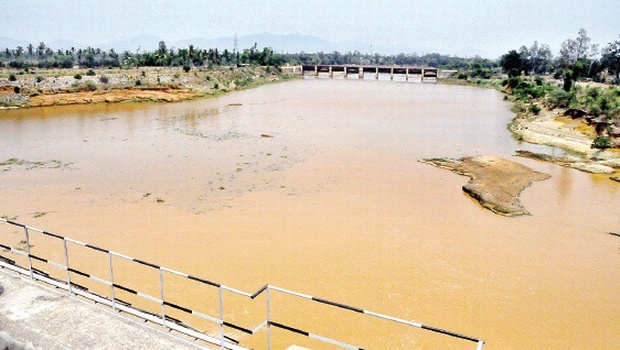
A view of the Thotapalli Reservoir in Vizianagaram district | EXPRESS PHOTO

Vizianagaram / Srikakulam : 

After more than a decade, the farmers of the ayacut area of Thotapalli reservoir are overjoyed that their dreams of irrigating their lands would be finally realised. The much-delayed Thotapalli project, except for minor works, has been completed and the Irrigation Department is making arrangements to release the waters from the reservoir in the third week of July.

NumbersANDHRA01jul2015

Thousands of farmers and their families of Vizianagaram and Srikakulam districts are excited about prospects of receiving Thotapalli reservoir waters to kick-start the kharif season. The farmers who come under the project ayacut have been suffering as there is no irrigation water to cultivate their fields. Depending on rainwater, some of the farmers who tried to cultivate their lands faced severe financial losses as rains eluded them in the peak season.

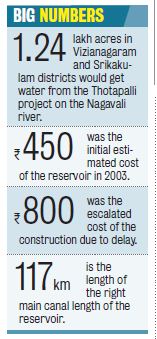
In order to provide irrigation water to about 1.24 lakh acres in Vizianagaram and Srikakulam districts, the government had taken up the Thotapalli reservoir on the Nagavali river in 2003. The project timeline was five years and the estimated cost of the project was `450 crore. The cost later escalated to about `800 crore due to the abnormal delay in executing the project.

The district administration faced a tough time in acquiring 1,100 acres of land for the project. There were a series of agitations by land losers for relief and rehabilitation. After clearing several hurdles, the department completed all the construction works of the reservoir and its 117-km-long main canal.

According to the government’s assurance to the farmers, water from Thotapalli will be available for the 2015 kharif season. The irrigation officials, on a war-footing, completed the works to release the water in the third week of July.

“Pending minor works relating to the 29 distributary canals, four branch canals and two NH crossing works will be completed by July 2. The 117-km-long right main canal of the reservoir was completed except the tail-end 2 km. There is a railway crossing across the 2-km-long canal which will be completed next year. The department had already paid `4 crore to the Indian Railways. Under the Thotapalli project, water will be provided to 40,000 acres (original target was 62,000 acres) in Vizianagaram district and another 40,000 acres in Srikakulam district (aiming to provide 58,000 acres) this year,” said Tirumala Rao, Thotapalli project superintending engineer.

source: http://www.newindianexpress.com / The New Indian Express / Home> States> Andhra Pradesh / by VK Lakshmi Gayatri / June 30th, 2015

Anglo Indians: Vizag’s first cosmopolitans

The Port City may today be regarded as the most cosmopolitan city of Andhra Pradesh with people of various cultures and religions living together in harmony and while this is generally attributed to the mushrooming of several public sector units, industries and government establishments in the post independence era, the seeds of cosmopolitanism were sowed much before that.

For, even a century prior to independence and long before the port, steel plant or the Indian Navy dropped anchor in Vizag, a pluralistic culture thrived in the city.

It all started with the British landing on Vizag’s shores in the 19th and early 20th century, some of whom married local women when their regiments were posted in Vizag during the First and Second World War.

While most members of the city’s Anglo Indian community are descendants of British soldiers and administrative officials, some of them are also of Australian and Canadian descent. “Anglo-Indians were found from the 19th and early 20th century in Vizag and were concentrated in areas like Soldierpeta, Gnapuram, Suryabagh and Old Town. The first and second generation Anglo Indians were mostly with the armed forces or served as administrative officials. The subsequent generations mostly worked in the ports or railways and followed a fully European way of life,” said city-based historian Edward Paul.

Being literate, the community had one of the most progressive ideologies, denouncing the dowry system, forced arranged marriages and gender bias, and their women were also quite liberated. Culturally active, they influenced almost all aspects of the city, be it education, sports, music and dance, or even the social scene.

Mostly Roman Catholics and a few Protestants too by religion, the community would be found every Saturday and Sunday in churches, which served not just as a platform for religious congregation but also as a forum for socialising and cultural dos. Dressed in fashionable clothes and high-heels, they would dance, play music and exchange pleasantries in the churches. The Port Gymkhana Club, Railway Institute and Town Hall were other places for socializing and partying.

Almost all Anglo-Indians had penchant for music and thanks to them Vizag had a lively social scene, good live bands and guitarists, while most houses had pianos. Thanks to their penchant for socializing they were also instrumental in setting up many clubs. They also made good sportsperson and were into hockey, football,bicycling and athletics.

The fun-food-drink loving Anglo Indians were an industrious lot too and did not look down upon any job. An old-timer of Vizag, Sohan Hatangadi, who has seen the community at close quarters, reminisced, “My neighbour Michael Buckley would clean the streets in front of his house every day using his own brooms. He would lay the pavement in his area with tar and stone.”

One of their major contribution was towards education and saw them set up many English medium schools. “As far as education is concerned, the oldest school in Vizag, St Aloysius Anglo Indian School catered to the boys, while the girls studied in St Joseph’s Convent. Even though not too academically inclined, they preferred to be financially independent soon after turning 18 years old. Women were mostly into teaching and nursing, while men, with their knowledge of English, would get clerical jobs or work in the railways, customs or port workshops,” said Owen Perera, an old timer belonging to the community.

During Christmas, the homes and narrow by-lanes of the Old Town area (Vizag in those days was limited to the Old Town area) would come alive with decorated stars,Christmas trees and lamps. Aromas of freshly-baked cakes and melodious yuletide music would waft from every Anglo-Indian household. Easter was another important festival.

With a spurt in migration to Australia, UK and other countries since the late 1960s and 70s, when there were around 200-plus families in Vizag, today barely 15-20 families (the elderly ones) are left in Vizag with life more about nostalgia for the good-old days while for some its about waiting for the younger generation’s homecoming from abroad during Christmas.

source: http://www.timesofindia.indiatimes.com / The Times of India / Home> City> Visakhapatnam / by Sulogna Mehta, TNN / June 25th, 2015

Little Shivani sets a new mark


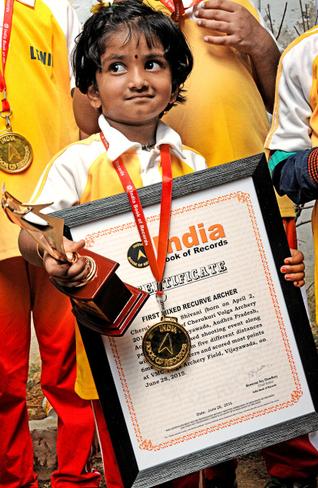
Child prodigy:Archer Dolly Shivani who entered the India Book of Records by emerging as the country’s first mixed recurve archer in Vijayawada on Sunday.— Photo. Ch. Vijaya Bhaskar
Three-year-old kid archery Dolly Shivani entered the India Book of Records as the first mixed recurve archer of the country by performing with five archers in five different distances at the Volga Archery Academy here on Sunday.

Shivani, who made her entry into the record book as the India’s youngest archer in March, competed with V. Sai (10m), Bilwesh Dutta Sai (9m), Susanth (8m), Virat Sai (7m) and Nischal (6m) and scored more than the required points set by the adjudicator.

Shivani hauled 90 points with V. Sai in 10 metre distance, while 105 points with Bilwesh in the nine-metre.

“With Susanth, she punched 95 points in eight-metre and 85 with Virat Sai in seven. Along with Nischal she scored 110 points in the six-metre distance,” said Viswaroop Roy Chowdary, the representative of the India Book of Records.

“In total, Shivani used 40 arrows (8 X 5 rounds) while each of her fellow archers used eight each,” he added.

The archers from the academy set a new record in which 39 archers belonging to Indian, Recurve and Compound segments, using different bows took part in a group event.

“In 29 minutes and 55 seconds they scored 430 points in the 15 metre distance aiming at a 122 centimetre target face. The specified time was 60 minutes and 320 arrows. They did it in less than half time,” said Mr Chowdary.

The group event saw literally everyone from Volga Archery Academy, including chairman Cherukuri Satyanarayana to rookie archers taking part.

Machilipatnam MP K. Narayana, local corporator D. Annapurna, sports administrators Jasti Satyanarayana, K.P. Rao and others took part in the event.

The five-member film crew from United States of America, which is here to shoot a trailer on Shivani, captured the entire event.

source: http://www.thehindu.com / The Hindu / Home> News> Cities / by Special Correspondent / Vijayawada – June 29th, 2015

Kotilingala Ghat Set to Enter Record Books

Rajahmundry :

The 1.2-km Kotilingala Ghat — one of the 23 ghats being developed for the pilgrims to take a holy dip in river Godavari during the forthcoming Godavari  Pushkarams — is set to emerge as the country’s largest riverine bathing ghat, according to sources in the endowments department.

Giving an idea of the enormity of the Kotilingala Ghat, they told Express here on Saturday that one lakh pilgrims could take a holy dip there at a time.

They further said that the district administration had divided the 23 bathing ghats – 15 of which are in the urban area and 8 in the rural area – into ‘A’ and ‘B’ Grade ghats for the convenience of the pilgrims.

In the urban area (Rajahmundry city), 12  ghats would be notified as ‘A’ grade ghats and the remaining three as B grade ghats, he said. The ‘A’ Grade ghats were Gayatri Ghat, Gowthami Ghat, New VIP Ghat (Saraswati Ghat), Padmavati Ghat, Sraddananda Ghat, Markandeya Ghat, TTD Ghat, Pushakar Ghat, Sankara Ghat, Lakshmi Ganapathi Ghat, PMK Ghat and Kotilingala Ghat. The ‘B’ Grade ghats would be Subbayamma Temple Ghat, Dobhi Ghat and Kanaka Durga Ghat, they said.

According to the sources, in the rural area, there will be one ‘A’ Grade ghat – Ramapadala Ghat at Dowleswaram — and seven ‘B’ Grade ghats — Boat Office Ghat, Padmavathi Ghat, Kancharladine Ghat, Gayatri Ghat, CERP Ghat, Chintalamma Ghat and Sunnamnbatti Ghat. The sources said that common pilgrims would be permitted to have a holy dip in the river at the VIP Ghat whenever VIP pilgrims were not present there.

Meanwhile, as per the directions of chief minister Nara Chandrababu Naidu, the  endowments department was constructing platforms at various ghats to enable the pilgrims to perform Pinda Pradanam and Tirdha Vidhulu, the sources said and added that at some places, sheds were also being constructed.

They said that construction of all the ghats, including the VIP Ghat at Gopada Kshetram, near Kovvur, in West Godavari district, would be completed by June 30 as per the directions of the chief minister. They added that Naidu would again review the progress of all the Pushkaram-related works on July 1.

source: http://www.newindianexpress.com / The New Indian Express / Home> States> Andhra Pradesh / by S S Chary / June 28th, 2015

200 to Compete for Table Tennis State-ranking

Tirupati :

The first AP State-Ranking Table Tennis Tournament (APSRTTT) began on a grand note with a large number of sports enthusiasts from across the state taking part in the competitions at Srinivasa Sports Complex (SSC) here Friday.

Being one of the prestigious events and first state-level table tennis competition in truncated AP, the APSRTTT gained a lot of importance in the contemporary sports world. The debut tournament, to be conducted for three days, was almost a big hit, as more than 200 candidates from both coastal Andhra and Rayalaseema regions registered their names. These 200 sportspersons will compete at five levels i.e, cadets (Under-12), sub-juniors (U-14), juniors (U-17), youth (up to 21 years) and men and women (above 21 years). Every candidate will compete in an 11-point game in men and women’s category, separately.

On the first day, quarter finals comprising seven rounds for all the age groups and semi-finals for the contestants belonging to cadets’ category was conducted. The winners will get a cash prize of `1 lakh, said APSRTTT tournament director Venkat Malapaka.

For the first time ever in the history of table tennis tournament, eco-friendly balls were used in the game, promoting the importance of environment. “We used 40+ non-celluloid plastic white balls in the game. This will disseminate and help recognise the importance of environment in the present global warming conditions. Meanwhile, the cash prize announced can add more contestants to the game, making them more competitive to participate at global level sports,” he felt.

In the semi-final round, R Adi Lakshmi from Vijayawada won against her opponent Soumya from Visakhapatnam with 11-9, 8-11, 11-6 and 11-7. “Since morning, I was very much excited to step into the ground and hit the ball. The ambience of the tournament had built a competitive spirit in me. Though the competition with my opponent was not so tough in the beginning, the later rounds were like tug-of-war. However, it feels great to win,” 11-year-old Lakshmi told Express.

In the inaugural ceremony, TTD chairman C Krishna Murthy said that the divided Andhra Pradesh had the capability to host the international and national level sports competitions, towards which government was making all elaborate measures keeping this in view.

source: http://www.newindianexpress.com / The New Indian Express / Home> States> Andhra Pradesh / by Express News Service / June 27th, 2015

It stands tall again

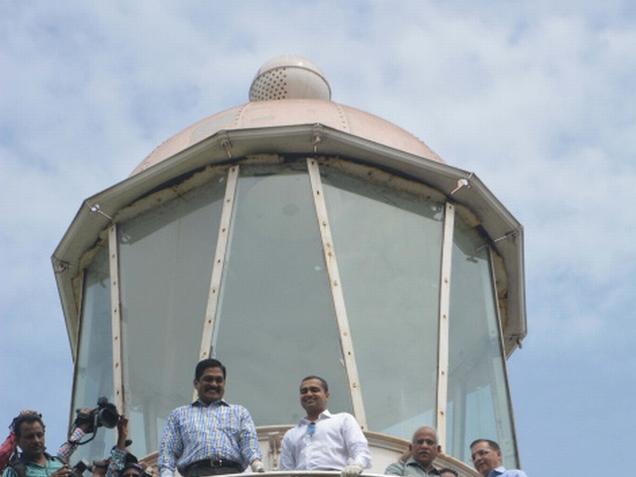
The old Light House has been restored and thrown open for public. Photo:C.V.Subrahmanyam

The iconic structure was established in 1903 to guide ships.

Setting a new benchmark in restoration of heritage structures in the city the Visakhapatnam Port Trust and the Visakha Container Terminal Pvt Ltd restored the old Lighthouse at Flagstaff on the Beach Road and the iconic building was thrown open to public on Friday.

The iconic structure which was a source of inspiration for the seafarers is a landmark that is the pride of the Port City standing testimony to the rich marine traditions of the region. This would probably be the first historical monument whose restoration has been taken up in a proper manner. “It is the first text-book restoration work in the city,” convenor INTACH PV Prasad said thanking the Port and the VCTPL for taking keen interest in the restoration work.

“We are proud to be associated with the proper restoration of a genuinely historical monument,” VCTPL managing director Vir Kotak said. We have taken up the work and gladly spent the amounts required for the restoration, he added.

Monuments and their architecture reflect the culture of the earlier generations and any work to preserve our heritage is praiseworthy, Chairman Visakhapatnam Port Trust M T Krishna Babu said lauding the efforts of the VCTPL in restoring the landmark building.

The 59-foot masonry tower was a transit line lighthouse. It was established in 1903 in the present location to help guide the ships into one of the safest natural harbours in the world – the Visakhapatnam Harbour. The dome and lantern of the lighthouse were from the lighthouse at Chantilly or Chintappali some 18 km from Bheemunipatnam. The light house had a gas-fired white diopter light of the 2 order with brightness levels of 45000 candles. It flashed every 20 seconds and was visible from 12 miles in clear weather. During World War II there were two anti-aircraft guns set up next to the lighthouse.

The lighthouse went into disuse in 1962 and after that the building itself went into disrepair. VCT persuaded VPT management to hand it over for restoration and revival. Chairman of VCT and JM Baxi Group of Companies Krishna B. Kotak, an ardent restorationist, brought onboard Mumbai’s conservation architect Vikas Dilawari to oversee the project which began in 2012.

Adding value

VCTPL has made a request to Navy for providing two surface-to-air guns to be installed on the cemented pedestals which were originally made for the purpose.

VCTPL proposes to request GVMC to take up the periodical maintenance and upkeep of the area outside the boundary.

Quotes

We have to thank Krishna Kotak for taking such keen interest in the conservation project.

MT Krishna Babu, Chairman VPT

We have to preserve our past to learn from it and build a strong future.

C Rajendiran, Principal Commissioner of Customs

As a Vizagiite we are proud that the restoration of this monument has been taken up

Monish Row, vice president, Vizagpatnam Chamber of Commerce and Industry

source: http://www.thehindu.com / The Hindu / Home> News> Cities> Visakhapatnam / by G.S. Subrahmanyam / Special Correspondent – / Visakhapatnam – June 27th, 2015

Iconic landmark set to regain glory

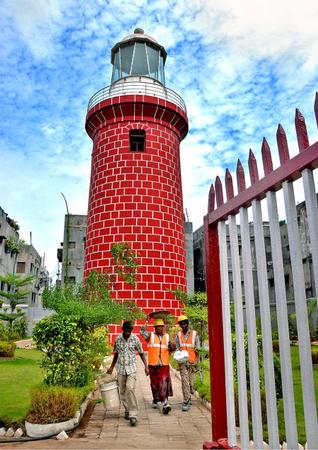
The resored lighthouse on the beach road in Visakhapatnam.PHOTO: C.V. SUBRAHMANYAM

Restored harbour lighthouse sans lantern to be inaugurated tomorrow

The Visakhapatnam Port Trust has taken the lead in restoring the structure of its iconic harbour lighthouse and the restored landmark is set to be inaugurated on Friday.

The restoration of the lighthouse signals the importance the State government is giving to maritime trade. The Government is looking at logistics to play a catalytic role in bringing about double digit growth to the State economy as part of which Visakhapatnam Port plays a key role as a gateway to the East. Under the guidance of well-known conservation architect Vikas Dilawari, the 59-foot round tower with gallery and lantern has been given a makeover. However, the port has not been able to get a lantern and the restored structure would be without a lantern.

The iconic building that was a transit line lighthouse directing the ships into the harbour channel went out of service in 1962. The building was plastered over and the stairs inside had collapsed. The yard had become a garbage dump for the neighbourhood.

Original glory

The Visakha Container Terminal Private Limited took the responsibility of restoring the structure to its original glory and after some painstaking work over the last two years has made it stand out. It has a shining new dome and the gallery is complete with a proper parapet. The structure itself is brick red reflecting its historical value. The yard has been converted into a well-maintained garden.

The restored icon is scheduled to be inaugurated by Visakhapatnam Port Trust Chairman M.T. Krishna Babu.

source: http://www.thehindu.com / The Hindu / Home> News> Cities> Visakhapatnam / by G. S. Subrahmanyam / Visakhapatnam – June 25th, 2015

Big and beautiful

Visakhapatnam :

It is without doubt one of the largest and most imposing colonial buildings not just in the Port City but also Andhra Pradesh and was built in 1910-13 when the British Raj was at its height and Vizag was the headquarters of the largest district in British India. Obviously, the imposing collectorate structure was built to reflect this power and glory of the Raj.

The E-shaped, five-winged castle like stone structure bears a strong Gothic influence and consists of large halls in each wing, with verandas on either side on both the ground floor as well as the first floor. The structure has an impressive porch with an internal spiral staircase leading to a watch tower and base pavilions on either side of the front facade.

Built by the district engineering board, the rubble structure has a tiled roof on the first floor, while the ground floor is Madras terraced, with long steel beams imported from England supporting the roof. Built to inspire awe and yet strictly functional, the stone castle spread over roughly 33,000 sq ft, which till date houses the collectorate of Visakhapatnam district, is by far one of the most beautiful colonial structures built in Andhra Pradesh.

While nobody knows who the actual architect of the impressive building is, Prof VK Giduthuri, associate professor, department of architecture, Andhra University, said the structure combines a blend of the Indian and European styles of architecture. “The arches and the high vaulted ceilings are typically European features. However, the Madras terrace and the open courtyards are clearly indicative of the Indian style of design.”

“It is unique in the sense that the proportions are no doubt grand, but the material used, with the exception of the steel beams, were all locally available. The interiors, though large and airy, are stark and functional,” he added.

Edward Paul, an expert on colonial structures in Visakhapatnam, said the scale and size of the district collectorate of Visakhapatnam was in direct proportion to the size of the then Vizagapatam district. “The old Vizag district was the largest in colonial India and comprised of the modern day districts of Visakhapatnam, Vizianagaram, Srikakulam, Koraput (including Damanjodi), Nowrangpur as well as Rayagada.”

Regarding the misconception that the building took a long time in the making and was constructed between 1865 and 1914, Paul said, “It is clearly mentioned in the Presidency archives records that this was not the case.”

Elaborating on the location of the district collectorate and the layout of the town, Giduthuri said that Sir Patrick Geddes, a noted botanist and amateur town planner and architect, had pointed out that Vizag was quite similar to New Amsterdam in terms of layout. “The administrative centre was located just outside the town overlooking the surf-ridden sea to ensure that things could be conducted away from the madding crowds.”

Fondly recollecting his young days when they would run down the dunes from the collectorate all the way to Beach Road, DN Sinha, an old timer, said: “The entire area between the collectorate and RK Beach in the early 1930s barely had a dozen garden bungalows and we used to run down the dunes all the way to the beach.”

For some not so old timers, the spacious collectorate courtyard was a great place to play cricket. P Krishna, a software engineer based in Bangalore, said, “We used to play cricket inside the courtyard during the summer holidays. It’s a pity that some of the collectors, who came in post 1997, did not take to us too kindly.”

source: http://www.timesofindia.indiatimes.com / The Times of India / Home> City> Visakhapatnam / TNN / June 18th, 2015

Deputy CM launches CSIAP website

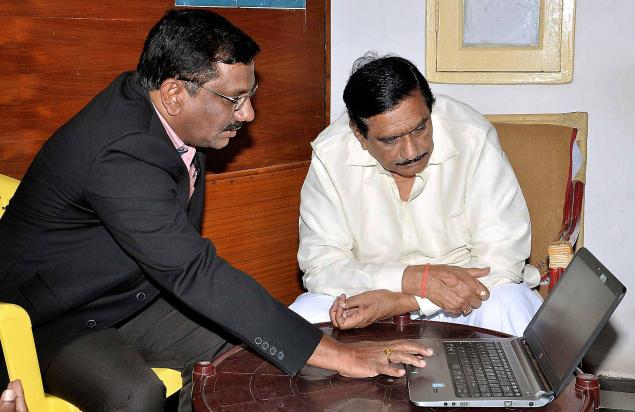
Deputy Chief Minister K.E. Krishnamurthy being briefed by CSIAP president P. Chandrasekhar (left)after the former launched the website in Kurnool on Saturday. - PHOTO: U. SUBRAMANYAM
Deputy Chief Minister K.E. Krishnamurthy being briefed by CSIAP president P. Chandrasekhar (left)after the former launched the website in Kurnool on Saturday. – PHOTO: U. SUBRAMANYAM

Deputy Chief Minister K.E. Krishnamurthy launched Cardiological Society of India Andhra Pradesh (CSIAP) chapter’s website www.csiap.com in Kurnool on Saturday..

CSIAP president P. Chandrasekhar explained the objectives of CSI to the Deputy Chief Minister and said it was the first chapter to bring out a website.

The society was split into Telangana and AP chapters consequent upon the bifurcation of the State, said Mr Chandrasekhar. The CSIAP chapter’s first annual conference would be held at Mangalagiri in Guntur district on July 18 and 19, he said.

CSIAP chapter’s first annual conference will be held at Mangalagiri in Guntur district on July 18 and 19.

source: http://www.thehindu.com / The Hindu / Home> News> National> Andhra Pradesh / by Special Correspondent / Kurnool – June `14th, 2015