Category Archives: Records, All

Raja Durbar held to continue legacy

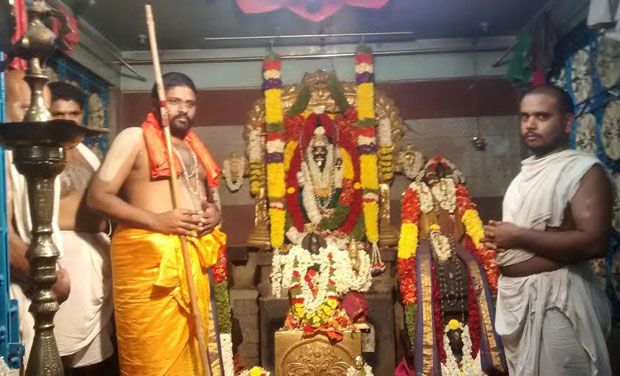
Pontiff Sri Vidyamanohar Teertha of Vyasaraja Math conducts Raja Durbar in Anantapur. (Photo: DC)

Anantapur:

A 494-years of spiritual legacy of a saint ruler saved not just the life of Vijayanagar emperor Sri Krishnadevaraya but also a dynasty. The saint was none other than Guru Vyasaraja Swamy, who was mentor for five generations of Vijayanagar kings.

Guru Vyasaraja Swamy had saved Sri Krishnadevarya on 30-01-1521 from Kuhu Dosha (adverse impact on king’s personnel horoscope). The adverse impact of it would have resulted in a snake biting the emperor at his throne.

But, Vyasaraja Swamy burnt the snake with his extreme power as he sat on the simhasan during a particular kuhudosa period. The Vyasaraja math of Sosale celebrates Raja Durbar every day since 1521 to commemorate the incident. Anantapur Vyasaraja Math was venue for grand celebration of incarnation of Saint Vyasaraja Swamy of his 494th year on Sunday.

Emperor Sri Krishnadevaraya offered his throne to the saint, who ruled for 36 minutes in which he passed orders for construction of many tanks and 732 temples of Lord Hanuman in the country.

JNTUA principal K. Prahlada Rao said the durbar has been conducted every day for 494 years by pontiffs of Sri Vyasaraja math, whose period was golden age in south India. Pontiff Sri Vidyamanohar Teertha of Vyasaraja Math conducted Raja Durbar at Anantapur after occupying the Simhasan on Sunday. Speaking on the occasion, Swamiji hoped good rains in Rayalaseema region.

source: http://www.deccanchronicle.com / Deccan Chronicle / Home> Nation> Current Affairs / Deccan Chronicle / August 04th, 2015

Masula scientists develop salinity-resistant paddy seed

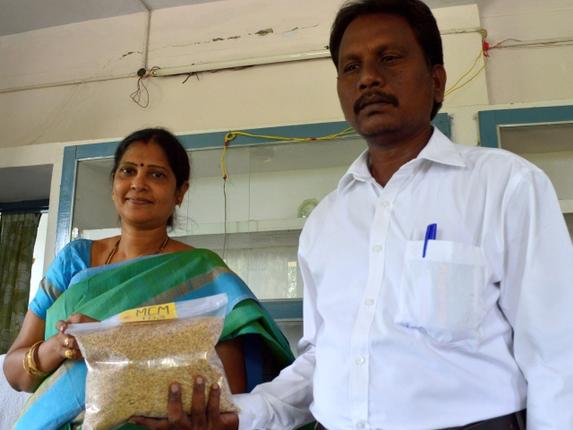
Scientists of Agricultural Research Station display MCM-103, a new paddy seed variety at Machilipatnam in Krishna District. Photo: T. Appala Naidu / The Hindu

The seed varieties developed by Principal Scientist T. Anuradha and Scientist K. Nagendra Rao are MCM 103, a Kharif variety and Rabi variety MCM110, which are sanity resistant.

Plant breeding scientists of Acharya N.G. Ranga Agricultural University’s Research Station at Machilipatnam have developed two new paddy seed varieties, exclusively meant for saline soil and the 10-year research has yielded expected results.

The seed varieties developed by Principal Scientist T. Anuradha and Scientist K. Nagendra Rao are MCM 103, a Kharif variety and Rabi variety MCM110. The duration of crop period of the varieties is 140 and 120 days respectively.

“The Directorate of Rice Research (DRR), Hyderabad, has tagged the MCM 103 as the best paddy seed variety among the 40 entries from across the country in 2013. The DRR has also tested the variety in the six states, where it gave expected results including yield and quality grain”, T. Anuradha told The Hindu.

“The MCM-103 seed variety gives nearly six tonnes of yield while the MCM-110 gives up to 5.5 tonnes per hectare”, she added. The scientists have claimed that the yield of the two varieties would arguably be much higher in the normal soil. Another Scientist K. Nagendra Rao added that the MCM 103 is being tested in the saline fields in the coastal Andhra districts from the ongoing Kharif season and the other variety would also be tested from the next Rabi season in the State.

The District Agricultural Advisory & Transfer of Technology Centre in the respective districts in the State had selected the fields to test the seed varieties from the Kharif-2015. “The medium duration paddy varieties will primarily encourage the farmers to turn the saline soil fields into cultivable fields. The varieties will also ensure better yield”, opined Ms. Anuradha.

Farmers indebted to scientists:

The farmers having saline soil are indebted to the scientists, said Ms. Anuradha and Mr. Nagendra Rao, who had developed two paddy seed varieties – MCM 100 and 101- in 2011. It has been proposed for seeking approval of the Andhra Pradesh State’s Seed Varietal Release Committee for final release of the two varieties into the market.

source: http://www.thehindu.com / The Hindu / Home> News> Cities> Vijayawada / by T. Appala Naidu /Machilipatnam – July 31st, 2015

Annavaram Sells 12.5 Lakh Laddus in 9 days, Sets New Record

Rajahmundry :

Probably for the first time in its history, Sri Satyanarayana Swamy Temple at Annavaram has set a record of sorts through sale of over 12.5 lakh laddus within nine days from July 14 to 22.

Thanks to the ongoing Godavari Maha Pushkarams, the temple is receiving an unprecedented rush of devotees for the past 10 days.

Through the sale of laddu packets, which cost Rs 10 each, the Annavaram Temple raked in Rs 1.25 crore.

On Wednesday itself, about 90,000 devotees had darshan of Lord Sri Satyanarayana Swamy at Annavaram. Like the ‘Tirumala laddu’ of Lord Venkateswara, the prasadam of Sri Satyanarayana Swamy is also popular among devotees.

source: http://www.newindianexpress.com / The New Indian Express / Home> States> Andhra Pradesh / by Express News Service / July 24th, 2014

School alumni make their promise good

MLA P.G.V.R. Naidu unveiling a plaque to mark the inauguration of a stage at ZP Girls' High School at Gopalapatnam on Wednesday.
MLA P.G.V.R. Naidu unveiling a plaque to mark the inauguration of a stage at ZP Girls’ High School at Gopalapatnam on Wednesday.

The resolve of SSC 1974 batch students of Gopalapatnam ZP High School has quickly materialised into a permanent asset for the Girls High School.

The batch announced that it would create an asset for the school during its golden jubilee in February 2015. The golden jubilee was celebrated for three days with Visakhapatnam West MLA P.G.V.R. Naidu, being himself an alumnus of the school, taking a lot of interest and organising the event in a big way.

Though the contributions of 1974 batch were then only Rs. 70,000, they committed themselves to spending Rs 1 lakh. When they had approached headmistress Swarnalatha on the amenities lacking, she wanted a permanent stage to be constructed.

However, when work was taken up the cost for the stage with roof rose to Rs. 2 lakh. Pursuing the work a few old students had begun it and completed it in a few months.

Inaugurating the stage on Wednesday, Mr. Naidu said the fruits of golden jubilee were tangible much quicker than expected. He hoped other batches of old students would follow the example of 1974 batch that was expressing their love for the alma mater after a full 40 years.

Several old students participated.

source: http://www.thehindu.com / The Hindu / Home> News> Cities> Visakhapatnam / by G. V. Prasada Sarma / Visakhapatnam – July 23rd, 2015

Civils Ranker Felicitated

Vijayawada  :

Venkata Ramakrishna Teja, an alumni of Narasaraopeta Engineering College in Guntur district, who secured 66th rank in the Civil Services exam was felicitated by the college management Saturday.

Teja had completed Computers Science engineering from the college 2009. A native of Chilakaluripet of Guntur district, he was an active and hardworking student.

Speaking on the occasion, Teja said students from rural background can also achieve success in the civils exams.

College chairman Mittapalli Koteswara Rao said the college is proud of Teja, who will now be an IAS officer.

source: http://www.newindianexpress.com / The New Indian Express / Home> States> Andhra Pradesh / by Express News Service / July 12th, 2015

Goddess Gayatri Devi’s footprint discovered


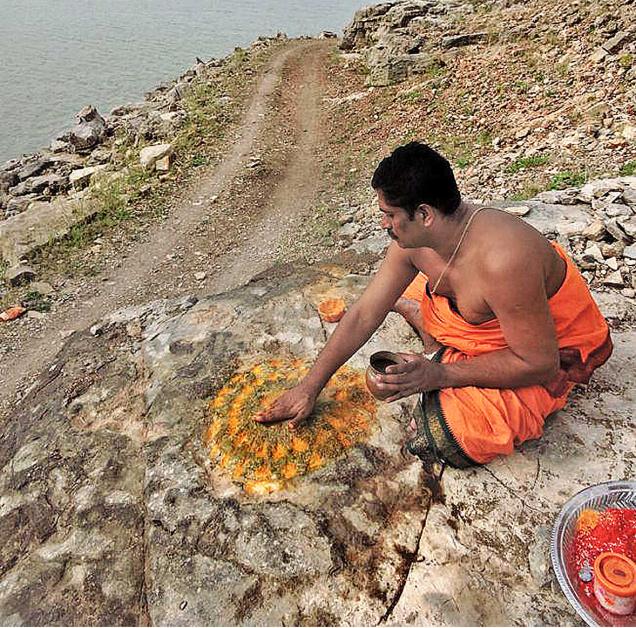
Vedic pandit Telakapalli Raghurama Sarma applying turmeric near Sangameswara Temple in Kurnool district.

A footprint of Sri Gayatri Devi, who, according to scriptures, appeared in the form of Gomatha to sage Viswamitra during his penance in Tretayugam, was discovered in the Viswamitra cave atop a hillock on the banks of Krishna at the Sri Sangameswara temple in Atmakur forest division in Kurnool district.

Quoting the ‘Skanda Puranam’, Telakapalli Raghurama Sarma, Vedic pandit of Sri Sangameswara temple, said he had discovered the footprint, applied turmeric to it and offered prayers to the idol of Sri Rama in the cave.

Recounting history, Sarma said the government had initially proposed the construction of an anicut for the Srisailam project at Siddheswaram in 1948, but subsequently built the dam at Srisailam in 1963. “As many as 100 villages were submerged following the construction of the project,” he added.

As water depleted in the reservoir this year, the footprint surfaced in the cave, Sarma said. On sighting the footprint on a stone near Chajratheertham, the pandit applied turmeric on it improving its visibility.

source: http://www.thehindu.com / The Hindu / Home> National> Telangana / by Special Correspondent / Kurnool – July 12th, 2015

First village museum to come up at Mukkollupadu

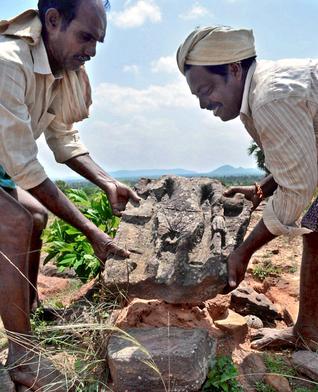
Local residents collecting objects of historical importance at Mokkollupadu.— Photo: T. Appala Naidu

The School of Planning and Architecture (SPA), Vijayawada, in support of the IIT-Mumbai’s Design and Innovation Centre is developing the country’s first village museum at Mukkollupadu of Nuzvid mandal in Krishna district.

The villagers, led by Vijayawada Police Commissioner A.B. Venkateswara Rao, on Sunday collected a range of sculptures and other artefacts lying in and around the village to preserve them at the museum. The historically important remains collected for the museum include those belonging to the period between the 2nd century B.C (Pre-Satavahana period) and the 6th Century AD.

“India’s first participatory village museum will be built and opened for public by the end of August. The villagers have started collection of historical important relics and statues on Sunday,” SPA-V Director Professor N. Sridharan told The Hindu .

“Enthusiasm among the locals to realise the dream of developing the museum is inspiring us,” added Mr. Sridharan and his team.

The Mukkollupadu Panchayat authorities have spared a piece of land for the museum, in which locals have assembled several sculptures found at a burial ground belonging to the Palaeolithic period.

Mr. Venkateswara Rao, who adopted the village, monitored the task of assembling of a few red-stone sculptures at the proposed museum site on Sunday.

“We will be geo-tagging the sculptures and maintaining a data and history of the relics as a part of conservation and promotion of the local history,” Mr. Venkateswara Rao told The Hindu .

The SPA-V experts, who are designing the museum, will also welcome the Nuzvid Veena makers to put their works at the museum to revive the art form from its slow death.

India’s first participatory village museum will be built and opened for public by the end of August.

N. Sridharan / SPA-V Director

source: http://www.thehindu.com / The Hindu / Home> National> Andhra Pradesh / by T. Appala Naidu / Mukkollupadu (Krishna) / July 07th, 2015

Jain memorial being planned at Konakondla

With the State government refusing to spend any funds on researching further into the Jain inscriptions at Konakondla and develop the village into a tourist attraction, the Bharat Varsheeya Digambara Jain Thirthakshetra Committee (BVDJTC) has come forward to develop the same spending crores of rupees.

A congregation of over a hundred people belonging to the Jain community at the village in the Vajrakaruru mandal of the district has decided to build a memorial in the name of Acharya Kondakunda besides the construction of a residential vidyapeeth (a place of learning) to teach, research and propagate his teachings.

Speaking to The Hindu , Mr R.V. Chakravarthi, credited with finding out these Jain religious places almost five decades ago in Konakondla, said that Acharya Kondakunda, who wrote the Jain religious texts — Pachastikayasara, Pravachanasara, Samayasara, Niyamasara and Barasanuvekkha — was also the author of the famous Tamil treatise ‘Tirukkural’, otherwise known to be written by famous Tamil poet Thiruvalluvar.

“Since Kondakunda, also known as Padmanandi, born in this village (Konakondla) was a Digambara, of no less a stature than that of the famous Gomata in Shravanabelagola in Karnataka, he sent his disciple Tiruvalla Nayanar to present the treatise to saints including that of the famous Avvaiyar of Sangam period, who mistook Tiruvalla Nayanar to be the author of the treatise,” said Mr Chakravarthi, speaking to a rapt audience at Konakondla.

The Bharat Varsheeya Digambara Jain Thirthakshetra Committee decides to build a memorial in the name of Acharya Kondakunda besides the construction of a residential vidyapeeth (a place of learning) to teach, research and propagate his teachings at the village

source: http://www.thehindu.com / The Hindu / Home> National> Andhra Pradesh / by V.K. Rakesh Reddy / Anantapur – July 07th, 2015

Grand dame of Vizag takes a trip down memory lane

Duvvuri Lalithamba is no ordinary woman. At 101, she has witnessed the transformation of the Port City from a sleepy town to the smart city of the future. The daughter of Sir Vepa Ramesam, who was the Chief Justice of the Madras Presidency and founder of the Neo-Malthusian Society, Lalithamba bears testimony to almost all the historical events, including the independence movement, bombing of Vizag by the Japanese and sinking of PNS Ghazi off the city’s coast in 1971.

As one of the founders of the Vizagapatam Ladies Club, Lalithamba is credited with organizing theatre and dance performances, including one by Bollywood star of yesteryears, Waheeda Rehman, in the city much before she became a star. In a tete-a-tete with Venkatesh Bayya of TOI, the grand dame of Vizag speaks about the developments that the city has seen in the last eight-and-a-half decades.

What was Vizag like back in the early 1930s?

Though a culturally advanced town blessed with a large population of educated people, Vizag was yet to find its own place on the map. Back then, it was popular with tourists, many of whom were landed gentry from Andhra, Odisha and Tamil Nadu. The locals and the wealthy also contributed to its languid grace and pace.

When and how did it evolve into a city?

It all started with the naval base coming up after the first world war. Then came Andhra University and the establishment of the Visakhapatnam Port Trust. With the city getting electrified in the mid-1930s, my husband DV Ram Murthy, who belonged to a landed family from East Godavari, was one of the first entrepreneurs to set up Lumen Electricals taking advantage of the introduction of electricity. Many people also benefitted from the setting up of the shipyard and Caltex, the present day HPCL. But all this has come at a cost. Vizag was once the summer capital of the Madras Presidency as temperatures never shot up beyond 30 degrees Celsius. But today the greenery is gone. The city has become an industrial hub and far more polluted than it ever was.

Do you remember the Japanese bombing of 1942?

We were living on the main road of the Old Town. Japanese fighter aircraft bombed the port area during the day. The city turned into a fortress, sirens were sounded all the time and the residents subjected to drills. Most of the bungalows and mansions were taken over by the military and Vizag turned into a massive military camp with soldiers from Australia, Canada and New Zealand. There were more anti-aircraft guns than people in some areas. The supply of electricity was restricted. For the first time in my life I witnessed an exodus. Most of the residents left for the neighbouring towns and villages. My husband, however, was asked to stay back to take care of the lighthouse and the electrical equipment in the port. He convinced me to move to Kakinada for a short while but I returned to Vizag and continued to stay with him.

What about the submarine attack by Pakistan in 1971?

That was totally different from the 1942 bombing. We were all taken by surprise. Those days we were living near the beach and heard a massive explosion one day. The window panes were shattered and we knew we were under attack. Later, the Navy said the Pakistani submarine Ghazi had come too close to the port and was sunk by the navy.

Have you witnessed any other cyclones like Hudhud?

We faced a cyclone in the mid-1920s when the entire town was flooded. The backwaters, which now constitute the core port area, literally flooded all of Old Town and other low lying areas. It was scary then, but Hudhud was equally scary, taking the wind speeds into account. I have also heard of an equally scary cyclone in the late 19th century.

Do you carry any baggage of being Vepa Ramesam’s daughter, Sir SV Ram Murthy’s niece and the grandniece of Sir CY Chinthamani? What was your father’s influence on you?

I do not carry any baggage and neither did my father. In fact when India gained independence, he was the first of the knights to get rid of the title. My father taught all of us to make maximum use of our mental faculties and encouraged us to take part in sports. Despite shifting to Madras to practice in the Madras High Court, he always loved Vizag. His father, Rao Sahib Vepa Lakshmi Narsimham, was a judge and the Commissioner Inams of the Madras Presidency. My grandfather’s house on the main road of Old Town originally housed the East India Company Writers. It had four courtyards with barns and stables in the backyard.

What about your contribution to the cultural scene in Visakhapatnam?

Well, I was active at a time when Vizag was undergoing a massive change. It was turning into a modern city and movies were making their presence felt. At the same time, the freedom movement was on and we were all inspired by Gandhi’s ideals and zeal. During this period, the Vizagapatam Ladies Club organised many socio-cultural events and we tried to engage women in social dialogue concerning various issues. I also set up the first self help group for women in the state and collaborated with the Andhra Mahila Sabha to ensure financial independence of women.

How do you describe your life?

Well lived!! As for my body, I have decided to donate it to the KGH for research purposes. I do not wish to be cremated.

source: http://www.timesofindia.indiatimes.com / The Times of India / Home> City> Visakhapatnam / TNN / July 06th, 2015
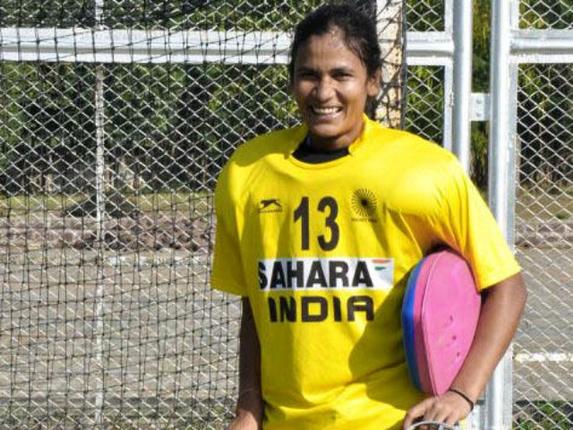
Women’s Hockey: Soundarya, Rajani script history

They are the first women hockey players from AP and TS to join the Indian team, which qualified for the 2016 Rio Olympics.

Yendala Soundarya
Yendala Soundarya

Yendala Soundarya and Etimarpu Rajani scripted history by becoming the first-ever women hockey players from Andhra Pradesh and Telangana to be members of the Indian team which qualified for the 2016 Rio Olympics.

 Etimarpu Rajani
Etimarpu Rajani

The last time India played in Olympics was in the 1980 edition when it was given a direct entry because of the boycott led by USA in the Moscow edition.

India made it to the next edition of Olympics (for the first time after 36 years) by virtue of defeating Japan 1-0 in the play-off match for the fifth place and both Ms. Soundarya and Ms. Rajani were part of the team in the World Cup semi-final league matches in Belgium.

Ms. Soundarya says she is delighted. “This is one of the finest moments in my career. We are all so happy that our biggest dream is coming true,” said both Ms.Soundarya and Ms. Rajani in a chat with The Hindu in Belgium.

For someone who took to hockey watching seniors and playing for India since 2006, the 25-year-old Ms. Soundarya was also a member of the Indian team, which won the silver in the Senior Asia Cup and the Champions Trophy.

Ms. Soundarya says that the team was confident in today’s crucial match. “Hats off to my teammate Rani Rampal; we emerged winner. And we are in celebratory mood right now,” she said in a voice choked with joy.

“I owe my success to my first coach Maqbool in Nizamabad and then to the SAI coaches, including Gloria, at the SAI Centre in Hyderabad, where I trained for five years,” the star player recalled. “Right now, no major event is scheduled and since we have qualified for the Olympics, some events may be lined up,” she said.

“I feel honoured to play for India, coming from a place like Nizamabad (she was a student of Modern Public School) which has no history of hockey players,” Ms. Soundarya exclaims.

Achievements not a surprise

SAI hockey coach P. Madhukaran, who was earlier the Indian women’s World Cup coach, recalls the abundance of talent these girls have shown in their formative years.

“Their achievements are not a surprise to me given their commitment and sincerity to keep improving,” he says.

source: http://www.thehindu.com / The Hindu / Home> National> Andhra Pradesh / by V. V. Subrahmanyam / Hyderabad – July 06th, 2015