Category Archives: Records, All

A.P inks pact with Japan for development of Capital city

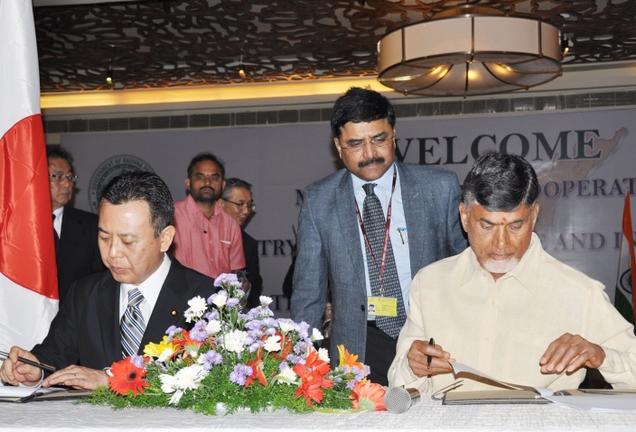
Andhra Pradesh Chief Minister N. Chandrababu Naidu signing a Memorandum of Cooperation with Japan State Minister of Economy, Trade and Industry (METI) Yosuke Takagi on development of new capital and industry in Vijayawada on Thursday.

Under the pact, an Andhra Pradesh Investment Task Force (APITF) will be set up in Japan for accelerating industrial development in A.P.

Japan State Minister of Economy, Trade and Industry (METI) Yosuke Takagi and Andhra Pradesh Chief Minister N. Chandrababu Naidu signed a Memorandum of Cooperation on development of new capital city of A.P. and industry cooperation here on Thursday.

Under the pact, an Andhra Pradesh Investment Task Force (APITF) will be set up in Japan for accelerating industrial development in A.P. It is a part of the MoC between Japan and Government of A.P that will facilitate further investments by the Japanese companies in the State.

Japan Ministries of Land, Infrastructure, Transport and Tourism, Agriculture, Forestry and Fisheries, Japan Bank for International Cooperation (JBIC), Japan External Trade Organization (JETRO), Japan International Cooperation Agency (JICA) and New Energy and Industrial Technology Development Organization (NEDO) have partnered with the METI.

A.P has requested the Japanese Government to extend technical assistance for developing a masterplan on such strategic sectors as transportation infrastructure in the new capital area.

The JICA has chosen transportation for extending technical assistance. The other Japanese multilateral funding agencies will help A.P Government in development of seaports, food value chains, ultra-supercritical coal-fired power plants, renewable energy projects and smart cities among others.

Later, JBIC Director General (Social Infrastructure Department) Noriko Nasu and A.P Principal Secretary (Finance) P.V. Ramesh signed a MoU for facilitating foreign investments in A.P.

On the occasion, Mr. Takagi said he was happy to be associated with the development of A.P and that he looked forward to a large scale participation in what is going to be India’s Gateway to the East Asian countries.

Mr. Naidu requested the Government of Japan to make investments in a big way in the Capital Region particularly in urban development, seaports and other sectors which had tremendous untapped potential.

source: http://www.thehindu.com / The Hindu / Home> National> Andhra Pradesh / by V. Raghavendra / Vijayawada – October 22nd, 2015
Adilabad police officer is first Indian woman to scale Kun

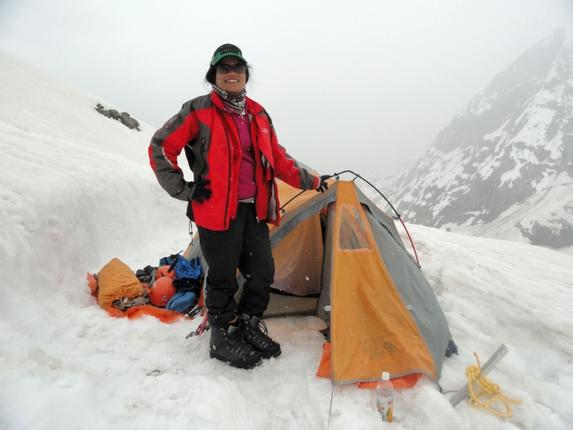
Adilabad Additional Superintendent of Police G.R. Radhika at a tent on her way to the summit of the Kun mountain in Jammu and Kashmir. - Photo: By Arrangement
Adilabad Additional Superintendent of Police G.R. Radhika at a tent on her way to the summit of the Kun mountain in Jammu and Kashmir. – Photo: By Arrangement

Adilabad Additional Superintendent of Police G.R. Radhika performed the feat on September 7 after a gruelling climb for over 10 days.

As any mountaineer would do, G.R. Radhika, the frail-looking police officer in Adilabad District of Telangana also swears by Sir Edmund Hillary’s belief, “It is not the mountain we conquer but ourselves.” And her concurrence with the legendary mountaineer does matter as she has become the first Indian woman to conquer the 7,077-metre Kun mountain, the twin of Nun, located in the inhospitable Zanskar range of Himalayas in Jammu and Kashmir.

Adilabad Additional Superintendent of Police performed the feat on September 7 after a gruelling climb for over 10 days. The Indian Mountaineering Foundation subsequently declared her to be holding the record for an Indian woman.

“I am a bit of a risk taker,” reveals Ms.Radhika about her personality which evidently craves for challenges that go beyond the ordinary ones faced by women. “I was brought up more like a boy than a girl,” says the younger one of the two children of a teacher couple as she tries to reason out her craving for adventure.

She likes to accept challenges which is why she quit her earlier job as an English language lecturer and took up policing. Despite her inclination, there was nothing to write home about in her 8 years as a cop until the opportunity to climb the rugged mountain came her way.

It was in 2012 that this mother of two children belonging to Anantapur District in the Rayalaseema region of Andhra Pradesh, her birth place and Kadapa, where she grew up, got to know about mountaineering as a sport. One of her friends suggested she get trained in mountain climbing after she successfully completed the difficult pilgrimage to Mount Kailash and Mansarovar in the Himalayas, Radhika recalls.

This set in motion her as yet short yet illustrious association with the sport. She finished her basic and advanced mountaineering courses which was, among other things, a confidence-building exercise.

“As part of the course I climbed the 5,980 mtr high Golep Kangri peak, also in the harsh Zanskar range in 2013,” Radhika states. “The following year, I scaled the 6,443 mtr high mount Menthosa in Himachal Pradesh which was all technical climbing,” she adds.

The policewoman enrolled herself for the Kun expedition with a recognised mountaineering outfit and set off towards it in the latter half of August. The team consisted of 7 muntaineers, some of them much experienced.

“Five of them dropped out on our way to the peak,” Radhika remembers trying to drive home the point about the difficulty quotient which even had her lose 4 kg of her weight. “Kun is considered more difficult because of its numerous crevasses and the ‘walls’ which meant a vertical climb of even 300 mtr at some place with a load of 6 kg,” she shrugs off a shudder as recent memories came flooding back.

Having seen her team mates back out did not diminish the gutsy woman’s enthusiasm in any way though she swears that it was only will power that kept her driving towards the peak. “The peak was visible but seemed ever so far thanks to he fatigue,” she recalls of her final effort.

“It took a few seconds for the feeling of victory to register,” she observes of the moment when she made it to the top. “I felt happy when it was confirmed that I was the first Indian woman to achieve the feat,” she adds, a wide grin breaking on her face.

Radhika is seriously contemplating making an attempt at scaling Mount Everest. “I have not decided as yet but I am definitely inclined to do so,” she asserts.

source: http://www.thehindu.com / The Hindu / Home> News> National> Telangana / by S. Harpal Singh / Adilabad – October 04th, 2015

JNTUK faculty achieves fourth patent for microbes

Assistant Professor and Head of the School of Biotechnology, Jawaharlal Nehru Technological University, Kakinada, Ramesh Malothu, has achieved fourth patent and the Microbial Type Culture Collection and Gene Bank (MTCC) microbial culture deposition on ‘Mutant Aspartate Kinase Gene from Coryne Bacterium Species and its application for production of L-Lysine.’

“It is all about the mutations in coryne bacterium species has made specific change in Aspartate Kinase (AK) gene.

Due to the change in the AK gene, the expression levels of L-Lysine are enhanced. L-Lysine is an amino acid which is essential for both human and animals, but it is not supplied to the body in required quantities,” Dr. Ramesh said on Tuesday.

source: http://www.thehindu.com / The Hindu / Home> National> Andhra Pradesh / by Staff Reporter / Kakinada – September 30th, 2015

First ‘Teloogoo’ translation of Bible happened in Vizagapatam

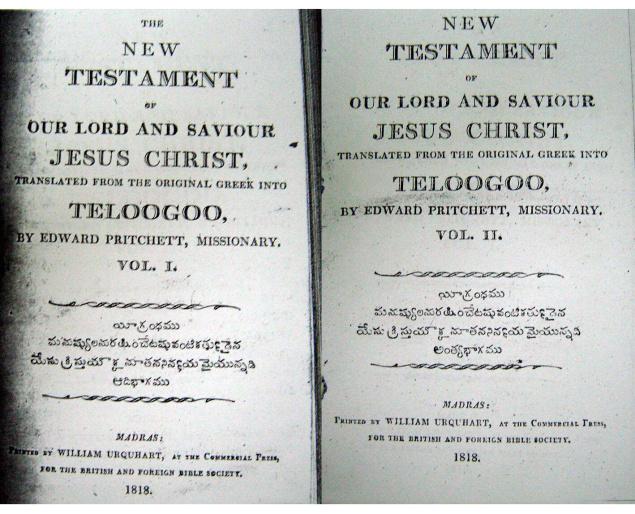
A view of the inside cover page of the New Testament that was first translated and printed in Telugu in 1818.—Photo: Special Arrangement

The world celebrates September 30 as the International Translation Day to commemorate the feast of St. Jerome, who was the first to translate the Bible from Hebrew to Latin.

Coming to translation, Vizagapatam (Visakhapatnam as then called by the British) has a page in the history of this crafty art.

It is in this once sleepy fishing town that the Greek version of the New Testament of Bible was first translated into ‘Teloogoo’ (Telugu, as then spelt by the Englishmen) in the early part of the 19th century.

History records that Rev. Benjamin Schulz was the first to translate parts of the Bible into the native Telugu language in the early part of the 18th century, and the manuscripts were sent to Halle in Germany for printing.

It is unclear as to what had happened to the manuscripts, but they were not printed.

Later, in 1805, two missionaries from the London Missionary Society, George Cran and Augustus de Granges, landed in Vizagapatam, with the task of providing English education to native children and to reproduce the Bible in the native tongue.

They first started a school within a fortnight of their arrival. Their subsequent efforts resulted in starting of an Anglo Vernacular School in 1836, which is still in existence by the name CBM High School.

For accomplishing the second goal, the missionaries took up learning Telugu and in two years mastered the language.

But it was in 1808 that a Maratha Brahmin by name Subba Rayer, who worked as accountant in Tippu Sultan’s army, joined them.

Subba Rayer, a native of Tranquebar (now called Tarangambadi in Tamil Nadu), converted to Christianity and changed his name to Anand Rayer.

An exponent in Telugu and Tamil, Anand Rayer moved to Vizagapatam to assist the missionaries.

In 1808, George Cran passed away and in 1810 Augustus de Granges too died.

But Anand Rayer did not lose hope. By that time, three gospels, namely Matthew, Mark, and Luke, had been completed and were ready for printing.

He took the manuscripts to William Carey at Seerampore in Bengal, who had by then translated the Bible into Bengali.

Though it was only part of the New Testament, the first-ever printed version of the Bible in Telugu was printed in 1812.

Later, Anand Rayer was joined by Rev. Edward Pritchett in Vizagapatam in 1812, and both took up translating the full version of the New Testament. And the first full print of the New Testament in Telugu came out in 1818. The full version was printed in Madras.

According to Mr. Edward Paul of INTACH, who researched on this subject, only three original copies of the first printed Telugu Bible are available now. While one is in the British Library in London, the other two are in United Theological College, Bengaluru, and with a seller of old books in the U.S.

Basing on the contribution made by Anand Rayer, the Bell at London Mission Memorial Church in Visakhapatnam is named after him as ‘Ananda Sunadam’

George Cran and Augustus de Granges paired up with Anand Rayer to translate a part of the New Testament. It was printed in 1812. Later, Anand Rayer teamed up with Rev. Edward Pritchett and printed the full version in 1818

Acknowledging the contribution made by Anand Rayer, the Bell at London Mission Memorial Church in Visakhapatnam is named after him as ‘Ananda Sunadam’

source: http://www.thehindu.com / The Hindu / Home> National> Andhra Pradesh / by Sumit Bhattacharjee / September 30th, 2015

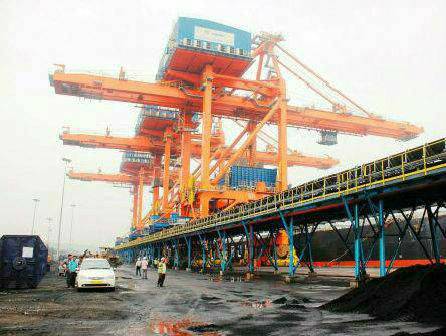
VPT handles fully laden Panamax vessel

Andhra Pradesh ranks first in value terms in port projects that are in under construction in public-private partnership mode as of April 30.

Visakhapatnam  :

The VPT on Monday handled its first ever gearless Panamax vessel MV Navios Centaurus carrying 74,1000 MT petroleum coke for Andhra Cements and Ambuja Cements.

The vessel, with a length of 229 metres and draft of 14 metres, was berthed in the inner harbour at EQ-8 of Vizag Seaport Private Limited.

Terming the berthing of the fully laden Panamax vessel in the inner harbour as a milestone, VPT chairman MT Krishna Babu said users will benefit immensely by way of substantial freight savings on account of reduced waiting time and improved turnaround time.

With VPT taking up dredging work from May 2013 at a cost of Rs 250 crore, the depth of the inner harbour is now around 16 metres, enabling it to handle fully laden Panamax vessels. tnn

source: http://www.timesofindia.indiatimes.com / The Times of India / News Home> City> Visakhapatnam / TNN / September 29th, 2015

Just a day away for historic moment at Ferri

Villagers in Nunna on the outskirts of Vijayawada are a happy lot with River Godavari set to flow into the Krishna as part of the Krishna-Godavari Interlinking project.PHOTO: V RAJU

Celebrations planned to mark the inter-linking of Godavari-Krishna rivers

It is just a day away for the historic moment of River Godavari interlinking with River Krishna and elaborate arrangements are being made by the district administration to celebrate the grand occasion near the confluence point at Ferri village in Ibrahimpatnam on the city outskirts on Wednesday.

More than 3,700 buses are being arranged to transport over 1.5 lakh farmers and women from across the State to participate in the programme. Chief Minister N. Chandrababu Naidu will be formally operating the pump to link the both the rivers at Ferri village on the banks of River Krishna.

He will be performing special pujas at the confluence point and lay foundation for a pylon to mark the occasion. Later, he will be addressing a public meeting at a 20-acre open site in the village. Collector Babu A is monitoring the arrangements and directed the officials to provide ample parking space for RTC buses and other vehicles arriving from different districts.

Meanwhile, Godavari water, which was released from Tadipudi lift irrigation project in West Godavari district, reached Nunna through Polvaram Right Main Canal on the city outskirts. The water will be flowing into Prakasam Barrage via Balerayudu tank, Pachivagu, Budameru Diversion Canal and NTPPS canal.

Irrigation officials have curtailed the flow of water at different points to ensure free flow of water from the canals during the ceremony. However, they explained that water was being curtailed to ensure that minimum level of water was maintained in the canal as it was a trial run.

Officials informed that the water would be reaching the Budameru Diversion Canal by Tuesday evening and would be eventually flowing into the NTPPS Canal. Officials in West Godavari had released about 600 cusecs of Godvari water from Tadipudi on September 1 into the Polavaram Right Main canal. They said there would be a transmission loss of about 15 per cent due to seepages and evaporation in the newly constructed canal.

source: http://www.thehindu.com / The Hindu / Home> News> Cities> Vijayawada / by S. Sandeep Kumar / Vijayawada – September 15th, 2015

Prestigious Award for Defence Scientist G Satheesh Reddy

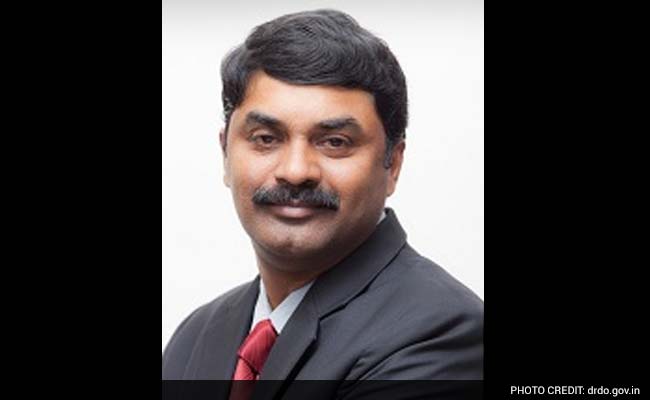
File Photo: G Satheesh Reddy /

Hyderabad : 

The Royal Aeronautical Society (RAeS), London has conferred G Satheesh Reddy, Scientific Adviser to the Defence Minister, with the Society’s 2015 Silver Medal for work contributing to major advances or contributions in aerospace.

Mr Reddy is the first Defence scientist working in India to be honoured with the prestigious “Silver Medal” of the Society, according to a release.

“This award is in recognition of your contributions as one of the leading navigation and avionics experts in India, under whose leadership India has developed state-of-the-art avionics sensors and systems for key national strategic programmes and other defence applications,” a letter addressed to Mr Reddy from the Society said.

The award will be formally presented with your medal, at the Wilbur and Orville Wright Lecture to be held on December 9 in the Society’s headquarters in London, it said.

RAeS is the world’s only professional body dedicated to the entire aerospace community. Established in 1866 to further the art, science and engineering of aeronautics, the Society has been at the forefront of aerospace ever since.

The Royal Aeronautical Society has been honouring outstanding achievers in the global aerospace industry since 1909, when Wilbur and Orville Wright came to London to receive the Society’s first Gold Medal, the release added.

source: http://www.ndtv.com / NDTV / Home> All India / Press Trust of India / September 12th, 2015

Peek into shared bonhomie

This is a historic day for Australia and India as it coincides with the launch of the first edition of bilateral maritime exercise in the city

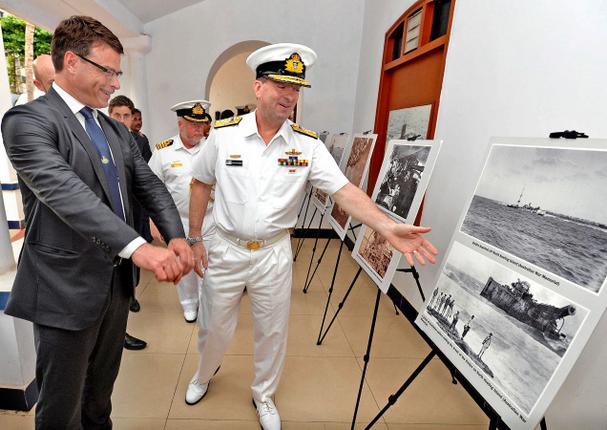
Australian High Commissioner to India Patrick Suckling, accompanied by head of Navy Capability of Australian Navy Rear Admiral Jonathan Mead, goes round the photo exhibition organised by the Australian Government at Visakha Museum in Visakhapatnam on Saturday. —Photo: K.R. Deepak

Some century-old photographs of Madras (now Chennai) that was bombed by German light cruiser SMS Emden showing the broken walls, and exploded and unexploded shells, some pictures of the daring German raider, and some of the wreck of SMS Emden are part of the week-long exhibition at the Visakha Museum on the Beach Road.

The photo exhibition, ‘Centenary of the Emden Spirit: 100 Years of Shared Military History’, organised by the Australian Government and Australian Consulate-General in Chennai was inaugurated by High Commissioner of Australia in India Patrick Suckling in Visakhapatnam on Saturday.

“This is a historic day for Australia and India as it coincides with the launch of the historic first edition of the bilateral maritime exercise AUSINDEX in the city,” Mr Suckling said speaking on the occasion.

Apart from the Emden incident, there are a large number of photographs on the bonhomie shared by Australian and Indian soldiers in different theatres of war during the two World Wars, and the recent interaction during the International Fleet Review in Sydney, among others.

Head of Australia Navy Capability Rear Admiral Jonathan Mead went round the exhibits in the museum and expressed his pleasure at the way they were maintained.

The exhibition focused on Emden as it was the first and the only time Indian city was attacked during the First World War. The German ship was finally defeated and sunk by the Royal Australian Navy ship HMAS Sydney at Cocos Island.

Incidentally, Emden was the first ship sunk by the RAN. This marked the beginning of a shared military history between the two countries. The exhibition will be on till September 23 during the museum’s timings.

source: http://www.thehindu.com / The Hindu / Home> National> Andhra Pradesh / by Special Correspondent / September 13th, 2015

Women scientists hail Manjula’s elevation

Hyderabad :

A woman defence scientist, having roots in Nellore district, has now become an inspiration for many women aspiring to work with the country’s defence establishments.

J Manjula, director of Defence Avionics Research Establishment (DARE), was on Thursday posted as the director general, Electronic and Communication Systems (ECS), at the Defence Research and Development Organisation (DRDO).This elevation makes her one of the top seven defence scientists in the country who report to the overall head S Christopher. It was only last year that Manjula was posted as director of DARE.

In fact, this is the second time in the span of a few months that Nellore district has seen one of its own being elevated to a position of eminence.

Before 53-year-old Manjula, it was Dr G Satheesh Reddy who made the district proud by being appointed as the scientific advisor to Raksha Mantri. He heads the Research Centre Imarat in Hyderabad.

Manjula’s appointed as DG has brought much cheer, especially among fellow women scientists. The “missile woman of India”, Tessy Thomas, was one of the first to congratulate Manjula. “It really is a great thing that Manjula has got to the top position. It was her sincerity and dedication to her work that led her to where she is now,” Tessy Thomas, director of Advanced System Laboratory , DRDO in Hyderabad told TOI. Manjula had worked at the Defence Electronics Research Laboratory in Hyderabad for more than 25 years in the field of electronic integrated warfare.”We are already seeing a lot of enthusiasm from college students towards science. We expect more would be interested in getting into defence research,” Tessy Thomas, who was the project director for Agni IV , said.

Manjula, a school principal’s daughter, was born in Nellore and did her schooling there. Later, she pursued her higher education in Osmania University in electronics and communication engineering. She worked with the Electronics Corporation of India Limited (ECIL) in Hyderabad before joining DRDO in 1987.

“She has been busy in meetings all through the day . She works till late in the night. Today she took over as the DG and after that was engaged in a video-conference,” an official at Manjula’s office in Bangalore said. Attempts to speak to her did not yield results as Manjula was said to be `extremely busy’ because of her new assignment.

source: http://www.timesofindia.indiatimes.com / The Times of India / News Home> Hyderabad / TNN / September 11th, 2015

City doctor suggests use of hypnosis as anaesthesia

‘The method has established itself well in the U.S.’

Some major and minor surgeries could be performed on a patient by sending him or her into a sub-conscious state by giving appropriate suggestions in a proper way through hypnosis, claims a city doctor.

This method would eliminate the complications associated with administration of anaesthesia and has no side effects, physician Sreehari said. Complications due to anaesthesia cannot be identified beforehand and hence sending a patient into a sub-conscious state would eliminate complications like anaphylitic reaction (reaction to a specific drug), sudden death, renal failure, respirator arrest, hypertension, etc.

Caesarean, hysterectomy, dental pain, removal of localised tumours, etc. could be performed this way but when to induce the patient into a sub-conscious state has to be planned.

“The effect has to be continued post-operative period till the patient is ready to be woken up,” Dr. Sreehari said at a press conference on Saturday.

“This method is some 100 years old and has established itself well in the US, while in India it is not being practised much though in 2003 the Union Ministry of Health permitted a patient to be taken into a sub-conscious state,” he said.

Publicity drive

To give publicity to this method of anaesthesia, Dr. Sreehari inducted 250 students of Presidency Degree College here into sub-conscious state on September 2, for about 20 minutes and entered the Guinness Book of World Records in the category of most persons anesthetised at a time.

source: http://www.thehindu.com / The Hindu / Home> Andhra Pradesh / by Special Correspondent / Visakhapatnam – September 06th, 2015