Category Archives: Nri’s / Pio’s

City man scales two mountains

KhasimRazaMPOs10aug2014

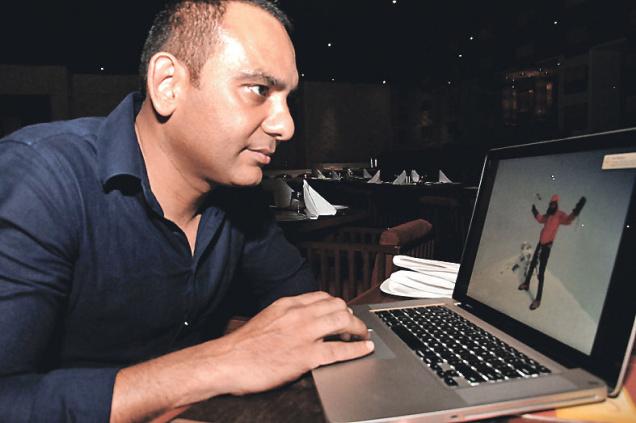
Khasim Raza conquers Mt. Elbrus, wants to climb all ‘Seven Summits’ by 2017. Though the ascent to the base camp which is at an elevation of 10,000 ft by chairlift is easy, it took nine days for his five-member team and guide to scale the mountain.

Vijayawada-born Khasim Raza made big news in the city when he climbed the Khilimanjaro, the highest free-standing mountain in the world. Now he is back in the limelight by conquering Mt. Elbrus the highest mountain in Europe. He plans to climb all ‘Seven Summits’ of the world by 2017.

It is the dream of every mountaineer to climb all seven mountains on the list. Mount Everest is the highest peak with an elevation of 29,020 feet. It is followed by Aconcagua (22,838 ft), McKinley (20,322 ft), Kilimanjaro (19,341 ft), Elbrus (18,510 ft), Vinson (16,050), Puncak Jaya (16,050 ft) and Kosciuszko (7,310). (The names of eight mountains are listed because there are two different lists of the Seven Summits. Mountaineer Bass lists Kosciuszko in his list, but mountaineer Messner lists Puncak Jaya in his list.)

Mr Raza did his schooling in N.S.M. Public School here and went on to become a British citizen.

He now operates with Dubai has his base. His father, owner of Metro Opticals in Gandhi Nagar, is one of the first opticians of the town. Mr Raza’s sights are trained next on Aconcagua, the second highest peak in the list, located in South America.

“Every mountain teaches you something. Kili (the affectionate way he refers to the mountain) taught me how to deal with wind speeds and high altitude, Elbrus taught me about cold. It is all snow and ice there,” he said.

Though the ascent to the base camp which is at an elevation of 10,000 ft by chairlift is easy, it took nine days for his five-member team and guide to scale the mountain. “We lived in accommodation that is similar to a container used for shipping goods. Every alternate day we went out on acclimatisation climbs. Unlike in Kili, the gradients on Elbrus are very steep,” he said. He says the view from the mountain slopes were really breathtaking.

Besides mountaineering, Mr Raza is every inch an adventure junkie. Just a couple of months ago he and some friends went on a cross-country cycling expedition in Cyprus. “I want to share my experiences to inspire youngsters to become more adventures and pursue challenges,” he said.

source: http://www.thehindu.com / The Hindu / Home> News> Cities> Vijayawada / by G. Venkataramana Rao / Vijayawada – August 09th, 2014

Indian Women Can Do Well in Business: SINDA Chief

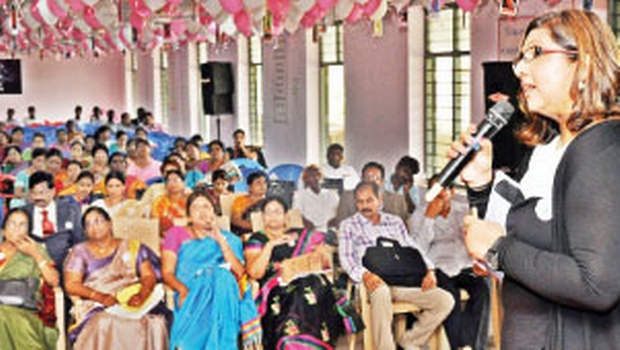
Singapore India Development Association (SINDA) head Renjala Balachandran speaking at a workshop on women entrepreneurship at the KBN College in Vijayawada on Wednesday | Express Photo

Vijayawada :

Singapore India Development Association (SINDA) head Renjala Balachandran said that Indian women were showing a lot of enthusiasm and energy and could make great progress in the field of entrepreneurship if provided with proper guidance.

Renjala Balachandran, who works in the field of women empowerment in Singapore, was present at KBN College in Vijayawada to participate in the seminar on ‘Women Entrepreneurship-A Global Perspective’  Wednesday. Speaking at the seminar, she stressed the importance of channelising women’s skills and entrepreneurial abilities for the development of economy and also to ensure gender equality.

The two-day UGC-sponsored seminar was aimed at discussing various topics on women entrepreneurship and empowerment. Krishna University VC V Venkaiah urged the students to be innovative and explore opportunities to succeed as entrepreneurs. Despite of a lot of progress, women’s representation in education, employment and entrepreneurship was still less in India. D Usha Rani, director of Centre for Women’s Studies, SV University, pointed out that though women were excelling in all fields and making their presence felt, they were facing a different set of problems.

Susheela Kaushik, co-chair, capacity building of women managers, UGC, Irfana Begum, project officer EduSAT, Vigyan Prasar, Delhi, AU Economics Department head Ratna Kumari, KBN College correspondent SVSM Razith Kumar, SKPVV Hindu High Schools Committee president R Ramaswamy and KBN College principal P Krishna Murthy were present.

source: http://www.newindianexpress.com / The New Indian Express / Home> States> Andhra Pradesh / by Express News Service / August 07th, 2014

Caribbean Islands lure Andhra Pradesh doctors with good pay

Picture for representational purpose (Photo: DC)

Guntur:

Doctors from AP are flocking Caribbean islands where they can earn up to $4,000 a month with an MBBS degree. Many doctors from Guntur, Vijaya-wada, Kurnool and Tirupati are now working in Jamaica, British Guiana, Trinidad & Tobago.

Dr Ravi Kishore Reddy of Guntur, who worked in a Caribbean nation, says, “Doctors are paid well. In T&T, out of 250 doctors, 200 are from AP.”

The local governments sign up doctors on five-year  contracts. “After five years, we get permanent  registration and after eight years, citizenship,” said Dr V. Siva Kota Reddy, an assistant professor in a medical college in Dominica.

However, things are changing. “Local governments are sponsoring students to study in Cuban medical schools. They are accommodating locals first, followed by Indians. The craze among local doctors to go to the US is slowly coming down,” he said.

Many AP students are joining MD course equivalent to MBBS in islands like Curacao. Dr Reddy cautioned that Indians may not be given  visas after studying the two-year pre-clinicals.

Several AP students are joining MD course equivalent to MBBS in islands like Curacao. These are offshore colleges where first two years of pre-clinical is done in Caribbean islands and clinicals in the US and Canada.

Experts cautioned that after completion of pre-clinicals, it is difficult for non-US students to get visa for pursuing clinicals and joining the medical courses is risky.

Dr Kota Reddy said, “The course is semester based. Most of the colleges have offshore tie-ups with the hospitals in US and Canada. For North American students, there is no issue. But those hailing from countries like India may find that they are not given visas after studying the two-year pre-clinicals. So, serious risk is involved.”

source: http://www.deccanchronicle.com / Deccan Chronicle / Home> Nation> Current Affairs / DC Correspondent / June 30th, 2014

Let the camera speak

Rashi Khanna and Naga Shourya in a still from 'Oohalu Gusagusalade' / The Hindu
Rashi Khanna and Naga Shourya in a still from ‘Oohalu Gusagusalade’ / The Hindu

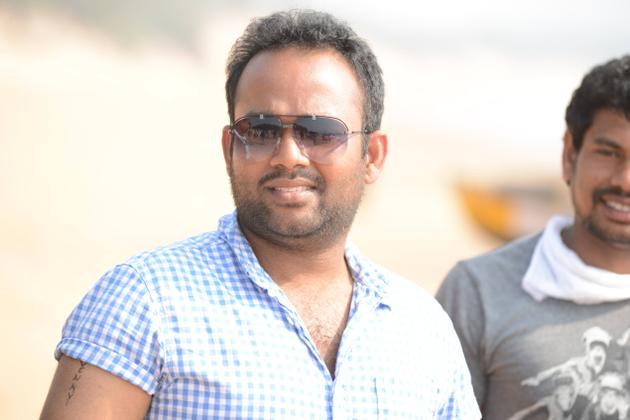
Debut cinematographer Venkat C. Dilip feels honing his skills in the US helped him take a new look at cinema

Venkat C. Dilip submitted his thesis as part of his course in cinematography only to be told by the professor that his work was overshadowing the film instead of seamlessly blending with it. Venkat made the necessary changes and re-submitted his thesis. He remembered this lesson when he stepped out of film school to work as a camera assistant for Hollywood projects like Savannah andCrackerjack and short films such as Passing Through Traveling Down and The Visions of Dylan Bradley. “I observed that the work of many cinematographers tends to dominate a project and didn’t want to do that,” he says.

Now, Venkat’s cinematography in Oohalu Gusagusalade is being lauded for befitting the narrative and not trying to rise above what’s being demanded by the script. This is his first Telugu film and Venkat feels he has come full circle. “I was born in Guntur and did mechanical engineering from Chennai, before moving to the US,” he says.

Like many youngsters aspiring to learn the basics of filmmaking, Venkat too decided to train to be a director. But rather than taking up courses for script writing and direction, he was drawn to cinematography. “The course also taught me editing, which is essential to be a filmmaker,” he says.

Venkat C Dilip
Venkat C Dilip

During the three-year masters programme at Savannah College of Arts and Design, he got to intern on the sets of Robert Redford’s The Conspirator. “I was the only Asian on the sets. From Guntur to training with Robert Redford’s unit, it was a big shift. My father had egged me on to go to the US. I am so glad he did; my learning and work experience there changed my thought process. I learnt to look at a film differently,” he says. Venkat’s parents are film buffs and academicians now working in Swaziland.

A common friend, Bala Rajasekhar, sent Venkat’s work to Srinivas Avasarala and he got to work onOohalu Gusagusalade. “Looking back, I feel grateful for the faith Srinivas Avasarala and producer Sai Korrapati had in a debutant like me,” he says. Shooting a film with limited budget had its challenges. “Coming from a film school, I love challenges. The prospect of having to work around limitations triggers creativity,” he adds.

The portions between Rashi Khanna and Naga Shourya in Vizag have drawn attention. “The Vizag locales were refreshing. I wanted this portion of the film to look beautiful, yet not artificial,” he says. Appreciation had been coming in from his ilk as well. “Senthil Kumar appreciated the beach song for its colours and texture and P.G Vinda liked the night photography. That was a bit tricky; we had limited lights and had to make the scenes appear natural,” says Venkat.

Oohalu has opened new doors in the Telugu film industry but Venkat is looking forward to return to the US. “I want to work on both international projects and Telugu films. It will be tough, but I hope I will be able to work in both countries,” he signs off.

source: http://www.thehindu.com / The Hindu / Home> Features> Cinema Plus / by Sangeetha Devi Dundoo / Hyderabad – June 23rd, 2014

Telugu elected Mayor of German city

Ravindra Gujjula, the son of former Ongole MP Gujjula Yalamanda Reddy, has been elected for the fifth time as the Mayor of Altlandsberg in Germany.

Ravindra who belongs to the SPD was elected unopposed with rival political parties also supporting his candidature.

source: http://www.thehindu.com / The Hindu / Home> News> Cities> Vijayawada / by Special Correspondent / Vijayawada – June 26th, 2014

Andhra Pradesh doctor makes leadless pacemaker

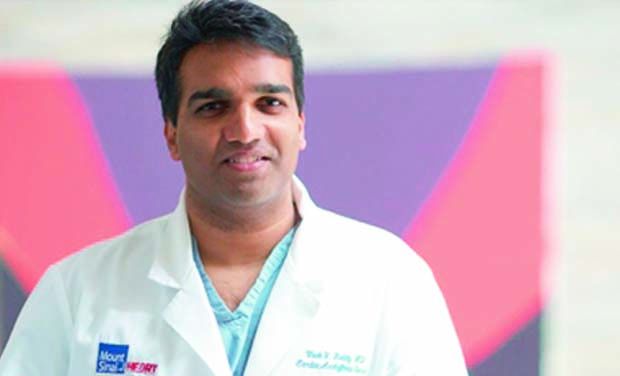
Dr Vivek Reddy (Photo: PTI)

New York: 

The world’s first wireless pacemaker, developed by an Indian-origin scientist, has shown promising results after one year of human trials.

The device, resembling a tiny, metal silver tube and smaller than a triple-A battery, is only a few centimeters in length, making it less than ten per cent the size of a traditional pacemaker.

“This is the first time we’ve seen one-year follow-up data for this innovative, wireless cardiac pacing technology and our results show the leadless pacemaker is comparable to traditional pacemakers,” said Dr Vivek Reddy, Director of Arrhythmia Services at The Mount Sinai Hospital here, who is the study’s co-investigator.

In comparison to a conventional pacemaker, the new-age leadless pacemaker eliminates the need for a surgical pocket and no visible pacemaker device under a patient’s chest skin, no incision scar on the chest, no connector wires or leads, and no restrictions on a patient’s daily activities. The device’s benefits may also allow for less patient discomfort, infections, and device complications and dysfunction.

“Our latest findings further support the promising performance and safety of this minimally-invasive, non-surgical pacing device. More long-term follow-up of these LEADLESS study patients will further our understanding of the potential advantages, benefits, and complication risks of leadless pacemaker technology, along with additional ongoing, larger trials,” Dr Reddy said.

The study’s long-term follow-up has evaluated 32 patients with a slowed heartbeat, bradycardia at two hospitals in Prague and one in Amsterdam, the hospital said in a statement. The miniature, leadless cardiac pacemaker is placed directly inside a patient’s heart without surgery during a catheter-guided procedure through the groin via the femoral vein. It works by closely monitoring the heart’s ele-ctrical rhythms.

source: http://www.deccanchronicle.com / Deccan Chronicle / Home> World> Americas / PTI / May 11th, 2014

Braille books

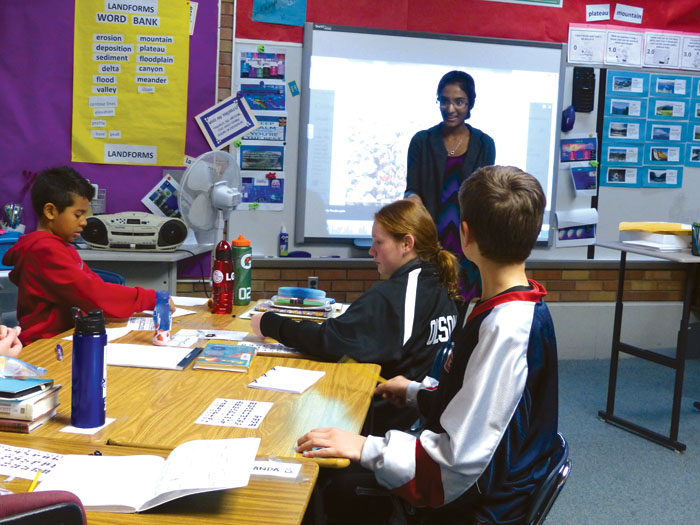
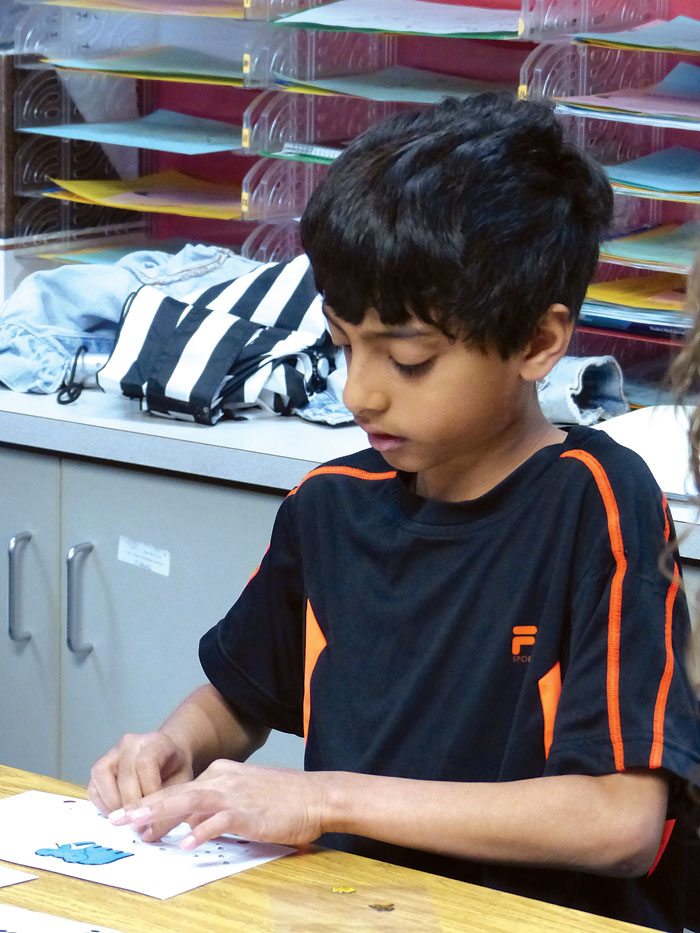
Chetana Guthikonda asks students in Laurie Miller’s fifth-grade class questions about the project after they finished.

Students in grades 3-5 at Creek Valley made braille books to send to the Devnar Foundation for the Blind in Hyderabad, India, organized for Global Youth Service Day by EHS junior Chetana Guthikonda.

Guthikonda, a member of the HandsOn Twin Cities Youth Advisory Board, created the project based on whether it was simple, sustainable and affordable.

She contacted the school in India to ask about its needs before deciding on the project.

Students created books for beginner readers with words like giraffe, bear, tiger and lion spelled in braille. Each book cost less than $1 to make in Edina, compared with more than $1,000 with a braille machine.

Making the books teaches Edina students about braille while teaching students in India how to read, Guthikonda said.

Fifth-grader Aakash Narayan creates a braille book for the Devnar Foundation in Hyderabad, India, near where he’s from in India. (Sun Current staff photos by Lisa Kaczke)
Fifth-grader Aakash Narayan creates a braille book for the Devnar Foundation in Hyderabad, India, near where he’s from in India.
(Sun Current staff photos by Lisa Kaczke)

source: http://www.current.mnsun.com / Sun Current / Home> Education / by Lisa Kaczke / May 09th, 2014

The Ground Beneath her Feet

SUMMARY

Shantala Shivalingappa,a Kuchipudi dancer from Paris,on her art and winning a Bessie,the Oscars of dance.
____________________________________________________________________________________
In New York City,news of a promising performer spreads quickly. When Shantala Shivalingappa arrived there to dance at a festival in October 2012,more than 2,000 people were waiting in the hall. Among them were students,families and newspaper critics,who had heard of her past concerts in the city. The largely American audience was unaware of Kuchipudi,a classical dance form from Andhra Pradesh,or the story Shivalingappa was about to tell,a legend titled Shiva-Ganga.
Shivalingappa, 37, danced solo, alternating between Shiva, with his feet rooted to the ground and matted hair open to the wind,and Ganga, swaying towards earth with light, easy strides. “All I could think of was that an Indian dance form had managed to strike a chord with so many people in the hall,” says Shivalingappa. The dancer from Paris who is relatively unknown in India had taken another step in her effort to “take the dance form to the Western audience”.
That performance garnered Shivalingappa more than a host of new fans. A year later,in October 2013,  Shiva-Ganga won an award for Outstanding Performance at the New York Dance and Performance Awards,popularly called the Bessies,and known as the international dance world’s version of the Oscars. It was a first for Indian classical dance or for any South Asian dance form. In India the event went unnoticed. “It was an exciting experience because there are many dances nominated for the Bessies,from street dance to ballet to Western contemporary. The award for an Indian classical dance showed that art has no boundaries,” says Shivalingappa.
Shivalingappa says her story begins even before she was born. Her parents met in Paris as students and have lived there since 1967-68. Shivalingappa’s mother,Savitry Nair,was a Bharatanatyam dancer,and her father worked with Unesco. “I have no other city to compare the Paris of my childhood to,so I could be biased. Paris has a strong cultural tradition,with people visiting museums and musical evenings from a young age,” she says.

Their home was a meeting point for dancers,artists and performers. Among those who would drop by for a meal or an impromptu home concert was the German pioneer of dance-theatre,Pina Bausch,Maurice Bejart,a Swiss-French neo-ballet choreographer,vocalists Bhimsen Joshi and M Balamuralikrishna,and mandolin maestro U Shrinivas. “In 1985,Mandolin Shrinivas was to perform at a festival of India in Paris. Unlike the other artistes,he was very young,only 15. I was a child so I quite liked to listen to him play. It opened my heart to Carnatic music,” she says.

Shivalingappa began training in Bharatanatyam and began taking singing lessons from her mother when she was five years old. Unsurprisingly,these were just a part of life,like going to school. “Dance and music weren’t more special than anything else I was doing,” she says. Until one day,when her mother took Shivalingappa to the academy of her guru Vempati Chinna Sathyam in Chennai,to “learn a few kuchipudi steps for a project she was doing in London”. “The master’s son demonstrated the shiva tandava for me,and it was like nothing else I had known. I wanted nothing,other than to learn this dance form and share it with others. I thought,‘Everybody should know about Kuchipudi in the West. 

She turned to Sathyam to learn Kuchipudi,staying in Chennai for six months at a time. “There were endless hours of classes,steps,jatis and choreographies. My master’s style of Kuchipudi was a combination of strong and powerful footwork and graceful,full-of-curves upper body moves. The impact was not only intellectual; I felt it all through my body,” she says.

Shivalingappa didn’t need to be told that the secret to mastering a classical dance is “time,time and time”. “I had come from Bharatanatyam,so my posture was angular and geometrical,which was a good thing. Kuchipudi,however,is as much about crisp lines as fluidity and sway and this was very difficult for me,” she says. The coexistence of contrasts in Kuchipudi is also what attracted Shivalingappa — the balance between geometric precision and graceful curves. “I gave it all the time I could,learning at the academy from 9 am to 1 pm,then again from 5 pm to 7 pm,and putting in extra hours before,after and in between classes,” she says. She was 16 and dance occupied her every waking moment. ; “When I wasn’’t practising,I was observing the master and his senior disciples. I wasn’’t interested in anything else,” she says.

Since her teens,Shivalingappa had been performing for some of the biggest names in the international dance and theatre circuit. Peter Brook cast her as Miranda in in his adaptation of The Tempest (1990) and Ophelia in Hamlet (2000). Bausch featured her in a series of shows,such as O Dido (1999),Nefes (2003),Bamboo Blues (2007) and Solo (2007); and Bejart directed her dance solo,1789…et nous,for the bi-centenary celebrations of the French Revolution in 1989. Crowds and critics alike,woke up to the dusky Indian dancer with lyrical movements. Alastair Macaulay,chief dance critic of The New York Times,was among those impressed by Shivalingappa’s “witty charm”. “In many ways,my Western collaborations have nourished my Kuchipudi. My sense of how to use space,approach body language,isolate and refine every element in a dance and control the speed of various sequences,all these can be traced back to the Western artistes I worked with,” says Shivalingappa.

In time, Shivalingappa used her Western shows and her growing popularity with audiences to stage pure Kuchipudi shows in Paris,Venice,Madrid,Barcelona,New York,Seattle and San Francisco,among others. “The concerts would always be held in big theatres,rather than at Indian festivals and be of very high quality. That put Kuchipudi in a high arena,and I banked on the fact that if people liked what I was doing,they would give me a chance and open more doors,” she says.

Among her popular pieces are Gamaka (2007) inspired by Indian classical music and describing “the oscillation or vibration of sound between two musical notes”,Swayambhu (2010) in which “the dancer becomes an artisan-alchemist,who seeks the right combination of material to give rise to pure expression”,and Akasha (2013),from the Sanskrit word for sky or space.
Currently in Sydney,she is busy rehearsing with Australian choreographer Shaun Parker for a piece that will open at the Sydney Opera House on January 9. She is also looking forward to showcasing her solo work at the Park’s New Festival 2014 in the four metros,Bangalore and Hyderabad in August and September. “Though I was born in India,and have performed twice at Kalakshetra (a training and performance centre started by Rukmini Devi Arundale in Chennai),this will be the first major tour of my solo shows,” she says over the phone.
Shivalingappa often cites the example of Pt Ravi Shankar who took Indian music to foreign audiences and created a worldwide impact. She herself represents a small group of artistes who live abroad and have mastered an Indian art — thus expanding its definition. “Living away from India actually sharpens our senses to Indian elements and arts. For me,both the East and the West coexist in a performance,” she says.
source: http://www.indianexpress.com / The Indian Express / Home> News-Archive> Web / by  Dipanita Nath / January 05th, 2014
Hyderabad’s link to Penn Masala

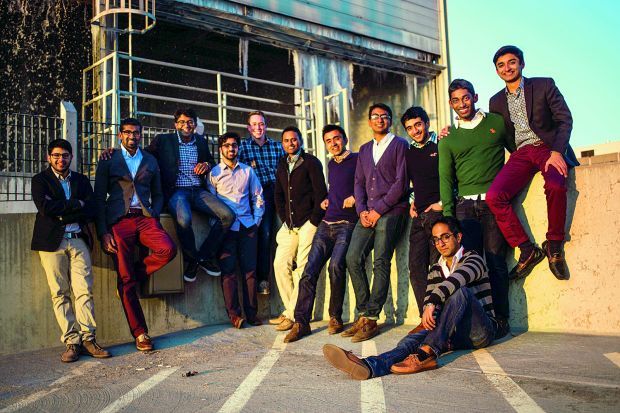
(From left to right) Chetan Khanna, Ashwin Muthiah, Varshil Patel, Akiff Premjee, Brendan McManus, Rohan Murthy, Dilip Rajan, Prashant Ramesh, Hari Ravi, Aneesh Kanakamedala (sitting below), Praveen Rajaguru, and Pranay Sharma.

Hyderabad: 

Browsing on Facebook, you might have spotted a video, the thumbnail of which shows six boys dressed in vintage 60s style. That is the latest genius from Penn Masala, a five minute video that summarises the evolution of Bollywood music which has already got over a quarter of a million views.

The world’s first Hindi a cappella group comprising students of University of Pennsylvania also finds its roots in Hyderabad, through its member Anil Chitrapu. Penn Masala is an evolving group with the current members being Akiff Premjee, Varshil Patel, Anil Chitrapu, Dilip Rajan, Ashwin Muthiah, Prashant Ramesh, Chetan Khanna, Aneesh Kanakamedala, Brendan McManus, Pranay Sharma, Hari Ravi, Praveen Rajaguru and Kashish Hora.

The video, The evolution of Bollywood, has taken the social networking sites by storm, with even top singers and music directors from India praising the group. “We had been brainstorming this idea for a while, ever since we saw another cappella group (Pentatonix) do a history of Western Music video. We started discussing and thought, ‘Wouldn’t it be incredible if we could show how Bollywood music evolved over time?’” says Akiff Premjee.

While the group’s success might be news to Indians, it has already tasted success in the US with its meeting with the US President Barack Obama.

Varshil says, “That experience was unlike any other. We were fortunate to be asked to perform at the White House for President Barack Obama’s Diwali celebration and the signing of an important Asian-American initiative… It’s actually funny, because later that year we went on to give a similar performance for UN Secretary General Ban ki Moon and he asked us ‘Was this as exciting as performing for Mr Obama?’”

Penn Masala had also toured India in 2013 and even had a show in Hyderabad. Talking about the experience of performing in Hyderabad, Akiff says, “Hyderabad was absolutely incredible when we visited last winter. The audience was phenomenal and we could tell how hospitable every one was when we met fans after the show. If only we could have spent a day or two longer!”

Anil Chitrapu, the music director and only Hyderabadi of the group, says, “Much of my family is in Hyderabad, and I try to visit as often as I can to see them. Whenever I’m in the area, I make sure to get myself a fix of Hyderabadi biryani from Paradise Hotel and chai from around Charminar,” he says.

Anil has learnt Indian Classical (Carnatic) music and studied under Sri D. Seshachary of the Hyderabad Brothers. “This style of music has helped me immensely with my vocal tone and ability to sing in Hindi and other South Asian languages. Also, I really like Vijay Prakash in his Telugu songs! He has an extremely versatile voice.”

source: http://www.deccanchronicle.com / Deccan Chronicle / Home> Lifestyle> Offbeat / DC / by Sanchita Dash / April 03rd, 2014

Hyderabad-born elected co-chair of Iowa Republican party

Hyderabad -born Indian-American businessman Gopal T.K. Krishna has been elected as co-chairman of the Republican Party of Iowa state, which has traditionally held the first caucus in presidential elections.

Krishna, a successful businessman with a background in electrical engineering, replaces Danny Carroll, who has been elected as chairman, according to an announcement by the party’s state central committee in Des Moines, Iowa.

“I have been, and am a Republican for all Republicans. The first three letters of my name are G-O-P. I ran because I don’t want to wait until the primary elections to promote unity,” he said after his election.

“I want to continue to increase our party’s voter registration advantage and participation in the forthcoming elections.

“I look forward to working with Republican National Committee Chairman Reince Priebus to advance the Growth and Opportunity Project, work to reach out to minorities and bring new people into our Republican Party,” he said.

“As long as I am Co-Chairman of the Republican Party of Iowa, outreach to all minority communities will be a priority,” Krishna said.

Krishna, who immigrated to the US in 1969, has a long history of working for Republican causes and campaigns.

Krishna has been elected seven times to the Republican State Central Committee, including serving as Chair of the Budget and Organization Committees, the announcement noted.

Krishna is a graduate of the Methodist Boys’ Multipurpose Higher Secondary School in Hyderabad. He received his Bachelor of Engineering degree in Electrical Engineering from Osmania University, Hyderabad.

After immigrating to the US, he received three masters degrees-Master of Science degree in Electrical Engineering from University of Kansas in Lawrence, Master of Business Administration degree from Drake University in Des Moines, and Master of Science degree in Sanitary Engineering from Iowa State University in Ames city.

He is the founder and president of  Krishna Engineering  Consultants, Inc.

source: http://www.business-standard.com / Business Standard / Home> News-IANS> Diaspora / IANS / Washington – April 01st, 2014