Category Archives: Nature

Research on organic farming pays dividends

Representational image

Nellore: 

In view of increasing demand for organic food everywhere, Nellore based Rice Research Station has been carrying out extensive research on organic farming at their model farm using popular rice varieties produced by the organisation.
Same variety of rice is being raised separately in the plots earmarked for organic and inorganic methods of farming since 2006. The efforts of the scientists have started paying off during the last few years.
“The yields in the organic method of farming are on par with the same crop raised by us-ing fertilisers and pesticides in our farm. The management practices are being shared with the farmers and many of them are showing interest to switch over to organic farming,” claimed Ms U. Vineeta, scientist.
According to Ms Vineeta, half an acre plot in the RRS is exclusively meant for organic farming using different kinds of manures such as poultry, press-mud compost, vermicompost, farmyard manure, neem cake, castor cake and karanja cake apart from bio-fertilisers.
The research team said that they noticed using karanja cake and castor cake resulted in high yields. The tests are carried out during early kharif (April to May 15) and rabi (October to November) seasons.
“The output was much high in the crops raised during kharif season because of faster rate of decomposition of manure applied to the crop in view of summer,” Ms Vineeta explained.
She attributed the reservations among cultivators against organic farming to scarcity of organic manure, high transportation cost besides labour problems. She observed that farmers would certainly opt for organic farming if the government offers special support price and marketing facility to enable them to transport their produce to organic food counters in the cities where consumers are after organic food.
Meanwhile, the RRS is also coming out with disease free short, medium and long duration high yielding varieties of rice containing superior nutritional value. Principal scientist (rice) Y. Suryanarayana said that they have been offering mini kits of NLR 4001 and NLR 4002 rice varieties after successfully tested them in research farm.
source: http://www.deccanchronicle.com / Deccan Chronicle / Home> Nation> Current Affairs / by Pathri Rajasekhar / Deccan Chronicle / August 04th, 2015
Masula scientists develop salinity-resistant paddy seed

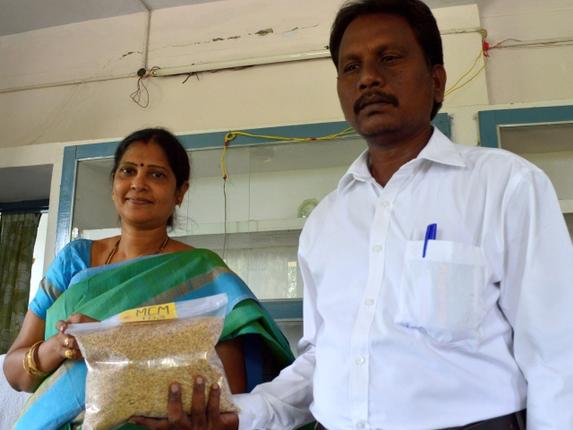
Scientists of Agricultural Research Station display MCM-103, a new paddy seed variety at Machilipatnam in Krishna District. Photo: T. Appala Naidu / The Hindu

The seed varieties developed by Principal Scientist T. Anuradha and Scientist K. Nagendra Rao are MCM 103, a Kharif variety and Rabi variety MCM110, which are sanity resistant.

Plant breeding scientists of Acharya N.G. Ranga Agricultural University’s Research Station at Machilipatnam have developed two new paddy seed varieties, exclusively meant for saline soil and the 10-year research has yielded expected results.

The seed varieties developed by Principal Scientist T. Anuradha and Scientist K. Nagendra Rao are MCM 103, a Kharif variety and Rabi variety MCM110. The duration of crop period of the varieties is 140 and 120 days respectively.

“The Directorate of Rice Research (DRR), Hyderabad, has tagged the MCM 103 as the best paddy seed variety among the 40 entries from across the country in 2013. The DRR has also tested the variety in the six states, where it gave expected results including yield and quality grain”, T. Anuradha told The Hindu.

“The MCM-103 seed variety gives nearly six tonnes of yield while the MCM-110 gives up to 5.5 tonnes per hectare”, she added. The scientists have claimed that the yield of the two varieties would arguably be much higher in the normal soil. Another Scientist K. Nagendra Rao added that the MCM 103 is being tested in the saline fields in the coastal Andhra districts from the ongoing Kharif season and the other variety would also be tested from the next Rabi season in the State.

The District Agricultural Advisory & Transfer of Technology Centre in the respective districts in the State had selected the fields to test the seed varieties from the Kharif-2015. “The medium duration paddy varieties will primarily encourage the farmers to turn the saline soil fields into cultivable fields. The varieties will also ensure better yield”, opined Ms. Anuradha.

Farmers indebted to scientists:

The farmers having saline soil are indebted to the scientists, said Ms. Anuradha and Mr. Nagendra Rao, who had developed two paddy seed varieties – MCM 100 and 101- in 2011. It has been proposed for seeking approval of the Andhra Pradesh State’s Seed Varietal Release Committee for final release of the two varieties into the market.

source: http://www.thehindu.com / The Hindu / Home> News> Cities> Vijayawada / by T. Appala Naidu /Machilipatnam – July 31st, 2015

GCC re-entering coffee mart after two decades

Visakhapatnam  :

After nearly two decades, the Girijan Cooperative Corporation (GCC) is re-entering the coffee sector in the Visakha Agency again and is targeting marketing around 2,000 metric tonnes of coffee procured from small tribal farmers in the Visakha Agency this year.

According to records, there are around one lakh tribals cultivating on nearly 96,337 acres and producing around 6,500 metric tonnes of coffee every year, which fetches around Rs 65 crore. With GCC’s support, the farmers are expected to earn around Rs 91 crore.

GCC has already identified 14 godowns to store the coffee stocks in the Agency and collection of material will start from December this year. It plans to set up one procurement centre each at the village level and two big centres each at the mandal level. GCC has already initiated awareness campaigns in each hamlet in June, inviting coffee growing farmers to enroll their names.

The corporation plans to register the data such as names of farmers, bank account numbers and Aadhaar number in July and August. It is likely to recruit separate manpower for coffee-related activities in September.

“The output and price realization in the Agency areas is very low due to improper harvesting techniques and marketing. If we provide guidance to coffee growing farmers in harvesting and marketing the produce, they will surely benefit. Currently, farmers get a very low price for their produce. If we market the same stocks, their earnings will increase by nearly 40% as we will ensure that each farmer gets the maximum price for his produce. GCC will be taking care of marketing the coffee from this financial year,” GCC managing director A Ravi Prakash said.

“GCC will take care of the pruning, curing, transport and auction of coffee. GCC will bear the entire cost of this and will be reimbursed by the government later. The state government will give Rs 25 crore initially and the Coffee Board will give a subsidy too. GCC will an organized marketing platform for small farmers,” he said.

This is not the first time that GCC is involved in the coffee sector. It had floated the Girijan Plantation Cooperative Development Corporation (GPCDC) in 1986 and developed 40,000 acres of plantation. However, GPCDC wound up its activities in 1997 and the plantation area was distributed among farmers and ITDA staff, sources said.

Meanwhile, the state government has also announced that GCC will provide marketing support for the Paderu Coffee Project, under which the government will invest Rs 526.16 crore in adding another one lakh acres under coffee plantations in the next 10 years. The project was announced by chief minister Chandrababu Naidu on October 17 last year after Cyclone Hudhud and a GO was released by the tribal welfare department last month.

source: http://www.timesofindia.indiatimes.com / The Times of India / Home> City> Visakhapatnam / TNN / July 03rd, 2015

Thotapalli Reservoir Becomes a Reality after 12 Long Years

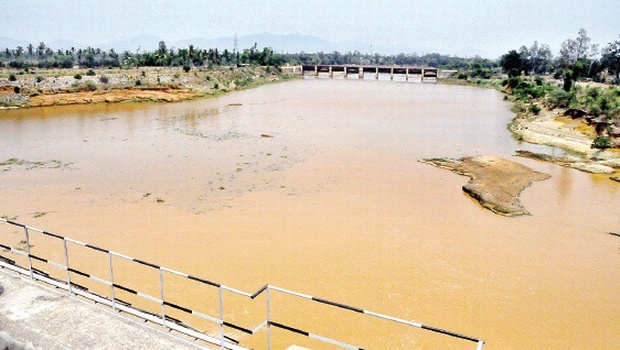
A view of the Thotapalli Reservoir in Vizianagaram district | EXPRESS PHOTO

Vizianagaram / Srikakulam : 

After more than a decade, the farmers of the ayacut area of Thotapalli reservoir are overjoyed that their dreams of irrigating their lands would be finally realised. The much-delayed Thotapalli project, except for minor works, has been completed and the Irrigation Department is making arrangements to release the waters from the reservoir in the third week of July.

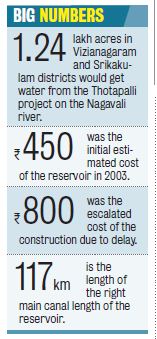
NumbersANDHRA01jul2015

Thousands of farmers and their families of Vizianagaram and Srikakulam districts are excited about prospects of receiving Thotapalli reservoir waters to kick-start the kharif season. The farmers who come under the project ayacut have been suffering as there is no irrigation water to cultivate their fields. Depending on rainwater, some of the farmers who tried to cultivate their lands faced severe financial losses as rains eluded them in the peak season.

In order to provide irrigation water to about 1.24 lakh acres in Vizianagaram and Srikakulam districts, the government had taken up the Thotapalli reservoir on the Nagavali river in 2003. The project timeline was five years and the estimated cost of the project was `450 crore. The cost later escalated to about `800 crore due to the abnormal delay in executing the project.

The district administration faced a tough time in acquiring 1,100 acres of land for the project. There were a series of agitations by land losers for relief and rehabilitation. After clearing several hurdles, the department completed all the construction works of the reservoir and its 117-km-long main canal.

According to the government’s assurance to the farmers, water from Thotapalli will be available for the 2015 kharif season. The irrigation officials, on a war-footing, completed the works to release the water in the third week of July.

“Pending minor works relating to the 29 distributary canals, four branch canals and two NH crossing works will be completed by July 2. The 117-km-long right main canal of the reservoir was completed except the tail-end 2 km. There is a railway crossing across the 2-km-long canal which will be completed next year. The department had already paid `4 crore to the Indian Railways. Under the Thotapalli project, water will be provided to 40,000 acres (original target was 62,000 acres) in Vizianagaram district and another 40,000 acres in Srikakulam district (aiming to provide 58,000 acres) this year,” said Tirumala Rao, Thotapalli project superintending engineer.

source: http://www.newindianexpress.com / The New Indian Express / Home> States> Andhra Pradesh / by VK Lakshmi Gayatri / June 30th, 2015

Red sanders has medicinal properties, say researchers

Hyderabad :

Red sanders, the prized wood that thrives in the Seshachalam forests in Chittoor-Kadapa-Nellore region of Andhra Pradesh, has been found to possess a plethora of medicinal properties to fight several diseases and disorders including gastroenteritis, ulcers and diabetes.

A joint study by researchers from four prominent educational institutions revealed that the leaves, wood and roots of red sanders tree contain many chemical molecules that have curative properties.

Red sanders, its high demand in the international market notwithstanding, has always remained an enigma as for as its real end use is concerned. There have been several myths attached to the red sanders in the absence of concerted efforts to study the pharmaceutical and other benefits of this rare and endemic tree.

In fact, the AP forest department has instituted a research study to find out what the buyers would actually do with the red sanders. The study is currently underway.

Meanwhile, researchers from MS Ramaiah University of Applied Sciences, Karnataka, Prist University, Tamil Nadu, Sebha University, Libya, and Mother Theresa Postgraduate and Research Institute of Health Science, Pondicherry, have validated a few of the medicinal properties of red sanders.

The tree has anti-bacterial properties with clear action against harmful bacteria like Enterobacter aerogenes, Escherichia coli, Pseudomonas aeruginosa and Staphylococcus aureus. Some of these bacteria are found in hospital environment with resistance to certain antibiotics.

Red sanders is also capable of fighting eye diseases, inducing vomiting and giving relief from mental issues.

“The heartwood is known to possess molecules which help in fighting diabetes, intestinal worms, high body temperatures, body swellings, diarrhea, and internal bleeding. Many more pharmacological activities, claimed by traditional practitioners, are yet to be explored,” the study published in the World Journal of Pharmaceutical Research said.

The research team comprised S Kavimani, Mohammad Azamthulla and R Balasubramanian.

Some of the claims, which still need scientific revalidation, are the ability of the red sanders oil to cure skin diseases, piles, wounds, bone fracture, psoriasis and leprosy, they said adding that “research interest to evaluate its therapeutic potential has developed recently perhaps on realization that the tree may contain novel chemicals, which exhibit a wide range of pharmacological effects”.

Times View

Red sanders is an enigma and this explains why there is such a high demand for this wood in the international market. Some believe it is an aphrodisiac. Others argue that it is an antidote for snakebites and scorpion stings. As long as the myth associated with red sanders is not busted, smuggling of the prized wood continues. The AP forest department should involve as many research bodies as possible to decode the red sanders and protect this rare tree from being axed by smugglers.

source: http://www.timesofindia.indiatimes.com / The Times of India / Home> City> Hyderabad / by Syed Akbar, TNN / June 25th, 2015

‘Grow Gliricidia to increase soil fertility’

As agricultural production in Andhra Pradesh is being increasingly impacted by adverse weather, farmers are searching for ways to mitigate the loss. Lost in desperation, they are not realising that there is a widely available tree which enriches the soil fertility multifold with little human intervention and negligible investments.

Commonly known as ‘fencing plant’, it is known for many generations but the farming community has almost forgotten it under the belief that chemical fertilizers are a sure-shot solution to the problem poor soil quality. Scientifically known asGliricidia Sepium, these trees add valuable nutrients such nitrogen, potassium and phosphorous to the soil thereby increasing its fertility many times more than any other nutrient can do.

It is a multipurpose legume tree that increases soil productivity and yields in addition to reducing soil erosion and control pollution associated with the use of chemical fertilizers.

The biggest advantage is sustainable agricultural productivity that Gliricidia brings. Natural Organic Farmers’ Association treasurer Ch. R.K. Prasad told The Hindu that Gliricidia was a boon for farmers and the International Crops Research Institute for the Semi-Arid Tropics (ICRISAT) recommends it time and again to farmers for achieving higher yields and contribute to environment but emphasis was more on use of chemical fertilizers, which was the trend in many countries.

Farm bunds

As the economy of Andhra Pradesh is heavily dependent on agriculture in the changed circumstances, the NOFA requested the government to motivate farmers and facilitate the growing of Gliricidia trees on farm bunds and borders of agricultural fields.

The results can be seen in a few months as the soil fertility goes up and no chemical fertilizer is a match to Gliricidia.

Also called ‘live fencing tree’, a Gliricidia tree grows anywhere. Farmers have to grow it to see its immense benefits as the ICRISAT had demonstrated.

The Agriculture Department is being asked to take necessary action so that the farmers can herald a potential revolution.

Commonly known as ‘fencing plant’, these trees add valuable nutrients such nitrogen, potassium and phosphorous to the soil

source: http://www.thehindu.com / The Hindu / Home> News> Cities> Vijayawada / by Staff Reporter / Vijayawada – June 18th, 2015

World Bank’s facelift for Kambalakonda eco-tourism park

The Kambalakonda eco-tourism park is all set for a facelift and will soon sport dedicated conservation and visitor zones thanks to World Bank funding.

Visakhapatnam :

The Kambalakonda eco-tourism park is all set for a facelift and will soon sport dedicated conservation and visitor zones thanks to World Bank funding.

If the plans of the forest department are anything to go by, the Rs 8.45 crore World Bank funding given to the Kambalakonda forest reserve for Cyclone Hudhud relief will be used to create dedicated conservation and visitor zones as well as restoration work.

For the conservation zone, the forest department plans to spend Rs 2.95 crore in setting up a butterfly park, lay a self-guided nature trek path and create an arboretum for display of medicinal plants and biodiversity of the Eastern Ghats, said forest department officials.

“The department will also spend around Rs 1 crore for creation of 10-metre wide view-cum-fire lines, construction of trenches and check dams to harvest rain water,” chief conservator of forests Ampili Bharat Kumar told TOI.

As part of the visitor zone, the authorities plan to invest Rs 5.5 crore in creating facilities like eco-friendly cottages (20), multi-cuisine food court and amphitheatre for interactive animal shows. Plans are also afoot to set up a Bio-Park with evolution as its theme at a cost of Rs 1 crore. For the convenience of visitors, wash rooms, rest shelters and benches, drinking water facilities among other things will also be set up, sources said.

The eco-tourism park, spread over around 40 hectares, is part of the 7139-hectare Kambalakonda reserve forest area and wildlife sanctuary that was devastated by the cyclone that hit the Port City in October last year.

The cyclone caused damages of nearly Rs 15 crore to the Kambalakonda eco-tourism park, wrecking many boats, cottages, observation towers and uprooting thousands of trees. The wildlife sanctuary houses many animals such as leopard, spotted deer, jackals, sambars, among others

Kambalakonda, which was declared a wildlife sanctuary in 2002 to protect the flora and fauna of the region, is part of the Eastern Ghats. Surrounded by many villages, Kambalakonda sanctuary falls under the Greater Visakha area but is under the control of the forest department.

source: http://www.timesofindia.indiatimes.com / The Times of India / Home> City> Visakhapatnam / by Siva G, TNN / March 18th, 2015

Now, Rooftops Turn into Gardens

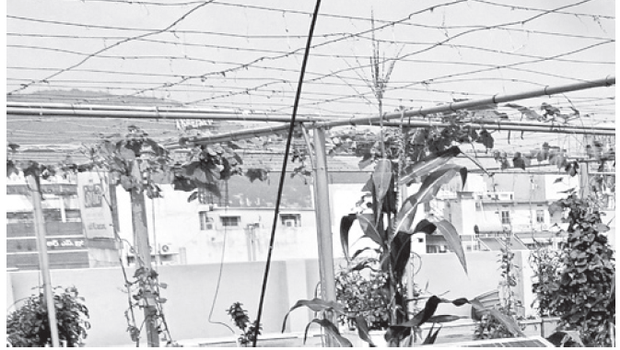
A garden being raised on the terrace of a house at Brindavan Colony in Vijayawada | Express Photo

Vijayawada :

The Horticulture Department has launched a new initiative called ‘Terrace Gardening’, under the ‘Rashtriya Krishi Yojana, with a view to encourage people to grow their own vegetables, according to a source.

The source told Express here on Saturday that as part of the initiative, the department was also providing a ‘Do it yourself’ kit to the interested people for their kitchen garden with a 50 per cent subsidy.

The source said that as gardening was a favourite pastime for most of the housewives and retired people, the department had initiated this programme and added that it was providing the kit, consisting of seeds, fertilizers and pesticides besides some gardening tools, with a 50 per cent subsidy. He added that it was targeting those who were averse to spending huge amounts for buying vegetables from the market.

“The kit consists of five varieties of vegetable seeds like brinjal, tomato, etc., according, pesticides, fertilizers, four silkolene covers, two cages for plants like tomato, red sand, neem cake, a water-sprinkler and other gardening tools along with a technical booklet with instructions, totally costing `6,000. This will be provided at a cost of `3,000 to the applicants, with the remaining `3,000 being borne by the Horticulture Department.

This has been introduced to provide a platform for the city-dwellers to cultivate their own vegetables on their rooftops,” said Krishna district Horticulture Department assistant director S Sujatha.

She said that the residents of Vijayawada, who wanted to avail themselves of the scheme needed to have 50-100 square feet of space on the roof of their houses and an overhead water tank. Taking into consideration the climatic conditions of the city, the Horticulture Department was issuing lightweight containers, waterproof covers, bio-pesticides, water-soluble pesticides and fungicides and thus providing an opportunity to the people to cultivate pure organic vegetables in the available space.

The officer said that the initiative was evoking a good public response and added that more than 50 persons had started cultivating vegetables on their roof tops and balconies.

She added that her department’s new initiative has not only provided a satisfying hobby to the people but also helped them cut down their spending on vegetables from the market.

“As they need to invest little money and can grow their own choice of vegetables, people are showing interest. Terrace gardens also go a long way in reducing air pollution and heat in the house even as they and give the grower a chance to taste real organic produce,” Sujatha said.

source: http://www.newindianexpress.com / The New Indian Express / Home> States> Andhra Pradesh / by Sai Durga Gona / March 30th, 2015

New lease of life for Emu farmers

EmuANDHRA30mar2015

It is no longer an endless struggle for Emu farmers in the State. They were in doldrums a few years ago, and most of them had given up the vocation and moved on.

However, some managed to continue, thanks to help from LB Processors, a US company, and they have now reached breakeven.

In line with a five-year contract between LB Processors and Emu Farmers Cooperative, the former will provide specialty oil to cosmetic and dietary supplement industries. It will also refine emu oil supplied to it by farmers before offering it to cosmetic industry.

LB Processors founder president Paul Binford and chief operating officer Caleb Binford, a father-son team, said they would buy a minimum of 12,000 gallons and a maximum of 20,000 gallons of oil a year from the oil extraction facility owned by the cooperative at Agiripalli in Krishna district.

Emu Farmers’ Cooperative Company CMD M.R. Rao Prasad said farmers had been struggling feed birds owing to financial constraints a couple of years ago. With bankers abandoning them, most farmers moved to other vocations. However, a group of 16 farmers, with the help of CMI, a consultant, set up a quality extraction unit and worked out a way to air-lift emu oil to the United States in May 2013.

They have exported 18,350 gallons (68,730 litres) of oil since then, Mr. Rao Prasad said. CMI US director Rajan Eadara said LB Processors made use of an all-natural process to refine the oil. Meanwhile, the number of emu farmers in the cooperative has gone up from 16 to 40.

The cooperative also plans to sell ready-to-cook frozen meat shortly. “There is a growing market for emu skin also, and, in future, the cooperative is planning to sell cosmetics made from emu oil,” Mr. Rao Prasad said.

source: http://www.thehindu.com / The Hindu / Home> News> Cities> Vijayawada / by G. Venkataramana Rao / Vijayawada – March 29th, 2015

India Network Foundation inaugurates mineral water project in Krishnapatnam village, Andhra Pradesh, India

Orlando, FL :

India Network Foundation a US based non-profit organization announces grand opening of a mineral water plant at Krishnapatnam, Andhra Pradesh that will provide safe drinking water to about 3000 villagers. The plant was designed and executed by India Network Foundation and will be managed by the villagers themselves. The water plant provides 1000 liters of treated drinking water per hour and will be supplied to villagers every day. India Network Foundation, sponsor of award winning health insurance program for visitors coming to the United Statescontributes to several community projects helping elementary schools in rural Indiaand drinking water projects in remote areas. A small village Krishnapatnam worked hard to complete building for the project to start the mineral water plant within one month of award of the grant by the India Network Foundation.

The Drinking water projects taken by the India Network Foundation provide high quality equipment, and training to local villagers. who have to manage the project on their own. The Foundation plans to help many more rural villages where community wholly participates for the benefit of everyone.

India Network Foundation also sponsors India Network visitor health insurance  plans for visitors coming to the United States, and Travel grants to researchers presenting research at national and international conferences. In India, the Foundation has been helping schools with maps and other educational equipment, and constructing several schools in Bhuj, Gujarat, India in the past. Recently, Foundation has launched an initiative to provide clean drinking water to villagers living in remote rural areas. The first such project, Mineral Drinking Water Project in Krishnapatnam village, Andhra Pradesh, India sponsored by the Foundation has been commissioned today. The plant will provide 1000 liters per hour of good quality drinking water to villagers at a nominal cost .The project involves partnership with local community and their willingness to provide a shelter, and electric connection while the Foundation will help with equipment and training.

Dr. KV Rao, Founder and President of India Network Foundation stated that the Foundation philosophy of providing direct help to end beneficiaries is challenging but very rewarding. Even after many years the foundation continue to receives letters of appreciation for help rendered to families of Indian soldiers died or injured in Kargil war and from school teachers that benefitted from map projects. Foundation encourages members in the United States to take advantage of its vast experience and knowledge in providing direct end user benefitting projects.

source: http://www.insurancenewsnet.com / InsuranceNewsNet.com / Home> Newswires / PR Web, Orlando- FL / February 26th, 2015