Category Archives: Nature

A.P. foodies find substitute for ‘pulasa’ in salmon

‘Pulasa’ is very special for connoisseurs of food in the Godavari region. This fish variety is available only when the Godavari is in spate but food lovers wait for the monsoon season and don’t mind spending a huge amount on the fish variety.Pulasa Chepa Pulusu is the most sought after delicacy for those who relish seafood; the dish is sent as a gift to many places by the natives of this region.
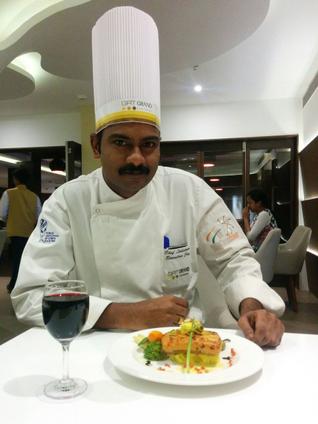
A chef with grilled Salmon dish at a hotel in Kakinada. Photo: K.N. Murali Sankar

In taste and texture, there can be no substitute to ‘pulasa’ but a city hotel is making an attempt to win hearts by serving something that tastes close to the rare fish variety. It is serving ‘salmon,’ a Norwegian version of this anadromous fish imported from Norwegian countries in frozen condition. The exotic fish variety has foodies compare its flavour with that of ‘pulasa.’ Weighing about 2.5 kg to 3 kg each, salmon is chopped into slices and grilled in Italian style before it is served to the guests.

“We use citrus risotto, unsalted butter, virgin olive oil and Italian rice to make ‘grilled salmon.’ Since it is an exotic dish, we retain the flavour and serve it to the guests with wine,” says Ch. Laxman, executive chef at the GRT Grand.

Both salmon and ‘pulasa’ are anadromous fish that are born in the sea and swim against the current to reach the freshwater source for breeding. While salmon lost its life in the process of breeding, pulasa can swim back to the sea, provided it is not caught in the fishing net.

“The lifecycle remains more or less the same for pulasa and salmon, but ‘pulasa’ has a unique taste when compared to salmon. We also find similarities between salmon and our Himalayan Trout, a fish variety available only in the Himalayan region,” says T. Rajyalakshmi, senior scientist and former director of the Central Institute for Brackish Water Aquaculture.

“Some of our guests recalled the taste of ‘pulasa’, while tasting the salmon. In fact, salmon is not suitable for gravy, whereas we cannot imagine ‘pulasa’ without gravy,” observes Mr. Laxman. Not just the foreigners who often check into the hotel, the local foodies also taste the salmon served in grilled and sauté form. “Response to the exotic fish variety salmon is quite good here and we are serving 12-15 orders a week,” says M. Uma Maheswari, general manger of the hotel.

source: http://www.thehindu.com / The Hindu / Home> National> Andhra Pradesh / by K.N. Murali Sankar / Kakinada – December 16th, 2015
The Mussoorie of Vizag!

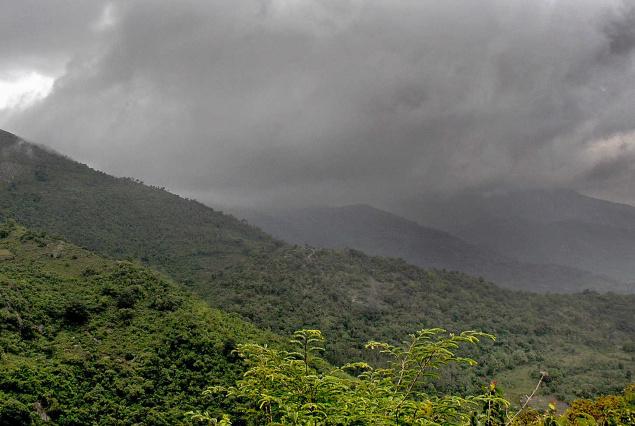
The tourism potential of the picturesque locales of the Eastern Ghats en route Araku in Visakhapatnam district are all set to be tapped. —Photo: C.V. Subrahmanyam

Modakondamma site in the Agency is among the projects cleared for development of tourism in district.

With the likely addition of several new places, most of them tucked away in the interior Agency area, the tourism scene in the district got a thrust this year ahead of the World Tourism Day.

At Lambasingi

Announcing the programmes lined up, VUDA Vice-Chairman and Regional Tourism Commissioner T. Baburao Naidu said that among the projects cleared were Modakondamma Padalu that would be improved at a cost of Rs.6 crore and cottages at Lambasingi, which records near zero temperature, at a cost of Rs. 10 crore.

“The Modakondamma site would enable a clear sight up to tens of kilometres and one can have a feel of the clouds like in Mussoorie,” Mr. Baburao Naidu said.

He said several local places had been identified.

The district got Rs.2 crore for improvement of facilities in various places often visited by tourists, including beaches.

Drinking water, benches etc will be provided at these places.

Events lined up

To mark the World Tourism Day on September 27, a photo exhibition would be organised for three days from Friday at Visakha Museum.

The three-day tourism fair that opens at Ramakrishna Beach on Friday would have food stalls offering traditional items too that were good for health, Mr. Naidu said.

Painting contest

A painting competition would be organised for children at Yatri Nivas and Appu Ghar in the morning.

The three-day festival would conclude with tourism walk on Sunday morning and cultural programmes in the evening.

Discount

AP Tourism guest houses would offer a 20 per cent discount in tariff for accommodation. Private operators would also be asked to do so, APTDC General Manager Bhimasankaram said.

A proposal has been sent to the State government to allow the discount on tourism packages also, Mr. Bhimasankaram said.

source: http://www.thehindu.com / The Hindu / Home> News> Cities> Visakhapatnam / by Special Correspondent / Visakhapatnam – September 25th, 2015

NREDCAP wins best performance awards

The New and Renewable Energy Development Corporation (NREDCAP) in Andhra Pradesh has bagged three awards for its outstanding performance at the national level in three categories.

Corporation Vice-Chairman and Managing Director Kamalakar Babu on Saturday said NREDCAP, which was in the forefront of implementing the National Biogas Manure Management Programme (NBMMP), had formulated the best renewable energy policies, besides introducing a single-window clearance for projects and capacity-addition off grid from waste energy products like bio-mechanisation and bio-kitchen waste.

Speaking after receiving the award presented by Chief Minister N. Chandrababu Naidu, Mr. Babu said the Central government had sanctioned funds to the tune of Rs. 137 crore as an incentive under the 13th  Financial Commission to the renewable energy sector. “These funds will be put to use for development of renewable energy and to develop innovative modes,” Mr. Babu said.

source: http://www.thehindu.com / The Hindu / Home> News> Cities> Vijayawada / by Special Correspondent / Vijayawada – August 30th, 2015

Top Indian scientist awarded 1st Sunhak Peace Prize

Seoul :

Noted Indian agriculture scientist Dr Modadugu Vijay Gupta, who has done pioneering work in aquaculture in India and several other countries, was today awarded the first Sunhak Peace Prize, billed as an alternative to the Nobel Peace Prize, which he shared with the President of Kiribati Islands.

Gupta, 76, shared the USD 1 million prize with President of Kiribati Islands Anote Tong here at a glittering function which was attended by invitees from all over the world.

Tong, 63, the head of the Pacific Ocean island nation which is facing dire prospects of being engulfed by rising sea waters by 2050, was chosen for the award for his dogged fight to end the carbon emissions which are spelling doom for small island nations.

The awards were presented by South Korean religious leader Dr Hak Ja Han Moon, the wife of late Rev Sun Myung Moon, who instituted the awards to recognise and highlight the work of individuals making big efforts for the betterment of the people.

Hailing from Bapatla in Andhra Pradesh, Gupta, a biologist, was also the recipient of the World Food Prize in 2005 for development and dissemination of low-cost techniques for freshwater fish farming.

Before his retirement, he served as the Assistant Director General at WorldFish, an international fisheries research institute under the Consultative Group on International Agricultural Research based in Penang, Malaysia.

Starting his career as a scientist in Indian Council Agriculture Research over three decades ago in Kolkata, Gupta worked in Laos, Vietnam, Bangladesh, the Philippines, Thailand pursuing his belief that the aqua technology which can provide food security and improve livelyhoods of rural poor.

“I believed throughout my career that all the advanced fish farming technology which we created in laboratories should be taken to people, then only it can make a difference to their lives,” he told PTI after receiving the award.

Regarded as a rebel within the ranks of the agricultural scientist community in India, Gupta mostly worked with the UN and agriculture related international organisations in different countries.

His work with rural communities in Bangladesh, a nation bestowed with lot of water resources, has made fish farming a major source of livelihood for millions of rural poor, according to the organisers.

As a scientist advocating sustainable alternatives, Gupta said aquaculture should be seen as a major source of food security.

“There can be no peace without food security in the world. You cannot talk peace to a hungry man,” he said.

source: http://www.timesofindia.indiatimes.com / The Times of India / News Home> India / PTI / August 29th, 2015

Andhra’s Vijayawada To Host World Coconut Day 2015

Kochi :

Andhra Pradesh’s Vijayawada city will be host the World Coconut Day 2015 on September 2 with the theme “Coconut for Family Nutrition, Health and Wellness”, an official release said.
The release by the Coconut Development Board (CDB) said September 2 has been designated Coconut Day by the Jakarta-headquartered Asian and Pacific Coconut Community (APCC), an intergovernmental organisation of 18 countries mandated to promote, coordinate and harmonize coconut developmental activities of the Asian Pacific region to achieve maximum economic development.
All major coconut-growing countries including India are members of APCC, whose foundation day is also on September 2.
The release said the celebration is aimed at creating awareness about the importance of coconut and its potential in alleviating poverty, encouraging investments and promoting the development of coconut industry in the member countries.
Around 500 farmers from all coconut growing states are expected to attend the function and would be a platform for the farmers to get firsthand knowledge about the new initiatives of the CDB.
An exhibition showcasing latest technologies in coconut sector and various value added coconut products including Neera.
The inaugural session will be followed by a technical session which will be attended by the who’s who of the industry.
As per the statistics of union agriculture ministry’s horticulture division for coconut production for the year 2013-14, the state of Andhra Pradesh occupies the first position in productivity (14,997 nuts/ha) though in fourth position both in area (1,21,920 ha) and production (1828.46 million nuts) among the coconut-growing southern states in India.

source: http://www.siliconindia.com / Silicon India News / Home> News>General / Wednesday – August 26th, 2015

‘Red sanders can be grown like any other crop’

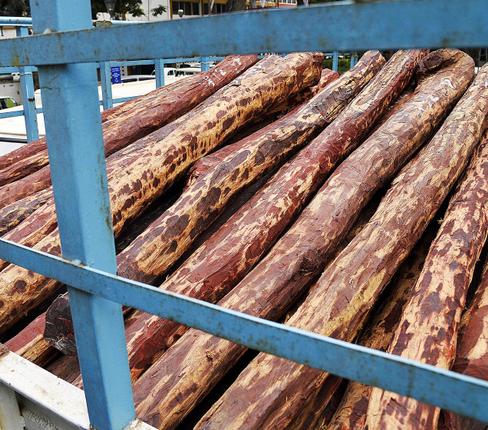
It is not necessary to inform the Forest Department before going in for red sanders plantation.File photo

The Forest Department has embarked on a massive plan of action to remove the “meaningless” phobia of red sanders plantation among farmers and planters.

Speaking to The Hindu , Chief Conservator of Forests (Tirupati Wildlife Circle), Mr. P.V. Chalapathi Rao said there were so many fallacies among the public about the commercial exploitation of red sanders plantations.

“They have formulated wrong opinions over the years that growing red sanders is a crime, or its trade is prohibited and involves criminal action by police and forest departments. Farmers and private planters should realise that just by paying a user charge of Rs. 10 or 20, they can grow red sanders and sell them at any price of their choice to anyone anywhere. It will be like growing any other agriculture crop,” he said.

The official said there was no need for planters to inform the Forest Department before going in for red sanders plantation. “Whenever they want to cut the trees and sell them, all they have to do is to get transit permits from the Forest Department. This is for the safety of their own material during transportation,” Mr Rao added.

The officer said though the Forest Department encouraged private plantation of red sanders, “virtually, no farmer is coming forward to openly say that he is interested.”

According to him, though there are some private plantations in Chittoor district, particularly in the western zone close to Karnataka and within the purview of the Tiruapti Wildlife Circle, no steps have been initiated yet for their assessment.

Farmers and private planters, by paying a user charge of Rs. 10 or 20, can grow red sanders and sell them at any price of their choice to anyone anywhere.P.V. Chalapathi RaoChief Conservator of ForestsTirupati Wildlife Circle

Efforts on to remove phobia among public

“Only recently, we hit upon the idea of surveying such private plantations, though their owners have not furnished details to the department so far.

“We also do not know at what price they are selling the produce and to whom and how. We will get into the details soon only to remove the public phobia about the trade and to encourage it,” Mr. Rao said.

He added that those who owned private red sanders plantations need not pay fee to the department for raising them, and they needed no official permission. However, he clarified that the government would not provide subsidy to plantations, and that planters should take care of the security of their plantations in view of the mind-blowing demand for red sanders in the international market.

Farmers and private planters, by paying a user charge of Rs. 10 or 20, can grow red sanders and sell them at any price of their choice to anyone anywhere.

P.V. Chalapathi Rao / Chief Conservator of Forests / Tirupati Wildlife Circle

source: http://www.thehindu.com / The Hindu / Home> National> Andhra Pradesh / by K. Umashanker / August 25th, 2015

Here’s a golden chance for aquaculturists to revive ponds

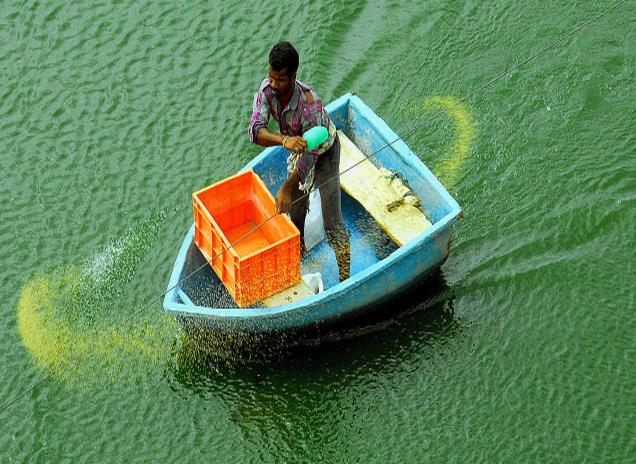
A grower sprinkling feed in an aqua pond at Ravivaripalem of Prakasam district.- PHOTO: KOMMURI SRINIVAS

Vannamei shrimp culture has come as a boon for aquaculturists in Prakasam district who were hit hard following the outbreak of the White Spot Disease in tiger shrimp farms, leading to abandoning of ponds in large tracts.

The growers are a worried lot now, with the price of Vannamei for 30-count plummeting to around Rs. 400 a kg after touching a high of Rs. 750 in 2013 in the wake of the outbreak of the Early Mortality Syndrome in China.

In this scenario, the Fisheries Department had chalked out an action plan to fully tap the potential of the district by focusing on revival of brackish water aquaculture in abandoned ponds on the one hand and cutting costs through supply of subsidised seed and feed.

Estimating that aquaculture is currently in vogue in around 3,000 hectares, the district administration has fixed an ambitious target of doubling it to 6,000 hectares in the district over a period.

Speaking to The Hindu , Fisheries Assistant Director said the State government had identified aquaculture as a growth engine and had come out with schemes for the revival of abandoned ponds, besides those for providing subsidy for inputs and mechanisation of aqua ponds to ensure sustainable shrimp farming.

Aquacutlurists, according to an estimate, have abandoned aqua-ponds in over 500 hectares in the district.

“We want to see that aquaculture is revived in at least 100 hectares during the year, he said, adding that selected players would be offered a subsidy of Rs. 2 lakh per hectare for specific pathogen-free seed, feed and chemicals.

Subsidy scheme

The department has also come out with a scheme to provide Rs. 5 lakh as subsidy for the Rs. 10-lakh mobile lab to test soil, water and shrimps right at aqua ponds for disease surveillance, Fisheries Development Officer K. Lakshminarayana said. The growers can also avail 50 per cent subsidy on purchase of solar pump-sets, iron rods, fans, paddle and aerators to ensure sustainable shrimp farming.

Farmers going for Tilapia culture in ponds are eligible for 50 per cent subsidy for a two-hectare unit costing Rs. 2 lakh to grow exotic species imported from Africa to augment their income, they add.

Growers are worried lot with the price of Vannamei for 30-count plummeting to around Rs. 400 a kg after touching a high of Rs. 750 in 2013

source: http://www.thehindu.com / The Hindu / Home> National> Andhra Pradesh / by S. Murali / Ongole – August 25th, 2015

A.P. major contributor to marine exports

A major player in the aquaculture sector, Andhra Pradesh contributed 46 per cent of marine exports, valued at around Rs. 35,000 crore, during 2014-15.

The contribution of the fisheries sector to the country’s Gross State Domestic Product (GSDP) is 6.04 per cent, and the total fish and prawn production in brackish and fresh water in the State was 19.78 lakh tonnes, and it was worth around Rs. 21,325 crore.

However, aqua farmers fear a dip in production owing to the prevailing drought situation.

Price fluctuations

“Aqua farmers invest Rs. 5 lakh on an average in an acre of pond for raising shrimp. But, the benefit is marginal, thanks to price fluctuation in the international market and adverse weather,” said V. Sathibabu, a farmer from Gudivada.

Another aqua farmer, G. Venkanna from Undi in West Godavari district, said canals, which were the principal sources of water for aquaculture, had dried up, and that a few tanks were dependent on bore wells.

“Aqua farmers spend lakhs of rupees every season on procurement of seed strock, feed and medicine, not to mention labour and power charges.

Apart from that the lease value is between Rs. 40,000 and Rs. 50,000 per acre a year,” he added.

source: http://www.thehindu.com / The Hindu / Home> National> Andhra Pradesh / by Staff Reporter / Gudivada (Krishna) – August 24th, 2015

A mission for coastal resource conservation

The Sorlagondi Reserve Forest in Nagayalanka mandal of Krishna district.- Photo: T. Appala Naidu

UN body joins Swaminathan Foundation to restore Sorlagondi mangrove forest. The UNFCCC will release the adaptation fund through the National Bank for Agriculture and Rural Development (Nabard).

The United Nations Framework Convention on Climate Change (UNFCCC) and the Chennai-based M.S. Swaminathan Research Foundation (MSSRF) will work together for the conservation of coastal resources, with focus on the restoration of the Sorlagondi mangrove forest cover in Krishna district.

“The UNFCCC has sanctioned Rs. 3.8 crore for the potential adaptation strategy of MSSRF in Krishna district through an ‘adaptation fund’. A roadmap to improve the mangrove forest cover in 200 acres and fish cultivation in around 50 acres of mangrove forest has been prepared, and it will be executed in August,” MSRRF Project Co-ordinator Rama Subrahmanyam said.

“The abandoned land will be brought under fish cultivation, while landless families will be involved in cage cultivation in three villages – Sorlagondi and Nali in Nagayalanka mandal and Basavanipalem in Koduru mandal,” he added.

Mr. Subrahmanyam said cage cultivation would be encouraged in brackish water by setting up as many as 10 cages in the three villages, which had been adopted by MSSRF.

The UNFCCC will release the adaptation fund through the National Bank for Agriculture and Rural Development (Nabard). According to NABARD sources, the objective of the adaptation initiative is to overcome the consequences of sea level rise and seawater inundation following cyclonic storms.

An official release by Nabard reads: “Restoration of degraded mangroves will be undertaken with native multiple mangrove species, which in turn would avoid ingression of seawater”.

The conservation of the mangrove forest becomes significant, as a portion of it has been spared for the proposed Missile Test Launch Facility project of the Defence Research and Development Organisation.

source: http://www.thehindu.com / The Hindu / Home> National> Andhra Pradesh / by T. Appala Naidu / Sorlagondi (Krishna) – August 21st, 2015

Vizag’s tree-temple, a heritage lover’s delight

Though nobody knows the exact date of the temple's construction, tribals believe that it came into existence naturally. (Representative photo)
Though nobody knows the exact date of the temple’s construction, tribals believe that it came into existence naturally. (Representative photo)

We’ve all heard about tree houses, but what about tree-temples? Well, such a rare heritage tree-temple does exist in our very own Visakhapatnam district in the tribal village of Kasipatnam near Tyda, enroute Araku Valley.

Encapsulated within the centuries old roots of a banyan tree, an even more ancient Shiva temple stands erect, its ageing bricks and tales of locals bearing testimony to it dating back to at least 300-400 years.

Located nearly 110 km from the city amid serene and verdant hills and near a little river, the Kasipatnam Ramalingeshwara Temple draws around 15-20 people daily from nearby villages. According to locals, on festive occasions such as Nagulachavithi, Karthikamasam and Mahasivaratri, hundreds turn up to offer prayers to the siva lingam. Strangely, the thick roots of an ancient banyan tree have locked within it the little temple that has a conical-shaped dome and structure made of small bricks.

The nearly 85-year-old Doddi Ramulamma, who has been looking after the temple since childhood, said, “My family has been serving the temple since it was discovered. My forefathers served the temple and this tradition was passed on from generation to generation. To fulfill the basic requirements of the temple and my family, I sell printed entry tickets (priced Rs 10 per visitor) provided by villagers. My husband, two sons and one daughter are all dead but I have two grandchildren. During Shivaratri and Nagaulachavithi, lots of people from various places come to visit the temple.”

People living here believe that prayers of devotees who visit the temple never go in vain. A popular instance being that of Pitala Govindraju from Gajuwaka. The childless man offered prayers to the temple and soon was blessed with two children. As an act of gratitude, he added new structures to the temple, such as steps and tiles on the interior walls of the sanctum sanctorum.

Though nobody knows the exact date of the temple’s construction, tribals believe that it came into existence naturally. However, some of the little educated among them say it was built more than 400 years ago going by the bricks used in construction and the aged banyan tree, which grew around the temple, pointed out another local Doddi Dharma.

Prior to cyclone Hudhud, the tree was huge and even more sprawling but due to the impact of the cyclone, most of its branches were broken. Though the structure of the ancient temple was resilient enough to withstand the ravages of time and that of the cyclone, it deserves conservation as an archaeological and natural heritage site.

However, the state department of archaeology is clueless about this temple. AP State Department of Archaeology and Museums assistant director K Chitti Babu said, “Such a rare tree-temple deserves protection but we haven’t seen it yet. We will visit the temple at Kasipatnam and try to ascertain its age from statues, deities and inscriptions.”

Meanwhile, Intach (Indian National Trust for Art and Cultural Heritage) member and environment activist Sohan Hatangadi, who had earlier visited the tree-temple, suggested the involvement of APTDC (AP Tourism Development Corporation) and state archaeology department along with locals for preservation of the temple and tree.

“It’s a unique example of a combined natural and manmade heritage site, which is easily 300-400 years old or even more. APTDC should put up signages at the site, while Intach can document the temple. Since it’s a religious place, locals should also be involved in the form of a cooperative to take care of the temple and generate revenue for the family looking after the temple. Also, some cleaning, light fencing around the tree-temple, garbage disposal and parking provisions away from the temple should be made. The side road through the village leading to the temple should also be repaired. One should ensure that the centuries-old heritage site doesn’t turn into a picnic spot for revelers in the name of tourism. Rather, the archaeological and natural heritage site needs to be preserved the best way possible,” suggested Hatangadi.

source: http://www.timesofindia.indiatimes.com / The Times of India / News Home> City> Visakhapatnam / TNN / August 16th, 2015