Category Archives: Nature

Mango farmers high on hopes

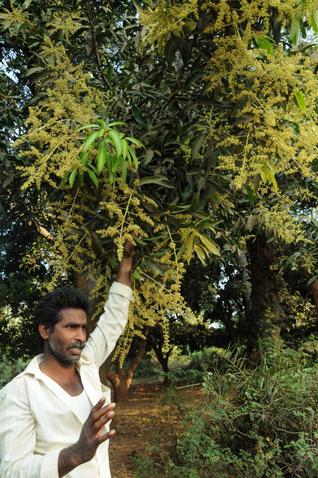
Srinivasa Rao, a farmer, showing the flowering on a mango tree at Nekkalam Gollagudem in Krishna district. /  Photo: Ch. Vijaya Bhaskar / The Hindu

Flowering is extensive and the crop is healthy, say farmers

Think of mangoes, and your are sure to conjure up images of the sweet, juicy, pulpy fruit that lures one and all during summer. And if one considers the varieties, the Nuzvid ‘rasalu’ certainly tops the list. This year, the farmers are hopeful of reaping a rich harvest of the famous ‘chinna rasalu’, ‘banginapalli’, and other varieties, as flowering is good and the crop in the region is not afflicted by an disease. If the weather cooperates, there will be good produce by March end, they opine.

“Krishna district, particularly Nuzvid, is known for ‘chinna rasalu’. Every year, we export some thousands of tonnes of the fruit to Bangalore, Hyderabad, Chennai, and other places,” say the farmers. Flowering is robust and extensive in the orchards at Nuzvid, Agiripally, Nunna, Thotlavallur, and other areas in the district.

In some areas, the fruit is in a tender stage and the crop will be ready in the next 20 days.

“Compared with last year, flowering is good and we are expecting a good yield this season. The investment is also less this year, as the crop is healthy,” a mango farmer V. Srinivasa Rao of Nekkalam Gollagudem village told The Hindu.

“I raised chinna rasalu, pedda rasalu, and banginapalli varieties in five acres. We have already picked the fruit twice, as there was flowering in the months of November and December. We are happy as the position is good so far,” said another farmer S. Venkata Ratnam of Adavi Nekkalam village.

“Eighty per cent of trees are in flowering stage. The recent rain did not cause much damage to the crop. This year the produce may be double than last year,” said S. Veeranjaneyulu, who has orchards in the Nuzvid area.

“Most of the produce will be used for consumption in Vijayawada, Khammam, Guntur, East and West Godavari, and neighbouring districts. Fine quality of ‘banginapalli’ fruit will be exported to other States and countries,” said Mr. Venkata Ratnam.

source: http://www.TheHindu.com / Home> News> Cities> Vijayawada / by Rajulapudi Srinivas /Nuzvid (Krishna Distr.) – February 09th, 2013

3 lakh hectares of land in East Godavari to be irrigated:Reddy

Three lakh hectares of land in East Godavari district will be irrigated by March, Andhra Pradesh Chief Minister N Kiran Kumar Reddy announced today.

“Water will be provided to three lakh acres by March this year in East Godavari district,” Reddy said after inaugurating the Indira Jala Prabha scheme at Vajrakutam village under Gollaprolu mandal of the district.

1,231 acres of land has been brought under cultivation in the district and 69 bore-wells dug up under the Rs 1,800 crore ‘Indira Jala Prabha’ scheme.

The chief minister was accompanied by Union Minister Jairam Ramesh, state Home Minister Sabita Indra Reddy and others.

source:  http://www.Business-Standard.com / Home> General News /by Press Trust of India / Rajahmundry (AP) / January 06th, 2013

Alien tree species pose a threat to Eastern Ghats

Visakhapatnam :

Forest biodiversity in the Eastern Ghats  is undergoing a tremendouschange. Experts at the department of environmental sciences, Andhra University, believe that the hilly slopes in the district are changing for the worse.

The department of environmental sciences estimates that over 80,000 acres of forest land has been permanently destroyed in the last 32 years alone (from 1980-2012). In addition to this, biodiversity in the deciduous forests on the hilly slopes of the Eastern Ghats in the district has virtually gone for a toss.

Pointing out that diversity in flora has a new meaning today,  Professor  A Solomon Raju  said, “Intrusive non-native species are taking over the forest cover and artificial block plantations in many pockets of our reserve are threatening the existence of seasonal native plants in many ‘forested’ areas.”

Over a period of time, many block plantations of tree species like Eucalyptus and timber trees such as Cashew rina have been introduced in the reserve area, resulting in erosion of endemic species peculiar to the Eastern Ghats like Native Basil, Fida, Justicia, Borreria and Merremia that help in soil conservation, increase moisture level and produce organic matter which helps trap carbon.

Agreeing to this, N Govinda Rao, a biotechnologist from  Andhra University  said that the introduction of foreign species in a specific and sensitive ecosystem must be done carefully and care must be taken to ensure that they are friendly towards the ecosystem and not intrusive.

According to experts, the forests in Eastern Ghats are unique, in the sense that they are the most ancient forest cover in the subcontinent. More importantly, thanks to the solid bedrock, they house a vast number of tree species.

The three-tier structure of the forest is predominantly tree based and supported by shrub and herbaceous cover which is conducive to supporting life forms of great variance. The undulating and gentle sloping nature of the Ghats makes it ideal to support a three-tier forest, said sources at the environmental sciences department.

Elaborating on this, professor Solomon Raju said, “The very sloping nature of the Ghats makes a three-tier forest absolutely necessary. The seasonal herbaceous species such as Hyptis and Ocymm are extremely eco-friendly, in the sense that they not only help bind the soil and absorb rain water but also act as generators of organic matter that help the forest sustain.”

Moreover, the sub-tropical nature of the climate ensures that species found in different climatic zones can make a home in the Eastern Ghats. However, experts fear that the very existence of forests in the Eastern Ghats is being threatened due to various reasons today.

The introduction of non-friendly species such as Eucalyptus and Cashew rina is spelling doom for the ethnic nature of the forest, even as illegal mining, excessive urbanisation and shifting cultivation in addition to illegal logging could actually wipe out the forest cover for good, experts pointed out.

“Almost three species of butterflies have been wiped out and honey bees too are a threatened lot. If we do not act today and protect our forest cover, the implications would be serious as pollination itself could be affected. This means that food production would be drastically affected in the long run,” warned Dr Govind Rao .

However, forest department officials defended the decision to opt for quick growing plantations of Acacia, Cashew rina, Eucalyptus, Prosopis (Thumma) and Coffee because the focus was on regenerating tree and land cover in completely denuded areas. “We also need to take into consideration the fact that these trees have a commercial value. After all we cannot have the locals in conflict with the ecosystem. In the process, we try to find a balance. Environmentalists might say that we are compromising, but at least we are doing our bit to regenerate forest cover. At the end of the day, the block plantations can be slowly replaced by a natural forest cover.”

source: http://www.timesofindia.indiatimes.com  / Home> Environment / TNN / December 11th, 2012

SIO exhibition to create awareness on environment

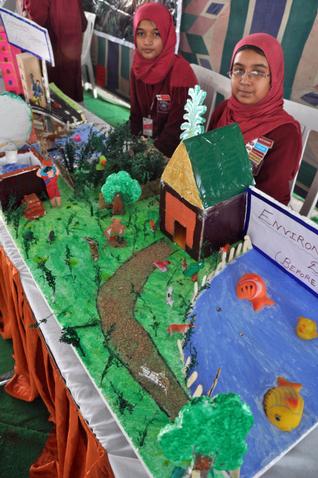
Documentary films will be screened at the venue for students in the next few days. Most of the models have been prepared by the children themselves.

The three day exhibition that SIO Hyderabad is organised with theme,”Think,Act,Save for all it’s worth, save the Earth” at nampally in Hyderabad on Saturday. /  Photo:G.Ramakrishna / The Hindu /

In an effort to create awareness about the environmental hazards, the Students Islamic Organisation of India is organising a three-day environmental exhibition titled ‘Think, Act, Save. – For all it’s worth save the Earth’ at the Exhibition Grounds in Nampally.

The event was inaugurated on Saturday by Dr. M.K.M. Zafar, Reader, Department of Translation, Maulana Azad National Urdu University. Students from over 15 educational institutions from across the city are participating in the event.

Students demonstrated the need for constructing Rain Water Harvesting pits in houses. Different models were used to educate people about the ill-effects of deforestation and various forms of pollution. This apart, a painting and photo exhibition is also on at the venue.

Documentary films will be screened at the venue for students in the next few days. Most of the models have been prepared by the children themselves.

“We are trying to involve and educate children about the environment and the need to protect it,” said Arifuddin Ilyas, City Secretary, SIO Hyderabad. Hameed Mohammed Khan, president, Movement for Peace and Justice and Syed Anas Rizvi, president, SIO Hyderabad participated in the inauguration function. The exhibition is open to the public from 11 a.m. to 8 p.m till Monday.

source: http://www.TheHindu.com / Home> News> Hyderabad / by Staff Reporter / December 09th, 2012

Prehistoric site found near Srikakulam

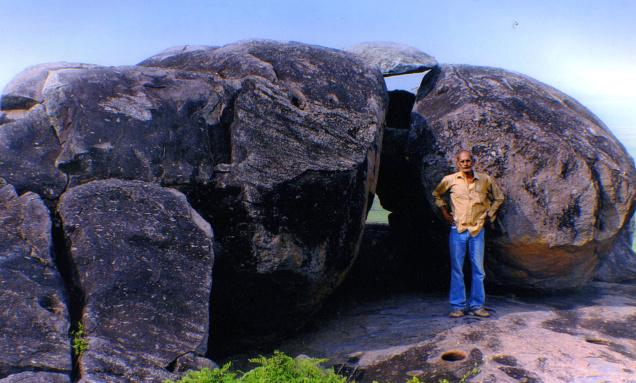
Archaeologist K. Venkateswara Rao who found the prehistoric rock shelter on the top of the Saidala Hill near Srikakulam.

Several rock shelters found on Sailada hill-top and Chittivalsa are significant, says archaeologists

Did the prehistoric man straddle the hillocks near Srikakulam town in Andhra Pradesh much like the Bhimbetka in Madhya Pradesh, UNESCO’s World Heritage Site ?

The rocky landscape near Srikakulam may not boast of the richness and the depth of the rock paintings of Bhimbetka that fetched it international recognition but several prehistoric rock shelters found on Sailada hill-top and Chittivalsa area in the recent past are equally significant, contend archaeologists here.

They are excited by the finding of a set of four 3.8 metre high rocks leaning inwards and forming a polygonal chamber on Saidala hill-top as it comes close on the heels of discovery of a cluster of druidical rocks at Chittivalsa and of dolmen and menhirs resembling those in Europe and Africa. Both these findings that indicate existence of a reasonably big habitation of prehistoric people in the area, were by free-lance archaeologist, K. Venkateswara Rao.

The recently found round-shaped dolmen like formation with a stone roof, stands on a circular rock bed of 13 metre radius on the top of the Saidala hill. Like others, this rock shelter too has post holes around it in two rows meant for installing wooden posts that served as props to supported a canopy. “The place appears to have been used for performing some rituals and ceremonies by the prehistoric people”, Mr. Rao said.

There are many caves, caverns and shelters of different shapes in the hillocks in the region but not as huge as this one that too with a rock bed inside.

Even now the place continues to be known as “Pandiri Rallu” a shelter made of rocks. The rock shelter has enough place to accommodate 10 to 15 people inside. A petroglyph of serpent was found on the western side of the shelter, a common feature on prehistoric dolmens in Europe.

Another name given by the locals to this unique rock formation is “Bunti Vanda”, virtually a den of bears. Burrows formed by flow of rain water from the top of the hill to the foot, have turned them into safe sanctuary for the bears. “Even now villagers dread to tread the bushy path to the top of the hill scared of the bears and feel the sacred place is visited by Gods and Goddesses. This in a way is blessing in disguise as the rock formation remains protected with no major damage”, Mr. Rao says.

Further evidence of the man living on the hills was the finding of a 6 x 4 ft depression in the rock perhaps used as a water storage pit. Mr. Rao says the prehistoric rock shelters on sacred hills of Sailada and Sangamaya and the nearby Pandavulametta at Chittivalsa and the later period’s historic fort of early Kalingas could be projected as unique site with continuous history for UNESCO”s recognition.

source: http://www.TheHindu.com / Home> News> States> Andhra Pradesh / by K. Venkateshwarlu / Hyderabad, November 12th, 2012

Brahman Cows Thrive in USA and Brazil

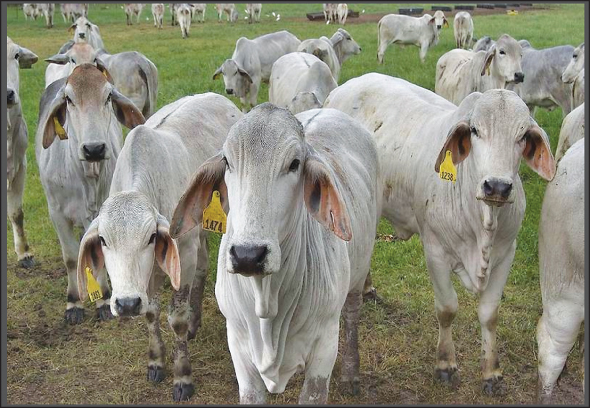
Brahman cattle after a rain near Perch Creek Road near College Station, TX

By Krishan Gupta

History of Brahman cattle between India and America is more than 140 years old. During British Raj Indian cattle were imported to USA and Brazil for milk and other products and according to their needs. Texas became the main hub to import cattle during that time. City of Hungerford, TX has one of the ten largest purebred producers in USA.

A Brahman cow is an extremely good mother, offering protection and an abundance of milk for her calves. Brahman calves tend to measure high weights at weaning because of the outstanding milk given by Brahman cows. They are known for their extreme tolerance to heat conditions, and resistance to insects due to their thick layer of skin. They live longer than many other breeds, often still producing calves at ages 15 and older. These cows have a greater ability to withstand heat than European cattle, and have more sweat glands, big hump, also an oily skin, thought to help repel pest insects along with a smooth coat and a short hair coat. They are also more resistant to parasites and disease in some countries, especially in South America. In South America, Brahman cattles are also used for milk, and other products.

The Brahma is a breed of Zebu cattle (Bos indicus), later exported from India to the rest of the world. The main breeds used were Kankrej, Gujarat, Nellore or Ongole and the Gir cattle. It is named for the Sacred Cow of Hindus.

Nellore cattle originated from Ongole (Bos Iindicus) cattle originally brought from India to Brazil. The Nellore has a distinct large hump over the top of the shoulder, neck, and long legs, which help them to walk in water and when grazing. The Nellore can adapt to all except very cold climates. They are very resistant to high temperatures and have natural resistance to various parasites and diseases.

Ongole city is located in the state of Andhra Pradesh, India and famous for its Ongolu Gittacattle (Ongole breed of oxen).  This is one of the major Zebu cattle breeds in the world. Zebucattle was originally called as Bos Indicus, sometimes known as humped cattle, Indicus cattle, Cebu or Brahmin cattle originating in South Asia, particularly the Indian subcontinent. They are characterized by a fatty hump on their shoulders, drooping ears and a large dewlap. Zebu are used as draught oxen, as dairy cattle and as beef cattle, as well as for byproducts such as hides and dung for fuel and manure.

Gir cattle are famous milk cattle breed of India. The native tract of the breed is Gir hills and forests of Kathiawar including Junagadh, Bhavnagar, Rajkot and Amreli District of Gujarat.

Kankrej cattle are a breed of Zebu cattle from the district of Kankrej in the state of Gujarat, India, They are also known by the names Bannai, Nagar, Talabda, Vaghiyar, Waged, Wadhiar, Guzerat cattle are a breed developed in Brazil from Kankrej cattle imported from India. The name Gurezat is a Portuguese spelling of Gujarat. They are, of course, very similar, both being tall draft/beef  breeds with high horns. On the average, Guzerat are darker, bigger and have longer horns than Kankrej. The bulls usually are quite dark on the head and forequarters, lighter elsewhere. Guzerat and Kankrej are the principal breeds used in the formation of the American Brahman, along with the Gir and the Nellore.

However there has never existed in India a breed called Nellore. This name corresponds to a District of the old Presidency of Chennai, now belonging to the new State of Andhra Pradesh by the Bengal Sea. It was in Brazil that some authors started to use the name Nellore as a synonym to Ongole, the Indian breed that contributed most to the creation of the Nellore.

The first importation of Indian cattle of any notoriety came in 1854, when sugar and cotton farmer, Richard Barrow of St. Franksville, Louisiana, was presented with two bulls by the Government of Great Britain, for his services in teaching cotton and sugar cane production to British officials establishing these crops in the deltas  of India.

In 1915, J.D. Hudgins and his son, Walter, began putting together all of the Indian cattles they could find and afford to purchase. In that year, they bought a group of females which were direct descendants of a 1906 importation from India. In 1924, they were able to purchase a group of bulls which had been imported from Brazil. These, and other humped cattle, formed the basis of the first breed to be developed in the United States “The American Brahman”. The registry for the American Brahman breed was organized in that same year. The J.D. Hudgins ranch is located at Hungerford, Texas, 50 miles southwest of Houston on U.S. Highway 59.   The Hudgins Ranch acquired the gray Brahman bull Monso in 1933. Manso’s descendants are the cornerstone stock from which the ranch’s American Gray Brahman herd was developed, now one of the largest registered American Gray Brahman herds in the world.

Originating from a nucleus of approximately 266 bulls and 22 females of several Bos indicus (cattle of India) types imported into the United States between 1854 and 1926. Today the Brahman breed has achieved acceptance for their environmental adaptively, longevity, mothering ability and efficient beef production

In 1933 the Hudgins Ranch purchased the gray Brahman bull Manso, a descendant of a pure blood Brazilian Brahma bred by the Sartwelle Brothers of Palacios, Texas. Manso proved to be an excellent sire and very prolific. His first calves were born in the fall of 1934. At the time of his death in 1943 at the age of 17 years, Manso had produced 316 offspring for the ranch. It has been estimated that over 75% of all cattle registered by the American Brahman Breeders Association carry Manso breeding. The Manso cattle breed have captured over 1500 championships including numerous National and International Champions

V8 Ranch was also established in 1944 by Howard Parker of Center, Texas and purchased by Sloan Williams in 1971. Because of these early roots he said that was proud to be one of the oldest continually operating Brahman herds in the United States.

The American Brahman Breeders Association was organized in 1924. J.W. Sartwelle of Houston was the first recording secretary of the Association and it was he who proposed the word “Brahman” and so it was adopted as the name of the new beef breed. American Brahman cattle, the first beef breed developed in the United States, are proven to be the top most rank in hybrid vigor, heat tolerance, and efficiency compared to all other beef breeds. With improved growth and performance, Brahman cattle increased profitability and play an important role in crossbreeding programs throughout the United States, Brazil, Australia and many other parts of the world.

source: http://www.indoamerican-news.com / September 27th, 2012
Rudraksha being grown in East Godavari

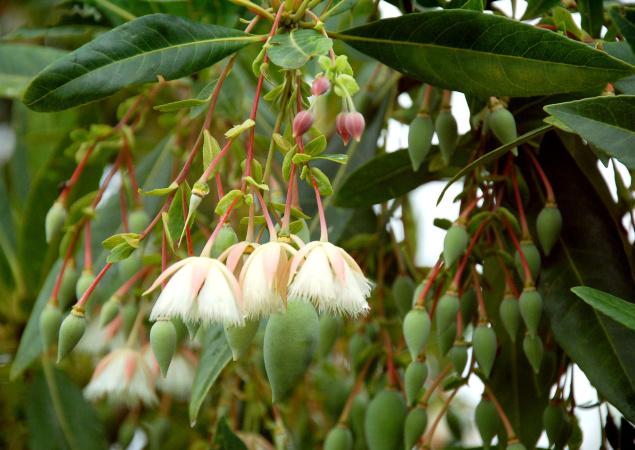
‘Ekamukhi’ rudraksha plant brought by a nursery in Kadiam village in the district two years ago starts flowering

The ‘ekamukhi’ (single-segmented) rudraksha plant, now confined to the Himalayas and India-Nepal border, is now being grown in the semi-arid tropical climate of East Godavari district.

Gangumalla Satyanarayana and his brothers, are among the hundreds of farmers engaged in growing nurseries of the plant in the district now. It was Sri Satyanarayana Nursery of Kadiam, owned by the Gangumalla brothers, that first grew the ‘ekamukhi’ rudraksha plant in the district. “We bought the plant about two years ago in Bangalore and the age of the plant at the time was three years. It began flowering four months ago. We only know that it is a rudraksha plant. But, recently a swamji told us that it was ‘ekamukhi’,” said Nagesh, one of the brothers. “The plant has grown into a small tree and hundreds of rudraksha buds of green colour with flowers hang from it now,” he says.

Hindus believe that ‘ekamukhi’ rudraksha is a resemblance of Lord Siva. Generally, rudraksha beads have five lines (mukhi) on them. They stand for five segments of the bead. Each segment contains a seed in it. But, ‘ekamukhi’ has only one seed, which is the most wanted variety.

Mr. Reddy, who is in charge of the Sri Satyanarayana Nursery, says ‘ekamukhi’ rudraksha is available in five or six shapes and presently their nursery grows the plant that bears oval-shaped Rudraksha. ‘Ekamukhi’ can be tested by a simple formula: put it in a bowl of milk and it will not degenerate for five days.

As for the size of the rudraksha, Mr. Nagesh said they had grown the plant in open air and had not taken due care as they had not realised its importance. “If the plant is properly maintained, the size and shape of the bead will match the rudraksha available on the Nepal border,” he said.

source: http://www.TheHindu.com / Home> News> States> Andhra Pradesh / by B.V.S. Bhaskar / Rajahmundry, September 10th, 2012

Butterfly park to add attraction to Vizag

Visakhapatnam:

A butterfly park, the first of its kind in the state, will soon be an additional attraction at  Indira Gandhi Zoological gardens in Vizag. The enclosure, which would also function as a base lab and slated to be thrown open to the public in the next couple of months, would house about 20 to 50 species of butterflies and is being constructed at a cost of Rs 20 lakh.

Elaborating on the need for a butterfly enclosure, curator G Ramalingam said apart from being eye catchers, butterflies play a major role in establishing pollination patterns.

Moreover, he pointed out that the main reason for the enclosure was to enable study of the butterfly species native to the Eastern Ghats. The first such butterfly enclosure in India came up in Pune in 2006 and today, there are six other such enclosures in the country.

While the existing butterfly enclosures are on the west coast and the Himalayan region, the one at Vizag would be the only such center in the entire east coast. Three of the seven enclosures are situated on the west coast, in Goa, Thane and Pune while the others are situated in Simla, Bangalore, Chandigarh and Rangrang (Sikkim). Speaking on the concentration of enclosures in these areas, Dr Ramalingam noted, “It is believed that the Himalayan and Western Ghats region have a varied and larger range of butterflies. However, that does not mean that the Eastern Ghats should be neglected. It is precisely for this reason that the enclosure that is coming up would also function as a base research lab. The lab would help us catalogue and decipher the local species and also take note of any Diaspora and cross migration.” While India is home to 1501 species of butterflies, 250 of these are found in the Eastern Ghats alone.

The enclosure on 500 square meters to begin with, would include butterfly species such as the Plain tiger, Blue tiger, Indian crow, striped tiger, Tawny Coster, Common Leopard, Indian Red Admiral, Swallow tails and Metal marks. The curator was of the view that the enclosure would attract one and all, from children to Lepidopterists.

source: http://www.timesofindia.indiatimes.com / Home> City> Hyderabad / TNN / August 12th, 2012

A blessing in disguise for mango ryots

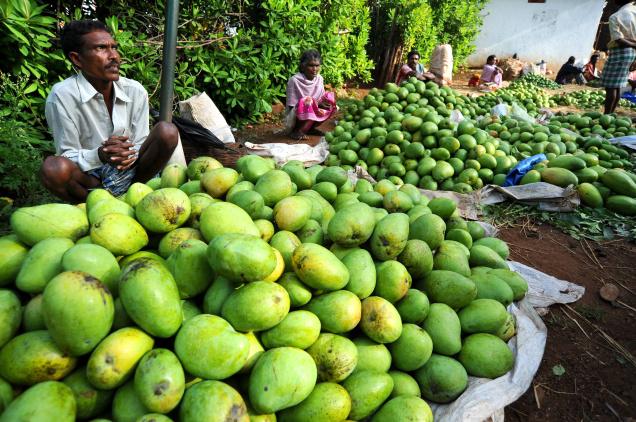
GOOD YEAR: A tribal farmer, with his bumper crop, waiting for customers at a shandy near Araku Valley in Visakhapatnam district.   Photo: K.R. Deepak / The Hindu

Delayed monsoon gives them bumper harvest

Delayed monsoon served as a blessing in disguise for reaping a bumper mango harvest in north coastal Andhra districts, according to Horticulture Department officials and mango crop experts. Mango plantations are spread over roughly 1.50 lakh acres in Srikakulam, Vizianagaram and Visakhapatnam districts.

Due to the impact of climatic changes, rains were occurring more due to formation of cyclonic depression and also gale and heavy winds. These are adverse conditions for mango flowering and fruit leading to steep drop in yield. Gale and winds were experienced a couple of time during the mango flowering and fruiting stage, but were limited to a few pockets in the region while Agency area witnessed bumper harvest as rainfall was higher when compared to plain areas.

Among the several varieties of mango banginapalli, collector, suvarnareka, neelam, romania, rasalu, cheruku rasalu and palukalu are produced in north Andhra. The palukalu variety is harvested in March and April and is in much demand in Delhi and Bengal. Vizianagaram is the local market from where it is sent to other States.

The banginapalli, suvarnareka, rasalu, cherukurasam and peddarasam varieties are harvested in May. The collector variety is mostly used in pickles, fruit drinks and in processing industry and will hit the market in mid-June and July. A British collector introduced the Thotapur variety of mango to the local farmers in the State and ever since it became popularly known as ‘Collector Kaya’.

Assistant Director (horticulture) G. Prabhakar told The Hindu that the mango crop had been by and large intact as there were no adverse climatic conditions like heavy winds and cyclones and the delayed monsoon has actually protected the mango crop. “Besides, the natural ripening of mangoes has actually turned the mangoes sweet. Initially at the advent of mango season there were complaints of traders adopting artificial methods like using of calcium carbide for ripening but as the dry spell continued for some time most of the traders waited for natural ripening, which was why most of the recent mangoes were sweet and tasty”, he said.

On an average, the mango production per acre was 4-5 tonnes. A rough estimate puts the total mango production in 1.50 lakh acres in the three districts at 450,000 tonnes.

Mango cultivation in Visakhapatnam is 40,000 acres in plain areas and 10,954 acres in the Agency areas. A feasibility study had been made by the ITDA to expand the mango crop area by another 23,758 acres in the coming years.

In Srikakulam district mango cultivation is in 65,000 acres in the Palakonda, Rajam, Regidi Amudalavalasa and Santakaviti mandals. In Vizianagarm district the mango cultivation is spread in 25,000 acres.

To help the farmers in the event of adverse climatic conditions causing damage to the crop, the State Government has brought the mango crop under the crop insurance scheme. The insurance scheme covers damages to the crop caused by high temperatures, unseasonal rainfall, pests and diseases and cyclonic winds and natural calamities etc. Premium amount for a tree less than15 years old and more than 15 years is Rs.52 and Rs. 46 respectively, with the beneficiary farmer and the Government contributing equally.

Mango accounts for 40 percent of the fruit exports from the country and Uttar Pradesh and Andhra Pradesh have the largest mango cultivation areas followed by Bihar, Karnataka, Kerala and Tamil Nadu.

Mango is utilised in all stages of its development both in its immature and mature state. Raw fruits are used for making chutney, pickles and juices.

The ripe fruits besides being used for desert are also utilised for preparing several products like squashes, syrups, nectars, jams and jelly. The mango kernel also contains 8-10 percent good quality fat which can be used for soap and also as a substitute for cola in confectionery.

source: http://www.TheHindu.com / Home> News>  Cities> Visakhapatnam / by Ravi  P. Benjamin / June 11th, 2012

Karimnagar Dairy becomes Producers Company

Will benefit milk producers and increase milk production

The Karimnagar district mutually-aided cooperative milk producers union albeit Karimnagar Dairy, which had been making strides in launching a milk revolution and benefitting milk producers, have been converted into the Producers Company by acceding with the Companies Act 1956 to grow into a bigger and stronger organisation to benefit milk producers.

Disclosing this to newsmen here on Saturday, Karimnagar Dairy chairman Ch. Rajeshwara Rao said that the decision to convert Karimnagar Dairy into Producers Company was taken after discussions with the board of directors on September 16, 2011.

Later, the process was completed in spite of objections raised by Andhra Pradesh Dairy Development Cooperative Federation Limited. He added that the Registrar of Companies of Minister of Companies Affairs had allowed for Karimnagar Dairy to be made into Producers Company after being satisfied with the dairy’s performance and keeping in mind the welfare of farming community.

Stating that they were forced to go to Producers Company under the Companies Act as the State government was scuttling the Cooperative Milk Producers Union’s development, he said that the Visaka Dairy was the first cooperative dairy in the State to go for conversion into the Producers Company.

He said that after the conversion of the dairy into the Producers Company, the milk producers alone would be the share holders and the profits would be shared among the milk producers only.

The conversion had made the dairy an independent agency without political interference and would give more benefits to the farmers.

The Karimnagar Dairy was established in 1971 and was handed to the farmers in November 1, 1998 as cooperative dairy as part of the Cooperative Act 1964.

Since then, the dairy had made long strides in milk production and welfare of milk producers. The milk sales had crossed 1 lakh litres and procurement had also crossed one lakh litres per day.

On the other hand, the loss making unit was made into a most viable unit with profits. The Karimnagar Dairy turnover reached 130.92 crore as on March 31, 2012, the dairy chairman said.

Dairy managing director V. Hanumantha Reddy was present.


  • Dairy is now an independent agency without any political interference
  • Visaka Dairy was the first cooperative dairy in State to be converted into Producers Company
  • —————————————————————————————-
  • source: http://www.TheHindu.com / Home> National> Andhra Pradesh /  by Staff  Reporter / Karimnagar, June 03rd, 2012
  •