Category Archives: Nature

Kakatiya University plant research wows scientists

Hyderabad :

In a rare feat for a rural Indian university, little known Infectious Diseases and Metabolic Disorders Lab (IDMDL) of Kakatiya University, Warangal, has attracted the attention of the global scientific community by discovering anti-diabetic and anti-HIV compounds in the extracts of herbs which are used by local tribes as a cure for various disorders. The lab, headed by a young scientist Estari Mamidala, extracted anti-diabetic chemical from a plant called Physalis Minima (budamma in Telugu; ban tipariya in Bengali; parpoti in Gujarati and tulati pati in Hindi ) and found anti-HIV properties in Tinospora Cordifolia (tippa teega in Telugu and giloe in Hindi) and Cassia Occidentalis (penta chennagi in Telugu and bendra lathi in Hindi).

After conducting an ethnobotanic survey for about a year, from July 2011 to August 2012, based on the local medical knowledge practices among the tribes in Mulugu Venkatapur, Regonda, Parkal, Shayampet, Hasanparthy areas of Warangal district in Andhra Pradesh, the team led by Estari identified about 65 plants believed to have great curative value. His team studied extracts from various parts, leaves, stem, roots and flowers, for the medicinal properties and found amazing qualities. Estari says these experiments are expected to pave a new path for alternative medicines from plants extracts which are cheaper and safe to use.

The Estari team also found four more medicinal plants (Phyllanthus emblica, Eclipta alba, Tinospora cordifolia and Casia occidentalis) which have the ability to inhibit replication of HIV-1. The extracts of these four plants have the potential to be used as natural products in the chemotherapy of HIV infection, said Estari.

In the studies conducted on rats, it was found that the leaf and flower extract of Physalis Minima significantly lowered the fasting blood sugar. However, the stems have not shown such a property. Repeated experiments with flowers and leaves clearly exhibited more potent anti-diabetic activity by reducing the blood glucose level significantly compared with the root and stem extracts of P. Minima.

Similarly, Tinospora Cordifolia was found to have anti-HIV property comparable to the drugs available in the market. Another plant, Cassia Occidentalis has also exhibited HIV inhibiting properties in a significant way. Speaking to TOI from Warangal, Estari said the extracts of Cassia Occidentalis had exerted their anti-HIV property by inhibiting the HIV Reverse Transcriptase activity. The study seems to justify the traditional use of plant for the treatment of infectious disease of viral origin, he said. The plant has great potential for developing useful drugs, he added.

The results of IDMDL studies have been published in the International Journal of Scientific & Engineering Research (Volume 3, Issue dated 7 June, 2012), Biology and Medicine (2013) and BMC Infectious Diseases (December, 2012).

source: http://www.articles.timesofindia.indiatimes.com / The Times of India  / Home> City> Hyderabad / by Jinka Nagaraju, TNN / May 15th, 2013
Medicinal rice can cure gastro, knee, heart diseases, says farmer

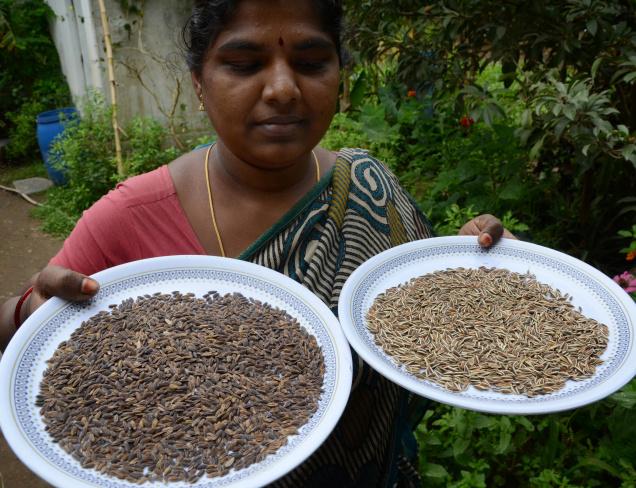
Susheela, wife of a farmer, Vishnuvardhan Rao, displaying the medicinal varieties of paddy cultivated in their fields, at Arisepalli village in Krishna district./ Photo: V. Raju / The Hindu

Here is some good news for patients suffering from joint pains, heart-related ailments and other chronic diseases. There is no need to run around hospitals if medicinal rice is consumed, says Panchakarla Vishnuvardhan Rao.

A farmer and Gopala Mithra member, Mr. Rao, is raising ‘medicinal varieties of paddy’ in the village in Krishna district. People are prone to diseases due to consumption of foodgrains that lack these values, said the farmer, who completed BZC in National College, at Machilipatnam.

Many people in their youth suffer from chronic diseases and take injections and gulp pills. The farmer’s idea is to give medicines along with food grains and keep the people away from diseases, Mr. Vishnuvardhan Rao told The Hindu.

In the ‘Navarai’ variety he has raised he claims it is good for gastro and knee patients, Dodda Beer Nallu is good for anaemic patients and adolescent girls, Rami Gali has high protein-content, Rohas Panjar and Kadam are other medicinal varieties of paddy.

“Farmers are cultivating medicinal paddy in Kerala, Tamil Nadu and Karnataka, which is good for pregnant women and patients suffering with other diseases. Medicinal crop varieties are not suitable for growing in saline soil and research should be done to cultivate the varieties in coastal areas”, said Mr. Vishnuvardhan.

Adopted from USA

He took the sample grains from a researcher, Sabarmatee, in Pasadena University, California in the US. She was raising 370 varieties of foodgrains in two acres in Orissa, as part of investigations.

The duration of the crop was 135 days and medicinal paddy contains high B Complex value and disease-resistance capability, he added.

It is better, if the crop is raised by using ‘go mutram’ (cow urine) and dung, said the farmer.

“My wife, Susheela, is encouraging me in raising different varieties of paddy. I allotted some land for cultivating medicinal varieties in my five and half acre paddy fields.

Farmers can give relief to the patients, if medicinal paddy is cultivated” Mr. Vishnuvardhan Rao opined.

source: http://www.thehindu.com / The Hindu / Home> News> Cities> Vijayawada / by Rajulapudi Srinivas / Arisepalli (Krishna Dist), May 12th, 2013

Two new paddy varieties developed

Machilipatnam Agricultural Research Station scientists T. Anuradha and K. Nagendra Rao displaying new paddy seed varieties./  Photo: T. Appala Naidu / The Hindu
Machilipatnam Agricultural Research Station scientists T. Anuradha and K. Nagendra Rao displaying new paddy seed varieties./ Photo: T. Appala Naidu / The Hindu

Two scientists of Acharya N.G. Ranga Agricultural University Research Station (ARS) here have developed two paddy seed varieties, MCM 100 and MCM 101, which can grow in saline soil. The 12-year research of the experts in developing these seed varieties has revived the hopes of farmers having saline soils.

In 2011, the Directorate of Rice Research, Hyderabad, tagged MCM-101, a rabi season seed, as the second best variety among the 33 paddy seed varieties developed by the other scientists in India, ARS Principal Scientist T. Anuradha told The Hindu. As a part of testing for the second consecutive year, the seed with 125-day duration (MCM-101 variety) was sown in five locations in Andhra Pradesh in saline fields.

“We noticed that the fine quality variety withstood the ‘blast’ disease and reported better quality yield than MTU-1010, a leading rabi seed variety in Andhra Pradesh”, said Ms. Anuradha. The kharif seed MCM-100 was tested in ten locations including West Godavari, Krishna and East Godavari, in 2012 kharif. When compared with the leading MTU kharif variety seed, the MCM-100 yield was five per cent higher.

“About 6,075 kg yield per hectare was recorded from this variety as against 5,850 kg for MTU variety. The average yield of our seed in all the ten locations was 5,539 kg as against 5,269 kg of MTU,” said Ms. Anuradha. The crop duration was 140-145 days.

“The response from the farmers, who are growing and have tested the mini kits of the seed, is the real certification for our work and a Himalayan achievement,” said scientist K. Nagendra Rao, another scientist in the research on ‘Development of Saline-Tolerant Rice Varieties for Coastal Andhra Pradesh.’

The MCM-100 and 101 seed varieties are exclusive seeds that were developed for saline soil, which is plentiful in the State and is not suitable for existing paddy varieties.

“The scientists aimed at developing seeds meant for saline soils, but these two varieties will also give yield much higher than present leading varieties – MTU 1061 and BPT 5201 – if farmers grow in normal soils,” claims the scientist duo.

source: http://www.thehindu.com / The Hindu / Home> News> Cities> Vijayawada / by T. Appala Naidu / Machilipatnam (A.P.) – May 10th, 2013

New project to save Great Indian Bustard in Kurnool

The Great Indian Bustard in flight at the Rollapadu Sanctuary in Kurnool district. / Photo: Rakesh Narala / The Hindu

The rare giant bird, Great Indian Bustard, is currently facing deep trouble due to ecological changes. According to an estimate, the endangered species has shrunk to just 300 in the entire globe. The birds at the Rollapadu Great Indian Bustard Sanctuary in Kurnool district have also dwindled to five from 10.

As the alarm bells are ringing, the Union Ministry of Environment and Forests (MoEF), the Bombay Natural History Society (BNHS), World Wide Fund for Nature (WWF) and State Forest Department have launched a unique Species Recovery Programme to save the Great Indian Bustard, which will continue for a decade.

Majestic bird

The project will be implemented at the Rollapadu Great Indian Bird Sanctuary set up in 1987 in an area of 6.14 square km near Nandikotkur in Kurnool district.

The BNHS will spare a principal investigator and two researchers who will lead the project to improve the breeding, habitat development and help increase the numbers. Over a dozen staff members will assist the scientists.

The Great Indian Bustard is a majestic bird with an average height of up to 120 cm, long neck and legs and a brownish plumage. A mature bird weighs up to 14.5 kg, while female birds are 15 to 20 per cent less in height and weight.

The GIB feeds on locusts, beetles, butterflies, snakes, scorpions, lizards, mustard, pulses like Bengalgram and groundnut seed. The bird spends most of the time on the ground and flies only when it intends to undertake long flights to migrate to other areas. A bird lays one or two eggs in a breeding season, which is the August-December period in Rollapadu.

Detailed study

Farmers in Rollapadu area recall that the busty birds would flock around them during harvest time to pick up insects that got exposed from the ground. These scenes have disappeared completely now and even a decade ago the GIB population was estimated at 40-50.

Divisional Forest Officer at Atmakur, Mohammad Moiddin Nawab, who is incharge of the sanctuary, told The Hindu that in the first stage of the recovery programme, a detailed study would be undertaken to pinpoint the causes of the falling numbers.

According to a view, the characteristics of the habitat are changing rapidly after construction of the Alaganur Balancing Reservoir close to the sanctuary. Initially, everyone thought that improvement in water availability would help the sanctuary. But this was not so. The improved irrigation facilities around the sanctuary have transformed the ecosystem from grassland to wetland. Farmers have now shifted from dryland crops to paddy and other commercial crops, which consume large amounts of chemicals and pesticides.

Within the sanctuary, the number of co-species hostile to the GIB such as wolf and the blackbuck have increased rapidly.

The blackbuck population rose from 17 in 1982 to 1,000 now. Wolves relished GIB eggs and chicks. Last year gloom descended on the sanctuary when a wolf devoured a precious chick. Currently, two forest watchers are guarding an egg laid by a bird. Sometimes, stray cattle also trample on the eggs.

source: http://www.thehindu.com / The Hindu / Home> News> National> Andhra Pradesh / by D. Sreenivasulu / Kurnool – May 07th, 2013

Visakha Dairy new plant to be ready in 3-4 months

Visakhapatnam :

Visakha Dairy plant, which is under construction at Rangampeta in East Godavari district, will be ready by August-September, according to Chairman, A. Tulasi Rao.

He was speaking to reporters at the Visakha Dairy plant here on Sunday after releasing a new product — 100-ml toned milk in tetra pak at Rs 5.

He said the dairy was selling 75,000 litres of high quality milk per day with varying fat content in toned, double toned, skimmed and standard milk variants. The dairy aims at a target of 1 lakh litres per day by the end of the year.

The 100-ml Visakha Tetra Pak is aimed at the lower-end consumer, combining the twin features of affordability and single use. The product would be sold in Andhra Pradesh, Chhattisgarh and Orissa.

He said that the plant could process 6 lakh litres per day. Visakha Dairy is procuring milk from Srikakulam, Vizianagaram, Visakhapatnam and the two Godavari districts.

“We are setting up the Rangampeta processing plant at a cost of Rs 20 crore with a capacity of 2.5 lakh litres to 3 lakh litres, as it is becoming increasing difficult to bring milk all the way from the two Godavari districts. We have to cut down on the transport costs. We tried to acquire the sick Godavari Dairy and turn it around, but the Government was not very keen on it. Therefore, we decided to put up a plant on our own,’’ he said.

Rao said that Visakha Dairy is procuring milk from more than 2 lakh farmers in the five districts, covering 2,800 villages.

“Our primary objective is to provide quality milk and milk products to consumers and at the same time do justice to our farmers by paying them a remunerative price. Of course, a balance has to be struck between the two aims. We have set up a hospital with excellent facilities here for the sake of the farmers and staff and we also try to provide educational facilities to the children of the farmers,’’he said.

source: http://www.thehindubusinessline.com / Business Line / Home> Companies / by Ch. R. S. Sarma   sarma.rs@thehindu.co.in / Visakhapatnam – May 05th, 2013

Urban agriculture booms in Hyderabad

Hyderabad :

Urban agriculture is the new culture that is catching up in the city. More than 4000 households in the outskirts of the city currently are self reliant for the vegetable needs of the family. This time Horticulture department for a change is giving subsidy directly to the citizens instead of farmers who want to grow of complete nutrients set of vegetables.

Officials say according to the Food and Agriculture Organisation (FAO) estimates, by 2050, global food demand will grow by 70 per cent to cater to the needs of the global population of 9.3 billion. As the natural resource to feed this population is going to be difficult task urban agriculture is seen as big solution to the problem.

Speaking to TOI horticulture department director K Devamuni Reddy said that the initiative as part of urban farming is met with good response since it was initiated two months back. “We give the citizens who are ready to grow a cluster of vegetables at their home a subsidy of Rs 360 and they have to spend another Rs 1200 from their pockets” he added.

This subsidy kit involves four silatin round beds, red earth, farmyard manures, 14 bags and other essential things to grow a garden at home. Officials said though the citizens have to spend additional Rs 400 to 500 for transporting ,response has been more than good. Mostly people in Uppal, Dilsukhnagar, LB nagar, Vanastalipuram who have own houses have shown good interest with more than 4000 subsidy kits being distributed so far. Officials plan to increase this number to another 1000 in next few months.

The growers will be able to get Ladies finger, Tomato, Brinjal, Pallak, coriander, Amarathis, Ridge guard, Bottle guard, Beans, cucumber, and Cluster beans. The subsidised kit will have the required seeds and the kit will be sufficient for two seasons to grow. “The programme is designed in a way that Indian Council of Medical Research ( ICMR) recommendation for nutritional needs are fulfilled. With each kit there would be a yield of 450 KG yield which would be covered in a span for three to four months” K Devamuni Reddy said. It would cover nearly one hand half KGs a day for a family of four members.

Official sources said that in Hyderabad, it was found that households that produce vegetables saved 20 per cent of their total food expenditures by retaining part of the produce for household consumption. “I find this programme interesting because we can get the guidance from them directly. Costs can be brought down too” V Venkatalakshmi of LB Nagar said. Soon the officials are planning to do visits of as many as households possible and monitor their practices.

source: http://www.articles.timesofindia.indiatimes.com / The Times of India / Home> City> Hyderabad> Vegetables / by Sribaala Vadlapatla, TNN / May 04th, 2013

Asian Seabass seed production unit to be set up in Krishna district

National Fisheries Development Board (NFDB) has sanctioned Asian Seabass seed production unit — the first in Andhra Pradesh — in Krishna District. With brackish water aquaculture activity gaining ground in the district, demand for huge quantity of Asian Seabass (Lates Calcarifer) species has also gone up.

Brackish water aquaculture is taken up in more than 5,000 acres across the district, but the farmers depend only on Seabass seed provided by Central Institute of Brackish water Aquaculture (CIBA), Tamil Nadu. The CIBA officials said that the variety survives in freshwater aquaculture ponds also, hence very popular.

The yield of Asian Seabass is much higher compared to other species. This led to the demand increasing manifold. Getting entire requirement from Tamil Nadu is turning out to be a Herculean task.

Many farmers had to withdraw their plan of growing the variety due to non-availability of seed in the district. “The NFDB has sanctioned a seed production unit worth Rs.72 lakh, which is proposed at Urlagonditippa village. It will be set up by T. Sankara Rao, a farmer,” Fisheries Deputy Director T. Kalyanam told The Hindu.

source: http://www.thehindu.com  / The Hindu / Home> News> Cities> Vijayawada / by T. Appala Naidu / Machilipatnam – May 05th, 2013

Hyderabad Metropolitan Development Authority’s unique ‘Adopt a Lake’ plan

Hyderabad :

To preserve and protect lakes, the Hyderabad Metropolitan Development Authority (HMDA) Lake Protection Committee has come with a unique scheme, ‘Adopt a Lake.’

With an objective of involving all stakeholders like individuals/corporates/institutions in lake protection, a Memorandum of Understanding (MoU) for lake adoption would be finalised by the Lake Protection Committee soon. Interested individuals/corporates/institutions have to maintain constant vigil by employing suitable watch and ward team to monitor the encroachments, debris dumping, constructions or tampering of ‘full tank level'(FTL) boundaries. They also have to maintain vigil at all inlets and outlets to keep the lake pollution free.

The interested parties have to submit a detailed proposal to HMDA’s Lake Protection Committee on how the lake could be maintained and upgraded to make it environment-friendly with proper bio-diversity. The HMDA would soon invite Expression Of Interest (EOI) from the different stakeholders to finalise the terms and conditions. of the draft MoU.

source: http://www.articles.timesofindia.indiatimes.com / The Times of India / Home> City> Hyderabad / TNN / May 02nd, 2013

Hay-granary technology still popular in Krishna

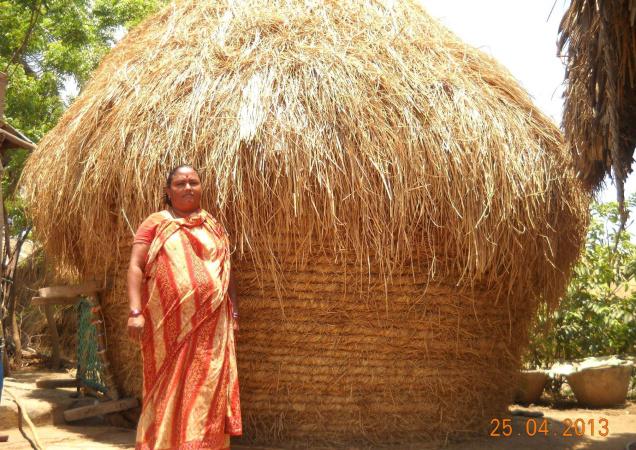
A farmer proudly displays the traditional granary made of spliced hay for storing grains in Kuchipudi in Krishna District. Photo: T. Appala Naidu / The Hindu

Farmers having a land-holding of not less than four-acres are largely dependent on traditional ‘Purri (granary)’ method of storing foodgrains, arguably free from rot and rain affect.

Gone are the days in Krishna district where farmers had to depend on middlemen for selling crop, as they had no godown space to store the produce till it fetched remunerative price. In this traditional farmers’ technology, two-lines of large rope made of spliced hay is tied surrounding a mud-clad space created with gunny bags and the soil for basement.

While constructing the hay rope granary, some farmers use gunny bags to create necessary space, which is simultaneously filled by pouring grains, others make a tight rope tied around a mud wall. “The granary set up in open space would never absorb rainwater and grains are safe from any weather condition” said a woman farmer and entrepreneur M. Vijaya Lakshmi from Kuchipudi.

“It’s a method in which rotting of grains is never reported and even mice cannot gain entry due to its thickness and strength,” added Vijaya Lakshmi, who built 120-bag capacity granary outside her residence by spending Rs.1,500 for labour charges. The strength of the granary depends on how much hay is used in the making of the rope. Irrespective of height or width, each granary serves the purpose for two-years to store grains.

This kind of granary is largely being used to store paddy and blackgram in Krishna district. Unprecedented number of hay granaries welcome the visitor in the villages which are far from mandal headquarters, and which are plagued by poor transportation facilities. Even in Diviseema and Kuchipudi areas village elders said that the farmers in Krishna district used to store grain underground till 1980s.

While small farmers prefer the method of storing grains for their domestic needs, middle and big farmers construct it in business interest, and store the produce till price in market goes up. “This age-old rural technology is a boon for people like me as I have no space inside the house to store the produce,” said Peketi Seetarami Reddy of Kaja village in Movva.

Mr. Reddy, tenant farmer in 23 acres, also buys paddy from his fellow farmers at low prices and stores it for better marketing prices in his 150-bags capacity hay granary. Expert in making hay granary construction, 55-year-old K. Seetaramayya of Arisepalli is happy that the work keeps him busy every January and brings numerous orders. He reveals that he too set up a granary, storing barely 15-bags of paddy for domestic grain storage.

source: http://www.thehindu.com / The Hindu / Home> News> National> Andhra Pradesh / by T. Appala Naidu / Machilipatnam, April 27th, 2013

Man’s gift to beast in the heart of the forest


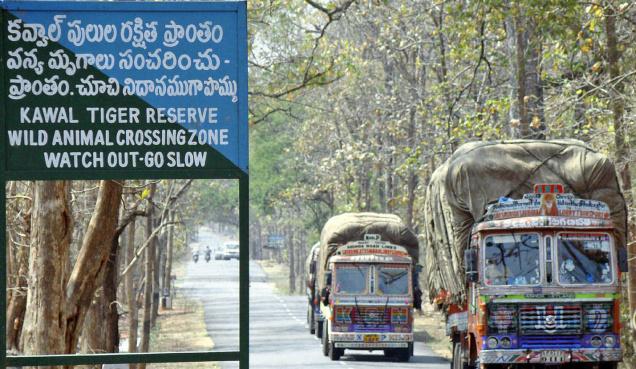
The Kawal Tiger Reserve has immense potential to become a base for tigers.. / The Hindu

Jannaram (Andhra Pradesh) :

As you drive through the dusty, dense Kawal Tiger Reserve in Andhra Pradesh’s Adilabad district, it does not take long to hear the jungle’s rhapsody.

Bison, sambar, wild boars and deer can be seen near water bodies, as spotted deer gallop amidst tall teak trees and dry grass.

An initiative undertaken by the World Wild Life Fund and the Andhra Pradesh Forest Department here has come to be a blessing for the animals in the reserve. It provides drinking water using automatic solar pumps.

Regular behavioural patterns of the animals were closely monitored before deciding to install the solar pumps.

As the sun rises and bright rays fall on panels, the submersible pump switches on by itself and shuts off when the sun sets. Each pump evacuates about 30,000 litres of water a day. Of this, 5,000 litres are stored in the overhead tank and the rest flows to the percolation tank. That is where the animals come to drink water.

S. V. Kumar, Principal Chief Conservator of Forests, A. V. Joseph, Principal Chief Conservator of Forests, Wild Life Warden, of Andhra Pradesh, travelled into the heart of the forest to commission the solar projects. Joseph told Business Line that the forest reserve has immense potential to become a base for tigers. Now, we have good number of herbivores and small carnivores and occasionally big animals come in here; it won’t be long before visits by bigger ones increase, he said.

VIABLE SINK

It was notified as a tiger reserve in 2012 and is seen as a viable sink for dispersing tigers. The reserve has a corridor linking tiger landscapes such as the Tadoba-Andhari tiger reserve about 100 km in the north, and Indravati tiger reserve, 150 km to the east.

The tiger reservoir is spread over about 900 sq. km., along with a buffer area of about 1,123 sq. km. It has a splendid montage of habitat that supports the rare assemblage of four Indian antelopes — nilgai, chousinga, chinkara and black buck. The forest is also home to nearly 250 species of birds.The forest authorities are enlisting local tribals to serve in the forest, and once the reserve gets popular, it will provide more job opportunities.

source: http://www.thehindubusinessline.com / Business Line / Home> News ? by V. Rishi Kumar  rishikumar.vundi@thehindu.co.in / Jannaram (Andhra Pradesh) – April 07th, 2013