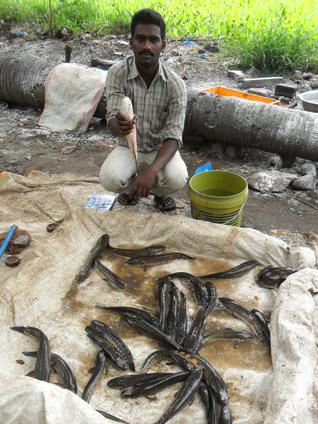
A fisherman sells ‘koramenu’ fish at Kanuru on the outskirts of Vijayawada./ Photo: T. Appala Naidu / The Hindu
Bullseye snakehead fish, locally known as Koramenu, a non-vegetarian’s delight during the summer in many parts of Andhra Pradesh, is in a great demand even during the ongoing rainy season in the city.
The fresh water fish is fetching up to Rs.400 a kg in Krishna district and even small-sized fish are being sold for a minimum of Rs.250 a kg. at Pamarru and Vuyyuru junctions. The high demand led to the price rising abnormally on Sunday and Tuesday. The price was double that of chicken and varied from one selling point to another depending on demand.
Local communities such as fishermen and Yanadi tribe catch the muddy-coloured fish when the local ponds and canals of the Krishna dry up in summer across the Krishna delta region. “Huge quantity of Koramenu fish comes from West Godavari district largely from Eluru area, where farmers grow it in their ponds. Nevertheless, the big-sized fish has become a ‘hotcake’ in Vijayawada city,” says Sala Nagaraju, who sells the fish at Kanuru junction in the city.
Offering Koramenu curry is still considered the best way to honour guests in many parts of Andhra Pradesh. Inclusion of the item in the menu of the feast is seen as a matter of prestige.
source: http://www.thehindu.com / The Hindu / Home> News> Cities> Vijayawada / by T. Appala Naidu / Vijayawada – September 07th, 2013
If you think Vizag is all about the RK Beach, Rushikonda Beach, VUDA Park and Araku Valley, think again. Take a trip with us to some of the roads less travelled…
(Far away from the madding…)
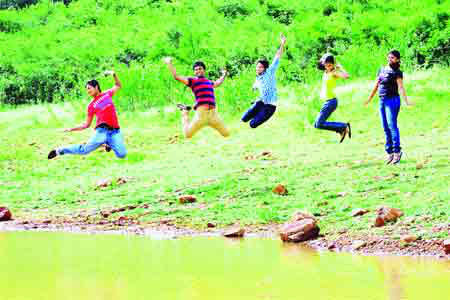
It’s the lazy hours on a holiday and the day is beautiful. You don’t want to waste it inside the confines of your home, so you ring up your friends, take out your vehicles and head to your favourite spot — that secret strip, away from the hustle and bustle of usual places that the tourists haunt. If you think our city doesn’t have such secret getaways, think again. Vizag’s mysterious coasts hide many of these untrodden lands, that were discovered by the adventurous and travel-loving youngsters.
Sravan Kumar, a final year student of Instrument Technology in Andhra University, says, “Places like RK Beach and Rushikonda Beach are too crowded, so we keep exploring places. During one such expedition, we chanced upon this beautiful patch of land, which is just about 100 metres away from the main road, when you travel from Gitam University towards ISKCON temple. Opposite the temple, there is a mud road which leads to this scenic, calm spot. There are just some bushes scattered around in the area, but you have a very good view of the sea.” Sravan and his friends say privacy is the main attraction; and of course, the nature’s charm worked too, given that some scenes of the Telugu flick Oka Romantic Crime Katha were actually shot here.
Jignesh Talasila, a mechanical engineering graduate from Gitam University, who is now an entrepreneur, says, “Almost midway on the 2 km-stretch from our college to the IT Park, there is a diversion, which leads to a secluded spot resembling a valley. We often drive here in our cars and spend the night.”
Though the night-outs are a bit of an adventure, as Jignesh himself admits, they are also a bit spooky. “It’s a little scary at night as the area is secluded — there is no human habitation around for at least half-a-kilometre,” he says. But his gang admits that is what makes the trips thrilling!
A tiny island, on the mouth of the river Gosthani near Bheemili beach, is a secret hangout spot that Pranay Thota, an entrepreneur, and his friends, love. Pranay says he discovered the spot during a casual conversation with a local, and ever since, his group frequents the place. “There are no trees or bushes on the island — it is just the sands below and the starry sky above. It is heavenly during full moon nights. We make a campfire, dine and wine, and chat away to our hearts’ content. We also arranged for the birthday celebrations of a friend there.” However, transportation is a little costly. “We pay about `1,500-`2,000 to the boatwala who takes us there,” he says.
For Sabarish, a BTech Computer Science graduate from Gitam University, the bike rides he and his gang take along the Tenneti Park road, are extremely memorable. “We stop in between to sit on the big rocks along the side of the road. The sound of sea waves make this a very relaxing experience,” he says. But this stretch is not their favourite. “After crossing the checkpost near the park, one kilometre ahead the road to Gitam, there’s a big turn. There is this empty space there, where we sit and just talk. We’ve seen many people park their cars to pose for snaps with a beautiful background,” he says. A small patch of rocky land stretching out to the sea here gives you the feeling of standing on an island, when the waves keep lashing against it from three sides.
“Near the Baba Institute of Technology at TM Palem, there’s this beautiful lake where we head for. You have to take the road to the left from the junction near the institute. It’s all green and the banks are vast. The lake looks best when it’s cloudy,” said Sampath Kandregula, a fourth year BTech student in Electronics and Communication, Gitam University. “It’s very clean. I just hope the place is not littered in the future,” he adds.
Harbours always make for a great view. Anish Chacko, who is into his fourth year of BTech in Naval Architecture and Ocean Engineering, says that the stroll they take to the inner harbour of Vizag Port in Dolphin Hills is very relaxing. “You get a panoramic view of the harbour, where small, private vessels are harboured. If you’re lucky, you can also see the big ships. A gorgeous view of Rose Hill, and the mosque, temple and church on it is clearly visible from this spot. However, it is a restricted area, and though you can just sit there watching the waters, you cannot go overboard or take snaps. It’s very calming on pleasant evenings,” Anish says.
source: http://www.articles.timesofindia.indiatimes.com / The Times of India / Home> Life & Style> Travel> Vizag / by Rumana UK, TNN / September 01st, 2013
A spice-cum-herbal garden is coming up opposite Sanjeevaiah Park on the Necklace Road.
The Buddha Purnima Project (BPP) wing of the Hyderabad Metropolitan Development Authority (HMDA) has initiated the process by floating the tenders. The tenders would be finalised in about two weeks time and the entire process would be completed by this month-end, BPP Officer on Special Duty P Rajender Reddy told Express.
The spice and medicinal-cum-herbal garden will come up in about 2.25 acres of land at a cost of 1.5 crore.
It will be developed with the support of Spice Board India under the Union ministry of commerce, Andhra Pradesh Medicinal and Aromatic Plants Board, Greater Hyderabad Municipal Corporation (GHMC) and other departments concerned.
Initially the civil works would be taken up first whereas the landscaping, planting and related works will be taken up later.
The facility would be developed in a eco-friendly manner. It would likely be thrown open to the public early next year.
Based on the topography of Hyderabad and surrounding places, spice plants like cinnamon, nutmeg, cardamom, pepper, cloves, chilli, cumin curry leaves, turmeric, ginger, garlic, mustard basil, cassia, coriander, saffron and other varieties etc would be planted. Spices park will help render educative services to the visitors. Because of the varying climates – from tropical to sub-tropical to temperate-almost all spices grow splendidly in Hyderabad, he added.
Herbal plants aloe vera, tulsi, chamomile, ashwagandha, sarpagandha, coleus, geranium, rosemary, jatropa and other herbal plants will also be planted etc. He said that there is a global resurgence in traditional and alternative healthcare systems, so having medicinal garden gains importance.
source: http://www.newindianexpress.com / The New Indian Express / Home> Cities> Hyderabad / by S Bachan Jeet Singh / ENS – Hyderabad / August 11th, 2013
The Indira Gandhi Zoological Park (IGZP), or Vizag Zoo will soon have the country’s exclusive wild dog breeding centre. It will help conserve a special breed of the fast dwindling population of wild dogs known as Dholes besides propagating them for various international animal exchange programmes, according to officials.
In fact, Vizag Zoo or IGZP is India’s only zoo that’s been successful in breeding of wild dogs for the fourth time. It had been selected by the Central Zoo Authority for conservation of endangered wild dogs.
While the IGZP will have a breeding centre for wild dogs the CZA has chosen Vandalur Zoological Park in Chennai, Tamil Nadu as the associate zoo.
According to IGZP curator G Ramalingam, wild dog population has witnessed massive increase within the protected area from just two to 19. Out of these, seven are female wild dogs, five adult males, four male and three female puppies.
Director of Zoological Parks in Andhra Pradesh, P. Mallikarjuna Rao also confirmed that Vizag zoo has witnessed a substantial increase in wild dog population. Dholes, according to him, are in demand in most of the zoos in Asia owing to the animal’s excellent eyesight and hearing capacity.
The dholes have been classified as the endangered wild dog species by the International Union for Conservation of Nature owing to their habitat loss, depletion of its prey base, according to Rao. “If this experiments turn out success the IGZP will be more popular in the country as far as captive breeding of wild dogs and their conservation is concerned”, he added.
According to Vizag zoo veterinary surgeon V Srinivas, wild dog breeding is a delicate scientific task needs to be and several measures are taken to ensure positive results. Captive breeding of wild dogs is carried out in off display units so that they get complete privacy during reproduction. Ends//
source:http://www.deccanchronicle.com / Deccan Chronicle / Home> News> Current Affairs / DC / July 21st, 2013
With the met officials predicting a good monsoon this kharif season, farmers in the district are all set to begin agricultural operations.
The normal cultivable area covers 5.61 lakh hectares in the district and by June end, cultivation began in 1.07 lakh hectares with the main crops being groundnut, cotton and red gram. The land has been tilled and made ready for the seedling stage.
Sowing of ground nut has begun in Kurnool and Adoni revenue divisions. Agriculture joint director D Thakur Naik said that cotton acreage could go up in the coming year as the prospects of an increase in price were bright. So far, cotton has been sown in 60,000 hectares as against the total available area of 1.7 lakh hectares in the district.
Groundnut has been sown in 50,000 hectares as against the total available area of 1.4 lakh hectares and red gram has been sown in 6,000 hectares as against the total available area of 35,000 hectares, he added. Though the cost of cultivation of commercial crops has been on the rise, farmers still prefer for them for the remunerative prices they fetch.
The normal rainfall in July is 117 mm and the rainfall recorded as on date is 77mm, raising hopes of a good Kharif output. Various agencies of the government have been involved in the distribution of seeds.
A wet spell may see a flurry of activity and once the water is released from KC Canal and Srisailam reservoir, agricultural operations are expected to pick up. Water is slated to be released from KC Canal on July 15.
source: http://www.newindianexpress.com / The New Indian Express / Home> States> Andhra Pradesh / by Express News Service – Kurnool / July 14th, 2013
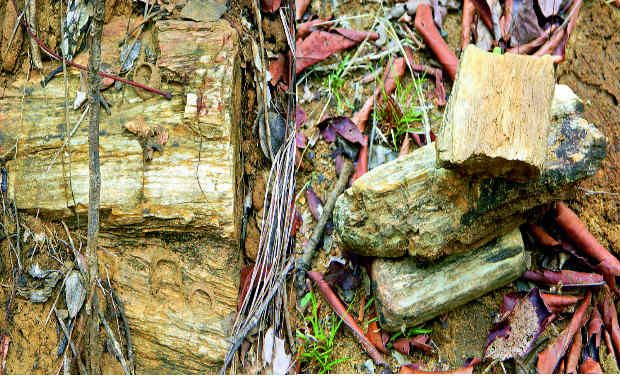
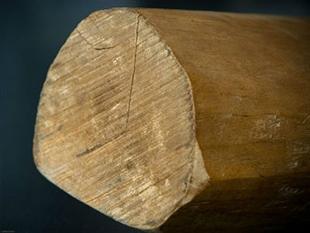
Specimen of wood fossils found in Sarvai Forest beat. The fossils reportedly date back to 20-250 million years.
Warrangal:
The Eturunagaram wildlife sanctuary in Warangal is attracting the attention of geologists, botanists and paleo-botanists, after forest officials discovered the abundant presence of wood fossils dating back to 120-250 million years.
These are fossils in the exact replica of cut wood. They are found dotting the landscape all over Chityal, Chintaguda, Sarvai North and Sarvai South forest in Eturnagaram wildlife sanctuary, making a strong case for declaration of the area as a ‘geo-heritage site’.
Such is their number that almost all small rocks one comes across in the four ‘Forest Beats’ in Eturunagaram wildlife sanctuary turn out to be wood fossils, which are beautiful works of natural art in themselves.
There have been instances of a part of a large trunk of a tree being found in fossilised form at these places in the past, prompting experts to throng the place in large numbers to carry out research work.
Experts suggest that these wood fossils came about during the formation of Gondwana, a super continent comprising present day India, Antartica, Australia, South America and Africa as one whole.
They changed into fossils through a process of cell-by -cell replacement by silica, leading to its petrification, which is defined as the process of turning plant material into stone by infiltration with water carrying mineral particles without changing its original shape.
According to Dr R. Mallikarjuna Reddy, head of the Geology department, Kakatiya University, the Gondwana period between 120-250 million years ago in geological scale is much older than the Jurassic Age (60-120 million years), the age of the dinosaurs.
“The wood fossils site in Eturunagaram is even older than the one found at Tamil Nadu’s Tiruchirapalli, a declared natural heritage site in India, which dates back to the Cretaceous period (145 -65 million years). Hence, the site needs protection to save it for the next generation,” said Dr Mallikarjuna Reddy.
The fossil wood, found in Eturunagaram is said to belong to Glossopteris species of trees of the genus gymnosperm, which is now extinct.
The discovery of the Glossopteris species of trees in different continents, including India, Asia is said to be an important link to prove the continental drift theory, which otherwise explains the gradual movement and formation of continents around the world.
source: http://www.deccanchronicle.com / Deccan Chronicle / Home> News> Current Affairs / by Prabeer Sikdat / DC / June 26th, 2013
It’s a new crop of farmers that’s seen making an entry into AP’s agro industry now.
Far removed from the traditional sickle-carrying uneducated bunch, these laptop-totting modern agriculturalists are mostly suave techies with a plush job in the hi-tech hub of Hyderabad. And what they seem to be putting their money on to further `cultivate’ their wealth is not just another seasonal vegetable or fruit, but the much profitable sandalwood.
Rough estimates suggest that well over 1,000 acres of land spread across areas such as Alair, Vikarabad and Zaheerabad, all located within 100 km from the city, have been brought under this new-age plantation activity that until a few years ago was restricted to dedicated zones within Karnataka and Tamil Nadu.
The low cost of land in these pockets __ industry experts claim that the prices are as low as Rs 20 lakh per acre __ coupled with a recession-hit real estate market and the surge in interest among young professionals to go back to the `fields’, has given the lucrative business that extra boost.
Far removed from the traditional sickle-carrying uneducated bunch, these laptop-totting modern agriculturalists are mostly suave techies.
So much so that M M Rao, after spending a good 14 years in the BPO sector , is now mulling giving up his present career and don the role of a full-time farmer. “I have bought half acre in Alair for this purpose with an initial investment of Rs 4 lakh. The value of this property has already shot up to Rs 6 lakh and post cultivation, it is only expected to rise further,” Rao said.
“Also, considering I am growing vegetables and mangoes here (sandalwood needs `host’ plants) in the intervening period, I expect to earn anywhere between Rs 20,000 and Rs 25,000 annually from the sale of the fruit till the sandalwood plants are ready for yield,” he added.
On an average, it takes around 15-20 years for a sandalwood tree to be rich in its oil content.
Apart from himself, the techie has also managed to persuade some of his friends to take to this ‘new profession’ as he is highly optimistic of impressive returns in the future.
To cash in on this swelling enthusiasm for sandalwood among novice farmers, corporate groups from the city have come up with special profit-sharing ‘packages’ to encourage more and more people to take to agriculture, especially organic farming .
“We work on a 50-50 revenue sharing model wherein the land owner gives us the property and we take care of everything – right from setting up infrastructure to cultivation to harvest. This spares the owner the trouble of not just the initial plantation but also securing the plot till the trees grow,” said K Srinivas Rao, director, Village Organics Pvt Ltd, the company that presently has over 500 acres of land (for sandalwood farming) under its belt. It also has on board specialized wood and horticulture scientists to assist with the project.
“Contrary to popular conception, the Rayalaseema-Telangana region is well suited for this cultivation as they are not waterlogged areas,” Rao, who is also the president of the Sandalwood Growers Association of India, said.
Among the many hi-tech Hyderabadis who have signed up with his firm is Sheik Rasheed Basha, an IT professional , working with the railways at present. “I was looking at an investment option and this sounded interesting. The real estate market is anyway down so I thought of putting my money here,” Basha said. Only two months ago, he bought 1,200 sq yards (approx) in Vikarabad. “I have invested about Rs 3.5 lakh, which I am sure, will grow by at least three times soon,” he added.
But while this fresh group of farmers is sure of good returns, city environmentalists do sound a word of caution. They fear that such long-term business models might fizzle out before the buyers make any money.
source: http://www.economictimes.indiatimes.com / The Economic Times / Home> News> Economy> Agriculture / by TNN / June 20th, 2013
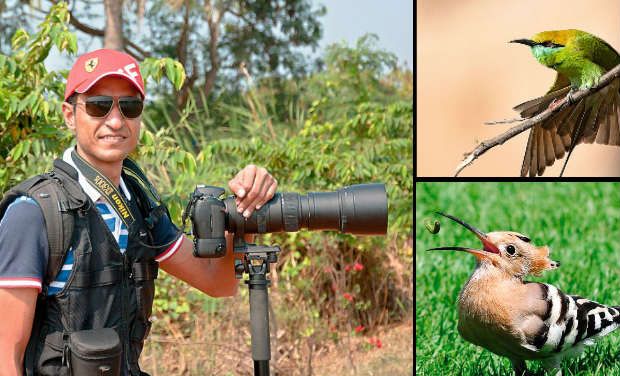
Among the artworks and photographs on display at Waterscapes, an on-going exhibition based on the theme of water, the photographs of Masood Hussain automatically catches the eye.
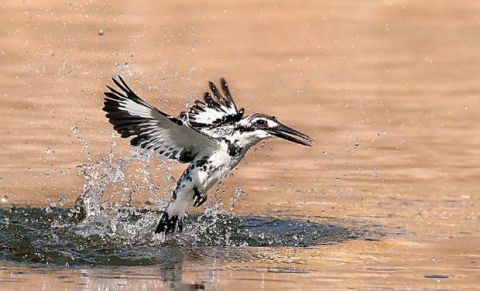
A beautiful shot of a Pied Kingfisher emerging from water after catching its prey and the reflection of a Spot-billed Duck caught in crystal clear water ignites one’s interest to know more about Masood. “The shot of the Pied Kingfisher at the exhibition was the result of three days of waiting at Gir National Park, Gujarat,” says Masood, a full-time businessman and a “Sunday” photographer.
A self-taught photographer, Masood might just be the youngest member of the AP Photographic Society to be awarded the distinction ‘Artist FIAP’ by International Federation of Photographic Art (IFIAP), an organisation comprising more than a million photographers globally.
The distinction is given to photographers whose artistic qualities and techniques have been acknowledged through participation in international salons under FIAP Patronage.
“Every country has its own photography salon and to apply at IFIAP, a photographer needs 40 such acceptances for different pictures. I have participated in 15 international salons and got acceptance from Canada, UK, USA, Thailand, Serbia, Belgium and France. You need to visit IFIAP’s Website and once they approve of your work, they award you this distinction. I’ll be getting the documentation by next month,” says the wildlife photographer.
As a child, Masood was exposed to wildlife during hunting expeditions organised by his grandfather. And gradually, he decided to do the same, expect this time he was using a camera for the shots. “Though I’ve been interested in wildlife photography, it’s only been two years since I have taken it up. Most of my work is shot at places like Sanjeevaiah Park, Ameenpur Lake etc.,” he says.
He even bagged the top honour in the Birds category at the AP state level photography competition organised during CoP-11 last year. “The thing about animal photography is that birds won’t pose for you. This makes it all the more challenging and one needs a lot of patience,” says Masood, whose works were featured on the cover of the Smart Photography magazine for the August 2012 issue.
source: http://www.deccanchronicle.com / Deccan Chronicle / Home> Lifestyle> Books-Art / DC / by Anisha Dhiman / July 02nd, 2013
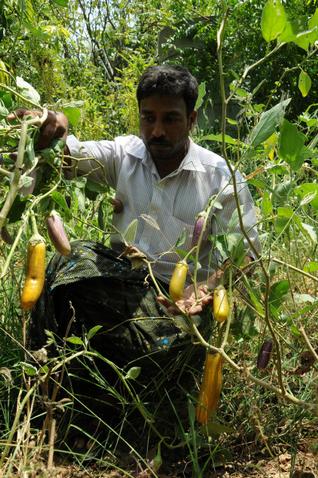
Prasada Varma showing the brinjals raised through natural farming at Kothur Tadepalli. Photo: Ch. Vijaya Bhaskar
For advocate Prasada Varma, cultivating vegetables and raising different varieties of plants is a hobby. He spends some time in his mango garden before attending court.
“As a criminal lawyer, I argued several cases in the last ten years. But, doing farm work and growing organic food gives me a lot of satisfaction. I am raising vegetables and pulses in my five-acre mango garden without using fertilizers and chemicals,” Lakhamraju Durga Shankara Prasada Varma told The Hindu.
Mr. Prasada Varma grows brinjal, tomato, leafy vegetables, chilli and pulses like black gram, green gram, red gram and Bengal gram as inter crops in his mango orchard at Kothur-Tadepalli village on Vijayawada’s outskirts. There is great demand for vegetables grown without the use of pesticides, he said.
Zero budget
“I follow the tips given by natural farming proponent Subash Palekar. ‘Zero Budget Natural Farming’ protects the environment and some useful bacteria in the earth. Farmers should stop using pesticides and chemicals and take up natural farming to protect the endangered species in birds and animals,” he said.
Many people, particularly students, are visiting the garden to purchase vegetables, which are grown without the use of fertilizers and pesticides, said Mr. Prasada Varma, adding that some ryots are arranging separate stalls and selling the products raised through natural farming, which will keep people away from diseases and doctors.
“The leaves that drop from the trees will dry and act as mulching. The process helps to grow micro organisms and earthworms and supply necessary nutrients to the plants,” the advocate explains.
source: http://www.thehindu.com / The Hindu / Home> News> Cities> Vijayawada / by Rajulapundi Srinivas / June 12th, 2013
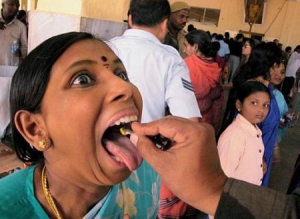
The famous fish medicine for asthma patients will be administered on June 8 & 9 at Exhibition Ground, Nampally. The fish medicine is distributed by well-known Bathini brothers of Doodhbowli.
Last year Bathini brothers had administered the medicine at Kattedan but several people were injured due to stampede. This year government has permitted to distribute the medicine at Exhibition ground.
The Bathini family claims to be giving the fish medicine free of cost for last 163 years. This medicine is administered on Mirag day which heralds the onset of monsoon.
source: http:s//www.siasat.com / The Siasat Daily News / Home> Hyderabad / Friday – May 24th, 2013