Category Archives: Nature

Greenko commissions first phase of Balavenkatpuram wind farm in India

Greenko Group has commissioned the 51.2MW first phase of the Balavenkatpuram wind farm in Anantpur District of the state of Andhra Pradesh, India.

Built with an investment of around €40m, the first phase features enhanced General Electric GE 1.6 XLE turbine, which has the potential to deliver around 30% capacity factor in an average year.

Greenko CEO Anil Chalamalasetty said the company has commissioned the phase one of the Balavenkatpuram wind farm ahead of schedule.

“Our first two wind farms refined our modular approach to wind farm construction, which is now delivering substantial and predictable growth.

“As a result, we should double our generating capacity this financial year to 600MW and remain in line to hit our 2015 target of 1,000MW,” added Chalamalasetty.

The company claims construction on the 50MW second phase is currently underway and is using Gamesa’s G97 turbine, which has a 90m hub height and 97m diameter blades.

Additionally, the company, which has commissioned the grid connection for the site’s 200MW full capacity, has signed a 25-year power purchase agreement with the state.

The project will benefit from the recently increased tariff as well as from the generation based incentive (GBI), a federal government scheme under which GBI will be provided up to INR10m (€117,942) per MW with the claim period between four years to 11 years.

Early this year, the state government has announced a new tariff regime for renewable energy at INR4.7 per unit, laying the foundations for accelerated growth, investment and job creation.

source: http://www.wind.energy-business-review.com / Energy Business Review / EBR Home> Power Generation> Wind> Wind News / by EBR Staff Writer / November 11th, 2013

Japanese garden to come up at Jubilee Hills

GHMC to develop the theme park in 3,500 square yards

Adding to its list of different theme-based gardens in the city, the Greater Hyderabad Municipal Corporation (GHMC) is readying a Japanese garden at Jubilee Hills.

Estimated to cost around Rs. 80 lakh and spread over 3,500 square yards at Road No.3, it incorporates the finer aspects of Japanese gardens such as stone benches, arch bridges, water plants and flora that go with the theme. The GHMC Commissioner Somesh Kumar visited the garden on Wednesday and instructed the officials to complete it in a month’s time.

The Additional Commissioner (Urban Biodiversity) N. Chandra Mohan Reddy said the garden was being dotted with features that usually are part of a garden in Japan such as Gazebo, stone benches, stone lanterns, stone bridges and designs prepared with small stone chips. “These gardens usually are not elaborate in nature, but come across as trimmed ones with trees that preferably have red-coloured leaves and are flowering,” he said. The Japanese garden is being set up with an all-round pathway set in granite stone and a small island in a pond which would be connected with a stone arched bridge. “We are planning to introduce five different coloured lilies in the pond,” Mr. Reddy said.

SOLAR LAMPS

A total of 12 solar lamps have been set up around the place. Authentic lanterns as used in Japanese gardens were scouted for and finally they are being acquired from Bangalore. Work is on to set up arch bridges carved out of single stone. “The theme for such gardens is usually informal and we are emulating the same to incorporate styles that are not in an order or in straight lines,” he added.

Apart from 49 major gardens in the city, the GHMC presently has 520 colony parks and 15 parks and gardens that are based on themes such as Palm Garden at Malakpet, Bamboo Garden and Bougainvillea Garden in Jubilee Hills.

source: http://www.thehindu.com / The Hindu / Home> News> Cities> Hyderabad / by Special Correspondent / Hyderabad – November 06th, 2013

On an island of birds, India’s Mars dream takes wing

Sriharikota :

Flocks of pelicans and painted storks laze around Pulicat lake, about 100km north of Chennai. Their peace would be disturbed six noons later, when a nation’s ambition for interplanetary exploration takes wing.

A few hundred metres from where the migratory birds spend their warm days, an extra large Polar Satellite Launch Vehicle would lift off at 2.38pm on Tuesday, carrying an indigenous spacecraft that would fly to Mars. The 300-day journey to the red planet would keep the Indian Space Research Organisation (Isro) on tenterhooks – and the world in rapt attention.

“This is our first step towards another planet,” says Isro chairman K Radhakrishnan. “Learning from this mission, we will take bigger steps. Isro’s 16,000 members are working together for that.”

And that shows at the Satish Dhawan Space Centre which is a beehive of activity during the run-up to the countdown that starts at 6.08am Sunday. The 80 consoles at the mission control room flash details from 150 computers and the innumerable circuits and parameters they monitor. Giant screens show simulation of flight events, the rocket velocity and altitude. Fifty-eight hand-picked scientists remain glued to the screens that show the simulated PSLV as a climbing blip.

“It’s a rehearsal,” says V Seshagiri Rao, associate director of the spaceport. On the day of the launch, the blip would disappear from the screens for about 28 minutes. “That’s when the rocket, making a peculiar manoeuvre, would go out of the range of our radars here,” explains Rao. To track this face, Isro has, for the first time, deployed two ships fitted with radars in the South Pacific Ocean.

But right now, the 44.4-metre-tall PSLV-C25 stands on the first launch pad, 7km from the mission control room. “It’s a versatile rocket, the same we used for Chandrayaan-1,” says vehicle director B Jayakumar, showing around the launch pad. “It can put satellites in different kinds of orbits.”

This time it will, after burning four stages, put the Mars orbiter in an elliptical orbit around the earth, about 43 minutes after the lift-off. After five orbital corrections to lengthen the farthest point, the spacecraft will begin its voyage to Mars on December 1. “September 24, 2014 would be the D-Day,” explains Radhakrishnan. “That’s when the spacecraft would enter the Mars orbit.”

Going around the red planet in a highly elliptical path (365km being the nearest to Mars and 80,000km the farthest), the orbiter would sequentially switch on its five instruments to study the martian atmosphere and surface. Most crucial among the search operations would be those for deuterium and hydrogen to study possible early presence of water, and methane that may suggest biological presence on the planet.

The Isro chairman is proud, but measured when he speaks about the probability of success of the mission. “Orbiting around Mars itself is a challenge. It will be an achievement if we do it.”

Whether India’s Mars orbiter spots methane or water, the winged visitors of Pulicat lake will be frequently disturbed as Isro revs up for a series of satellite launches. The next big one: A GSLV with an Indian cryogenic engine on December 15.

source: http://www.articles.timesofindia.indiatimes.com / The Times of India / Home> Science> Sathish Dhawan Space Centre / by Arun Ram , TNN / October 31st, 2013

Rs 19,000 crore for Fisheries Development in 5 years

The National Fisheries Development Board (NFDB) is considering a slew of measures to enhance the quality of fish exports until they reach the consumer by applying innovative techniques and also to improve the living standards of families engaged in aquaculture, NFDB chief executive officer Dr MV Rao said here on Monday.

The Board has decided to invest `19,000 crore for various developmental activities in the present five-year plan period, he said. ‘’In this endeavor, it is planned to achieve an overall target of six per cent annual growth of fish production, two per cent in marine fisheries sector and eight per cent in inland fisheries sector during the 12th five year plan,” he added.

Talking about some of the recent activities of the NFDB, he said to facilitate  fisherwomen of East Godavari in efficient marketing and transport facilities a programme titled ‘East Godavari Maha Samakhya’ has been initiated. ‘’We have also provided fund for transport of dry fish to Bhimili fisherwomen, funded fishermen societies in Bidar for better marketing opportunities and also promoting cage culture in Chhattisgarh, Maharashtra and Jharkhand,’’ he pointed out.

He added that 22 technology upgradation projects were taken up with the support of fishery colleges and other technical institutes. ‘’Skill development and capacity building programmes were conducted for fisherfolk, farmers and officials across the country,” he added.

Along with the coastal fisheries in the state, the Board has also decided to develop inland fisheries, he said. “The state has enormous potential to develop and nurture inland fisheries,” he said.

source: http://www.newindianexpress.com / The New Indian Express / Home> Cities> Hyderabad / by Express News Service – Hyderabad / October 22nd, 2013

Gene which prevents fungal disease in rice discovered

Hyderabad :

In a major breakthrough, city-based Directorate of Rice Research (DRR), an arm of Indian Council of Agricultural Research, has discovered a gene that is resistant to rice blast. The researches said the new variety will be released as seed in the next Kharif season.

Rice blast is a plant-pathogenic fungus that affects rice in more than 90 countries across the globe and destroys rice crop which is enough to feed about 60 million people worldwide, experts informed. Over the years, the fungus has developed resistance to both chemical and genetic  treatment in some varieties of rice. After working on the project since 2005, the new gene is now being inserted into a variety of rice which will be blast-resistant, Maganti Seshu Madhav, a DRC scientist said.

“The worldwide ‘great blast-resistant gene hunt’ began around 10 years back. We surveyed most of the landraces (naturally formed plant varieties) collected from India as well as the varieties from different countries. We even searched wild species which are distantly related to rice. Finally our hunt ended with the discovery of the resistant gene in Vietnamese variety called ‘Tetep’,” Seshu Madhav told TOI. Madhav, who discovered the gene, cloned and transferred it (Pi-54) to popular varieties to save them from the deadly fungus.

Scientists say the rice blast fungus, also called ‘magnaporthe grisea’ causes a huge yield loss in the country. In Andhra Pradesh , all the zones, including north coastal zone, Godavari zone, Krishna zone and the Telangana zones are prone to blast disease causing an average loss of 40%. Once the varieties are released into the market before Kharif 2014, it would eliminate use of fungicides to control the disease.

Stating that some fungicides do control the disease partially, Seshu Madhav said when the fungicides are used intensively and regularly, the fungus rapidly develops resistance and finally destroys the crop.

After winning many national awards and the Ohio state university’s best international research scholar award for his research on the blast resistance genes, Madhav said the Pi-54 gene will address the concern of millions of farmers.

“Another strategy would be to develop a broad spectrum race-non specific resistance using latest molecular biology approaches,” he added. India’s first blast resistance gene (Pi-54) along with two more genes, Pi1 and Pi2, are being studied extensively. Improved varieties, are now undergoing tests throughout India and after the successful tests in Andhra Pradesh, the new varieties with blast-resistance gene will be released to farmers mostly in Kharif next year,” he added.

Another important breakthrough for DRC has been the discovery of multiple genes, responsible for the aroma in various landraces. After determining major genes that control the aroma, Seshu Madhav, in association with Indian Institute of Chemical Technology, is working to understand metabolic profile of the chemical compound that causes aroma in rice.

This would help in transferring the gene to local varieties, making Sona Masuri, Samba Masuri, Jaya, Nelloore Sannalu, Warangal culture, Kurnool Sona among others retain an aroma like Basmati rice. “This is bound to boost the market worldwide,” he added.

source: http://www.articles.timesofindia.indiatimes.com / The Times of India / Home> City> Hyderabad> Gene / by Jinka Nagaraju, TNN / September 23rd, 2013

Pilarichettipalem’s women farmers churn out profits from small holdings

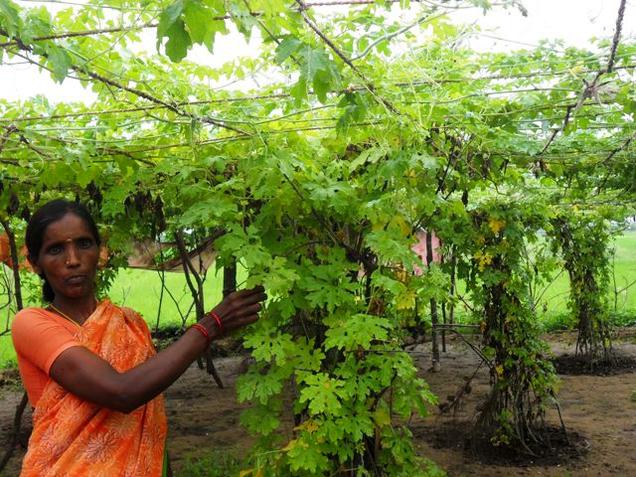
Many among the 40 women farmers are now growing bitter gourd in rainy season at Pilarichettipalem village in Krishna District./ Photo: T. Appala Naidu / The Hindu

Turn their patches of land into vegetable fields and make money round the year

Women have turned into successful farmers by developing their small holdings that were not viable to grow paddy into vegetable fields and making money round the year at Pilarichettipalem of Machilipatnam rural mandal in Krishna District.

Among the 40 women farmers engaged in producing a dozen varieties of vegetables, including leaf vegetables, most of them are landless who entered into tenancy in recent times.

Men help out

“Earlier the small holdings, not exceeding 5 cents in and around the village, were either left without any cultivation or used for cattle ground. Now, the average monthly profit has touched to Rs 5,000 to Rs 6,000 on these fields,” P. Krishna Kumari, who raises bitter gourd told The Hindu.

The women grow vegetables such as bitter gourd, ladyfinger, drumstick, green chilli to amaranth and sorrel leaves based on the weather conditions. At a distance of barely 5 km from the Krishna District headquarters, Machilipatnam, the men from these families join hands to take the produce to the market and sell at remunerative prices.

“The practice is merely to generate additional income for the family and not to lose the benefit from the fertile soil. It is clearly evident that major crops cannot be raised on these holdings due to rising input cost and thus vegetable farming has been proved viable and lucrative,” said another farmer, Yelagani Nagamani, a regular worker in the imitation jewellery industry.

Like Nagamani, every woman active in vegetable farming also had an additional source of income from cattle rearing too. Having gained experience, a clear competition exists among the women farmers on how best one can be innovative.

After the village witnessed a tremendous change brought by the women farmers, there were hardly any small holdings readily available to newcomers for farming.

“The tenancy rates have also gone up to Rs 2,500 to Rs 3,000 per year on any given small land in the village, witnessing a huge demand for them,” said other farmers.

source: http://www.thehindu.com / The Hindu / Home> News> Cities> Vijayawada / by T. Appala Naidu / Machilipatnam – September 25th, 2013

A walk down pre-historic lane

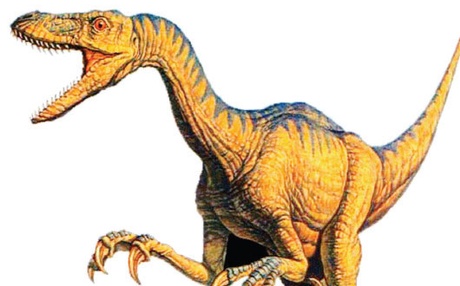
Velociraptor Sculpture Size: Life size

For the first time in the country, a unique Jurassic Park is going to come up near Lotus Pond at Jubilee Hills in the city.

Over a dozen extinct animals that existed some 150 million years ago will be brought to life in the form of life-size dinosaur models. To show a simulated environment of animals in their natural habitat they will be placed among native vegetation or water. For those interested in learning more about the history of dinosaurs, this park will be of immense benefit.

The Jurassic Park (prehistoric animal sculptures) will feature over a dozen life-size dinosaur models like Tyrannosaurus Rex (T-Rex), Triceratops, Stegosaurus, Barosaurus, Espinosaurio to name a few. These models will range in sizes from the 28 metres long  Barosaurus to the two metres long Archaeopteryx.

The dinosaur models or sculptures will be made from a base of carved polystyrene foam and covered with fiberglass.

Plants like Cycads (60 species) and Ferns(20 species)from some 80 species which have survived since the age of the dinosaurs period and which still exist will also be planted in the park which are conducive to the city’s climate.

Speaking to Express, GHMC Additional Commissioner (Urban Biodiversity wing) N Chandramohan Reddy said that the unique Jurassic park will come up in a two acre open space near Lotus Pond in Jubilee Hills.

The park would be developed at a cost of Rs 55 lakh and the tenders would be invited shortly. According to him, the park would be ready and thrown open to public from March 2014.

Of the Rs 55 lakh being spent to built the park, Rs 20 lakh would be spent for life-size models, Rs 25 lakh for planting Cycad and Ferns and the remaining Rs 10 lakh will be devoted towards building an information centre.  The information centre will provide a range of information to the visitors who are eager to know more about the life history of dinosaurs, how they lived, how they survived and the reasons for their extinction.

Chandramohan Reddy said the proposed Jurassic park will be a delight to dinosaur fans and inspire a new interest in pre-historic things for younger people. According to him, the park will be an educational and fun place, where everyone can learn more about the majestic animals that ruled the earth for over 150 million years.

Another unique feature of this park is its unique outdoor setting. While most museums have dinosaur skeletons, the park here will have realistic life-size dinosaur models and colour variations to give a better understanding as to how they looked when alive.

source: http://www.newindianexpress.com / The New Indian Express / Home> Cities> Hyderabad /  ENS – Hyderabad / by Bachan Jeet Singh / August 28th, 2013

Let’s go to the zoo!

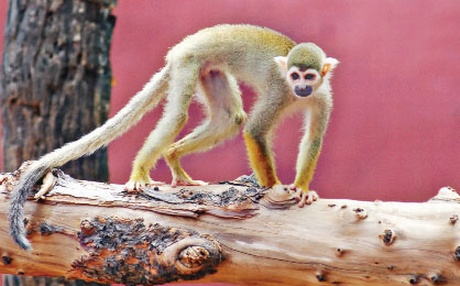
The common Squirrel Monkey.

If you think you’ve been there and done that at the Nehru Zoological Park, it’s newest members will change that.

After a decade and a half, the zoo is now host to a pair of Squirrel monkeys, courtesy the Gujarat-based GSPL India Transco Ltd, (GITL), which donated the animals. A South American animal that lives in many parts of the continent including the French Guiana, Venezuela, Brazil and Ecuador, it is commonly captured for pet trade and medical research, but is not a threatened species yet.

Also joining the zoo’s roster is a mute white swan and a black swan. While the white swan was donated by ITC Bhadrachalam, the Black Swan was acquired under the exchange programme from Mysore Zoo.

With the addition of these four, the Nehru zoological park now boasts of 158 species and 1471 animals. The park is also going to be adding an adult female cheetah and giraffe in a month’s time.

“While two male and one female cheetah have arrived here from Czech Republic last year, one more female cheetah will arrive soon,” says zoo curator, A Shankaran. “We have a male Giraffe and one more female Giraffe will arrive from Malaysia in a week’s time”, he further informed.

The furry-looking monkey (scientific name: Saimiri sciureus) is typically known for it’s slightly longer tail that measures 41 cms. The common squirrel monkey has a grey coat but stands out because of its bright yellow legs.

The mute swan is usually found in Europe and Asia while the black swan is a native of Australia. Measuring between 110  and 142 centimetres in length and weighing 3.7 kilograms, the black swan has a wing span between 1.6 and 2 metres. Whereas, the mute Swan measuring between 125 to 170 centimetres length, has a white plumage with an orange bill.

Visitors who turned up at the zoo were quite excited to see the new additions. “To be surrounded by all these amazing animals is a great experience. I have been coming to the zoo since last 20 years and whenever I hear that a new member is being added to the zoo family, I make it a point to visit with my family and welcome the member,” said Aditya Reddy, a senior executive at IT firm.

“The pair of squirrel monkeys are very cute. I liked its tail very much. It’s rare to spot a  squirrel monkey and here we are able to see them. Its really great,” gushed Swetha, a student.

“Both the mute swan and the black swan looked impressive with their huge wings, especially when they spread it,” exclaimed a 12 year-old Rohan, who was also fascinated by the S-shaped neck of the bird.

source: http://www.newindianexpress.com / The New Indian Express / Home> Cities> Hyderabad / by Express News Service – Hyderabad / October 07th, 2013

A quaint village in Guntur transforms into a bustling commercial locality

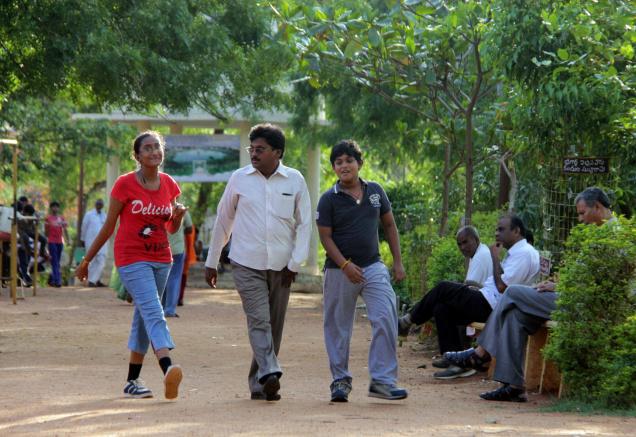
Walkers on a morning stroll at the walking track in Koretipadu in Guntur. / Photo: T Vijaya Kumar / The Hindu

An earthen smell lingers around as one makes his way through the narrow lanes of Koretipadu.

The elderly ambling and spending better part of evenings around the village square and at the temple is an unusual sight in a town whose skyline is changing by the day as years are rolling by.

This quaint place is stepped in the history. It derived its name from the household name of one of the greatest poets in Telugu, Tikkana.

Daruvuri Veeraiah, who has written about authentic history of Guntur district in his book ‘Gunturu Mandala Sarvasvam,’’ says Kottaravu, household name of Tikkana, gradually changed to Kottaru and later to Koretipadu.

The book also mentions that Koretipadu had existed even before Guntur. The boundaries of the village extend from present JKC College to Pandaripuram. The area has now been divided into many residential colonies for facilitating development works.

The times are fast changing, and the quaint village has transformed itself into a bustling residential and commercial locality with a cluster of apartments and high-rise buildings dotting the skyline.

A sprawling walking track nestled among a row of trees is the most favoured destination here. The track abuts a water tank and measures 850 metres.

The track springs to life in the early hours with people, young and old, making their way to the park. For many, a walk around the tank surrounded by trees is a refreshing start to the day.

“We have 340 life members in the association. Our walkers’ association is encouraging people to walk and be healthy and also to contribute to society. We are affiliated to 42 associations in India and Singapore and are proud to say that our association ranks among the best performing associations,’’ Chelikani Seetharamaiah, president of Koretipadu Walkers Association told The Hindu on Sunday. Apart from the park, there is little to cheer about the locality.

In spite of being one of the most populated areas, the locality does not have a Rytu Bazaar.

It did have a market centre, but was pulled down long back.

The locality does not have a Municipal Health Centre and the facilities at the municipal schools are deplorable.

source: http://www.thehindu.com / The Hindu / Home> News> Cities> Vijayawada / by P. Samuel Jonathan / Guntur – June 17th, 2013

Record revenue from mango loading at Nuzvid

The Hindu
The Hindu

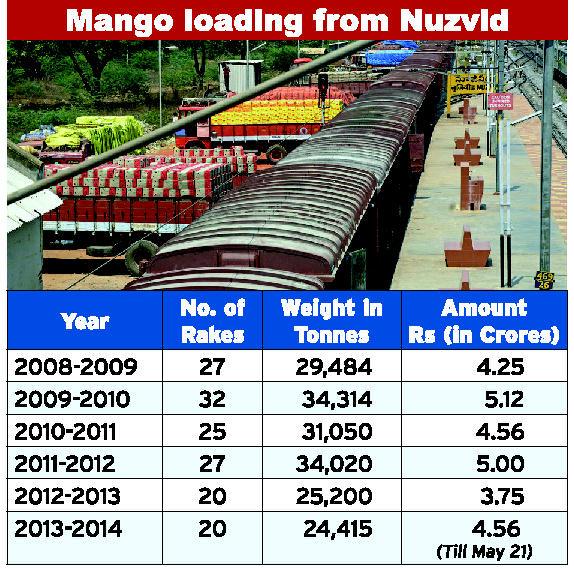
The division has already netted Rs. 4.56 crore

Krishna District is home to one of the best mango varieties in the country and export of the King of Fruits to other States in the country is on an average around 30,000 tonnes annually through the Railways.

This season is not considered to be a very good year for mango crop, but better than last season, helped the Railways also achieve handling 24,415 tonnes from April 1 to May 21 creating a sort of record as the projections for the season are reaching beyond 30,000 tonnes. Last season the Vijayawada Division of South Central Railway had handled only 25,200 tonnes, but now with another 10 days to go for the season to come to an end, Divisional Railway Manager Pradeep Kumar hopes they will gross the highest revenue too.

With freight tariff going up by 25 per cent from June 1 last year, the Division has already netted Rs.4.56 crore sending out 20 rakes comprising 42 covered wagons per rake. “There is still some demand from the aggregators and exporters to send mangoes to Anand Nagar Delhi station and we are ready to supply any number of rakes within a short notice,” the DRM told The Hindu on Wednesday.

While each wagon can be loaded with 30 tonnes, it takes about five to six hours and the Railways places wagons at Nuzvid station at 7 a.m. everyday and ensures that the rake crosses Andhra Pradesh same day to reach New Delhi within 48 hours to ensure the half-ripe Mangoes are just ripe enough for consumption and are sold in the market in Northern States.

The 2009-10 season saw the highest loading of 32 wagons sending out 34,314 tonnes. Now every care is taken in loading and staking them and providing the wagon with a mesh window to keep airflow in-tact. Banginapalli, Chinna Rasalu, Totapuri and Collector are the popular ones. This is one of the two dedicated mango loading stations in the country with other also being Andhra Pradesh – Vizianagaram, now under East Coast Railway.

source: http://www.thehindu.com / The Hindu / Home> News> Cities> Vijayawada / by Ramesh Susarla / Vijayawada – May 23rd, 2013