Category Archives: Nature

Visakhapatnam zoo: A tourist delight

Visakhapatnam :

The Vizag zoo is a veritable treat! My wife and I visited the zoo recently and I look forward to many more visits to partially satiate my thirst for photography. Housing almost 800 animals with around 80 different varieties and spread over 625 acres amidst the verdant expanse of the Eastern Ghats, the Indira Gandhi Zoological Park (IGZP) has the potential to emerge as a major tourist attraction.

The inmates range from big cats to primates, bears, herbivores, reptiles, birds as well as a special butterfly section that deserves special mention as it was the brainchild and effort of 12 students of BVK College. However, a lot more needs to be done to make it truly world-class. Singapore airport, for instance, has a butterfly park that is a delight for photographers and children alike and where the curator has placed cut pineapple slices with a natural honey spread to attract literally hundreds of butterflies fluttering about. A separate section allows the visitor to observe all the stages before the butterfly is born. With a little help and guidance, the Vizag zoo butterfly section can also become a greater visual treat than it presently is.

Among the objectives of the zoo are the conservation of fauna and close monitoring of the health of the animals but, more importantly, educating the public on the importance of wildlife conservation. Was it not Mahatma Gandhi who once said that the greatness of a nation can best be judged by how it treats its animals? In response to the demand for animal parts in China, particularly the tiger and rhino horn, it is credible to suggest that the tiger could well become extinct in a few years unless something is done urgently.

Some years ago, in a zoo in India, a tiger was skinned while it was still alive. The image in the newspaper that carried the report was of the tiger’s mate watching from a separate cage, its eyes filled with fear. The rhino is hunted for its horn and the elephant for its tusks. There are images of how the animals are trapped and then, the horn or tusks sawed off and the animal left bleeding. It takes the animal several hours to die, during which it suffers enormous pain.

Newspapers regularly carry reports of the man-animal conflict caused through the encroachment of the natural habitat of animals by human beings. Leopards and elephants regularly stray into villages and are either caught on time or end up killing goats and occasionally, turn into man-eaters and then, have to be shot. Amitav Ghosh, in his book The Hungry Tide, gives the account of how villagers, fed up of a tiger attacking villagers, trap it and then, brutally blind it before beating it to death. This is not fiction. And it is, therefore, all the more praiseworthy that the Vizag zoo has, among its commitments, the raising of public consciousness and involvement in conservation. It is this kind of partnership that delivers results finally. Conservation is not the sole responsibility of governments but rather a collective endeavor.

So, what can we do? Take the zoo website for instance, which appears to be maintained by a private provider. It was last updated in 2012, with some of the pages still under construction. Websites can be fun and a great way of reaching out to the public. Inviting photographs from visitors; tracking the biography of each animal in the zoo to create a kind of bonding with the animals; providing information and other details on animal health and conservation; uploading short films on the animal inhabitants; having a separate section on poaching and wildlife conservation; educating the visitors on do’s and don’ts, among other things.

Improving the website can be the easiest to achieve, but is the very first step that needs to be taken. A study of the websites of some of the great zoos globally, such as, New York, London or Sydney, can provide good pointers on how the Vizag zoo website can be revamped. Can this not be a project that the students of Gitam or Andhra University take up pro bono?

Educating the public is far more challenging than one cares to believe. Grown-up men hooting, while jumping up and down in front of the cages of primates, possibly to impress their children or simply as a reflection of their incomplete transition from the monkey, is a bizarre but regular sight. Or how the cars that are permitted within the zoo never fail to use the horn without a thought on how the noise disturbs the animals. Should the zoo not consider banning vehicles or imposing stiff fines in case of violations? Would it not be better for the zoo to run battery-operated vehicles and offer hop-on-hop-off services at a charge?

Can a ‘Friends of the Vizag Zoo’ not be created, comprising those willing to provide voluntary service, especially on weekends and holidays, to educate the public on how they ought to behave? Can the corporate sector not step in and provide, maintain and run the battery-operated vehicles? But then the manner in which CSR is approached needs to be rethought. A public sector bank, for instance, supports providing information on animals within the zoo. Interestingly, the size of the board on which the bank has placed its own advertisement is so large that people tend to read the bank’s message rather than the purpose for which the bank’s assistance might have been sought in the first place.

CSR cannot and should not become another advertising gimmick. If it does, it would defeat the very purpose of CSR. I should mention that it was heart-warming to read that a group of schoolchildren from Kolkata visiting Vizag offered their services to clean the zoo. This kind of effort goes a long way in creating the bonding that lies at the heart of tourism. Given the number of visitors the zoo attracts annually, can AP Tourism not see it as a legitimate tourism promotion activity? It is mentioned as one of the must-see places in Vizag in tourism brochures but there is a clear absence of AP Tourism’s presence and participation in the zoo. Chandana Khan, the head of AP Tourism, is an artist and painter in her own right. Would art classes in the zoo for school children not be an innovative way of attracting children and artists?

And while AP Tourism is mulling over the thought, could they consider improving the ‘canteen’ in the zoo? Would making available roasted corn and fresh coconut water not only provide employment and income but also be a healthier option to aerated drinks? Is it also not possible to have a shop in the premises selling picture postcards, tee-shirts, mugs, books/films on wildlife, and other zoo related products?

I am convinced that while AP Tourism has a role to play, it needs to do so imaginatively. Unless efforts are collective, collegial and participatory, tourism will succumb to the whims and fancies of a few, and deny people their legitimate right to be proud of their city.

(The writer is an ex-Indian diplomat-turned-writer presently living in Vizag. He can be reached at amit.dasgupta2013@yahoo.com)

source: http://www.timesofindia.indiatimes.com / The Times of India / Home> City> Visakhapatnam / by Amit DasGupta / TNN / March 30th, 2014
IPGI crop geneticists sequence peanut’s genome: ICRISAT

ICRISAT, a member of the Peanut Genome Consortium, today claimed that the International Peanut Genome Initiative (IPGI) has successfully sequenced the genome of the humble peanut.

City-headquartered ICRISAT is a member of the Peanut Genome Consortium, a multi-national group of crop geneticists working in co-operation for several years in the peanut genome sequencing project.

The new peanut genome sequence will be available to researchers and plant breeders across the globe to aid in the breeding of more productive, more resilient peanut varieties, an ICRISAT statement said.

Peanut (Arachis hypogaea), also called groundnut, is an important crop both commercially and nutritionally.

Globally, farmers tend about 24 million hectares of peanut each year, producing about 40 million tonnes. While the oil and protein rich legume is seen as a cash crop in the developed world, it remains an important sustenance crop in developing nations.

“Rich in protein and edible oil, peanut is central to the financial and nutritional well-being of hundreds of millions of farmers and consumers across the semi-arid tropics of Asia and sub-Saharan Africa,” Director General of the International Crops Research Institute for the Semi-Arid Tropics (ICRISAT) William Dar said.

“Improving peanut varieties to be more drought, insect and disease resistant, using the genome sequence, can help farmers in developed nations produce more peanuts with fewer pesticides and other chemicals and help farmers in developing nations feed their families and build more-secure livelihoods,” Rajeev Varshney, Research Programme Director – Grain Legumes and Director, Center of Excellence in Genomics, ICRISAT.

source: http://www.business-standard.com / Business Standard / Home> PTI Stories> National> News / Press Trust of India / Hyderabad – April 02nd, 2014

Terrace cultivation catching up in Ongole

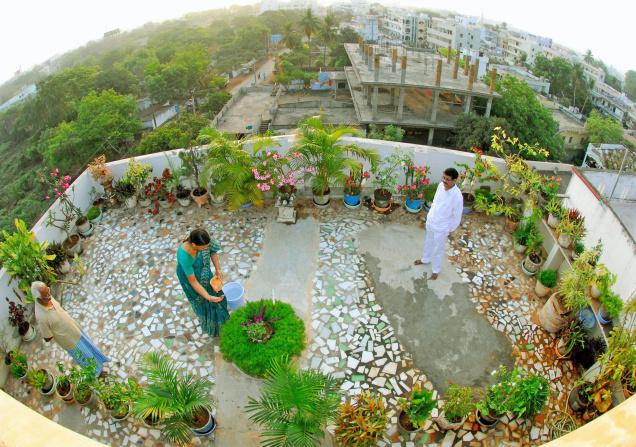
A housewife watering plants in her terrace garden in Ongole./ Photo: Kommuri Srinivas / The Hindu

People urge the Horticulture Department to organise events to promote terrace cultivation among apartment owners

The city, which is in the hot race for location of capital for the successor State of Andhra Pradesh, is fast becoming a concrete jungle with mushrooming of apartments.

However, more and more people are taking to terrace cultivation putting to best use whatever little open space available with them on the terrace and on balconies to promote greenery and lead a healthier life as the apartment culture has come to stay.

Growing saplings on the terrace and on balconies of apartments can reduce carbon emission and air pollution, says Dr.Kona Radhakrishnamurthy, a retired professor from C.S.R. Sarma College here, while speaking to The Hindu.

“Growing saplings is like child rearing,’’ adds Dr Radhakrishnamurthy, Reader in Philsophy, who has turned his penthouse into a beautiful garden growing plants that could withstand moisture stress and seasonal plants including the most-loved jasmine.

“We can make our locality a better place to live in getting accustomed to new urban lifestyle,” says a housewife Santi who has taken to vegetable gardening in her apartment in a small way.

She has sown the seeds of change among other flat owners, who are equally fed up with ever-increasing cost of fruits and vegetables as also flowers.

Let more and more people join the bandwagon getting the thrill of growing plants to lead a better life in the given situation, adds a technocrat, M Srinivasa Rao getting tuned to the changing lifestyle. The Horticulture Department should organise events to promote terrace cultivation among apartment owners, they added.

source: http://www.thehindu.com / The Hindu / Home> News> National> Andhra Pradesh / by Staff Reporter / Ongole – April 02nd, 2014

‘Utilise garbage to generate electricity’

APJKalamHF29mar2014

A.P.J. Abdul Kalam asks people to take pledge to protect at least one water body in their lifetime

The enormous quantities of conventional waste generated in the country like garbage and fly ash, which is the result of India’s rapid growth story, should be utilised to restore environment rather than deteriorate it, observed former President of India A.P.J. Abdul Kalam.

“Effluents are released from millions of households; mounting garbage is a rich source of energy as the municipal waste can be used to generate electricity. The TIFAC (Technology Information Forecasting and Assessment Council) could convert garbage to fuel. India needs thousands of such power plants in small towns to generate electricity from garbage,” he said.

Mr. Kalam was addressing a gathering on Friday at a two-day national seminar on “100 years of Activated Sludge Process and its application to industrial wastewaters and CETP’s in India”. The seminar is being organised by Jeedimetla Effluent Treatment limited (JETL) in collaboration with Indian Environment Association on the occasion of silver jubilee of JETL.

No toxics in fly ash

Elaborating on the usage of fly ash, he said, “The dumping of fly ash should be avoided and there should be 100 per cent utilisation. Toxicology reports have said there is no toxic in the fly ash, but only nutrients.

Fly ash can be used in green building materials and this can also create employment. It can also be used as manure by the farmers.”

He appealed to each one of the audience to take a pledge to protect at least one water body in their lifetime.

He also appreciated the efforts of the JETL in effectively treating effluent waste.

source: http://www.thehindu.com / The Hindu / Home> News> Cities> Hyderabad / by Staff Reporter / Hyderabad – March 29th, 2014

Biogas plants gaining acceptance in Krishna district

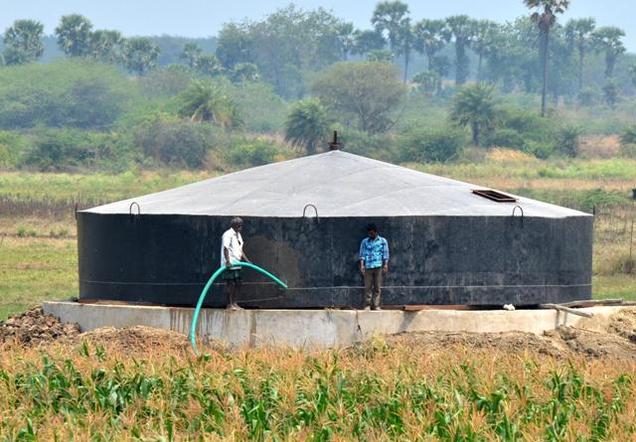
Works at a swift pace at the 200-cubic metre biogas plant being built by NREDCAP at a dairy farm in Lakshmipuram in Veerulapadu mandal of Krishna district./ Photo: V. Raju / The Hindu

An increasing number of innovative farmers in Krishna district are embracing biogas to cater to their energy needs.

Generation of biogas from animal dung has been in practice for long, but the new concept is to generate electricity from the gas, an effective way to end the woes of inflated power bills.

The Union Ministry of Non-Conventional Energy Sources, through the New and Renewable Energy Development Corporation of Andhra Pradesh (NREDCAP), is promoting bio-gas plants in a big way by offering a 40 per cent subsidy on the unit cost. A unit holder, who is usually a farmer or a dairy owner, gets back the invested money within two years of the commencement of operations at the plant.

The Corporation is building one such 200-cubic metre- plant at Lakshmipuram village under Veerulapadu mandal of Krishna district for Healthy Farm Products Ltd., a newly-developed dairy farm project gearing up to launch operations very soon.

“The Rs. 20 lakh-biogas plant can generate 300 units power per day. The Corporation has extended a 40 per cent subsidy (Rs. 8 lakh) while the remaining cost of the project is borne by the dairy owners. With the 20 kw. of power generated, the dairy can save nearly Rs. 3,000 per day, which translates roughly into Rs. 90,000 per month,” says NREDP District Manager Srinivasa Rao.

Pointing to the digester, he says water and cow dung is mixed in 1:1 ratio and pumped into the plant and biogas results from anaerobic fermentation of organic materials. He goes on to explain about the preparation of the input material, the fermentation and methanogenesis, followed by conversion of the biogas to renewable electricity and useful heat with cogeneration/combined heat and power.

“This energy release allows biogas to be used in a gas engine to convert the energy in the gas into electricity and heat,” explain Chennupati Vazeer and V. Madhav, owners of the dairy farm. The plant at Lakshmipuram is likely to commence operation by this month-end another one is fully operational at Veeranki Lockulu, informs Mr. Srinivasa Rao. The Corporation is upbeat about the increasing size of patronage for this innovative mode of fuel. “We are working on five more similar plants at different places in the district. We want apartment-dwellers also to opt for small-size digesters as an answer for their electricity needs and other energy sources,” says Mr. Srinivasa Rao.

source: http://www.thehindu.com / The Hindu / Home> News> Cities> Vijayawada / by P. Sujatha / Vijayawada – March 12th, 2014

Drought-fruit Seema Chinta tastes sweet success

Visakhapatnam :

A native of Central America and Northern South America, which was till recently looked down upon as a poor drought substitute of mango and cashew, Madras Thorn has suddenly been catapulted to the top of the popularity charts in fruit markets of Andhra Pradesh.

Commonly known as Sweet Tamarind, the fruit has grown so popular over the past few summers that it now fetches anywhere from Rs 150 to Rs 300 per kg, depending on the packaging, in cities like Visakhapatnam, Hyderabad and Vijayawada. K J Madhavi, an ardent fan of this pulpy fruit, said, “Most of the stuff we buy is at supermarkets where a kg goes for Rs 500 as it is claimed to be of export quality.”

Madras Thorn was first introduced by the Portuguese in India, albeit accidentally. The sweet tasting pod pulp of the fruit, which is rich in anti-oxidants, was stacked by sailors on long voyages and later became popular in India as drought food during summers. The tree thrives in most parts of peninsular India, except the wetter regions, and in Andhra is popularly referred to as Seema Chinta.

The fruit’s rising popularity has taken many by surprise. “This tree was found in most gardens and backyards even in big towns, and in villages was found scattered on fields with many farmers using the fruit pulp as part of the diet for their cattle. However, in the drought prone agriculturally poorer parts this fruit acted as a major food substitute. Just like Mahua in some areas of Central India, Madras Thorn was considered highly useful as the pulp was used to make dye, qualified as a food substitute and even the tender green leaves were used to prepare a kind of rasam,” said horticulturist R N S Sarma.

Old-timers from Visakhapatnam too pointed out rather cheekily that it was hard to believe that a fruit they used to consume as a substitute for mango during the summers, had now become so pricey.

Many vendors believe that the demand is on the rise for various reasons. K Narasimhulu, who sells the fruit near the RTC complex at Visakhapatnam, said, “It has become a major competitor during the mango season primarily due to rising mango prices as well as fears of indiscriminate use of pesticide in mangoes, something that is not a concern with the Madras Thorn.”

Narasimhulu further pointed out that unlike small town and rural customers, the buyers in big cities no longer discriminate between popular fruit and drought food. “A large number of people are now looking at the medicinal value of the food they consume and the health benefits they gain.”

“The bark of the tree can also be used to make a soup to treat stomach ailments and infections, apart from fever,” said G Bullayya, a naturalist and native herbal medicine specialist residing in Addatigala of East Godavari. He, however, lamented the fact that Seema Chinta was yet another example of how the government had failed to realize the potential of an extremely useful tree. “The fruit that was once sold at Rs 5 a kg (in the early 80s) now sells for more than Rs 200 even in places like Rajahmundry. It is tragic that the government has failed to identify and tap the potential of our forest yield to the maximum extent possible,” he said.

Sources in the state horticulture department admitted that so far no concrete efforts had been made to make the extremely useful tree an essential part of mainstream horticulture. They did, however, admit that a tree that could prosper even in desert-like conditions could have a major role to play in improving the economy of arid regions.

source: http://www.timesofindia.indiatimes.com / The Times of India / Home> City> Visakhapatnam / by Venkatesh Bayya, TNN / March 14th, 2014

Nadipathy Centre in Kakinada gaining popularity for treating chronic diseases with Beach Sand Therapy

Alternative Medicine :

The Nadipathy Centre in Kakinada of Andhra Pradesh is fast growing popular among locals as it has been curing patients suffering from various ailments (normal to chronic) using traditional Nadipathy techniques. Among the various Nadipathy treatment techniques, the Beach Sand Therapy (BeST) is gaining popularity among the locals. “We treat patients from normal to chronic diseases. The process of diagnosis is same in Nadipathy and we prescribe BeST to the patient to get rid of bodily ailments like aching joints, reducing blood pressure, relieving mental tension and providing treatment for skin and muscle problems,” says Dr Krishnam Raju, a prominent Nadipathy specialist.

According to information from Nadipathy Centre in Kakinada, in west Godavari district of Andhra Pradesh a team of researchers have conducted experiments on various patients and from their observation it is found that the BeST has given proven results. Particularly this method is found more effective in curing skin and muscles related ailments. Beach sand has a special mixture of minerals which can be used as a therapy to relieve aching bones and joints and invigorate the body, mind and soul. The BeST is the origin of many Salt therapies popularly known as Salt room therapy. Among some of the techniques used for treating patients the Nadipathy treatment procedures are being rediscovered by even modern day doctors as these techniques are found quite effective and giving fruitful results in keeping patients fit and healthy.

In fact Nadipathy is a traditional form of Indian treatment practiced in olden days. This traditional treatment method uses technique of utilizing conscious energy or techniques of consciousness along with alternative medicines such as acupressure, acupuncture, marma therapy, mudras, meditation, yoga, vedic chikitsa, nadi chikitsa, cupping therapy, moxa therapy, naturopathy, magnet therapy, seed therapy, beach sand therapy, chromo therapy, reflex therapy, sheitsu therapy, detoxification therapy, bown therapy, bach flowers therapy, Su jox, chiroprachic therapy, massage therapy and so on.

Dr Krishnam Raju, who has started a Clinic of his own in Kakinada, is rediscovered the olden treatment techniques and proving successful in the Alternative Medicine system. “Nadipathy” is a combination of more than 100 alternative therapies. It is fully integrated with the new health System. “After going through several ancient systems of Indian alternative Medicine preached in ancient scripts we experimented and found these techniques to be effective giving a stress-free, conscious cleansing and detoxifying body and mind for patients. It rejuvenates the body organs and increase longevity,” says Dr Krishnam Raju.

The techniques of “Nadipathy’ are designed to maintain cardiac, pulmonary, muscular, skeletal, Psychological fitness as well as nutritional fitness. Using Nadipathy techniques Dr Raju has cured patients suffering from paralysis, hypothyroidism, diabetes and gastric problems. The traditional treatment methods are also found effective in regaining vision in some of the patients. Dr Raju also claims that Nadipathy is subjective approach with objective adjustment. This is the way of Indian synthetic thinking or holistic approach towards the self and the universe.

source: http://www.pharmabiz.com /PharmaBiz.com / Home> Top News> Alternative Medicine / by A. Raju – Hyderabad / Thursday – February 27th, 2014

Agricultural research gets gender transformation approach

Hyderabad :

Empowering women smallholder farmers overcome the unique hurdles they face in the semi-arid tropics, and thus securing the future of food production and the economic growth in Asia and sub-Saharan Africa, was among the key messages at the Asia Regional Planning Meeting of the International Crops Research Institute for the Semi-Arid Tropics (ICRISAT).

The meeting held at the ICRISAT headquarters in Hyderabad, acknowledged the significant contributions made by women smallholder farmers and the transformative role they play in dryland agriculture. “The efforts of ingenious and resourceful women smallholder farmers are helping us in our mission to achieve prosperous, food-secure and resilient dryland tropics. They have always been at the forefront in fighting poverty, hunger, malnutrition and environmental degradation. It is upon us to work with and provide them with scientific innovations and solutions to help increase the productivity of their crops and their incomes, while improving the resilience of their lands and livelihoods,” ICRISAT Director General Dr William D Dar said.

“ICRISAT now adopts a gender transformative approach in all its research for development activities in Asia and sub-Saharan Africa. Our interdisciplinary teams of scientists, with guidance from gender specialists, will methodically assess the women smallholder farmers’ control over resources and explore more opportunities for value addition to their services. Our aim is to achieve real gender equality and thereby significantly help empower women,” Dr Dar added.

Present during the meeting were two new gender specialists to be based in West and Central Africa  (WCA) and Eastern and Southern Africa (ESA) to complement the gender specialists based in its headquarters in India, for enhanced and active gender integration into agricultural research for development.

“This Regional Planning exercise helps us to ensure that ICRISAT’s research is aligned with the CGIAR Research Programs on Dryland Cereals and Grain Legumes that we are leading, as well as with all the five other CGIAR Research Programs we are involved in. But more importantly, it serves as a guide for us to make sure that we are still focused on the right questions, that we are relevant to the smallholder farmers, particularly women, and that we have strategies, tools and technologies in place for maximum impact,” said Dr CLL Gowda, ICRISAT’s Deputy Director General for Research, in his welcome remarks.

The meeting attended by over 100 ICRISAT scientists and senior staff mainly from its headquarters in India, and some from its WCA and ESA regional offices, consisted of a review of past research for development activities, as well as brainstorming and interactive sessions to help identify new areas of research and opportunities for scaling out improved technologies and tools.

ICRISAT’s 2014 work plans for Asia were drawn up and the way forward was mapped out with focus on inclusiveness – gender integration; working with and bringing in the concerns of smallholder farmers; enhancing their participation and engagement in the institute’s research for development activities; and working along the Inclusive Market-Oriented Development (IMOD) framework to give smallholder farmers access to scientific innovations and connecting them to markets.

Dr Deborah J Delmer, Chair of the Program Committee of the ICRISAT Governing Board, led a brainstorming session during the meeting on ‘Integrating genetic engineering with genomics for crop improvement, with social science and natural resources perspectives’. The technical deliberations stressed on the importance of a better integration of social science and natural resources perspectives in modern biotechnology, to maximize its potential applications in crop improvement and the betterment of farming systems in overcoming the serious challenge of feeding the rapidly growing world population in the future.

source: http://www.timesofindia.indiatimes.com / The Times of India / Home> City> Hyderabad / by Syed Akbar, TNN / February 18th, 2014

Govt to give couples another shot at parenthood

Visakhapatnam :

After a spate of population control and family planning measures pushed the total fertility rate (TFR) in Andhra Pradesh (1.8 births per woman) well below the national average of 2.7 births per woman, the state government has now reversed gears and is focusing on population stabilization policies and spacing of children.

Taking this endeavour a step ahead, the state department of health and family welfare has mooted proposals for sanctioning two centres in Hyderabad and Visakhapatnam to carry out specialized recanalization surgeries to reverse family planning operations.

“We have proposed setting up of recanalisation centres in Secunderabad (Gandhi Hospital) and Visakhapatnam, utilising this financial year’s National Rural Health Mission (NRHM) funds for infertile couples or those who want an issue after losing their child.

It’s a microsurgery and needs high amount of expertise,” said state joint director of family welfare Dr Ch Jayakumari.

The latest proposals come even as the proposal to set up three infertility clinics in Hyderabad, Vijayawada and Kurnool for below the poverty line (BPL) childless couples, which was mooted in 2012, failed to make much headway.

Many couples, who have undergone family planning surgeries like tubectomy or vasectomy, are changing their minds due to various reasons.

Couples generally undergo such surgeries after the birth of their second child as part of family planning operations, which also fetch them monetary incentives. As per the National Family Health Survey, more than 60% women undergo tubectomy, while just around 2-3 % men undergo vasectomy in the state.

Recently, at the King George Hospital (KGH), a 20-year-old woman from Padmanabham lost her newborn daughter to asphyxiation a day after she underwent tubectomy. In a fit of rage and grief, the husband G Naidu alleged that the proced

owever, the issue was resolved after the hospital authorities found the allegations false and assured the husband that a re-canalisation or ‘reverse procedure’ could be done after some days when the wife recuperates from her second Caesarian-section.

Like this couple, there are others, who want a recanalization done for various reasons, mostly after they lose their child.

Around 25 reverse family planning operations or recanalisations take place at KGH every year, which is the biggest state-run teaching hospital in north-coastal Andhra. Couples, who undergo a change of mind, months or years after performance of either tubectomy or vasectomy, usually come for these recanalisation surgeries.

Interestingly, there have also been a few former Maoist couples, who approached doctors in the hope of getting a reverse surgery done, said Dr P V Sudhakar, head, department of plastic surgery, KGH, and acting medical superintendent of the hospital.

“The primary reasons for recanalization include death of the first or second child due to ailments or accidents or when the spouse wants a child with a new partner following the death of or divorce from the first partner. There have also been a few cases of couples, who had undergone tubectomy or vasectomy when they were actively involved in the Maoist movement, changing their minds after surrender and seeking a recanalisation procedure to lead a normal family life,” added Dr Sudhakar.

According to doctors, the success rate of recanalization is around 80% but a lot depends on the time frame and expertise of the surgeons. “If it is done within six months to one year of family planning operations, the chance of success is quite high. This specialised surgery is done under magnification by experts from the genito-urology and plastic surgery departments,” said Dr Soma Raju, regional health director, north coastal Andhra.

“The greater the delay in taking up recanalisation after vasectomy, the greater the risk of antibodies developing against the sperm cells, reducing the sperm count. While, in the case of women, fibrosis and changes inside the fallopian tube obstruct the transport of the ovum, thereby rendering recanalisation ineffective,” averred Dr Sudhakar, who undertakes this highly skilful and specialised surgery at KGH.

source: http://www.timesofindia.indiatimes.com / The Times of India / Home> City> Visakhpatnam / by Sulogna Mehta, TNN / February 18th, 2014

Vizag zoo to get country’s first wild dog breeding centre

DholeHF19feb2014

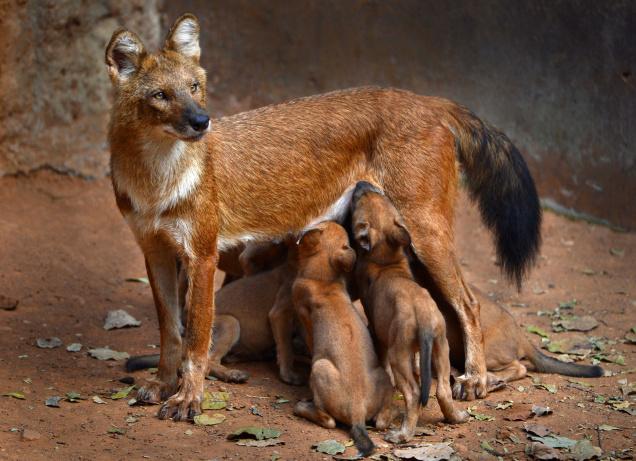
Dholes are classified as an endangered species by the IUCN

In about two to three months’ time, the Indira Gandhi Zoological Park (IGZP) will be the first zoo in the country to have a conservation breeding centre for the endangered wild dog or ‘dhole.’

Selected by the Central Zoo Authority to carry out this project at a cost of Rs. 50 lakh, the zoo authorities have earmarked an area on the premises for the centre.

Rise in numbers

After a series of successful in-breeding of wild dogs in the zoo, its population witnessed a massive increase within the protected area from just two to 22, the highest number of wild dogs in captivity in the country, according to current records.

Recently, two more litter of wild dogs were spotted at the wild dog enclosure, which is now being monitored to prevent disturbances. However, the number and gender of the litter are yet to be ascertained.

Similar in-breeding of wild dogs was carried out in zoos in Chennai and Mysore without much success.

Classified as endangered by the IUCN, wild dogs or ‘dholes’ are dwindling in numbers due to habitat loss, depletion of prey base, and destruction of forest corridors leading to fights with other predators and diseases from domestic and feral dogs.

Genetic profiling

The conservation centre in IGZP is expected to help in recovering the population of the endangered animals.

“To start with, a genetic profiling of the existing animals in the zoo will be done. Once the strong genes among them are identified, the conservation breeding process will be started through a series of measured steps.

The idea is to re-introduce the species in the wild later,” IGZP curator G. Ramalingam told The Hindu.

“Tenders have been called for the project. We have also issued circulars to hire a biologist for the project, which will be finalised soon,” he added.

source: http://www.thehindu.com / The Hindu / Home > News> Cities> Visakhapatnam / by Nivedita Ganguly / Visakhapatnam – February 19th, 2014