Category Archives: Nature

Vijayawada to host aquaculture exhibition

Nearly 20,000 delegates from India and abroad are expected to participate in the three-day exhibition to be organised by Mpeda

The third edition of ‘Aqua Aquaria India ‘, the biennial aquaculture  exhibition organised by Marine Products Export Development Authority (Mpeda ) will be held from February 20-22 next year at the Andhra Loyola College Campus in Vijayawada.

The event was proposed to have 300 stalls to showcase various production and harvest technologies, machinery and accessories in export oriented aquaculture as well as ornamental fisheries sectors. Nearly 20,000 delegates from India and abroad are expected to participate in the exhibition. The early bird scheme for exhibitors for registering at concessional rates closes on November 30, 2014.

It is befitting to organise the show in Andhra Pradesh considering its reputation as the largest producer of shrimp by aquaculture. Besides, the region also produces large quantities of fish from its fresh water resources, and is emerging as a potential area of development for ornamental fishes, said Mpeda.

Aquaculture farmers and ornamental fish breeders, feed manufacturers, hatchery owners, machinery suppliers, exporters/importers, officials from fisheries institutions and state/central government departments, researchers, students and aquarium hobbyists in India and abroad are expected to participate in the fair as well as in the technical sessions.

source: http://www.business-standard.com / Business Standard / Home> Current Affairs> News> Et cetera / BS Reporter / Kochi – July 03rd, 2014

AP: Farmers floats cooperative

CowAP05jun2014

Nearly 1,000 farmers from six villages in Mopidevi mandal of Krishna district have resolved to form a marketing co-operative society for their agriculture produce.

The farmers growing vegetables and horticulture products along the banks of the Krishna river will greatly benefit from this cooperative venture.

The venture mainly supported by Nabard will enable the farmers to open vegetable and fruit collection points in their respective villages and sell the produce without middlemen.

With the availability of abundant ground water the farmers in the villages have been growing crops round the year and waiting for better marketing facilities. The cooperative society will solve their long-standing problem.

source: http://www.indiancooperative.com / Indian Cooperative / Home> From States / by Amey Kumar / June 01st, 2014

Child Rights Body to Start Mother’s Milk Banks

Hyderabad :

Balala Hakkula Sangham, an organisation for the protection of child rights, has come with a first of its kind initiative to start a Mother’s Milk Bank, in association with Lotus Hospitals, to cater to the needs of orphaned infants. Infant mortality rate in Andhra Pradesh is 41 per 1,000 births in 2012 and most of the deaths are due to respiratory and diarrheal causes.

The main objectives of the initiative is to ensure that every baby born receives mother’s milk, to avoid bottled or animal formula milk and to provide ancillary support to breastfeeding. Donors of milk are tested for various diseases like Tuberculosis, HIV VDRL and Hepatitis before they make a contribution and will be screened by experts to rule out any virus or harmful bacteria. After a thorough screening procedure, the milk is donated to the needy children free of cost.

The average volume of milk taken is between 50-150 ml. “Experts say on an average, lactating women can produce 600 ml milk per day and 300 ml should be sufficient for their little ones. The minimum requirement for children without a feeding mother is 150 ml per day,” said Balala Hakkula Sangham general secretary P Anuradha Rao. For women who donate their milk, it helps them too as it would increase prolactin levels, preventings benign tumors in them.

The contributed milk is refrigerated and transferred to the bank in large containers. Later, it is pasteurised at 62.5 degree centigrade for 30 minutes, which preserves the milk from 80 percent of immunological factors, destroying pathogens, including HIV virus.

The pasteurised milk can be stored for six months, in the freezer for 48 hours, and six to eight hours at room temparature. The milk will be donated on first come first served basis.

Campaigning for donors will begin on the International Day for Protection of Children on June 1. Mother’s Milk Banks will come into operation from the first week of August, which is the International Breast Feed Week.

Breast milk contains various proteins and enzymes such as Immunoglobulins, Lysosomes and Lymphocytes that kill bacterial cells and increase immunity.

“Breast milk is every child’s right. Unfortunately there are instances where a child is deprived of this valuable right. In such a circumstance, the child can still be fed with breast milk through the breast milk banks,” Anuradha Rao said.

source: http://www.newindianexpress.com / The New Indian Express / Home> Cities> Hyderabad / by Sameera Jonnalagadda / May 26th, 2014

A boon for fisherfolk in Krishna

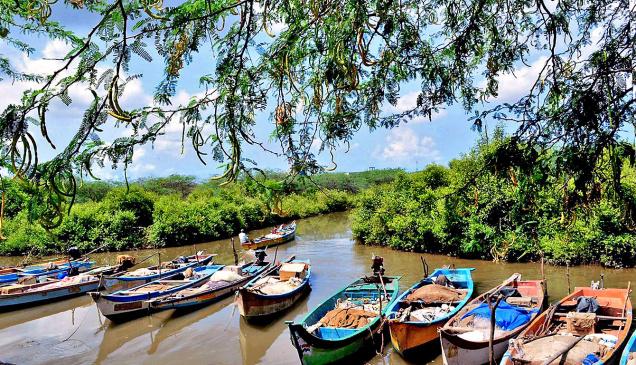
Fishing boats moored in the mangroove forest in Nagayalanka mandal of Krishna district./  Photo: T. Appala Naidu / The Hindu
Fishing boats moored in the mangroove forest in Nagayalanka mandal of Krishna district./ Photo: T. Appala Naidu / The Hindu

 Since the estuary passes through the sanctuary, boatmen bank on it for fishing

Besides the conservation of mangrove forest, boating and fishing in the brackish waters in the Krishna Wildlife Sanctuary (KWS) in Krishna district has become an integral part of the local communities living on the sanctuary premises.

While elders of fisherfolk families are mostly seen busy in search of fish catch on country-made or small engine boats, children and women join their men, spending their day peacefully moving into the lush green mangrove forest and tranquil waters on the boat.

Since the estuary of Krishna passes through the sanctuary near the Sorlagondi and Nachugunta reserve forests, which are also part of the sanctuary in Nagayalanka mandal, scores of boatmen try their luck in fishing everyday. “The estuary is a natural way that directly takes our boat to the confluence point of river Krishna into Bay of Bengal. Half of the fishing is done before arrive the sea through the forest and estuary,” said a Yanadi tribal family.

Mullet, Grooper, Red Snapper, Sea Bream and Sillago Sihama, known as ‘Ladyfish’, whose seed is being developed by the Central Marine Fisheries Research Institute, are a few fish species caught in the estuary. Near the proposed Defence Research and Development Organisation’s Missile Test Launch Facility, a treasure trove of mangrove plant species and serene water always appeal the passersby, thanks to its beauty. The locations which were explored suitable for fishing are including Gullalamoda, Sorlagondi, Eedurmondi, Nachugunta and Zinakapalem under the sanctuary boundary. Though locations within in the range of the KWS have no means of tourism facilities, the visitors always love to have a glimpse at the life of the local communities and fishing in the KWS, particularly in Summer.

source: http://www.thehindu.com / The Hindu / Home> News> National> Andhra Pradesh / by Staff Reporter / Sorlagondi – May 19th, 2014

Krishi Parivartan Yatra: Agro-tech and business opportunity for farmers

Sangareddy :

The International Crops Research Institute for the Semi-Arid Tropics (ICRISAT) on Sunday kick started Krishi Parivartan Yatra, hosting the first of five agro-tech and business opportunities expos scheduled to take place in five cities in India.

Krishi Parivartan Yatra or a journey of agricultural transformation takes 50 farmers and entrepreneurs, who are beneficiaries of the World Bank-funded National Agriculture Innovation Project (NAIP) of the Indian Council of Agricultural Research (ICAR), on a five-city tour to share new technologies and agri-ventures with fellow farmers.

The activity is being organized by NAIP to promote cross learning and sharing of success stories among farmers across the country, so as to strengthen agribusiness and boost the transformation of Indian agriculture. It will conclude and culminate into the Agri-Innovation Conclave in New Delhi on May 18.

The first expo held at ICRISAT showcased the best of enterprises developed through NAIP initiatives. The activity included parallel sessions and discussions where the NAIP farmer beneficiaries shared their success stories with about 200 farmers and entrepreneurs and promoted the tremendous potential in agribusiness. The train journey was then flagged from ICRISAT’s global headquarters in Hyderabad for the five-city tour after the day-long activity.

“Innovation in agriculture is widely considered as the key to achieve food security. To actualize this vast untapped potential of Indian agriculture, this Krishi Parivartan Yatra is being organized to bring to the fore, the unlimited opportunities that agriculture and agribusiness offer,” said Dr D Rama Rao, national director, NAIP at the inaugural session of the Yatra.

“Our mission is to make smallholder farmers in the drylands prosperous, not just self-sufficient. And that is why we are engaged in promoting an inclusive and technology-based entrepreneurship and agribusiness program,” said Joanna Kane-Potaka, strategic communication and marketing director, representing ICRISAT director-general Dr William Dar.

“ICRISAT’s Agri-Business Incubation (ABI) Program has supported more than 200 agribusiness ventures and benefited over 500,000 farmers in Andhra Pradesh and neighboring states. We have identified and supported some very good innovative products and technologies and taken them to the market. The Krishi Parivartan Yatra supports our goal to bring together the best of agri-ventures and enterprises to improve the livelihoods of smallholder farmers,” said SM Karuppanchetty, chief operating officer, ICRISAT-ABI.

The Yatra journey, along with the just concluded Agri-Biz Idol Camps held in various cities between May 5 and 9 to reach out to the youth and start-up entrepreneurs, will both culminate in the Agri-Innovation Conclave from May 18 to 19 in New Delhi. The conclave aims to bring together agribusiness experts, professionals, and other stakeholders from across the country, on a common platform to share NAIP’s success and conceive path breaking ideas for strengthening the future of agribusiness in India.

NAIP-ICAR has embarked on this unique initiative to promote awareness on the potential opportunities in agri-business, nurture agri-innovators for future generations, and also to promote the various business incubation services offered by NAIP’s Business Planning and Development (BPD) units. The BPDs which primarily act as an agriculture incubation centers help start-ups or entrepreneurs foraying into agribusiness to flourish by providing comprehensive business solutions.

Over the last five years, 22 agribusiness incubators (BPDs) have been set up throughout India in agricultural universities and research institutes by NAIP-ICAR with support and mentoring by ICRISAT-ABI. The success has led to ICRISAT and ICAR sharing their expertise across the continents to Africa, to coordinate the setting up of food business incubators and food technology laboratories in 10 African countries.

source: http://www.timesofindia.indiatimes.com / The Times of India / Home> City> Hyderabad / by Syed Akbar, TNN / May 11th, 2014
APFDC earns highest-ever revenue from pepper auction

PepperHF19may2014

Vietnam model of cultivating it as mono-crop mooted

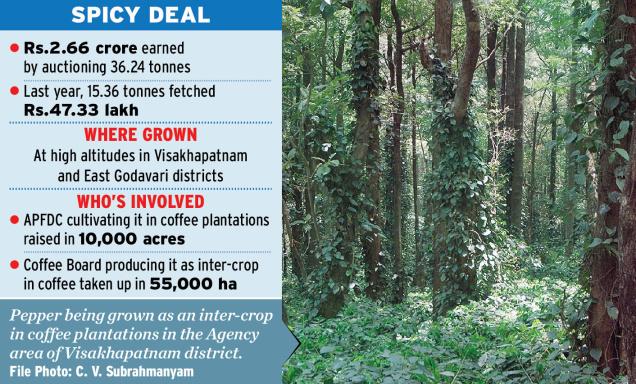
Auction of black pepper grown in Visakhapatnam and East Godavari by the AP Forest Development Corporation has fetched Rs.2.66 crore.

High in demand all over the world, particularly in Western and European countries, black pepper is known as an important ingredient to enhance the taste quotient of several delicacies — be it vegetarian or non-vegetarian. It is also recognised for its medicinal value in the treatment of Alzheimer’s disease, diarrhoea, and respiratory ailments.

During the auctions conducted at a function hall in MVP Colony here on Friday in the presence of APFDC Vice-Chairman-cum-Managing Director Rajesh Mittal, the response from the bidders was very good.

“Auction of 36.24 tonne brought us revenue of Rs.2.66 crore this time, the highest ever so far,” APFDC General Manager A.N. Gurumurthy told The Hindu on Saturday. During last year, the corporation earned Rs.47.33 lakh by auctioning 15.36 tonne.

Pepper is grown at high altitude in several parts of Visakhapatnam and East Godavari districts as an inter-crop in coffee plantations. Tribal people involved in coffee plantations by the Coffee Board also produce pepper.

Pepper plants are creepers hanging from silver oak and other shade-giving trees in the coffee plantations of Anantagiri, Araku, and other valleys of the Eastern Ghats. They also attract several people interested in ecotourism.

While the APFDC is growing pepper in coffee plantations raised in 10,000 acres, the Coffee Board produces pepper as inter-crop in coffee taken up in 55,000 hectare. The APFDC and the Coffee Board have been getting awards at the highest level for raising fine flavour coffee, bringing international recognition to locally produced coffee.

Experts say that pepper potential in the lush-green jungles of the Eastern Ghats could be explored better by raising coffee in more area and promoting pepper under the shade of coffee plants.

Some moot that pepper production could be raised by following the Vietnam model of cultivating it as a mono-crop in large stretches of high-altitude hilly terrains by planting it on wooden poles or concrete pillars without disturbing the eco-system. Vietnam is one of the leading pepper exporters.

source: http://www.thehindu.com / The Hindu / Home> News> Cities> Visakhapatnam / by Santosh Patnaik / Visakhapatnam – May 11th, 2014

Hussainsagar water to be on sale

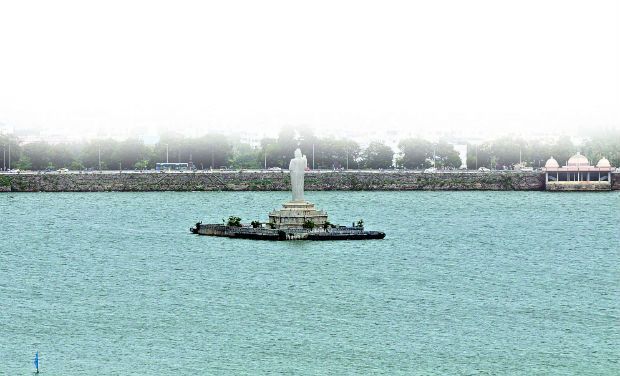
File picture of Hussainsagar lake. (Photo: DC/File)

Hyderabad:

The Buddha Purnima project wing aims to earn Rs 60 lakh per month from the sale of treated water from Hussainsagar, which is the only revenue generating project under the Hussainsagar Lake and Catchment Improvement Programme (HCIP).

The three filling stations, at Khairatabad flyover, NTR Garden service gate and Sanjeevaiah Park second gate together will have the capacity to fill 1,000 tankers (of 10 kilo liters) per day. Out of the 50 MLD of treated water, 35 MLD will be used to maintain the lake balance, seven will be used by HMDA and the rest will be sold.

The three filling stations will be connected with a six-km pipeline procured from Kolkata. The HMDA chief engineer for the reuse project explained, “Per day, 50 MLD of sewerage water is being treated at various sewerage treatment plants (STPs), out of which 35 MLD is needed to maintain the lake balance (for evaporation and percolation); of the remaining 15 MLD, 7.10 MLD is required for gardening and landscaping of HMDA amusement establishments surrounding Hussainsagar. The remaining 8 MLD will be stored at the filling stations for sale.”

The treated water contains dissolved oxygen less than 3 milligrams per liter (mg/l), residual chlorine from 0.1 to 0.2 mg/l and other elements like nitrogen, phosphorus, coliform and suspended solids. It can be used for irrigation, construction, landscaping, gardening and washing purposes.

Till now, the South Central Railway, Secunderabad, has come forward to purchase 1.10 MLD for washing bogies (0.6 MLD at Nampally station and 0.5 MLD at Kachiguda); few private construction companies and concrete ready mix plants have also showed interest.

“The exact price per tanker will be finalised after the completion of the filling stations. The HMDA has estimated close to Rs 2 lakh revenue per day (Rs 60 lakh per month). Each station will have four filling points and the maximum flow at each point will be 69 cubic meter per hour,” added the official.

source: http://www.deccanchronicle.com / Deccan Chronicle / Home> Nation> Current Affairs/ by DC Correspondent / May 08th, 2014

From Pastapur to Senegal, widening the network of millets

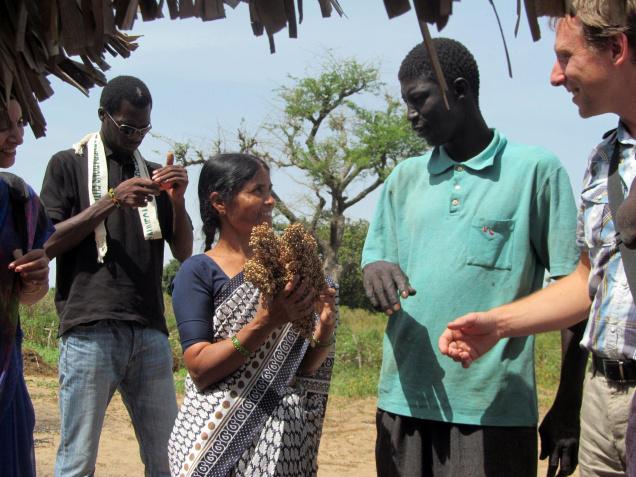
Chinna Narsamma, a member of the DDS, exchanging millet seeds with a delegate from Senegal at Pastapur in Medak district on Tuesday./ Photo: Mohd. Arif / The Hindu

Medak-based DDS, with 10 African nations, strives for Afro-Indian Millet Alliance

The Deccan Development Society (DDS), which is working on various crop improvement programmes, has succeeded in forging alliance with several African nations for research and development of millet cultivation.

The DDS, headquartered at Pastapur in Medak district, along with 10 African nations, is actively participating for the realisation of the Afro-Indian Millet Alliance which has been under planning stage since February last year.

Food security

“Many West African nations are getting ready to pursue agricultural models designed by the DDS that encapsulate ecological farming, biodiversity, food and nutritional security, along with ecological security.

The Millet Network of India (MINI), of which the DDS is the national convenor, has foregrounded the various cultivation aspects of millets including biodiversity, ecology and farmers’ self-reliance,” said DDS Director P.V. Sateesh.

Overseas alliance

Speaking to the media at Pastapur on Tuesday, Mr. Sateesh said that last week the DDS was invited to attend to the West African Regional Assembly of the COPAGEN, a network present in nine West African countries– Senegal, Burkina Faso, Togo, Cote D’Ivore, Mali, Benin, Niger, Guinea, Guinea Bissau–, is engaged with millions of West African farmers.

“We are very happy to see that the research on Bt Cotton pursued by the DDS in Adilabad, Nalgonda and Warangal is being followed to find out the impact of Bt cotton in Burkina Faso, a West African country. Following in the footsteps of the DDS, the farmers there have formed community research groups and are regularly monitoring and colleting data on the cultivation aspects of Bt cotton,” he said.

A DDS team comprising Narsamma, a peasant farmer; Ms. Jayasri Cherukuri, Coordinator of the MINI and P.V. Satheesh, Director of the DDS, made a detailed presentation on the work done by the network here on Tuesday.

Meanwhile, the DDS and the COPAGEN are also planning to organise farmer exchange programmes between the Africa and India, with a special focus on the women farmers in both the countries.

source: http://www.thehindu.com / The Hindu / Home> News> National> Andhra Pradesh / by Staff Reporter / Sangareddy – November 22nd, 2013

A tribal farmer raises 40 varieties of biodiversity plantation

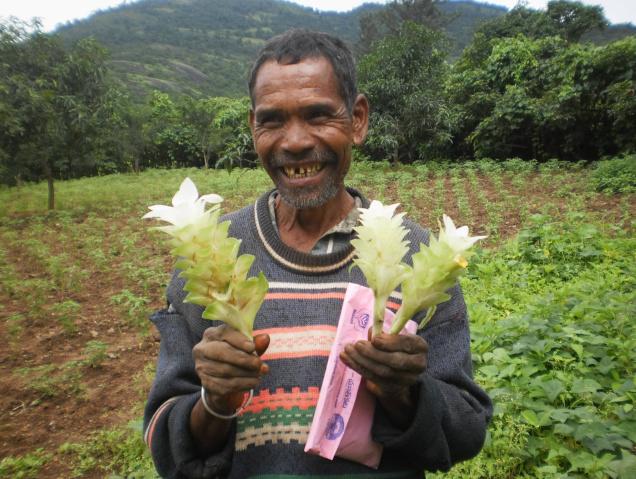
Tribal farmer Killo Dombu and his land cultivated under NABARD's 'Maa Thota' scheme at Anthriguda hamlet in Ananthagiri mandal in Visakhapatnam district. / Special Arrangement / The Hindu
Tribal farmer Killo Dombu and his land cultivated under NABARD’s ‘Maa Thota’ scheme at Anthriguda hamlet in Ananthagiri mandal in Visakhapatnam district. / Special Arrangement / The Hindu

Killo Dombu of Anthriguda village in Dumbriguda mandal is proud of his achievements. Almost every plant is productive on his one-acre plot which yields cash crops. The innovative methods of cultivation adopted by him are a big draw today.

He is growing 40 varieties of horticulture plants, using bio-pesticides and adopting totally organic methods of cultivation. The crops being raised by him include vegetables, fruit plantations, forestry species, creeper vegetables, floriculture, tubers, oilseeds and medicinal plants. He has a bio-mass based manure pit in one corner of his plot. He also has cattle which give milk, cow dung and the stuff required for producing organic manure.

Dombu advocates growing multiple crops instead of mono-crop. His plantations include 40 plants each of mango, chiku, acid lime, red sanders, teak, bamboo, fish tail palm, jack, jamun, custard apple, guava and Bahumia. Creeper varieties are pumpkin, beans, bottlegourd and ridgegourd. His plantation is fenced with trees such as euphorbia, agave and jetropha. Vegetables including brinjal, green pepper, chilli, pepper, rajma and cabbage are being grown as inter-crops along with medicinal plants.

P. Viswanatham, chairman of Vikasa, an NGO working to propagate organic farming among tribal farmers, told The Hindu that Dombu had been a source of inspiration to other ‘Maa Thota’ farmers. Dombu says that he is earning Rs.50,000 per year on the crop yield. Besides, the millet crops cultivated in his land take care of daily bread of his family members. A beaming Dombu shares his success story with his co-farmers and asks them to adopt his methods of farming. His wife, daughter and son-in-law together work in his ‘Maa Thota’ supported by NABARD. Not many visitors understand what he tries to communicate in chaste Odisha but the smile on his face and his green garden speak volumes for his achievement.

source: http://www.thehindu.com / The Hindu / Home> News> Cities> Visakhapatnam / by Ravi P. Benjamin / Visakhapatnam – October 12th, 2012

They too feed your rythu bazaars

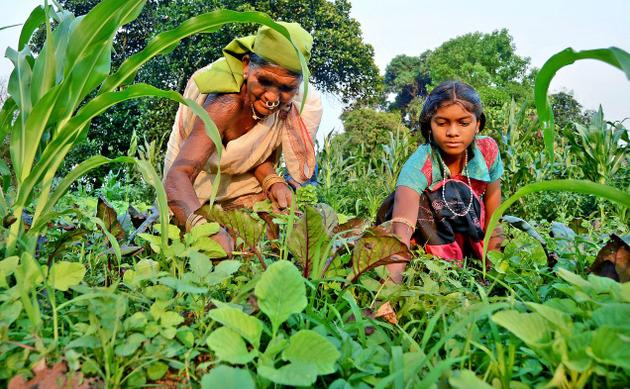
Tribal farmers picking up leafy vegetables at Chavudupalli village near Chintapalle in Visakhapatnam district. Migrating from Andhra-Odisha border, they have settlled down in the area several decades ago. - / Photo: K.R. Deepak / The Hindu
Tribal farmers picking up leafy vegetables at Chavudupalli village near Chintapalle in Visakhapatnam district. Migrating from Andhra-Odisha border, they have settlled down in the area several decades ago. – / Photo: K.R. Deepak / The Hindu

Tribal farmers demand cold storage and warehousing facility and more land to boost their income

They are fully content with what they grow in their fields.

Supplying natural, healthy and organic vegetables throughout the year to the nearest towns as well as rythu bazaars of Visakhapatnam provides them the bread and butter. With no interest to diversify into any other field, they have been eking out a living happily on the outskirts of Chintapalle, about 130 km. from Visakhapatnam. The place and its neighbourhood was once hotbed of Maoist activity. Any vegetable you name be it brinjal, beetroot, potato, lady’s finger or ginger or some spices, it is available in their fields though they are season-specific.

Tribal farmers picking leafy vegetables at Chavudupalli village near Chintapalle in Visakhapatnam district. - / Photo: K.R. Deepak / The Hindu
Tribal farmers picking leafy vegetables at Chavudupalli village near Chintapalle in Visakhapatnam district. – / Photo: K.R. Deepak / The Hindu

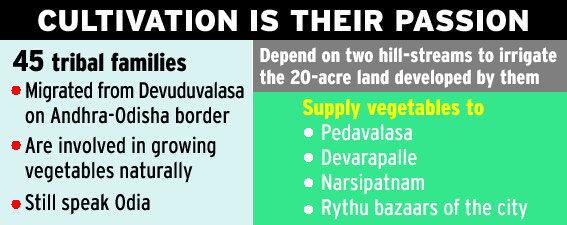
“Cultivation is in our genes. We work with passion and though our earnings are not enough, we live in peace as all our family members are involved in some way or other right from sowing seeds to harvesting and marketing,” said Khora Raghunath, 50.

TribalFamiliesHF04may2014

About 45 tribal families, who migrated from Devuduvalasa near Araku on Andhra-Odisha border are now settled at Chavudupalli near Chintapalle. They speak Odia though they have shifted to Chintapalle several decades ago. Taking advantage of two hill streams, which pass near their fields developed by them in an area of 20 acres, the tribals grow cabbage for four months and leafy vegetables for 45 days. ‘Sahukars’ (local agents) come to their village in vans to pick up stocks and take them to Pedavalasa, Devarapalle and Narsipatnam shandies (weekly markets). Some of their yield finds its way to the Rythu Bazaars in the city. “Our only request to the authorities is to provide cold storage and warehousing facility. We also need more land so that our income level will be decent enough to meet both ends met,” said Khora Damodar, another farmer.

source: http://www.thehindu.com / The Hindu / Home> News> Cities> Visakhapatnam / by Santosh Patnaik / Visakhapatnam – April 24th, 2014