Category Archives: Leaders

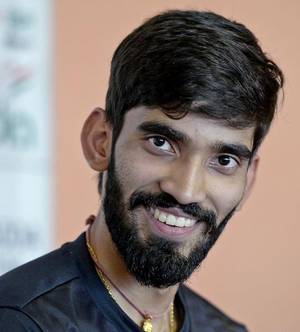
House okays Srikanth’s appointment

Kidambi Srikanth | Photo Credit: NOAH SEELAM

The Assembly on Saturday passed a resolution approving the appointment of Guntur-born Indian shuttler Kidambi Srikanth as Deputy Collector.

The Council of Ministers resolved, vide resolution CR No. 429-2/2017, dated November 2017, to provide employment to him in a post in Group 1 services (Deputy Collector) of the State in appreciation of his outstanding performance in badminton.

Four titles

Srikanth won four super series titles – Indonesian Open, Australian Open, Denmark Open, and French Open – in one year, and he was the only Indian and fourth player in the world to achieve the feat.

source: http://www.thehindu.com / The Hindu / Home> News> States> Andhra Pradesh / by Special Correspondent / Vijayawada – December 02nd, 2017

Bill Gates remembers his first meeting with Andhra Pradesh Chief Minister N Chandrababu Naidu

Microsoft founder Bill Gates. Image: Reuters

Microsoft Founder Bill Gates on Friday said he was really excited at meeting Andhra Pradesh chief minister N Chandrababu Naidu for the first time over 20 years ago.

Addressing the valedictory of the three-day AP AgTech Summit 2017, the Co-Chair of Bill and Melinda Gates Foundation recalled his meeting with Naidu who was then chief minister of undivided Andhra Pradesh.

“I was told that there is someone who believes in digital technology even more than you do. It was hard to believe but when we met, he had his digital equipment — computer — and he had the vision to make government better by using advanced tools,” said Gates.

He also revealed that they agreed and today they have reached a milestone as they can use dashboards for agriculture and health. He also referred to the use of Microsoft app Kaizala by the state government for its activity.

“It’s been a real journey over these 20 years, making that vision a reality. I expect it to accelerate and in the years ahead will move very quickly,” said Gates.

Earlier, Naidu in his speech revealed how he managed to get an appointment with Gates for 10 minutes but the latter spent 40 minutes with him. “I made a presentation through a laptop and I was the first Indian politician to do so,” the chief minister claimed.

Naidu explained how he convinced Gates to set up Microsoft’s development centre in Hyderabad. “Not only Microsoft opened its development centre in Hyderabad but Satya Nadella who is from our place became Microsoft CEO.”

Terming Gates as a great personality, the chief minister said he was spending the money he earned to help people around the world.

source: http://www.firstpost.com / First Post / Home> Tech> News Analysis / IANS / November 20th, 2017

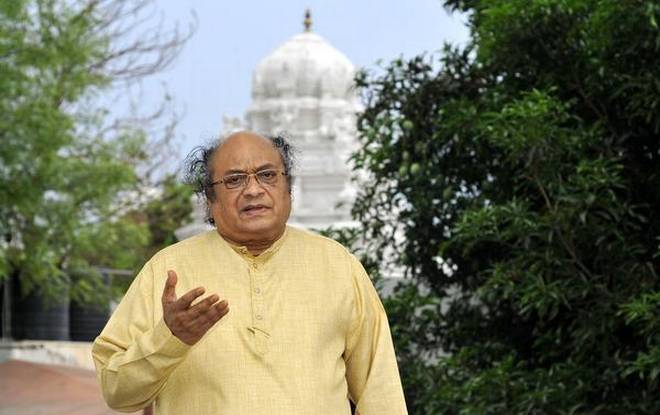
Jnanpith winner C. Narayana Reddy passes away

C. Narayana Reddy won the Jnanpith award in 1988. | Photo Credit: Nagara Gopal

CiNaRe was known for his use of Telugu in its pure form, and would not be swayed by filmmakers on the use of the language.

Eminent poet, litterateur and Jnanpith awardee C. Narayana Reddy, popularly known as CiNaRe, passed away in the early hours of Monday, aged 85. He was taken to a hospital following health complications and was declared dead.

CiNaRe, born on July 29, 1931 in Hanumajipet of erstwhile Karimnagar district, studied till his graduation in Urdu because Telugu as a medium was not available during the Nizam’s rule. However, because of his intense love for the language he taught himself Telugu and it was only during his degree that he took the option of Telugu as a paper. CiNaRe went on to do a post-graduate degree and a Ph.D on ‘Modern Traditions of Telugu’.

It was the late N.T. Rama Rao, who wielded the megaphone in film Gulebakavali, who gave CiNaRe his break as a lyricist. He wrote all the songs in the film, including the hit ‘Nannu dochukunnavate .. Vannela Dorasani.’

CiNaRe was known for his use of Telugu in its pure form, and would not be swayed by filmmakers on the use of the language.

He was awarded the Padma Shri in 1977 and the Padma Bhushan in 1992. His compilation of poems, titled ‘Viswambhara’, got him the Jnanpith award in 1988. In 1997, he was nominated as a Member of the Rajya Sabha. His academic distinctions include serving as a professor of Osmania University and as Vice Chancellor of the Telugu University.

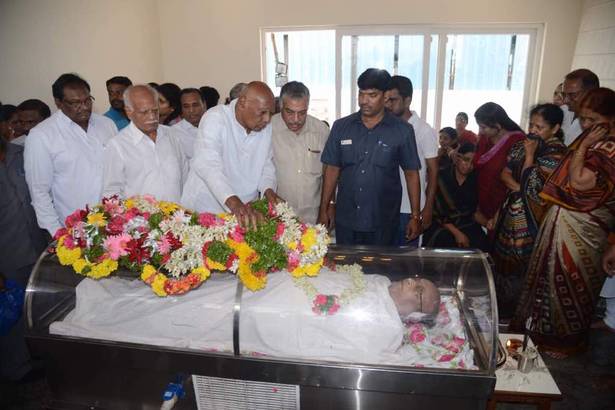
Former Governor K. Rosaiah pays homage to C Narayana Reddy in Hyderabad.   | Photo Credit: K.V.S Giri
Former Governor K. Rosaiah pays homage to C Narayana Reddy in Hyderabad. | Photo Credit: K.V.S Giri

Among those who condoled with the death of CiNaRe were Governor of Maharashtra and Tamil Nadu, Ch. Vidyasagar Rao and Chief Minister of Telangana, K. Chandrasekhar Rao. Those who visited the family residence and paid their respects included former Governor of Tamil Nadu, K. Rosaiah, Ministers K.T. Rama Rao, G. Jagadheeshwar and actor Venkatesh.

His last rites will be performed on Wednesday.

source: http://www.thehindu.com / The Hindu / Home> Books> Authors / by Suresh Krishnamoorthy / Hyderabad – June 12th, 2017

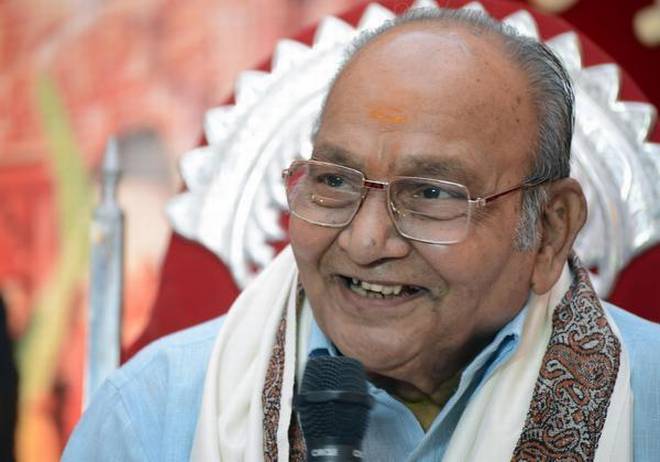
‘K Viswanath brought dignity and grace to Telugu cinema’

BANGALORE, 23/12/2012: Dadasaheb Phalke Awardee K. Vishwanath at Media Conference as part of Bengaluru International Film Festival in Bangalore on December 23, 2012. Photo: V. Sreenivasa Murthy   | Photo Credit: V Sreenivasa Murthy
BANGALORE, 23/12/2012: Dadasaheb Phalke Awardee K. Vishwanath at Media Conference as part of Bengaluru International Film Festival in Bangalore on December 23, 2012. Photo: V. Sreenivasa Murthy | Photo Credit: V Sreenivasa Murthy

Four filmmakers discuss the impact of this year’s Dadasaheb Phalke award winner K Viswanath’s films on their writing and storytelling methods

In the late 1970s and early 80s, Telugu cinema was witnessing a phase that wasn’t really earning it plaudits. Outlandish costumes and a pop of colour bombs in song sequences were becoming markers of popular cinema. The 80s were characterised by bell bottoms, oversized sunglasses and floral prints in other film industries as well.

K Viswanath’s films stood out like a breath of fresh air. The characters in his films spoke like real people; they had concerns that mirrored real-life situations. Over the decades, any Telugu film aficionado would have heard and recounted tales of how Sankarabharanam (1979) opened to near-empty halls before it became a rage and ran to packed shows for over a year and its key actors Somayajulu and Manju Bhargavi enjoyed the popularity reserved for stars.

Viswanath’s films cannot be slotted into what was then called ‘art’ or ‘parallel’ cinema, through he steered clear of mainstream excesses. His films drew audiences in droves, the music percolated well into popular realm and the stories and characters would be cherished for decades.

When Viswanath chose stars like Kamal Haasan, Chiranjeevi, Jayaprada, Bhanupriya, Radhika, Venkatesh or Vijayashanti, he gave them a chance to better their craft and have the satisfaction of looking back at these films fondly years later. It’s befitting when an actor like Venkatesh today recollects how Swarnakamalam allowed him to be real and not resort to exaggerated expressions, or, when Kamal Haasan takes to Twitter to thank Viswanath for making him a part of Sagara Sangamam.

Kamal Haasan was no stranger to films depicting realistic stories, thanks to working with directors like K Balachander and Bharatiraja in Tamil. Yet, Sagara Sangamam was a landmark film. It showed that the protagonist needn’t be young and charming through the film. He could be flawed and yet be revered.

The best part of Viswanath’s films, as director Nandini Reddy points out, is that they remain rooted and effortless. “It didn’t look like he was setting out to make great cinema. He was just trying to tell a story in the best possible way he knew and it all seemed so organic and real,” she says. We nod in agreement.

Nandini Reddy

Writer/director

“One of my earliest memories of Telugu cinema is watching Sankarabharanam. It was our Sound of Music. Everyone, age no barrier, loved that film. I was in school and when Manju Bhargavi made a visit, it was no less than a star visiting. Sankarabharanam is a beautiful amalgamation of story, music and performance. The narrative is fluid, which is a hallmark of Viswanath’s work. When we write a film, we mull over the placement of different segments and how it should build up to a climax. In Viswanath’s stories, it all seems to emerge naturally. His was a Zen method of filmmaking. Every musical note, every expression seems so well thought out and beautiful. The close-up shots of Jayaprada, Kamal Haasan or Radhika conveyed so much without words. He believed in brevity of dialogues. Actors lived their parts. I think Viswanath brought dignity and grace to Telugu cinema.”

(Nandini Reddy is known for her rom-coms and family dramas like Ala Modalaindi and Kalyana Vaibhogame)

Tharun Bhascker

Writer/director

One of Tharun’s childhood friends is K Viswanath’s grandson Mukund. Tharun remembers discussing cinema with Mukund and his friends, much before he knew Mukund’s lineage. For Tharun, the vivid childhood image of cinema stems from watching Sagara Sangamam.

“The film showcased the aesthetics of dance in a non-commercial format. It was offbeat, yet created tremors in the industry and among the audience. In the beginning of the film, we see the protagonist, the hero, as an alcoholic and someone who had given up on his career. That flawed character, to me, announced that it wasn’t a usual film. It was courageous of Viswanath sir as a writer and filmmaker to do that. That kind of writing stuck with me when I grew interested in screenwriting. I have revisited the film on several occasions and with friends, have eagerly watched the song where Kamal Haasan stands on the well, inebriated. We have watched and discussed how an entire song can be choreographed thus and the shot constructions.”

(Tharun Bhascker directed Pelli Choopulu, which won the National Award for Best Feature Film in Telugu in 2016; he’s now working in his next — a coming-of-age buddy comedy with four youngsters, which he describes as “Dil Chahta Hai meets Hangover.)

Srinivas Avasarala

Writer/director/actor

“Viswanath’s films gave me insights into on-screen dynamism, particularly the movement of people and the camera. Remember the scene where Kamal Haasan dances in a newspaper office in Sagara Sangamam? We see Sailaja on the right to begin with and as the scene progresses, she moves left to where her boyfriend is standing. It’s a scene where she needs psychological support and we see her moving to him. Similarly, in Swanakamalam when the father is against the son’s wishes to marry a girl of his choice, we see the mother entering and the son swiftly moves to stand near her. Again, it’s an example of psychological support. As a writer and filmmaker I’ve often asked myself if I would be able to write or make a film like he has. Deep within I know I cannot make a film on classical music or dance, because that requires a deep understanding of the art form and conviction. As a child, when I watched Sankarabharanam I was absorbed by what I saw on screen. This despite the fact that like most children, I wasn’t keen on classical music.

(Srinivas Avasarala wrote and directed Oogalu Gusagusalade and Jo Achyutananda)

Nag Ashwin

Writer/director

“We all grew up watching K Viswanath’s films and most filmmakers of today aspire to make films that are commercially viable, socially relevant and with a blend of humour, which came so easily to him. On a few occasions when I met him at film events and spoke about cinema, he would mention that a story or a movie came to him naturally and he was just a conduit to make it happen. That’s an approach I relate to. My favourites among his films are Swarnakamalam (1988) and Swatikiranam (1992). I’ve lost count of how many times I would have watched them for the nuances of filmmaking and fresh approach to storytelling. Until I watched Swatikiranam, I didn’t know it was possible to make such an impactful film about a guru getting jealous over a student’s success. As a child, I remember watching Aapadbandhavudu (1992). I was stunned at how it moved me emotionally. I remembered hearing that the film didn’t do well. I kept wondering how such a film didn’t find enough takers. Every few years I revisit this film to see if it was ahead of its time. The music is evergreen, as is the case with every film of Viswanath.”

(Nag Ashwin debuted as a director with Yevade Subramanyam and is now making a biopic on late actress Savitri, titled Mahanati)

source: http://www.thehindu.com / The Hindu / Home> Entertainment> Movies> Personality Movies / by Sangeetha Devi Dundoo / April 25th, 2017

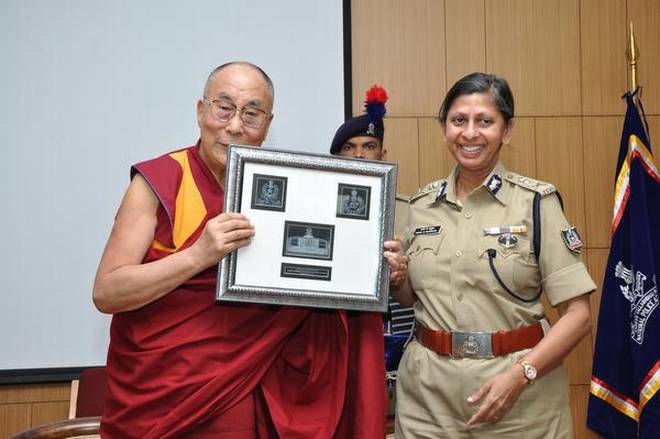
Aruna Bahuguna retires

Aruna Bahuguna | Photo Credit: special arrangement

Senior IPS officer Aruna Bahuguna, Director of Sardar Vallabhbhai Patel National Police Academy, retired on Tuesday, having put in over 39 years of service.

At a specially convened ceremonial parade in her honour, she received salute from 139 IPS probationers of 69th Regular Recruit batch and 15 probationers from Maldives, Nepal and Bhutan at NPA.

Ms. Bahuguna said probationers should remember that even their minute thoughts would contribute to the country’s progress. Values and integrity should be the only companions of yours, she said.

“In you I see myself 39 years aback …full of zeal, commitment and dreams. I conclude my innings in the IPS doing what this institution does best ….the realisation of dreams,” she said.

Ms. Bahuguna joined IPS in 1979 and was allotted to the then united Andhra Pradesh State cadre. She served AP as Additional DGP (co-ordination), DGP (State Disaster Response and Fire Service).

She also worked with Intelligence Bureau and with the Ministry of Home Affairs.

Ms. Bahuguna was awarded Indian Police Medal for Meritorious Service in 1995 and President’s Police medal for Distinguished Service in 2005.

source: http://www.thehindu.com / The Hindu / Home> News> States> Andhra Pradesh / by Special Correspondent / Hyderabad – March 01st, 2017

Mythri worked all her life for women empowerment

J. Mythri, daughter of atheist leader and social reformer Gora, died on Saturday afternoon. She was 86.

A Gandhian and social worker, Ms. Mythri worked all her life for women empowerment. She was the chairperson of the Atheist Centre, Vijayawada, and contributed a great deal in propagating atheism as a way of life. She was affectionately called Mythri ‘amma’ by family members, relatives and outsiders who would not miss to call on the lady with a radiant smile that always greeted visitors with warmth.

Born on December 1, 1932 in Vizianagaram, she was the third daughter of Gora and Saraswathi Gora. The family members donated her body to the Pinnamaneni Siddhartha Medical College, Vijayawada.

source: http://www.thehindu.com / The Hindu / Home> News> States> Andhra Pradesh / by Special Correspondent / Vijayawada – February 13th, 2017

Gouthu Lachanna remembered

Visakhapatnam:

Andhra University vice-chancellor Prof G Nageswara Rao paid tributes to Sardar Gouthu Lachanna on his birth anniversary by hailing him as one of the great real life heroes of Andhra Pradesh.

The vice-chancellor said not only did Gouthu Lachanna play a key role in emancipating the down trodden but was also a front liner during the freedom struggle.

He hailed him as man who dedicated his life for the betterment of mankind. TNN

source: http://www.timesofindia.indiatimes.com / The Times of India / News Home> City> Visakhapatnam / TNN / August 18th, 2016

Anti-liquor activist Dubagunta Rosamma no more

RosammaANDHRA08aug2016

Nellore :

Anti-arrack movement leader responsible for imposing total ban on liquor, Vardhineni Rosamma (93) popularly known as Dubagunta Rosamma, passed away  in Dubagunta village of Kaligri mandal, about 90 km from here on Sunday morning.

According to her family, she breathed her last around 3.30 AM on Sunday at her residence in Dubagunta village. Rosamma’s family has been living as agricultural labourers in the village. She is survived by two sons V Srinivasulu, and V Yddukondalu, and a daughter K Padmaja. Her last rights are expected to be held on Monday in Dubagunta village.

Nellore MP M Rajamohan Reddy, Udayagiri MLA B Venkata Rama Rao, former Udayagiri MLA M Chandrasekhar Reddy, MLCs V Balasubrahmanyam, S Chandra Mohan Reddy, CPM senior leader Jakka Venkaiah and others condoled her death.

Unlettered woman who made history

Vardhineni Rosamma, born in 1923 in Juvvaladinne village, married Kondaiah Naidu of Dubagunta village and settled as a agricultural labourer. Rosamma, who was an unlettered woman, was inspired by literacy movement, during the regime of Collector M Raju in 1990s. Later, she joined the Anti-Arrack Movement in 1991, with the inspiration of a book called ‘Mahila Meluko’ written by Vitavu Balasubrahmanyam. She intensified the movement by making ‘Dubagunta village the focus.’

All political parties except Congress, non-governmental organisations and social activists extended support, and joined the anti-arrack movement, which led to its ban by the late CM N T Rama Rao.

After winning polls, NTR  signed on the dotted line to ban liquor in the State.  AP had a golden era for two-and-a-half years during the regime of NTR and crime rate drastically came down following ban on liquor. N Chandrababu Naidu, who assumed office after NTR, lifted the ban. Rosamma’s last days were bad. The government, allotted  her four acres of land in Dubagunta village and a plot at Kavali outskirts, forcibly grabbed it by saying that she had no pattas.

Even APSRTC’s free pass was cancelled few years ago. After losing both kidneys, she travelled to Kanuparthipadu village to meet Chief Minister Naidu. She was not allowed to meet the CM, and was mercilessly necked out from the venue by calling her mad. However, philanthropists donated some money for her health and she died undergoing dialysis at her village on Sunday.

source: http://www.newindianexpress.com / The New Indian Express / Home> States> Andhra Pradesh / by Express News Service / August 08th, 2016

The multilingual scholar who made Tirupati proud

Multilingual scholar Kozhiyalam Satagopacharya

He was a scholar honoured by the Tirumala Tirupati Devasthanams (TTD) by being carried on a caparisoned elephant around the famous Sri Govindaraja temple here.

Kozhiyalam Satagopacharya received the rare honour way back in 1961-62. Followed by scholars chanting hymns and to the traditional drum beats of percussionists, the procession led by the then Executive Officer C. Anna Rao also dropped him at his residence. His achievement?

He rendered the Ramayana discourse for a full year at the jam-packed Anjaneya shrine located in front of the temple.

While his centenary was observed by his disciples at Mylapore (Chennai) on Saturday, his home town Tirupati too went nostalgic.

It is a rare coincidence that the 100th year of this scholar, who shares the lineage of ‘Abhinava Ramanuja’ Kozhiyalam Swamy, runs concurrent with the millennial celebrations of Sri Ramanuja.

Born in July 1916 in Therani on the banks of River Kusasthali on the Tamil Nadu border, the Sanskrit scholar taught for more than 25 years in the TTD’s Sri Venkateswara Oriental College. The multilingual scholar used to give a Tamil lecture on ‘Tiruppavai’, participate in Sanskrit debate and immediately switch over to chaste Telugu for a discourse on the ‘Ramayana’. Tamil and Telugu commentaries on ‘Sri Venkateswara Ashtothara Sathanamavali’, Vedanta Desika’s ‘Dayasatakam’ and a Sanskrit commentary‘Vidhitraya Paritranam’ on Sri Venkatadhvari were some of his notable contributions.

He mastered spoken English too within a few months. Satagopacharya made news those days by preparing and rendering the welcome address for the then President Dr. Sarvepalli Radhakrishnan at the Kendriya Sanskrit Vidyapeetha. The President was all praise for his erudition, his disciples recall even today. Describing him ‘an authority on Nyaya, Mimamsa and Vedanta’, the then Lok Sabha Speaker Madabhushi Anantasayanam Ayyangar used to refer scholarly material to him.

His abject poverty never had any impact on him. “He never let money or the absence of it cast a shadow on us,” recalls his son K. Srinivasan, Secretary of the Navajeevan charitable group that runs an eye hospital, home for the visually challenged and an old age home, feeding 1000 people a day.

Though he got an appointment as a reader in the Vidyapeetha, he breathed his last before joining duty.

source: http://www.thehindu.com / The Hindu / Home> National> Andhra Pradesh / by A.D. Rangarajan / Tirupati – July 25th, 2016