Category Archives: Inspiration /Positive News and Features

Social entrepreneurship, not politics, is Deepa’s call

Entrepreneur Deepa Venkat is not like a majority of her counterparts for whom politics is the only profession to chose. Instead, the entrepreneur daughter of former BJP chief M Venkaiah Naidu prefers to pursue Mahatma Gandhi’s dictum — back to villages.

Swarna Bharat Trust, a charitable organisation run by her, collaborated with Soma Enterprises and Andhra Bank last September to set up an institute to impart technical education to rural youths. Around 400 deprived youths from Andhra Pradesh, Maharashtra, Bihar, Jharkhand and Madhya Pradesh and since passed out from this place and are now settled with good jobs at different firms.

“It gives you a great sense of satisfaction to see helping somebody’s life and future,” Deepa says, adding, “My father (Venkaiah Naidu) is the driving force behind this initiative. He praises me at good works and do not mind pulling me up when there is some fault.”

Deepa is recipient of a national award under “Humanitarian and Voluntary Leadership” category given by the Junior Chamber International (JCI), a worldwide federation of young leaders and entrepreneurs.

The trust set up by eight friends of Naidu in 2001 also runs another Cyber Grameen project to impart computer training to rural youth, vocational training centre called SIRED for self improvement in 18 trades.

The Trust also runs training centre for farmers to help them effectively use resources to increase yield. There is a modern medical centre sponsored by M/s Venkateswara Hatcheries named after their founder Dr BV Rao where free medical facility by prominent Doctors from Hyderabad and Chennai drawn from five corporate hospitals visit by rotation to treat the patients in the district and nearby areas.

The local Red Cross and Indian Medical Association (IMA) join the Trust to conduct regular medical camps. The Trust also runs a mobile medical unit with modern medical facility like x-rays, clinical lab, pathological lab etc.

Trust also operates an eye hospital in association with LV Prasad Eye Institute, Hyderabad, to provide free eye treatment for those who can not afford costly treatment. A free Veterinary Hospital is also run by the Trust in Collaboration with Mandava Foundation.

“The Trust runs a Bridge School for children who have discontinued studies due to various reasons in association with Simhapuri Vidya Seva Samiti. It also conducts free legal aid and recently five eminent judges have participated in the face to face meet with the villagers,” Naidu said. Other initiatives include an Elders’ Home.

source: http://www.DailyPioneer.com / Home> Nation /PNS / Nellore ( Andhra Pradesh) / Wednesday, January 16th, 2013

They succeed against all odds

‘The job came as a New Year gift and I want to make the best of it’

E. Srimannarayan was only 10 when he ran away from home at Kanigiri in Prakasam district. Angry for being beaten up by his father, he stepped out and hit the road. Pangs of hunger forced him to work as a cleaner in a hotel.

After a few months, he shifted to Karimnagar and worked as a daily-wage coolie at a construction site. But soon the young boy found himself inadequate to do the hard work and did the next best thing that came to his mind – he boarded a train to Vijayawada and landed at the local railway station. Living on the platforms of Vijayawada railway for the next one year, he kept himself afloat by begging and rag-picking.

One fine day, he found himself isolated after a tiff with his ‘friends’. He headed to the night shelter operated by a local NGO Navajeevan Bala Bhavan near the railway station because the volunteers there were familiar. He had seen them in the railway station, almost daily, motivating street kids like him to join the shelter.

“They promised me that they will send me to school and I agreed because I wanted to fulfil my dream of becoming an engineer,” says Srimannarayana.

BRIDGE SCHOOL

To make up for the lost time, he joined a bridge school before going to a mainstream institution. Now, 24, Srimannarayana has completed engineering and has bagged the post of an electrical engineer in L&T, Visakhapatnam.

“The job came as a New Year gift and I want to make the best of it. The way I was motivated worked wonders for my life and I want the same for others on street,” he says.

The tale of 22-year-old A. Vinod Kumar is more or less the same. The youngster can’t remember when or how he landed on streets. “I was just four and found myself working as a domestic help in some area of Tirupati. Too much work and no food made life miserable. I did menial works at many places before landing at Chennai railway station where I was picked by Don Bosco volunteers,” he recalls.

The boy could speak only Telugu and so he was referred to Navajeevan Bala Bhavan in Vijayawada. But, he did not like the strict regimen at Bala Bhavan and ran away many times only to be brought back every time by volunteers. He joined school and in 7 standard, and he emerged topper. That’s when he realised that better things were possible in life.

After a three-year diploma in polytechnic, he sat for ECET and directly joined the second year engineering course in a local college. Vinod Kumar has bagged a job of a loco-pilot in South Central Railway.

Both the boys have vowed to adopt two school-going street children each and sponsor their education.

source: http://www.TheHindu.com / Home> News> Cities> Vijayawada / by P. Sujatha Varma / January 10th, 2013

The wizard weaver of Nalgonda

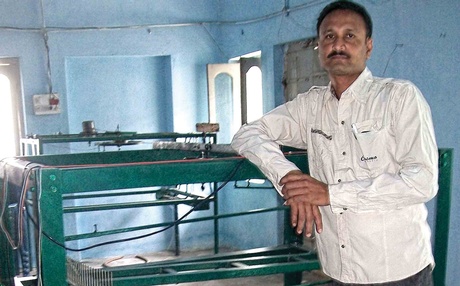
Chintakindi Mallesham with his invention.

Necessity is the mother of invention, but these days, it’s exactly the reverse: invention is the mother of necessity. But for Chintakindi Mallesham, the age old adage stands true. For, the plight of his mother and other Pochampalli weavers impelled him to innovate. He designs machine for weavers, who live at the far end of dirt roads in Sharjipet village, Nalgonda in Andhra Pradesh, as well as in other villages in India. His invention costs Rs 16,000. The idea germinated in his mind in 1992. Reason: his mother’s tired arms. “You can’t understand how difficult asu—the tying of threads and dyeing them in selected colours—is,” he says. It is this understanding of tedium and tired muscles that Mallesham brings to his work.

Despite lacking a formal education or technical training, Mallesham has made a machine that has mechanised the most tedious part of Pochampally weaving—the tying of threads and dyeing them in selected colours. He replaced the woman’s arm with a mechanical one, which winds the silk thread on the pins and offers a choice of settings. The result is that the thread needed for three or four sarees is now processed in a reduced timespan. He has named the machine, Laxmi Asu, as a tribute to his mother.

The journey wasn’t easy, Mallesham was burdened by the loans he took to develop the machine and had to leave it unfinished and work in Hyderabad as a daily wager. In the journey to his invention, once he got stuck, since he did not know which parts to use to provide for one particular movement in the asu process. He then worked in a machine shop where he spent time observing various machines, searching for that one elusive movement. “The owner used to shout at me,” recalls Mallesham, a school dropout. “Finally, one day I found it and rushed off, without my wages for the day. My machine was ready.”

His achievement has made Forbes magazine list him as one of the seven most outstanding rural entrepreneurs of India in 2010. “The Pochampally saree involves weaving patterns on the loom. The yarn has to be wound with hand using the ‘asu’ process, according to the design. This might involve even moving multiple pegs over 9000 to 10,000 times, for each saree. By doing this manually, many weavers suffer from joint pains and strain their eye,” explains Mallesham. The Lakshmi Asu, he explains, does the weaving in 90 minutes against 5 hours with the manual process and enables more innovative designs. Only 200 watts equivalent to the power consumption of an air cooler usage is consumed.

Initially, he was at the receiving end from family and villagers who saw his preoccupation with the machine as an excuse to escape earning a livelihood. So it took seven years to introduce the first prototype of Laxmi Asu.

“The first few customers gave feedback that there should be some technical modifications, and I worked on that too,” says Mallesham. I have sold about 600 machines but most weaver families cannot afford the money. Their lives can change if the government helps them buy the machine,” says Mallesham.

source: http://www.newindianexpress.com / Home> Magazine / by Swati Sharma / January 13th, 2013

ACCENT: Helping the blind see

On this typically steamy day in Kakinada, doctors have been performing cataract surgeries all morning. There are still dozens of surgeries to go when the power goes out. I flinch and start to panic. The doctors, however, carry on like nothing happened. It feels like forever, but is actually less than 20 seconds before the hospital’s backup generator kicks in.
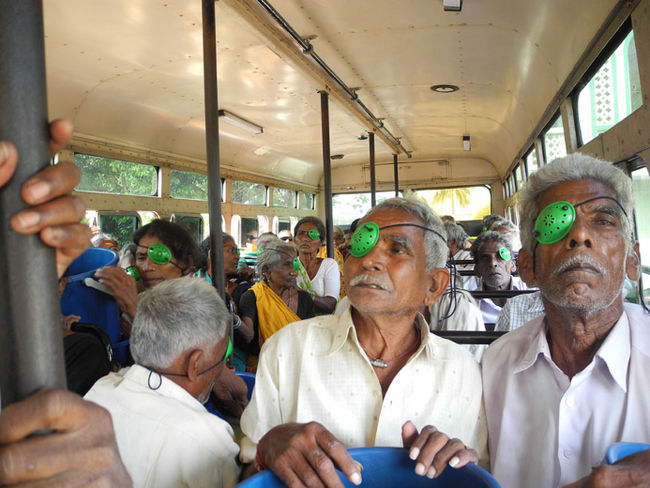
LAURA STRICKER The Sudbury Star Cataract surgery patients board the bus which will take them back to the village of Rowthulapudi, 50 kilometres from Kakinada.

I’ve been in India for more than a week and am used to the sporadic power outages. But tucked away in the corner of the operating room at the Srikiran Institute of Ophthalmology, trying to stay out of the way and make myself as small as possible, the lack of electricity makes me nervous.

For the staff, it’s just another part of working in a country where providing reliable electricity for more than one billion people has long been a challenge. One of the biggest expenses the institute has is to keep its generator running. But all that is worth it, I’m told, because they’re helping people who would otherwise spend their remaining years languishing in their homes, unable to take care of themselves.

Nalam Amalu is one of those people. When she had her first cataract surgery in 2009, it was after she’d been blind in her right eye for two years.

So, when the vision in her left eye started to go a few months ago, Amalu, 65, knew she had to go back to Srikiran. The institute was established in 1993 to help people such as herself, who have eye problems but don’t have the money to get care, or access to a hospital.

The Manjari Sankurathri Memorial Foundation, set up in 1989, runs and funds the hospital. Chandrasekhar Sankurathri (Dr. Chandra) moved from Ottawa to Kakinada and founded the organization in his family’s memory. Manjari, his wife, Srikiran, his son, and Sarada, his daughter, were killed in the June 23, 1985 Air India bombing.

“When I got my right eye operated on, I was thankful to God for sending a person like Dr. Chandra, who is able to conduct these (eye testing) camps and give sight to so many people who are neglected,” Amalu says. A short, skinny woman, the bangles on her wrists clank as she uses her torn shawl to wipe her nose and eyes.

She lives in S. Pydipala village, she explains, speaking in the local language Telugu. The village is six kilometres away from Rowthulapudi, the site of the testing camp. To get to the camp she paid 10 rupees ($0.18 Canadian) for a car ride.

“I don’t have anybody to take care of me,” she continues. “I’m so grateful to Dr. Chandra and the hospital for giving me sight again.”

Men in India are more at risk to get cataracts from working in the fields without eye protection, staff members at the hospital say. But at Srikiran, more women — who often get left behind — are the ones getting the surgery.

On average, after getting the surgery, patients see their vision improve by 90%. Infection is a common problem, though, as they don’t follow post-operative care instructions and lack the clean water necessary to wash out the eye. Even after the surgery, most people need eyeglasses. For those who can’t afford to pay, the glasses are given to them for free.

On the day of the surgery, 100 people wait patiently for their turn, sitting on thin mats scattered throughout a long room. Nurses walk from person to person to confirm identities by asking their name, which eye is getting operated on and the name of their husband or father — a step that gets repeated at every stage before the surgery. Each patient has a white sticker put over the eye getting operated on.

These surgeries, hundreds of which are performed every week, have an impact that goes beyond just improving vision.

“When people become blind, they cannot be productive citizens in the community, and somebody has to look after them,” says Dr. Chandra. “When they’re already poor and they cannot make a living because they are blind, and then another person has to look after them, this puts even more economic strain on the family.

“So, for such people, we are providing free eye care and also restoring their eyesight, completely free of cost to them. By doing so, we are making them a productive part of the family and the community again; thereby the economic burden is eased. They also get their self-respect and confidence restored.”

Another patient, who gives her name as K. Mallamma, says her restored vision means she can help her son, who lives with her, with his business.

Since January, she’d been losing vision in her left eye, she tells me through a translator. It got so bad she couldn’t see to walk the short distance from her house to get fresh water.

“Now I can move around, now I can do a little bit of housework, like sweeping. Before I was not doing these things. My son was doing those things. But now I will be able to do all that.

“At least now I’ll be able to help my son (who does laundry for people in their village) a little bit. Like when he irons the clothes, I’ll be able to fold them.”

With one cataract surgery costing $50, and 90% of the surgeries done for free, Srikiran survives largely on donations, says Dr. Chandra.

“In this aspect, I think we are very unique in India, because nobody else does that many free surgeries. And it is possible for us because several people in Canada are supporting us, from the east coast to the west coast.”

These donations also go to cover the cost of operating four vision centres outside Kakinada. If patients have problems after the operation, or have a post-operative checkup, they can go instead to one of these centres if they’re closer than Srikiran. A computer at the main branch of the institute connects via webcam to the centres.

For those who need the surgery, getting them to the post-operative stage isn’t always easy.

“Sometimes they don’t even want to come because they’re so disappointed in life, some of them are very grouchy and sad. But we tell them look, you come with us and we’ll try to help you as much as we can,” Dr. Chandra says. “So when they come, the next day when you take off the bandages, you should see the feeling in their face. It’s really hard to describe it.

“When you see those happy faces, that gives us maximum satisfaction — to see the value of what we are doing.”

Kotipalli Iswaiamma, 75, was initially scared to get the operation and unco-operative at the field camp. After the surgery, she was so overcome with emotion, she had trouble speaking.

Ten years ago, she hit a wall and lost all sight in her right eye. Six months ago, the vision in her left eye started getting worse.

This was a big problem because she looks after her husband, who is completely blind.

“I have to take care of all his needs,” she says, including taking him to the toilet and bathing him. “He stopped eating food. Instead of having three meals, he only has one so that he won’t go to the toilet as much.

“Now at least vision in my one eye is good, so I can take care of my husband,” she adds, her voice wavering.
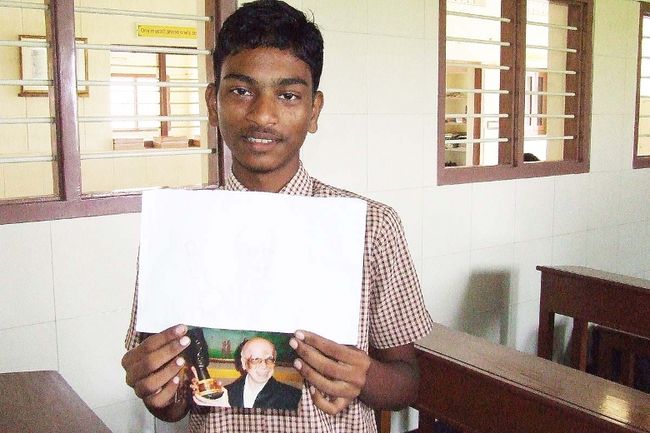
Laura Stricker photo. Guttula Manikanta, a grade 10 student at Sarada Vidyalayam school, shows a picture he drew of Chandrasekhar Sankurathri, founder of the Manjari Sankurathri Memorial Foundation.

Reflecting on the nearly 180,000 eye surgeries performed and the students that have a brighter future, Dr. Chandra says his family would approve of what he’s doing.

“I think they would be very happy, and that gives me a lot of satisfaction,” he says softly. “It’s what I do with my life now. I have no regrets about it. I’m very happy with what I do. I always wish I could do more.

“Something always at the back of my mind is to look after women and child health, because there’s a lot of problems with child-bearing women,” he continues. “Their health is not very good. Infant mortality is the one thing we want to address sometime in the near future.

“I just want to thank all the supporters across the country, and especially in Sudbury. We really appreciate their support and are looking forward to having the same support in the future, to ease some of the suffering of the poor. I really thank from the bottom of my heart.”

— Star reporter Laura Stricker’s trip to India was funded by the Ontario International Development Agency, a longtime supporter of the Manjari Sankurathri Memorial Foundation. For more information on the organizations, visit www.msmf.ca and www.ontariointernational.org. Read Accent every Saturday.

laura.stricker@sunmedia.ca Twitter: @LauraStricker

source: http://www.thesudburystar.com / The Sudbury Star, Canada / Home> NewsLocal / by Laura Stricker, Sudbury News / Saturday, December 29th, 2012
Karimnagar NRIs lead by example

Non-Resident Indians hailing from Karimnagar district in the State and living in the United States of America have offered to sponsor the travel back home, for Gulf migrants who are stranded in the United Arab Emirates by providing them air tickets from Abu Dhabi, Dubai and Sharjah to Hyderabad.

In a press release, M. Bheem Reddy, vice-president, Migrants Rights Council, said Alladi Sanjeeva Rao and Challagonda Venu, both from Karimnagar district and who now live in Boston, were moved by the plight of migrants and had offered to help.

The ‘undocumented, overstayed’ migrant workers in the UAE could now leave back home without paying the penalties and serving jail term, under the amnesty’ scheme from December 4 to February 3, 2013, Mr. Reddy said.

Mr. Rao and Mr. Venu offered to sponsor air tickets for four migrant labourers each.

The services of Janagama Srinivas, a social workers in Sharjah were being used for the purpose, the release said, adding that those interested could contact him over his mobile +971505490298.


  • Mr. Rao and Mr. Venu offer to sponsor air tickets for four migrant labour each
  • ———————————————————————————-
  • Those interested can get more information on +971505490298
  • _______________________________________________
  • source: http://www.TheHindu.com / Home> National> Andhra Pradesh / by Special Correspondent / Hyderabad, December 10th, 2012

    In Andhra Pradesh, Catholic nuns bring drinking water to 250 tribal families

    Residents in the village of Koderna (East Godavari District) drank polluted water, fighting malaria and typhoid. Five Sisters of the Cross were instrumental in getting a pump to bring water from a clean source as well as opening a school and a dispensary.

    Hyderabad (AsiaNews)

    Thanks to the efforts of five Sisters of the Cross of Chavanod, a tribal community in Koderna (East Godavari District, Andhra Pradesh) now can meet basic needs like safe drinking water and education for their children. Until a year ago, the 250 families that call the village home had to rely on polluted water and typhoid and malaria were widespread. Local kids did not go schools. Now villagers have a well with clean water, a dispensary for basic health needs and a school.

    Last year, the Sisters of Chavanod visited the unspoilt mountains that are next to the village. During their trip, they discovered the village. “Beside the tranquil streams and sparkling atmosphere of the mountains stood the village where people drank highly polluted water,” said Sister Priyanthi Samala.

    Sadly, the government has shown little interest for the fate of this village, as did other communities in the area. A school does exist in Koderna but it lies empty because the teacher comes every two months.

    Outsiders do visit the village but only to buy local goods, like tamarind, wood, charcoal, ragi (finger millet), bamboo, brooms and spices at very low prices.

    In view of the situation, the nuns got in touch with an engineer who looked at the ground to see how drinking water could be brought to the village from another source.

    Eventually, he succeeded in his search. The nuns then approached the government for help and began to work on the villagers to have them join the project.

    “After a year of assiduous efforts to motivate this community and several frequent visits, we gained the confidence of the people and established our work in their location. We were certain of their cooperation,” Sister Samala said.

    “They did not hesitate to send their children to the school,” but “the few children who saw the school for the first time were terrified and perplexed.”

    Now about100 of them attend the school the nuns set up and run out of a rented house. Eventually, the sisters hope to get a building of their own.

    source: http://www.asianews.it / Home> India / by Santosh Digal / November 17th, 2012


    Hyderabad US Consulate joins hands with breast cancer foundation

    Hyderabad, Oct 4 (IANS)

    The United States consulate general in Hyderabad has joined hands with the Ushalakshmi Breast Cancer Foundation for greater breast cancer awareness.

    The Pink Ribbon Campaign will be organised Oct 7 to mark the beginning of the International Breast Cancer Awareness Month.

    Actor John Abraham and cricketer V.V.S. Laxman will be the star campaigners at the Pink Ribbon Walk to be held at the Kasu Brahmananda Reddy Park here Oct 7, in honour of women who have fought the illness with determination. The aim of the walkers is to raise awareness about the need for early detection of the disease.

    Some prominent buildings in the city, like Charminar, the Buddha statue, the US consulate and Hyderabad Public School will be illuminated to demonstrate the strength of pink, a colour that represents breast cancer awareness.

    “Our participation salutes women cancer survivors and encourages those fighting the disease not to give up. We walk together to show our solidarity and commitment to spread the word about early detection,” Consul General Katherine Dhanani told reporters here Wednesday.

    Ushalakshmi Breast Cancer Foundation (UBF) has trained 1,200 healthcare workers to perform clinical breast examinations (CBE), used to detect breast cancer in its early stages.

    Director of UBF Raghu Ram said trained healthcare workers would perform CBE on 50,000 poor women in Hyderabad.

    “Women with signs of breast cancer will be referred to the nearest primary health centre. Women with no abnormalities will be examined again in two years. Data will be maintained by UBF with the help of TCS,” said Ram.

    In India 1,00,000 women are newly diagnosed with breast cancer every year, a number that has overtaken cervical cancer. This figure is expected to increase to 1,30,000 by 2020.

    Around 50,000 women die from breast cancer every year in India and it has become the leading cause for death among women in metropolitan cities.

    More than one million women worldwide are diagnosed with breast cancer annually.

    source: http://www.newstrackindia.com / Home> Others / IANS / Andhra Pradesh> Health/Medicine , Thursday, October 04th, 2012

    Hyderabad: Single-seater aircraft for just Rs 1 lakh

    Hyderabad:

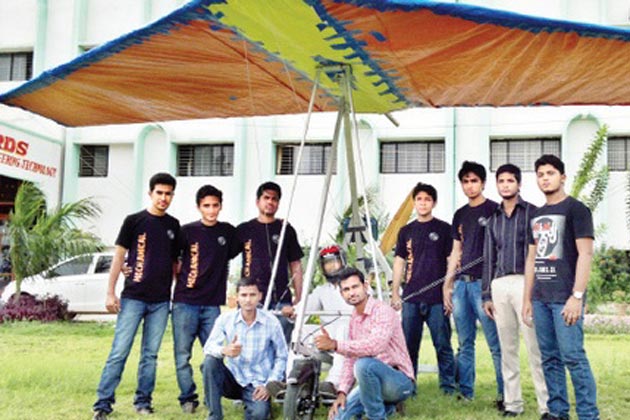
    Students of mechanical engineering at the Lords Institute of Engineering and Technology have designed and fabricated an aircraft that can be used for commuting within the city, in what is called an effort to solve traffic problems in the city. Made with a budget of about Rs 1 lakh, the single-seater can take off with a short run up of about 100 meters at a cruising speed of 50 to 60 kmph and fly at an altitude of 1000 ft.

    The aircraft has a fuel efficiency of around 25 km/litres and can fly at a moderate speed of above 100 kmph. Research is on to further modify the aircraft and make it commercially viable for production.

    The aircraft has been developed under the guidance of Dr. Mohd Masood and has been solely developed in the college campus. The project is part of a series of projects planned to solve the day to day problems of citizens of the country.

    Students of the Lords Institute of Engineering and Technology have designed and fabricated  the aircraft.

    source: http://www.ibnlive.in.com / Home> South> Hyderabad / IBN Hyderabad / The New Indian Express / September 17th, 2012

    Rotary’s initiative

    Rotary clubs donated 2600 desks to Government schools at a programme in Hyderabad on Tuesday.  / Photo: G. Krishnaswamy / The Hindu

    Asma, a fourth standard student at Centenary High School, Secunderabad was all smiles as she looked at the brand new benches on the school ground. She does not have to sit on those decades-old rickety benches anymore and strain her back to write.

    Thanks to the efforts of Rotary Club of East, West and 22 other clubs, students of 59 government schools in the capital and other districts would now sport similar smiles, as 2,600 benches were distributed to the schools for free.

    This initiative was taken up under the Right to Learn – Literacy programme of Rotary International. The target was to ensure that no student in government schools in the State would sit on the floor and attend classes, said Ravi Vadlamani, chairman of Total Literacy Mission of Rotary International. The programme to distribute one lakh benches was launched last year. Already 70,000 benches were distributed to different schools across the State, claimed Mr. Vadlamani.

    As part of the campaign, similar initiative would be launched next year to distribute another 10,000 benches to government schools in the State. Further, efforts were being made to attempt a Guinness Record by distributing 10,000 benches to 218 schools in Hyderabad and Ranga Reddy districts at a special programme in Hitec city on November 23, he said. R.S. Praveen Kumar, Secretary – AP Social Welfare Residential Schools said there were over 300 social welfare schools in the State. About 1.5 lakh children study in these schools and most sit on the floor in classes. It is a major challenge and initiatives like this would benefit the students a lot, said Mr. Kumar.

    The Rotary Foundation Trustee, Ashok Mahajan, Rotary International District 3150 District Governor T.V.R Murti and others also spoke on the occasion.

    source: http://www.TheHindu.com / Home> News> Cities> Hyderabad / by Staff  Reporter / August, 15th, 2012

    Indian Navy on way to be world class force: Vice Admiral Anil Chopra

    Visakhapatnam:

    The Indian Navy is well on its way to be a potent world class force, with 46 ships and submarines to be added in its fleet, Flag Officer Commanding-in-Chief,  Eastern Naval Command Vice-Admiral Anil Chopra today said.

    Addressing the naval officers and civilians after unfurling the national flag on the 66th Independence Day today, Vice Admiral Chopra said even as the year gone by saw the Eastern Naval Command add stealth frigates, nuclear powered submarine and unmanned aerial vehicle squadron to its arsenal, now it has planned to include 46 more ships and submarines and a large number of aviation assets.

    In the near future, the Command will be home to additional strategic platforms, anti-submarine corvettes, P8i long range maritime reconnaissance aircraft, MiG 29K  fighter jets and advanced jet trainers, he said.

    The Command has remained in the forefront with the Eastern Fleet leaving footprints all across the Indian Ocean region – from the Gulf of Aden to the West Pacific.

    On the occasion, he urged all present to stand up to the security challenges faced by the nation.

    A ceremonial parade was held at the Eastern Naval Command parade ground where Vice Admiral Chopra took the salute.

    source: http://www.economictimes.indiatimes.com / Home> News> Politics/Nation / August 15th, 2012