The team of ‘Zindgani Apne Dum Par’. / Photo: G. Ramakrishna / The Hindu
For an inter-school competition, five students made a film on a man who most of us must have seen at the Jubilee Hills Checkpost
It took them just two minutes and forty seconds to tell the story of a man who most of us must have seen at Jubilee Hills Check Post signal. It is the story of Sriram a roadside vendor who sells dusting cloths. Physically challenged as a result of a childhood accident, Sriram has only one arm. Yet, instead of being dependent on others to fetch him food, he is on his own. An entrepreneur of sorts, Sriram sells dusting cloths to save enough, so that he can open a small shop. With whatever he earns he also takes care of his family — wife and two sons.
Titled Zindgani — a story untold, the film is what five students from the Annapurna International School of Film and Media made for the 48 hour Inter-school Filmmaking Competition.
The team of five consisted of Akula Nishant Shiv, Akshat Sharma, Saikat Chakravarty, Deven Ahire and Tanya Joshi.
The film bagged the Best Film award for most suitable depiction of the theme at the competition section — Apne Dum Par. It’s a story of a common man – who lives life on his own. ‘“The idea was to go beyond the heroes projected on the 70mm screen; beyond masks, flying gadgets and the like. For once maybe we can open our eyes, to look around us, communicate with those who are physically present in our surroundings, and pass them a smile whenever we can.’ This is what our teachers explained to us, so that we got the theme right,” says Nishant Akula. And 48 gave us another chance to deal with the theme. The guidelines of the competition mentioned that we had to make a short film (of not more than 3 min 30 sec) with the theme Apne Dum Par.
“Sriram is a common sight at the Jubilee Check post almost everyday. Often that sight would inspire us, and our conscience would say: “Here’s a story that people should know about…” explains Nishant.
Describing the experience, Nishant says, “it was challenging and exciting. Until we spoke to Sriramwe didn’t realise how difficult life is for him and his family. But Sriram isn’t someone who gives up hope. He is educating his two sons with the help of funds from an NGO and wants to provide them a good life. Also after being adjudged as the best film from the whole lot who we competed with, gives us a very good feeling.”
source: http://www.thehindu.com / The Hindu / Home> Features> Education Plus> Issues / by Prabalika M. Borah / November 11th, 2013
“Aarogyasri is God’s gift. I would not have survived but for the cashless treatment provided under it,” said 46-year-old Rupa Pujari, who has been undergoing dialysis under the scheme for the past two years.
She is one of the several thousands of beneficiaries who are getting free haemodialysis treatment under Aarogyasri across 19 dedicated centres in the State from Srikakulam to Warangal. The scheme to help poor patients with kidney failure completed four years of service on November 6.
After both her kidneys failed four years ago, Ms. Rupa had to shell out around Rs.10,000 every month for her treatment for about two years. After learning about the Aarogysri scheme, she began availing treatment and has been undergoing haemodialysis for the past two years. Echoing similar views, 71-year-old Rahmat Ali Khan said it would have been very difficult to meet the expenditure had it not been for the free treatment under Aarogyasri. “In the past, I had to sell something to pay for the treatment. But now we even get medicines, apart from haemodialysis. We are grateful to the government,” he added.
According to Prof. Pradeep Deshpande, emeritus professor of Nephrology, Gandhi Medical College, around 30,000 kidney failure patients have benefited from cashless treatment since the launch of the scheme. It was initiated after a number of poor patients began approaching the then Chief Minister Y.S. Rajasekhara Reddy for financial assistance for dialysis treatment. He said it was started in public-private partnership mode by installing 18 dialysis machines in Gandhi Hospital, 15 in Osmania Hospital here and some in Visakhapatnam.
He said that proposals were pending with the State government to increase the number of haemodialysis centres to 25 across the State, besides starting CAPD (Continuous Ambulatory Peritoneal Dialysis) and paediatric haemodialysis. He said that the Gandhi Hospital has been designated as the nodal centre.
Officials from Uttar Pradesh, Delhi, Madhya Pradesh, Goa, Maharashtra and Tamil Nadu had visited Gandhi Hospital and evinced interest in the scheme.
source: http://www.thehindu.com / The Hindu / Home> News> National> Andhra Pradesh / by Special Correspondent / Hyderabad – November 11th, 2013
Most Vizag denizens and tourists frequenting R K Beach may have come across ‘Little Gandhis’ coated in silver paint holding aloft begging bowls and pestering visitors for alms. But over the past few days, these little beggars are missing in action.
The reason? They have found shelter in government and private children’s homes in Vizag and Vijayawada, where books have replaced the begging bowls in their hands. All thanks to NGO Generation Yuvaa (GY).
At a time when government is gearing up to celebrate Children’s Day by organising competitions and seminars on child rights, here is a group of youngsters, some of whom quit lucrative jobs to form an NGO for the welfare of youth and children.
Meet engineering graduates B Naresh Kumar, Solomon George, Rakesh Reddy of NGO Generation Yuvaa, that works for the welfare of children, especially street children, orphans and child beggars who are deprived of basic rights such as primary education and health.
Starting with 30 students six years ago, GY has grown to 6,000 members and 200 active members in the city. GY consists of professionals and students aged 26-28 years. While some have completed their graduation and post graduation in various streams, some are pursuing their studies.
The NGO focusses on eradication of child begging by enrolling the kids in schools and counselling them, providing employment to youth and motivating city youngsters to take up social causes. Their efforts have been successful in drastically reducing the number of child beggars and now several government departments, including the women and child welfare, labour and police are collaborating with them in the rescue and rehabilitation of children.
“The aim of Generation Yuvaa is to work on the holistic development of children to create a society where every child has complete access to basic child rights so that he or she can become a better citizen,” said GY founder president B Naresh Kumar, a B Tech graduate.
The NGO’s secretary K Rakesh Reddy is a BTech and MBA, who quit his job with an MNC to plunge into this fulltime and currently spearheads the NGO’s rescue and rehabilitation programmes and blood camps. Treasurer C Solomon George chucked a lucrative job in a software company in Bangalore and today looks after outreach activities of the NGO, including campaigns and rallies.
Talking about GY’s activities, Rakesh said, “We started a children’s home to provide shelter to street children, orphans and beggars aged 5 to15, at Birla Junction. It currently houses 43 children. We also started ‘Green House’ to provide employment opportunities to people with disabilities and elderly beggars. They are usually employed in a crafts showroom or plant nursery while the younger ones are sent for schooling to Bharatiya Vidya Bhavan. We also organise blood camps under our Suraktha wing, motivate youngsters to take up social work, counsel parents and families on the importance of education for children, sponsor higher education of needy, meritorious students and enroll urban slum children in schools and so on.”
Pointing to the dangerous consequences of child begging, Solomon said, “As they often mingle with criminal gangs, many of these child beggars get into substance abuse or develop anti-social personalities and commit crimes. They are also exposed to the risk of sexual abuse.”
These children are either from BPL families and pushed into begging by families, have run away from home or are bought or rented for begging by organised gangs. “Around six years ago, we had almost 1,000 child beggars in the city and its outskirts, while the number now has come down to around 250. We have counselled more than 1,200 families against begging and want to uproot this social menace by finding a permanent solution through education, counseling and employment opportunities,” concluded Naresh.
source: http://www.articles.timesofindia.indiatimes.com / The Times of India / Home> City> Visakhapatnam> Street Children / by Sulogna Mehta, TNN / November 12th, 2013
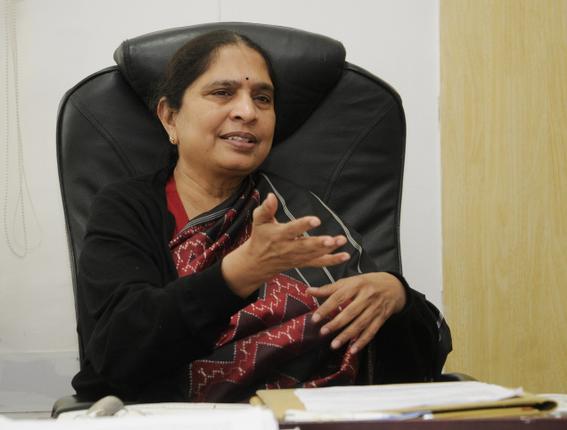
Dr. Shantha Sinha./ Photo: V.V.Krishnan / The Hindu
Thousands of children and their parents in villages across Andhra Pradesh have so much to thank Dr. Shantha Sinha for. She fought against child labour by getting children into schools and ensuring they got an education. A winner of many awards, including the Ramon Magsaysay award in 2003, Dr. Shantha Sinha credits her volunteers for their magnanimity.
About a decade ago, Parigi and other mandals in Mahabubnagar district of Andhra Pradesh were known for child labour. Girl children, in particular, went to cotton farms. Toiling hard from daybreak to midnight for a paltry sum and a glass of buttermilk, the young girls were forced to leave schools and work in harsh conditions. Some succumbed to pesticides as they were enrolled in these “farm badi” (farm environments simulated as schools with intervals, school bells and award) using superstitions to convince hapless parents.
Enter the Bridge schools, high impact awareness campaign run by Mamidipudi Venkatarangaiya Foundation — popularly known as MV Foundation — and the sheer determination of one woman Dr. Shantha Sinha.
Soon schools were abuzz with students and it was back to school and a happy childhood for the voiceless children out here in the remote region. Talking to the poor parents on the one hand and mobilising multi media support on the other, it was a tedious yet successful effort by Dr. Sinha and her volunteers camping in the villages.
Today, thanks to her, 800 villages in Ranga Reddy district have successfully achieved 99 per cent enrolment and retention of children till Std. X. Organisations such as CRY, Tatas, HIVOS and European Commission have come forward to render support to the cause.
A source of inspiration for many, Dr. Sinha, who is currently chairperson of National Commission for Protection of Child Rights (NCPCR), was awarded the Padmashri in 1998 and the Ramon Magsaysay Award for Community Leadership in 2003 in recognition of her efforts.
She is also the founder of MV Foundation (which is named in memory of her grandfather Mamidipudi Venkatarangaiah).
“My experience in MV Foundation helped me largely in my role as chairperson of NCPCR. The overall objective of the Commission is to ensure that all laws, policies, programmes and administrative mechanisms are in consonance with the Child Rights perspective as enshrined in the Constitution of India and the UN Convention on the Rights of the Child. MV Foundation had been the beginning of my endeavour to fight against child labour and NCPCR gave me a wider perspective which was more challenging. A whole gamut of issues opened up and I got the larger picture,” opined Dr. Sinha.
Bonded labour
As director of Shramik Vidya Peeth where she was involved with bonded labour, Dr. Sinha realised that 40 per cent of the bonded labourers were children. At Shramik Vidya Peeth the focus was on adult labour and during that time, there was no agency that was working exclusively for the welfare of children.
Dr. Shantha Sinha’s family trust, founded after her grandfather, was involved in giving scholarships to students. Dr. Sinha took up the issue of child labour under the family trust. And thus, began the journey of MV Foundation.
“Dr. Sinha is a role model for many of us. She is responsible for effectively motivating 80,000 volunteers. She gives space to all and a platform to everyone to voice their opinion,” says Arvind Kumar, Documentation and Research Co-ordinator, MV Foundation.
“My family was very supportive and hence could take up the challenge of rescuing children. Since a majority of children were Dalits, initially a lot of resistance came from the upper castes. The children and their families were threatened; our volunteers too faced threats. Slowly and steadily we overcame the pressure and in due course we began to focus on girl children. We also realised that children from all communities were deprived and our strategy was concentrated towards changing the mindset of the people. We tried to explain to people how education is important for a child’s mental and physical growth. This focus helped a lot. It all started from Ranga Reddy district and today around 6,000 villages across Andhra Pradesh are a part of the initiative, having gained momentum in diverse geographical, political and cultural terrains,” said Dr. Sinha.
Today the staff at MV Foundation has gained expertise and is actively involved not only in Andhra Pradesh but across the country. Having dealt with complexities in Andhra Pradesh, the staff is able to efficiently overcome challenges across Madhya Pradesh, Bihar, Orissa, Rajasthan and other States as well, says Dr. Sinha.
“I have worked with MV Foundation for 18 years now. I admire Dr. Sinha’s non-hierarchical approach. It is commendable the way she respects everyone and allows everyone to voice their opinion,” says R. Venkat Reddy, National Convenor, MV Foundation.
A teacher herself
Dr. Shantha Sinha also served as a faculty member of the department of Political Science at the University of Hyderabad.
“Being in the university was an advantage, and helped in development and institutionalising. On the other hand my theories in the university came from the practical experience I gained working for MV Foundation,” confides Dr. Sinha.
Every successful effort begins with the first step and a focussed leader.
Dr. Shantha Sinha’s dedication to her work and the drive to help her team realise the big vision for change is what every volunteer vouches for. “As a person Dr. Sinha is very fair and gives everyone equal status. I have been associated with MV Foundation for 12 years and I have learnt a lot from her. I am in awe of her dedication towards her mission,” says Dhananjay, Training Co-ordinator, MV Foundation.
“When you enjoy doing something it becomes a passion and you don’t treat it like a job that needs to be dealt with. I have always enjoyed doing what I do; be it at NCPCR today or what I did at MV Foundation sometime back…or my role as a professor in the university; I am very passionate about my work. I have always tried to get totally involved with my work and the people I work with. My idols have been my volunteers. It is amazing to see their level of involvement and dedication, their capacity to be generous and magnanimous,” says a humble Dr. Sinha.
A visit to any of the villages in Ranga Reddy today will find beaming children going for higher education with gratitude to the lady from the city who made their freedom a reality.
source: http://www.thehindu.com / The Hindu / Home> Features> Sunday Magazine / by Ajuli DasGupta / March 12th, 2011
It takes a strong mind and heart to train oneself to be a sportsman. And in a country where cricket is a religion, it isn’t an uncommon instance where other sportsmen bemoan the government’s lack of support. And if it’s tough enough when one is able-bodied, what of the many talented differently-abled people? That is the issue that city-based Aditya Mehta is trying to drive home.
Perturbed by the state of sports facilities provided for the differently-abled and the way people react towards them, Aditya Mehta is planning a unique initiative: to cycle the 3800 kilometers-odd distance between Kashmir and Kanyakumari. A commendable feat, the 31 year-old makes this even more of an achievement being an above knee amputee himself. Strike one for Mehta.
The Hyderabadi who lost his leg in an accident, got frustrated of sitting at home and took up the sport after coming across a hoarding of Hyderabad Bicycle Club. A business man by profession, he turned the sport into a passion for himself in a span of 19 months, even registering his name in the Limca Book of Records for being fastest above-knee amputee to comlete 100 kilometers on a cycle. “I bought a cycle after seeing the hoarding and started practising. Initially, I fell down many a time, but slowly I picked up and achieved a lot from then on,” said Aditya about the initial stages of his cycling journey.
Not one to be slowed down or to entertain sympathy, he points out that the empathy shown by people for amputees might deter their confidence levels and make them lose faith in trying to lead a normal life. “Often, people use the word ‘bechara’ for amputees, even parents sympathetically wonder what amputees can do in life. But I feel that they have the potential to lead a normal life,” he states strongly.
Having seen for himself what differently-abled people can do for themselves, he has made it his pet project to encourage fellow amputees to go out there and achieve. However, he does admit that help from the government could take them a long way.
“If we see other nations like China or smaller countries like Malaysia, sports facilities for them are really good. However, in our nation, there are no sports academies for amputees. I want to motivate amputees to take up sports and drive the point that they can lead a normal life,” states two-time silver medalist. For Aditya, this ride isn’t just a statement to the government but also to other differently-abled people. Having picked up his medals for India at the Hero Para-Cycling Championship held in Delhi on March-2013, he hopes his initiative will prompt the government to take notice of his requests to provide a special academy and other facilities for amputees.
Besides just cycling the distance, Aditya also hopes to raise funds for his foundation. Along with four close associates, the Hyderabadi is in fact registering the Aditya Mehta Foundation today, to which people can donate money for every kilometer he covers. The foundation will utilize the generated funds in providing sports equipment and prosthesis for other amputees interested in sports. “Differently-abled people from different states who are selected in various competitions, call and ask me to help them find a sponsor. This is how I intend to help,” he shares.
The 36-day bicycle ride titled Airtel Endurance Ride by Aditya Mehta is powered by Bharathi Cement and will begin on November 7 at Srinagar. Aditya will cycle to Kanyakumari and reach on December 13 after a four-day break in between. With a schedule of covering 100-120 kilometers a day, Aditya will also be accompanied by a doctor throughout the journey. “As it is a very long ride, my palms might swell and I might get saddle sore, but I am prepared for it,” says the determined cyclist.
source: http://www.newindianexpress.com / The New Indian Express / Home> Cities> Hyderabad / by K. Shiva Shanker – Hyderabad / October 28th, 2013
Warangal Child Welfare Committee (CWC) was adjudged the best CWC in south India during a two-day conference held to assess the best practices being adopted by these committees in Hubli, Karnataka by Sathi, a non governmental organization in collaboration with Jamshedji Tata Trust. The award was presented on July 31.
Total 17 CWCs had participated in the programme from four states including Karnataka, Andhra Pradesh, Goa and Maharashtra. Warangal CWC with its 21 best practices and the exemplary work done towards eliminating child labour ended up bagging the first prize.
The committee during its two-and-a-half-year tenure has rescued more than 278 children and ensured that the 109 child labourers rescued get a compensation of Rs 4,29,500 from their employers . Dr Mamatha Raghuveer, chairperson of CWC, Warangal, said, “Juvenile justice board has got more powers than CWC but still we could get justice to several children. In Warangal, every Wednesday drives are being taken up to rescue child labourers and street children.”
CWC, Warangal has done extraordinary work in stopping 68 child marriages, bringing down corporal punishment cases, streamlining adoption process, filing petitions against police who have chained children in police stations and successfully rehabilitating abused children. Also, seven children sold illegally by parents for money were handed over to their biological parents after counseling.
This is the first such award for Andhra Pradesh. The award carries a cash prize of Rs 15,000 and the prize money is supposed to be used for the benefit of children.
source: http://www.articles.timesofindia.indiatimes.com / The Times of India / Home> City> Hyderabad> Street Children / by Bushra Baseerat, TNN / August 01st, 2013
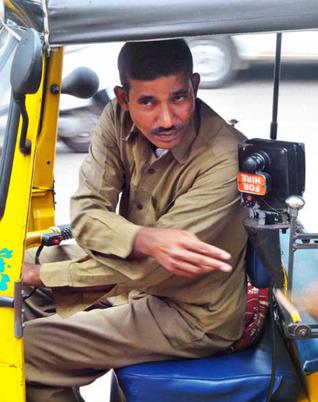
Javeed Khan, a multi-tasker, who works as a Home Guard, auto driver and Haleem server. He does all this just to earn enough to give a decent education to his four children. / Photo: Mohammed Yousuf / The Hindu
A traffic cop, an auto driver and a haleem supplier all rolled into one, Javeed Khan slogs most part of the day to give a decent education to his four children
Cop by day, auto driver in the afternoon and haleem supplier by night. That’s Javeed Khan for you. A multitasker, Khan dons many hats – all to keep the wolf away. He slogs most part of the day and night just to give a decent education to his four children.
A Home Guard bearing number 3024, Khan is attached to the Saifabad traffic police station. Like all Home Guards he gets paid a pittance of Rs. 200 a day. There is no weekly off, no medical facility – nothing. No work no pay – that’s the rule. The monthly earnings are hardly sufficient to run the house, forget educating children. But Khan and his wife are determined to give their children a good education no matter how much they have to struggle. So Khan has decided to sweat it out. He can be found regulating traffic at the Iqbal Minar in Saifabad from 8 a.m. to 1.30 p.m. Thereafter, he drives an auto till late in the night. And during Ramzan he has been working at a haleem joint at Patharghatti. “I earn Rs. 200 per day serving haleem. After Ramzan, I will go back to driving auto which fetches me an equal amount after paying the auto rent and meeting the petrol charges,” says Khan.
THOUGH HE HAS STUDIED UP TO INTERMEDIATE, HE WANTS HIS CHILDREN TO BE WELL EDUCATED. YET, PAYING THE COLLEGE FEE OF HIS DAUGHTER WHICH COMES TO RS. 18,000 PER ANNUM HAS BECOME A TASK. IT IS HIS ARDENT WISH TO GET REGULARISED IN THE POLICE DEPARTMENT WHERE HE IS WORKING SINCE 2000. “NOW I AM 41 AND NOT ELIGIBLE TO WRITE THE EXAM,” HE RUES.
KHAN IS ALL PRAISE FOR HIS FORMER BOSS AND ADDITIONAL COMMISSIONER OF POLICE (TRAFFIC) C.V. ANAND FOR PROVIDING MASKS, GOGGLES, REFLECTING JACKETS AND KIT BAGS TO TRAFFIC COPS. FOR YOU, WITH YOU – ALWAYS. HOPE THE POLICE DEPARTMENT ABIDES BY ITS OWN ASSERTION AT LEAST IN THE CASE OF ITS WORKFORCE.
source: http://www.thehindu.com / The Hindu / Home> News> Cities> Hyderabad / by J.S. Ifthekhar / Hyderabad – August 08th, 2013
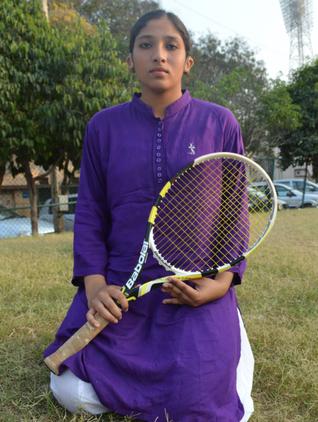
Tennis player Shaik Jafreen of Kurnool, who will be taking part in the Sofia Deaflympics this summer, at the Lal Bahadur Stadium. – / Photo: V.V. Subrahmanyam / The Hindu
Hearing and speech impairment has done little to dilute Shaik Jafreen’s passion for tennis and the 15-year-old from Kurnool is set to represent India in the Sofia Deaflympics to be held in Bulgaria from July 26
In an era when innovations on the communications front are shrinking the world, she has a major handicap – cannot speak and comprehend properly what the others say. But, the indefatigable Shaik Jafreen is now keen to let her tennis racket do the talking with her selection to represent India in the Sofia Deaflympics to be held in Bulgaria from July 26.
“This is great news to me. I am really determined to prove a point or two,” gestures the 15-year-old hearing and speech-impaired tennis player from Kurnool. Her father S. Zakeer Ahmed is an advocate. For someone whose dreams of taking part in the 2012 London Paralympics were dashed because of the poor handling of entries for the event, Jafreen strongly believes that the Sofia edition can well be the turning point of her career.
“I badly need a big win and if I get that there, it should do a world of good to me,” she conveys her desire .
She underwent a one-month intensive training session under Anirudh at the KSLTA in Bangalore and also bagged a gold medal in the 2012 Punjab National championship in the hearing and speech-impaired category. Yet, it has been a real struggle for this girl from a relatively small town to be in the competitive circuit as she has little support outside her own family.
Her father even disposed of his plot to let Jafreen pursue her passion for the sport with costs often coming to about Rs. 3 lakh per annum. “She was so dejected when I once threw up my hands that she refused to touch food. I then decided to support her at any cost,” says the father. Jafreen, an Intermediate first year student in KRM Government Junior College, will be joining the national camp in Delhi from July 10.
source: http://www.thehindu.com / The Hindu / Home> News> City> Hyderabad / by V. V. Subrahmanyam / July 07th, 2013
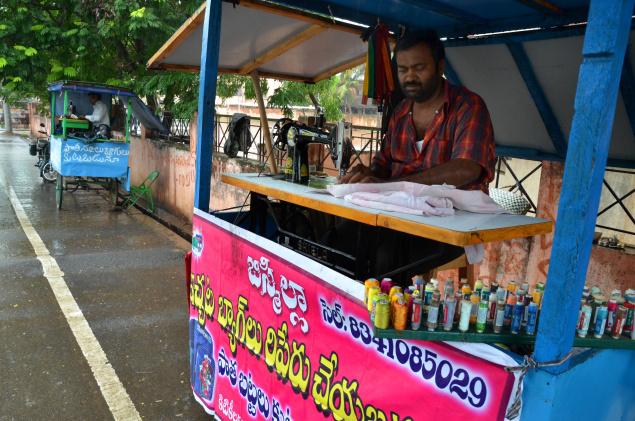
Tailor Sheikh Sattar in his mobile tailoring unit in the foreground and also seen is Syed Baji in his mobile unit on the Patamata High School Road in Vijayawada. / Photo: V. Raju / The Hindu
If you want something new, you have to stop doing something old, said Austrian-born American management consultant Peter F. Drucker. The duo K. Syed Baji and Sheik Sattar do not have any idea who was Peter F. Drucker and also never came across the management guru’s teachings and quotes.
Tailors by profession, the duo appears to follow Drucker’s quote in its spirit in real life unknowingly. Both tailors by profession, they have moved away from the stereotyped operation from shop to mobile platforms. They are tailors on the move. Penury forced them to innovate, said Syed Baji. I managed a tailoring shop for about 15 years, but mounting establishment cost such as power bills, material cost and salaries forced me to close down my shop, he said.
After closing the shop, Syed built a covered trolley with foldable doors on all four sides and set up his sewing machine on it. He parks his mobile tailoring unit on the High School Road near Patamata Ryhtu Bazaar and operates on a daily basis from 9 a.m. to 6 p.m.
They specialise in alteration and do not take up stitching of new clothes as the space does not permit this task, said Sattar.
The business model was simple, the duo point out. “Women come to the ryhtu bazaar and before entering the bazaar they give us the clothes that need to be altered and collect them back on return.
“This way they save time and we earn our livelihood,” said Syed.
On an average we chip in about Rs.300 to Rs.500 on a daily basis and that is sufficient to keep the fire burning at home, he added. While Syed set up his mobile unit about four years ago, Sattar’s venture is just one-year old. Syed has two daughters whom he got married and a son who works at a star hotel in the city.
Sattar has a school-going daughter and a son. “I want them to take up higher studies of their choice and for which I would not mind working a few extra hours a day. The alteration business has no season and the flow is good throughout the year,” observed Sattar.
source: http://www.thehindu.com / The Hindu / Home> News> Cities> Vijayawada / by Sumit Bhattarcharjee / July 18th, 2013
An act of kindness, no matter how small, is never wasted. Postman R. Ramachandra Rao lives by this lofty maxim.
A modest grade of a postman has never been a barrier for him to rise to the dire needs of the less privileged people around him.
The headmaster of the S.B.S.R.K. Girls High School at Gandhinagar was pleasantly surprised when Mr. Rao approached him expressing his desire to help a few students in his small way. He distributed school bags, uniforms, books and other stationary material to eight students. “I told the students to wait for a few more days to get their uniforms stitched as I needed little more time to mobilise money for it,” he says in a matter-of-fact way.
Earlier, in a similar gesture, Mr. Rao extended help to Ch. Yesubabu, a boy from Singhnagar, who was born with a hole in his heart. “I gave him clothes, bedsheets and a small amount of money,” he says.
A dwarf boy pursuing a degree course in SRR & CVR Government Degree College also attracted his attention. In yet another similar case, responding to a newspaper advertisement by a mother seeking financial help for treatment of her young son suffering from a bone-related ailment, Mr. Rao promptly contributed his mite.
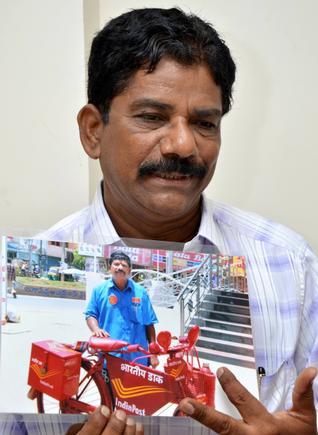
Winner of the Dak Seva Award from Andhra Pradesh last year, Mr. Rao earlier made news for wearing his loyalty to his Department on his sleeve.
In open display of his loyalty to the Department of Posts, he moves around in his uniform, riding a red bicycle. The cycle is equipped with a red bag and a red colour box affixed to the rear. “Even my water bottle and lunch box are also red in colour,” he informs, pointing to the two articles.
A native of Kothapalem village under Muthukur mandal in Nellore district, Mr. Rao came to this city in 1974 and discontinued his studies after he failed in SSC exams and managed to find himself a menial job.
He also has a rare achievement. The Department of Posts, Vijayawada, has released an exclusive postcard with his photograph printed on it.
“My retirement date is due next year. But I don’t want to stop so early,” he says.
source: http://www.thehindu.com / The Hindu / Home> News> Cities> Vijayawada / by P. Sujatha Varma / June 26th, 2013