Category Archives: Uncategorized

Mythological theme park to come up near Tirupati

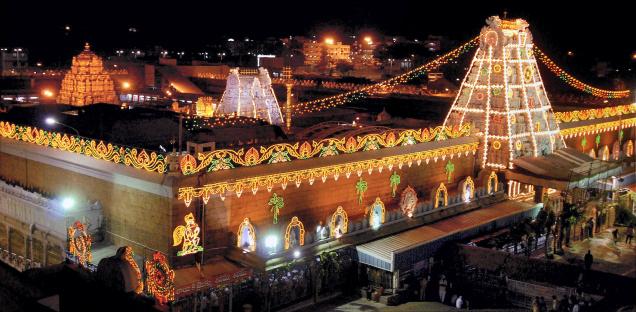
Lord Venkateswara Temple in Tirupati.
Hyderabad: JAN 14:

Sri Vaishnovi Infra Ventures and Resorts Pvt Ltd has signed an agreement with the Tourism Department, Government of Andhra Pradesh, during the CII Partnership Summit to establish the Temples of India and Mythological Theme Park near Alipiri on the foothills of Tirumala.

The Rs 300-crore project will be established in 38 acres encompassing the Temples of India, Mythological Theme Park, Sri Venkateswara Museum, a three-star hotel, amphi theatre, shopping mall, cultural centre, and entertainment zone including restaurants to cater to the needs of the devotees coming to Tirumala.

The project has been designed by architect Nitish Roy.

Through the Temples of India and Mythological Theme Park, it is proposed to display mythological themes such as “Sri Venkateswara Mahatyam” and replicas of famous temples such as Puri, Annavaram, Simhachalam, Ahobilam and Guruvayoor.

According to a company statement, the theme park would provide direct employment to 2,000 people.

A memorandum of understanding was inked during the CII Partnership Summit on Friday.


source: http://www.TheHinduBusinessLine.com / Industry & Economy> Government & Policy / by V Rishi Kumar / January 14th, 2012

4000 Patients Benefited With Free Health Camp in Parkal

Parkal camp was HUGE success and set a new record for one day camp: 4000 patients were treated in a single day. It was a BIG event by any standard…. 4000 patients……. Rs. 12 Lakhs Medicines distributed (3800 prescriptions filled!!)….. 45 doctors…… 40 pharmacists……100 paramedicals…. 150 NSS volunteers….5 security…. 200 guests…….. 500 people lunch……1500 people Pulihora lunch…… Planning—Coordination–Execution….EXCELLENT. Patients were very happy (that’s the key factor)– doctors are happy too. Many said that camp was like a MODEL camp. Thanks to all teams!!.
———-
Warangal (December 24, 2011). A mega general health camp, sponsored and organized by NRI Dr. Samba Reddy, attracted huge crowd of patients from rural villages in Parkal in Warangal District. The out-patient medical camp, which was conducted with help of Lions club Dr. P. Vijayapal Reddy, IMA Warangal doctors, NATA doctors and local doctors, was held on December 24, 2011 at Govt. Junior College premises, from 9 AM to 4 PM.

The camp was inaugurated by Sakku Bhai (Dy Drugs Controller), AVN Reddy (NATA President), Dr. Samba Reddy (sponsor & organizer), Dr. Vijay Chander Reddy (IMA president-elect), Dr. Samba Siva Rao (DM&HO), Lions club and NATA team members.

A record number of over 4000 patients received medical treatments for various conditions. Originally planned for 1000 patients, but there was an overwhelming crowd of rural and poor patients from surrounding 25 villages within the Parkal Mandal headquarters. The organizers accommodated up to 4000 patients!!!

Whooping Rs. 12 Lakhs medicines, arranged by Dr. Samba Reddy, were distributed to an estimated 4000 patients at this camp. “Over 3800 prescriptions were filled at the Camp Pharmacy” said the Chief sponsor & Camp Organizer Dr. Samba Reddy. He is NATA Media Chair & Conference Secretary and took charge of conducting this health camp. Professionally, he is Associate Professor (College of Medicine), Texas A&M University Health Science Center, USA (see Biography).

Over 45 doctors from MGM hospital, Rohini hospital, various private clinics within twin cities of Hanamkonda & Warangal and also Parkal area participated and provided medical services to patients. More than 20 doctors are super-specialty doctors, including Orthopedics, Cardiology, Gastroenterology, Urology, Gynecology, ENT, Ophthalmology, Dermatology, General Surgery, Psychiatry, Dental and Oncology.

Over 400 lab diagnostics were performed including 250 blood tests, 120 HIV screening and 100 malaria screening (courtesy Vijaya diagnostics & District health office).

Camp pharmacy was inaugurated by Smt. Sakkubhai, Deputy Drugs Controller, who was the Guest of Honor for this camp. Medical and orthopedics wings were inaugurated by Dr. Buchi Reddy (Chairman, Rohini hospital) and Dr. Samba Siava Rao (DM&HO, Warangal), respectively.

The leading physician Dr. P. Vijayapal Reddy served as the convener of this camp. Lions Ch. Narasimha Reddy and K. Mallesham did good job as camp chairman and Lions club president, respectively. They coordinated bus transportation to patients from their villages.

Rs. 12 Lakhs Medicines Distributed

The pharmacy list consists of over 400 high quality medicines (from all therapeutic categories), which are supplied by reputed Pharma companies Dr. Reddy’s, Natco, Veritaz Aurabindo, Dynamite, Novostart, Sunrise International, and other companies. The camp organizer Dr. Samba Reddy arranged all medicines for this camp with help from his friends and colleagues.

Lunch provided to 500 people

All patients felt very happy with free treatment and more importantly with FREE medicines. Food (pulihora) and water packets were provided to patients (at least 1000 patients). Lunch was provided to all participating doctors (50), pharmacists (40) guests (50), and paramedical staff (100) as well as NSS volunteers (total over 500 people). Thanks to Dr. Vijayapal Reddy for hosting such nice lunch at guest house in Parkal.

Over 45 Doctors Participated in Health Camp
The following doctors participated/ helped FREE and not taken any consultation Fee.
NATA Doctors USA: Dr. Sanjeeva Reddy – Physician/Gastroenterology (USA); Dr. Swaroopa Reddy – Physician/General (USA).

IMA Warangal Doctors:

Dr. P. Samba Siva Rao – Physician (DM&HO), Dr. P. Vijay Chander Reddy – Orthopedics (MGM) –IMA president-elect, Dr. Ramesh Kumar – ENT (MGM), Dr. Ram Kumar Reddy – Orthopedics (MGM), Dr. Venkateshwarlu – Orthopedics (MGM), Dr. Sreedhar Raju – Psychiatry (Warangal), Dr. Narender Reddy – General (Hyderabad), Dr. Rajendra Prasad Reddy – Gynecology (Narsampet), Dr. Ragotham Reddy (Physician) – IMA secretary, Dr. Ashok Reddy (Pediatrics), Dr. Sheshu Madhav (Pediatrics) – IMA president, Dr. Buchi Reddy, Physician, Dr. Babu Rao, Physician, Dr. Narasimha Reddy, Physician, Dr. Surender Reddy, Urologist (MGM), Dr. Dilip Kumar, Dr. Manoj Kumar, Dr. Prasad, Dr. Hanmantha Rao, Dr. Praveen, Ophthalmologist, Dr. Sudheer (Orthopedics), Dr. Anwar (IMA treasurer), Dr. M. Ramana Reddy – Ex.DM&HO (Warangal), Dr. D. Sai Chander – PG/Pediatrics, Dr. Naveen Kumar, Dr. Sudhakar Reddy, Dr. Suhakar (surgery), Dr. Mohan Rao (RMO), Dr. Chandra Sekhar (MGM), Dr. Mallikarjun (Eye), Dr. Gopi. Plus 10 medical officers from DM&HO office on camp duty.

Parkal Doctors:

Dr. P. Vijayapal Reddy – Physician, Dr. Rajeshwer Prasad – Physician, Dr. Lalitha, DGO, Dr. Sanjeevaiah (Civil hospital), Dr. Samuel, Dr. Sarojana, Dr. Rama Devi, Dr. Venkata Laxmi, Dr. Rajani Kanth, Dr. Satyanarayana, Dr. Satyanarayana Reddy, Dr. Vidyasagar Reddy, Dr. Kashaiah – Physician/Pediatrics, Dr. Naveen, Dr. Sridhar, Dr. Raja Reddy . Plus 5 other local doctors.

Medical conference bags were provided to all participating doctors. NATA mementos were distributed to them.

Over 40 Pharmacists Dispensed Medications at the Camp

The pharmacist’s team consists of over 40 pharmacists. Medication dispensing was done under the supervision of Chief pharmacists Dr. Samba Reddy, Dr. Arutla Srinivas, Dr. Raghuram Reddy, D. Narender, Dr. Aruna Devi, Dr. Sakkhu Bhai, Dr. Gopi Reddy, Mr. Ramdan, Dr. Raghunandan, and junior pharmacists from Kakatiya University pharmacy colleges and pharmacy executives from Hyderabad. Over 3800 prescriptions were filled in a single day, a record number in camp pharmacy.

Over 100 Paramedical Staff provided patient services

Five types of paramedical staff (total 100) comprising Nurses, health assistants, PHC health workers, ANM students provided patient care services at the camp. About 50 people are from District medical office and 50 are students from local health Education College.

Over 150 NSS Volunteers provided patient coordination services

Four units of NSS volunteers (total 150 students) from GDC and other colleges within the Kakatiya University area have provided volunteer services with patient coordination at the camp site. This task was headed by 10 program officers and one NSS national coordinator Dr. Suresh Lal. Camp certificates are awarded to all volunteers and paramedical staff.

A total of 150 small mementos (by NATA), 50 big plaques, 300 appreciation certificates, 50 doctors bags, and 1500 medicine bags were distributed at the camp.

NATA Team members as Guests

The following NATA seva day team members participated in the camp: AVN Reddy, Dr. Swaroopa Reddy, Dr. Sanjeeva Reddy, Bala Indurti, Jithender Reddy, Harinath Medi and Anil Jyothi.

CHARITY EVENT FOR POOR PATIENTS

This camp is meant to help local poor patients from Parkal and nearby villages, said Dr. Samba Reddy. He is doing this with a service motto to his native village Cherlapally and other surrounding villages. It is a big motivation, so that other NRI and NGOs may come forward to do many such charitable events in rural areas in Warangal, said Dr. Samba Reddy, who lost his Mother recently due to illness.

He thanked all teams for making this camp a grand success for the benefit of poor and rural patients in Parkal area.

We got more medicines stored at Lions Club for future health camps, said Dr. Samba Reddy.

————
OVERALL… It was a BIG event by any standard..for 1 DAY CAMP….. 4000 patients….. Rs. 12 Lakhs Medicines ……. 45 doctors….. 40 pharmacists……100 paramedicals…. 150 NSS volunteers…… 100 guests…… 500 people full lunch……1500 Pulihora lunch.

Despite such MEGA camp with big numbers …. camp organization was smooth without much glitches.

This is due to 1-month plan, meticulous design and execution of camp in a very professional manner.

source: http://www.nataus.org / North America Telugu Association / December 24th, 2011
 

Sydney Test to be special for Hyderabadis

India left-arm spinner Pragyan Ojha, Dr. G. K. Harinath, CEO of Cricket New South Wales, V V S Laxman and Indian team manager Shivlal Yadav met at the Sydney Cricket Ground on Monday.   The Hindu.

Sydney keeps its date with history when the India-Australia second Test that starts on Tuesday happens to be the 100th Test at this hallowed venue ‘Down Under’. And, Hyderabadis too have something to rejoice for being part of this piece of great moment in Test cricket.

Dr. G. K. Harinath, CEO of Cricket New South Wales, is a Hyderabadi who settled long ago in Australia and is now also a Board member. “I am proud to be part of this historic moment. There is so much in the air every time the SCG hosts an international match,” he says in an exclusive chat with The Hindu from Sydney, on the eve of the 100th Test match.

Then there is the Hyderabad’s star batsman V. V. S. Laxman, whose romance with SCG is now part of cricketing folklore thanks to his memorable hundreds on previous tours.

In fact, Dr. Harinath met the three Hyderabadis at the SCG this morning – Laxman, Indian team manager Shivlal Yadav and left-arm spinner Pragyan Ojha. “It was a very touching encounter. It is always great to meet someone from our own city who heads Cricket NSW and is also a Board member of Cricket Australia. Honestly, I felt really proud when we met him,” says Shivlal.

Dr. Harinath also reveals that Laxman’s father Dr. V. Shantharam happened to be his classmate and thereby he has a special relationship with the elegant Indian batsman’s family.

“V. V. S. is immensely popular in Sydney. What impresses me the most is that he is a gentleman besides being a world-class player. People like him contribute a lot to the promotion of cricket across the globe,” the NSW Chief Executive Officer commented.

“Sydney has a seating capacity of 50,000 and it is a picturesque venue with the backdrop of Harbour Bridge and the famous Opera House apparently being the USP of this wonderful stadium. It has a fantastic tradition of always sporting wickets and people love to come to an iconic ground which also has world-class facilities,” he explained.

“The most memorable moment for me is to be conferred the Life Membership of Cricket New South Wales considering that only 120 were privileged to get it so far in its 150-year history,” a proud Dr. Harinath pointed out.

Even as the focus will be on Sachin Tendulkar looking for the elusive 100th century in international cricket, Hyderabadis too will be “eagerly awaiting that great moment and be part of history”.

“I sincerely hope that the great Indian maestro (Sachin) will score his 100th century here. As an Australian of Indian Origin and as the Chairman of CNSW, it adds extra dimension to my life and at the end I would like to see this as a contest between two great teams. India with its passion and millions of supporters and the Aussies with a never-say-die attitude,” he concludes.

source: http://www.TheHindu.com / News> Cities> Hyderabad / by  V. V. Subrahmanyam / Hyderabad, January 03rd, 2012

2012: Year of jobs in AP

With about 25 recruitment exams for government jobs to be held in the state in a single year, 2012 will create a record of sorts and is likely to be remembered in the history as the “year of jobs.” The recruitment exams are scheduled from February to December. While the universities and colleges have become centres for political agitations with students taking an active part in supporting Telangana and United Andhra Pradesh agitations since November 2009, the spate of fresh job notifications has forced them to take up serious studies and even join coaching centres. Be it the Osmania University, Kakatiya University, Nagarjuna University or Andhra University, the students are now focused on cracking exams for government jobs.

Chief Minister N. Kiran Kumar Reddy has created a record of sorts by announcing to fill 16,500 vacancies in various government departments by AP Public Service Commission in one year. Out of this, the APPSC has issued 30 notifications to fill nearly 10,000 posts within a week. The notifications for the remaining 6,500 vacancies are expected next week. The CM’s ambitious 1-lakh government jobs in a year scheme will be implemented in 2012. YSR, the former CM, held the record of filling 50,000 teacher posts at one go in 2008.

As part of the CM’s 1-lakh job scheme, the school education department has made arrangements to issue notifications to fill 35,000 teachers’ jobs in January 2012. The Police Recruitment Board will appoint nearly 20,000 constables and SIs. The revenue department has recently issued notifications to fill 8,500 VRO, VRA posts and has received over 10 lakh applications from students.

source: http://www.deccanchronicle.com / Home> Channels> Cities> Hyderabad / December 31st, 2011


A gazab keeps ghazals alive

Hyderabad:

In a narrow lane of Goshamahal, behind a Durga temple, flows the dhun of ageless ghazals from the doors of Sangeet Sadhna, a hall dedicated to music by Pandit Vithal Rao Shivpurkar, one of the last court musicians of the Nizams. Hyderabadi classical ghazal tradition can be traced to Vithal Rao, who at 81 is still hail and hearty or `gazab’ as the last Nizam Mir Osman Ali Khan called him. A heart attack that he suffered has failed to dampen his spirit as he sits straight on a carpet with his legs crossed, dressed in his trademark white kurta pajama, with pictures of  Md Rafi and Bade Ghulam Ali Khan saab adorning the walls, giving a glimpse into a glorious past he has lived.

With the mere mention of his huzoor, Osman Ali Khan, his eyes brighten up and a 13-year-old Vithal leaps out of his persona. He narrates, “I had taught the boys from Goshamahal School one of Huzoor’s nazms which they used to sing every morning before entering their classes,” and thus flows from his mellifluous voice__ “shahe deccan zindabaad, zindabaad-pa-hindabaad”. In no time, the Nizam heard of this little boy, whose father was a pehelwan, and called for him. “I did not know what to sing and was very nervous,” recalls Vithal. He sought the help of Shankiri Bai from Nizambaag who taught him the perfect song for the occasion. On the first day of his visit, huzoor sat on a rocking chair tapping his leg to keep with the beat. As Vithal reached the lines, “Khabar-e-tahayyur-e-ishq sun, na junootrahi na parii rahi/ na to tu rahaa na to main rahaa, jo rahii so bekhabarii rahi,” the Nizam stopped him and asked him to repeat it. Then he asked, “Naam kya hai?”(What is your name?). On hearing his Hindu name Rao, huzoor retorted “yeh gazab hain!” (It’s a wonder!) And this continued for the next ten days when Vithal was called over and over again to sing the same couplets which elicited the same response each time__ “Gazab hain!” Soon after, a gift of Rs 1,000 was sent to his house, in case the little boy lost it if handed over to him directly.

There was no looking back for Vithal Rao after this. He became a regular at the mehfils of the Nizam’s sons Taki Jah Bahadur, Hasm Jah Bahadur and he became a favourite of his daughter Shahazadi Pasha. Eventually, then prince Moazzam Jah Bahadur, who used to reside at Hillfort Palace took him under his wings. “The prince called a huge party where the creme-de-la-creme of Hyderabad was invited. He declared me as his son and renamed me Vithal Jah,” recounts Vithal. This was a moment of ultimate pride and happiness for him, says the singer who has been the lead in the military orchestra of the Nizams. In fact, the original orchestra of the Nizams used to play western instruments, but it was after hearing Vithal that a new orchestra was created to promote Indian music and he was made in charge of it.

Speaking of the change in music trends in Hyderabad, Vithal Rao says, “Pehle ghazal the, ab gazal hai.” He rues the end of a generation who knew and sang in correct Urdu. Sitting beside him, his nephews Sunil Rao and Deepak Rao, who are carrying forward his tradition of ghazals, nod in agreement. “The programmes today are mostly corporate sponsored. Artistes are treated as workmen whose work is to perform in return for fees, keeping in mind the changing taste of the audience,” says Sunil. “The element of respect is missing and art has become a commodity,” adds Vithal citing how in a recent show a lot of people came to watch him only to test his knowledge. “They went on giving various farmaish, from Mehdi Hassan to Ghulam Ali, but I managed to exhaust their requests,” Vithal says with a cynical laugh.

With pressures from all corners of the music world demanding an amendment in the classical format, does he think that ghazals can survive the changing taste? Vithal says till he is alive he will ensure that ghazals are alive. He has trained enough youngsters to carry forward his tradition and he has full confidence in them. But then nothing is certain. “Pakki baat zindagi, pakki baat maut, us beech kuch aisa kaam kar lena ki log bole__ achhe the,” the ghazal maestro signs off.

source: http://www.timesofindia.indiatimes.com / Home> City> Hyderabad / by Pritha Chakrabarti / TNN / December 21st, 2011


THE DECCAN TRAIL …. Mirpakaya Mango Moghuls

Hyderabad to Vijayawada, it’s a trip from tangy to the fiery-hot

Andhra full meal . At the Viyawada Ramiah mess/ A. PRABHAKAR RAO

I am, I must confess, an accidental food writer. It all started with a one-off food story, which led to another, and another…till now I’m being asked to write culinary books and host TV shows. But, truth be told, my idea of the perfect meal is a simple, crisp dosa, accompanied by a favourite book. Hence this culinary drive from Hyderabad to Vijayawada turned out for me to be more of a journey through history and geography, with random diversions through politics and trivia.

Hyderabad is one of the important centres of Mughlai cuisine, along with Delhi, Lahore, Lucknow and, perhaps, Rampur. But there’s an important difference: by the time the 50-year-long Deccan campaign ended, the cuisine that the Mughal armies had brought with them had evolved, through its interaction with the southern climate, ingredients, peoples and cuisines. Most notably, it acquired a distinctive tangy undercurrent, thanks to a variety of sour flavourings, from tamarind to green mango. Thus, biriyanis, qormas and kababs are all very well, but the keynote of Hyderabadi cuisine is a khatta salan (sour curry)—such as baghare baigan, tamate ka kut or a simple khatti dal—which is the starting point for planning any Hyderabadi meal. Everything else, whether lamb, fowl or fish, comes later. This is something north Indian Muslims find rather strange—almost as strange, in fact, as the Hyderabadi Urdu dialect.

Khatta salan comes first in Hyderabadi cuisine, before fish or fowl, something north Indian Muslims find strange.

Because it originated as a cuisine of the elites, Hyderabadi cuisine is generally a slow-cooked labour of love. Even the humblest dish calls for a certain artistry, and presentation is as important as flavour, texture and fragrance. So where can you get good, authentic Hyderabadi food? Unfortunately, the answer is that it’s something you get only in people’s homes. Well, there are two other possibilities: Hyderabadi weddings and the Nizam Club, so you could try to wrangle an invitation, or gatecrash. Alternatively, there’s Shadaab, a little eating house in the Old City, or the slightly more upmarket Point Pleasant in Banjara Hills. But your best bet would be to order from somebody like Begum Aziza Hassan, famed for her pluperfect shikampurs, baghare baigan and biriyani.

The drive from Hyderabad to Vijayawada—the heartland of Andhra cuisine—takes only five hours, but it’s a journey into a different cultural ethos. The road heads east, through dramatic rockscapes, some of the last remnants of the famous boulders of Hyderabad, sculpted into fantastical formations by 2.5 billion years of wind and storm; the rest, sadly, have fallen prey to real estate development, and a unique national treasure has been squandered.

The road takes us through places whose names all seem to end in either ‘pally’ or ‘gudem’ (Tangallapally, Maggalapally, Yellareddigudem, Annapareddigudem). Our driver insists on driving on the wrong side of the road, at 140 kmph. Every time I admonish him, he obediently gets back into his lane—but only briefly. I think I’m going to have a cardiac arrest, as he continually swerves left at the last possible moment to dodge oncoming vehicles. Hesitantly, I ask him how long he’s been driving this route. “Seven years, sahib,” he replies, impassively. I philosophically tell myself he knows what he’s doing, and close my eyes and try to sleep. But I swear to myself there’s no way I’m going to go back this way; I shall return to Hyderabad by train.

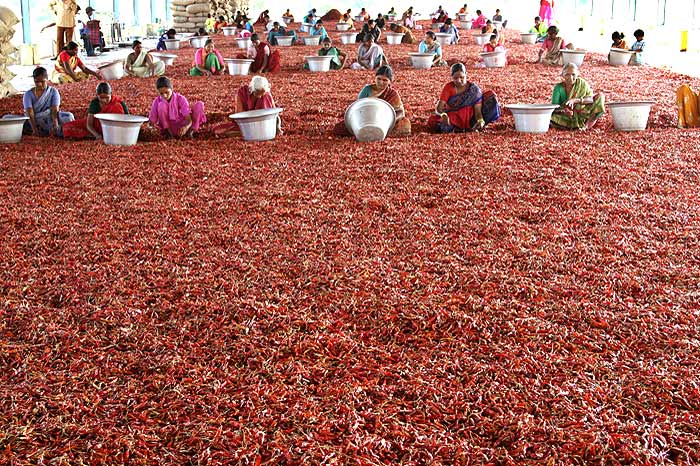
Chilli land Guntur’s firestick chilli is delectable torture. (Photograph by T. Narayan)

As we approach Nalgonda, the land flattens out, with lines of pencil-straight toddy palms. In the summer, villagers sit by the roadside, selling tadgolas, the fruit of the toddy palm—translucent, cool, luscious under their fleshy ochre skin. Apart from these, and the creamy local sitaphals, foodwise, the drive is uninteresting; it’s only near Guntur that things look up, with the nondescript dhabas giving way to stalls selling scorching chilli mirpakaya bajjis.

From Nalgonda, the road swoops south, and the landscape slowly turns a lush shade of green: this is the rice bowl of India, watered by the Krishna river. We’re now crossing the divide into coastal Andhra—the historic ‘Coromandel Coast’ where, in the 1750s, the French and British intrigued and battled so fiercely. At first, the French seemed well-entrenched here, but the English, of course, ultimately finessed them. They absorbed this strategic coastal belt into their Madras province. And so it remained, right until 1953, when it became India’s first linguistic state, Andhra. Then, three years later, the Telangana region was added on to it—a political marriage that’s been on the rocks for 40 years. All that’s left of it now is a bitter tussle over who gets to keep the dowry of Hyderabad. (So much for the logic of linguistic states.)

Apart from being India’s rice bowl, coastal Andhra also claims to produce the sweetest jaggery, the thickest curds and the best chillis. Guntur, in fact, is perhaps the chilli capital of the world: it is home to the world’s largest chilli market, and its chilli farms make the largest single contribution to India’s output of 1.1 million tonnes of chillis per year. And while its chillis may not be the world’s hottest (that distinction goes to Assam’s bhootjholokia chilli), the Guntur ‘firestick’ chilli is hot enough for the police to use, allegedly, as a means of torturing stubborn suspects. This is hard-core chilli country, and you see evidence of it everywhere, from the vivid scarlet stretches of drying chillis by the roadside to the city’s eating joints, which offer foods that run all the way up the Scoville scale, from the merely spicy to the truly incendiary. (The gunpowder-sprinkled ‘Guntur idlis’ are a speciality.)

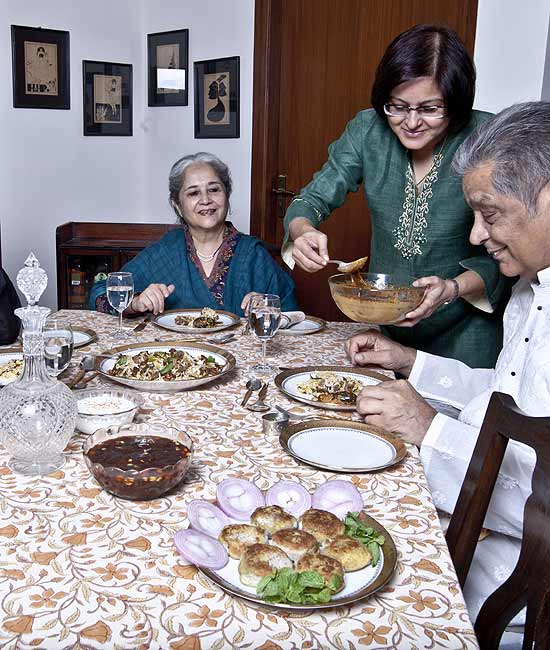
Family affair A Hyderabadi meal. (Photograph by A. Prabhakar Rao)

If Hyderabadi cuisine was largely the product of history, Andhra cuisine is a result of geography. Its themes are rice from the delta; tamarind, green mango and gongura (sour roselle leaf) that grow here in abundance; dour vegetables like brinjal, lady’s finger, drumstick and gourd; fresh seafood from the coast and, of course, the chillis of Guntur. The cuisine, unsurprisingly, is one of the world’s hottest, and so a meal always ends with a soothing dollop of curd-rice—the ancient secret for dousing the fire of the chillis (the ancients intuitively understood that chilli molecules are fat-soluble, not water-soluble, which is why cold water never helps).

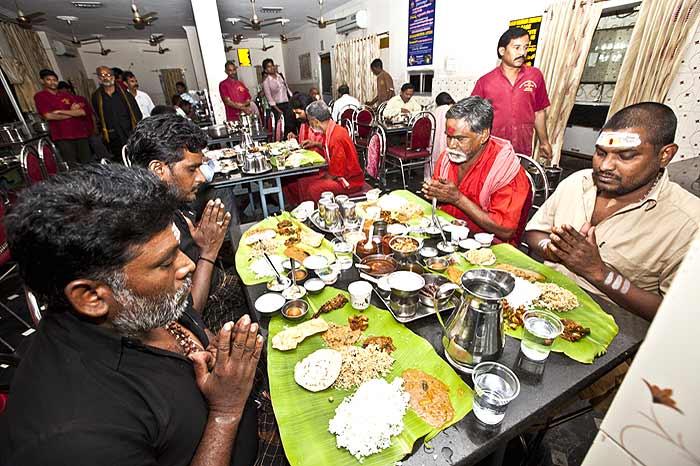
A typical Andhra meal includes steaming rice, a pappu or dal, a couple of pulusus or curries and rasam. There might also be a sambar and chaaru (something roughly in between a sambar and rasam). And for extra zing, there’ll be an array of pickles, chutneys and kaaram, or spicy powders. The items are laid out on your banana leaf in an ergonomic, traditional pattern: rice in the middle; curries on the right; pickles and pachadi on the left; and special delicacies, like pulihora, in pride of place at the top right-hand corner. The thematic flavours are chilli and gongura, and given the fact that Andhra is such an intensely political state, such characteristics sometimes acquire a political undertone: during the Separate Telangana movement, for example, there was crude graffiti shouting not just ‘Andhra go back!’ but also ‘Gongura go back!’ and ‘Mirchi go back!

What if the French had trumped the English in Andhra? Would we be eating creolised fish pulusus?

Unlike Hyderabadi cuisine, Andhra cuisine never had the advantage of court patronage—which played an important role in the evolution of, for example, Telangana cuisine. It was, instead, essentially the food of the common man—which is why it remained simple, earthy and robust. It’s interesting to speculate what would have happened to Andhra cuisine if history had turned out differently. What if the intrinsically Telugu Vijayanagara empire had conquered the Cholamandal coast, and lasted a century longer? Or, what if the French—who were once well-ensconced here—had trumped the English, and wrought a Pondicherry-like influence on the region and its cuisine? Might we, perhaps, today be eating creolised fish pulusus with baguettes made of rice-flour?


From Guntur, the road turns north and crosses the Krishna river into Vijayawada. One of the city’s landmarks is Babai Hotel, originally a footpath stall set up in 1942 by Patruni Shyama Murthi, affectionately called ‘Babai’ (uncle), who invented what many consider to be the ultimate idli: a supremely fluffy creation, topped with a blob of home-made butter. Babai’s idli became so popular that his stall became a pilgrimage centre for Andhra Pradesh’s film stars, tycoons and politicians, and it’s said that the idli had no fixed price: wealthy patrons would simply hand over a sheaf of notes, based on how much they’d enjoyed their meal. Today Babai’s idli joint, now run by his nephews, may not be what it once was, but it’s still a shrine for foodies.

Our journey had ended; it was time to go back. I took one look at our driver and recalled our trip from Hyderabad, driving on the wrong side of the road, at 140 kmph. It didn’t take long to make my decision. I paid him off and caught the Narsapet-Hyderabad Express instead. Discretion, truly, is the better part of cowardice.

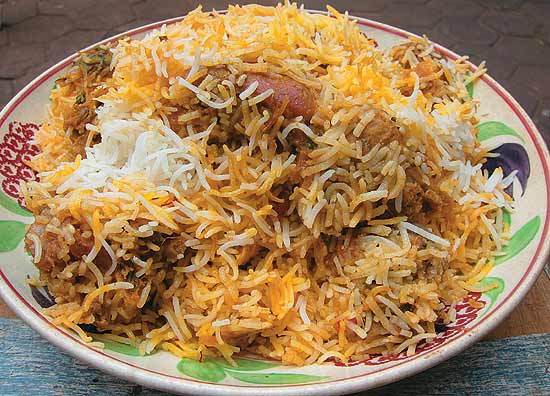
Do-Gosht Biriyani

One of the secrets of a good Hyderabadi biriyani is said to be the generosity of the proportion: it should ideally be one portion of meat for every portion of rice. And then there’s the ‘do-gosht biriyani’, or two portions of meat for every portion of rice! Two much of a good thing.


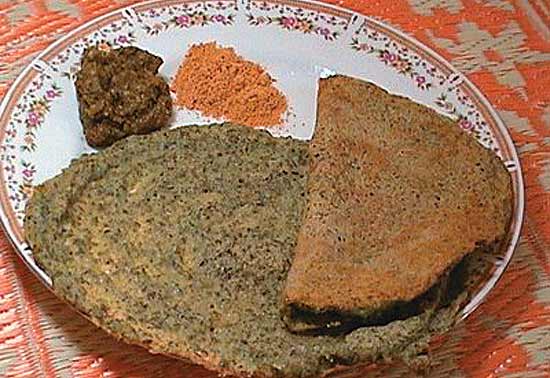
MLA Pesarattu

Pesarattu is the Andhra version of a dosa, but made of green gram instead of rice. A popular variant is the ‘MLA pesarattu’, stuffed with upma. It apparently got its name from the state’s MLAs, who invented this greedy snack in the MLA canteen to sneak into the assembly and eat during long, boring sessions.

___________________________________________________________

When he’s not waxing eloquent on food, Anvar Alikhan is an advertising professional

___________________________________________________________

source: http://www.OutlookIndia.com / Society / Magazine, January 07th, 2012

Special Issue: THE AROMAS OF INDIA

Karimnagar Collector, SP have lunch with Dalits

School assistant suspended for allegedly encouraging untouchability


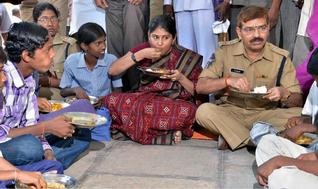
Setting an example:Collector Smita Sabharwal and SP V. Ravinder having lunch prepared by Dalits along with students at ZPHS Sundaragiri village in Karimnagar district on Friday.— Photo: Thakur Ajay Pal Singh

It was a welcome surprise for students of Zilla Parishad High school in Sundaragiri village of Chigurumamidi mandal on Friday as they had community lunch along with top officials of the district.

Collector Smita Sabharwal, Superintendent of Police V. Ravinder, Karimnagar RDO Hymavathi, Huzurabad DSP Nagalaxmi, DEO Purnanda Rao and others set an example by eating the midday meals prepared by the Dalits at the school.

Warning the officials of serious action if anyone encouraged untouchability, the Collector ordered suspension of Hindi school assistant Satyanarayana for allegedly encouraging untouchability among the students and forcing them to shun meals prepared by the Dalits due to differences with the school headmistress.

She also found fault with headmistress Vasantha for not informing higher authorities about the issue.

She said that the sensitive issue came to the administration’s notice through a report published in The Hindu on December 16.

The Collector visited the village on Friday and interacted with the students. Later, she inquired with the headmistress Vasantha about why the students were refusing to eat the meals and inspected the records.

Ms. Sabharwal and Mr. Ravinder picked up plates, had the food served by Dalit women and sat along with the school students to eat the lunch comprising potato curry and sambar.

Surprise checks

The Collector said that the food quality was good and nutritious and noted that over 200 students were eating midday meals against the school’s total strength of 260.

She said the RDOs and DSPs had been instructed to visit the schools regularly to check the practice of untouchability in the educational institutions.

source: http://www.TheHindu.com / News> National / by Staff Reporter / Karimnagar, December 24th, 2011

Bajaj Discover presents 6th Dr. Batra’s Positive Health Awards 2011, Anil Kumble Felicitates the Awardees

Mumbai, Maharashtra:

The awardees recognized were Ms Sujatha Burla, Mr Siddu S. Loute, Mr Shreedhara T S and Ms Bhumika Rajendra for their exemplary effort of transforming humans to heroes.

Bajaj Discover presents Dr. Batra’s 6th Positive Health Awards 2011, held at the Chowdiah Memorial Hall today witnessed Anil Kumble, the cricket legend felicitating this year’s positive health awardees. This was an initiative to honor significant people who live a positive life despite their physical disabilities. Four such heroes were awarded in the presence of about 1,000 people in appreciation of their laudable efforts and their outstanding courage in their endeavor against diseased and disabled conditions of life.

The winners for this year’s edition of the awards were recognized and selected by an eminent panel of jurists comprising of Smt. Maneka Gandhi, Ms. Anu Aga, Mr. Vivek Oberoi, Mr. R. Balki, Mr. Rajiv Bajaj and Dr. Mukesh Batra. The awardees recognized were Ms Sujatha Burla, Mr Siddu S. Loute, Mr Shreedhara T S and Ms Bhumika Rajendra for their exemplary effort of transforming humans to heroes.

In addition to a short biographic film on each awardee, attendees at the award function were treated to scintillating performances by the dance guru Shiamak Davar’s troupe of specially-abled children.

Admiring the spirit of the awardees, the Indian Cricket Legend, Anil Kumble, said, “I am immensely delighted to felicitate these heroes who have fought out the trials and tribulations in life and have created a niche for themselves in the society. The foremost rule of any sport is to never give up, no matter what, but to keep fighting till the end. These individuals have lived that never ceasing spirit and have successfully fought against all the impossibilities in life to create possible winning situations for themselves. I salute Dr Mukesh Batra and Mr Rajiv Bajaj for this extra-ordinary event and for the great work that they are doing to contribute towards such a noble cause.

Speaking on the occasion, Dr. Mukesh Batra, Founder and CMD, Dr. Batras’ Positive Health Clinic Pvt. Ltd. said, “Dr. Batra’s Positive Health Awards salutes people with unyielding grit and unflinching determination, who have beaten all odds to overcome seemingly hopeless situations and have been dedicated enough to make commendable contributions to society. These heroes have demonstrated the strength of the human spirit and have proved that, all it takes to make a difference in the world is a strong will power and great positivity. The Positive Health Awards honor this spirit and re-affirm Dr Batra’s commitment to health and positivity.”

Reiterating his support to the cause, Mr. Rajiv Bajaj, MD, Bajaj Auto Ltd. said, “The Dr. Batra’s Positive Health Awards is a step in a noble direction and we are proud to be associated with this initiative for the second consecutive year. We firmly believe that the lives of these awardees will inspire and spread hope to others.”

About the Awardees:

Ms Sujatha Burla (32 years): A road accident that happened 10 years back changed her life forever making her quadriplegic with limited mobility below the shoulders. She is a TEDx speaker and a popular TV presenter for TV9 hosting a show called “Close Encounter with Suzy”. She has never suffered with bed sores in last 10 years as she practices yoga and physical exercises regularly. She provides counselling to paraplegic people and also addresses the NASA & ISRO scientists with motivational speeches on positive thinking and living. She has been running an orphanage for the past 3 years. She belongs to a middle class family from Hyderabad. Her father passed away few years ago. With no financial support from any of her 3 elder siblings, she earns a living and supports her mother too.

Mr Siddu S. Loute (25 years): Visually impaired since birth, Mr. Siddhu is a Mathematics prodigy fondly called as a human computer. By Class II, he had already memorized math tables up to 56 lakh and now claims to have memorized tables up to 99 crore. When provided with a date from the past or future, he can provide the exact day the date falls on. He has memorized 45,000 phone numbers which makes him a walking-talking telephone directory. He had also participated and won a prize in a popular television show on Sony TV called ‘Entertainment ke liye kuch bhi karega’. His unique talent combined with his irrecoverable condition got him featured on a couple of TV channels such as TV9, Suvarna, Suvarna News, DD 1 and Sakshi. Overtly ambitious as he is, he has completed his LLB and aims to become an IAS officer with an honest intention to help the needy and the downtrodden. Son of a truck driver, he was abandoned by his family since the age of 5, and has since been living independently.

Mr Shreedhara T S (23 years): Mr. Shreedhara is 100% blind but he can read, write and speak English, Hindi and Kannada. He has developed a Kannada version of the text-to-speak software (first generation open source software) through which any visually challenged person can read, write and work on computers. The Knowledge Commission of Govt. of Karnataka has hosted his software named ‘E-Speak’ on its Kannada Wikipedia website to be used free of cost. He has hands on experience with Windows 98, Windows 2000/XP, Windows Vista, MS Office 2003. He can type at a speed of 35-40 wpm and has extensive knowledge and experience in using the internet. Coming from a farmer’s family, his parents practice farming in a village in the Shimoga District of Karnataka. Currently, his father has come to Bengaluru and has been assisting him in pursuing further education in computers.

Ms Bhumika Rajendra (9 years): She was only 3, when she had an elevator accident and had to get her right leg amputated above the knee. In spite of this disability, she had always wished to excel in Bharatnatyam and classical singing and would constantly practise to turn her dreams into reality. Though the artificial leg that was fitted to her knee was akin to an alien, she accepted it as a vital part of her being and has ever since been pushing her limits to excel in the Bharatanatyam dance form. During her dance sessions, there have been instances when her skin used to give way and the stump bled. And every time that happened she thought of giving up, but she fought unceasingly against all odds with a positive spirit. She has performed with the famous Kannada cine actor Sridhar at a “Zee Kannada” programme organized by Zee TV Network in Bengaluru. She has given many stage performances and has been extensively covered by various publications. She belongs to a lower middle class family from Kodagu District in Karantaka and her father works as a lecturer.

source: http://www.indiaprwire.com / HealthCare/Hospitals> Awards / December 15, 2011

US doctors to lead 2 Satya Sai bodies

Anantapur:

The Sir Satya Sai Central Trust on Monday appointed two persons as chairmen of the two international foundations run by it.

Michael Goldstein, an ardent devotee of Satya Sai Baba, will take charge as chairman of the Sri Satya Sai World Foundation, an official press release from the Sri Satya Sai Central Trust said. Goldstein, who received his doctorate in medicine from George Washington University, has been a practising physician for over 30 years and former medical director at a tertiary hospital in Southern California. He was selected as chairman on November 23, 2011 on the occasion of Baba’s birth anniversary.

Similarly, Narendranath Reddy was elected chairman of the Prashanti Council. Narendranath Reddy, graduate from SV Medical College, Tirupati, received his training in internal medicine at the New Jersey College of Medicine and Dentistry and did his sub-specialization in Endocrinology and Metabolism at Mount Sinai School of Medicine, New York. He has been a practising internist-endocrinologist in Southern California for over 30 years.

Satya Sai Trust spokesperson Anantharaman told TOI that the world foundation takes care of all of the trust’s publications outside India and ensures that they adhere to the local laws and also ensure that the publications do not deviate from the message of Satya Sai Baba. The Prashanti Council takes care of all international seva activities outside India including educational and welfare-oriented programmes. Both these organizations operate in 135 countries and the place of operation of the two chairmen will function as the headquarters of these two international bodies, he said.

source: http://www.timesofindia.indiatimes.com / Home> City> Hyderabad / TNN / December 20th, 2011


Umarani, Clifford honoured with Pravasi Mithra awards

HYDERABAD :

Indian social workers Umarani Padmanabhan from Dubai and Clifford Correia from Bahrain were felicitated and conferred with the “Pravasi Mithra” awards at a function held here on Sunday to mark the ‘International Migrants Day’ with special emphasis on awareness for Gulf migrants.

The progamme, organised by the National Domestic Workers Movement (NDWM-AP) and Migrants Rights Council (MRC), was attended by government officials, representatives of NGOs involved in migrant rights and families of Gulf migrants.

Speaking on the occasion, Umarani Padmanabhan hailed the UAE government officials for their cooperation in solving the problems of Indian workers in the country. “With the help of the Indian Embassy in Abu Dhabi & the Indian Consulate in Dubai, we have been able to help several poor migrants,” she said.

Echoing similar sentiments, Correia said: “We have been able to provide assistance to needy migrants from India with the help of the Indian Embassy in Bahrain. We have also provided free tickets to needy Indian migrants through the Indian Community Welfare Committee.”

Dasari Sreenivasulu, Principal Secretary, Labour and Employment Department, Government of Andhra Pradesh, who was the chief guest, released a book titled Pre-Departure Information Manual for Intending Emigrants published by Migrant Forum in Asia (MFA). He also handed over the ‘Pravasi Mithra’ awards to Umarani and Correia.

Addressing the gathering, Sreenivasulu assured the families of migrants that he would use his good offices in resolving issues of their kith and kin who were stranded in various countries of the Gulf region. “I have visited labour accommodations in the Gulf countries to interact with the migrants from Andhra Pradesh lodged there.”

Stating that he would strive to release as many of them as possible under amnesty, he said he would ensure that good education for children of migrants, particularly those who are in jails. “I will help in placing them in various residential schools of the state,” he said, and urged prospective migrants to take advantage of various governmental initiatives such as ‘Overseas Employers Conference’ organised by the state government earlier this year.

He said the meeting was the first of its kind in the country for those keen who were keen on working abroad. “It would be in the interest of intending migrants to go though the ‘Overseas Manpower Company of Andhra Pradesh’ (OMCAP) rather than approaching private agents for jobs abroad,” he observed.

Migrants Rights Council President P Narayana Swamy demanded of the Federal Government to appoint sufficient staff in Indian Missions abroad to look after labour problems. He also demanded that a National Commission for Migrant Labour be set up.

Marizen Santosa, MFA representative from Philippines, Binu Arickal, Dan Church representative from New Delhi, M Bheem Reddy, Vice-President, Migrants Rights Council and Sister Lissy Joseph of NDWM also participated in the function.

news@khaleejtimes.com

source: http://www.khaleejtimes.com / Online> International / by P S Jayaram / December 20th, 2011